


 My Daddy taught me not to waste. He would yell at us to close the door, turn out the lights, clean my plate. He so impressed that quality upon me that I echoed his words to my children. Something about waste bothers us. We would never volunteer to pay $100 for a McDonald’s Happy Meal. No, that would be a waste!
To understand the radical work of the Gospel, we must understand that the Gospel runs counter to everything that man is taught. The Gospel is opposed to every rational thing that we teach our children. The core concept that is most repulsive to us is seen in John 12. But before we dwell upon the Gospel and “waste”, I want us to see what other things can block the power of the Gospel from our lives. This will lead us into a deeper understanding of the power of the Gospel for our everyday lives. This will open the Gospel to us and it will drive our discipleship.
 The Gospel is “Death with a view to increase”. Discipleship is “gaining by trading”. Fruitfulness is the result of living the Gospel. We are not talking of your own fruitfulness, like looking at your garden and admiring your green thumb. We are speaking of fruit that comes from gaining the life of Jesus Christ. Fruit comes from Him and our willingness to give everything to Him.
John 12:24 Truly, truly, I say to you, unless a grain of wheat falls into the earth and dies, it remains alone; but if it dies, it bears much fruit.
 A grain of wheat has life in it, but it abides alone. It has the power to impart life to others, but to do so it must be buried in death.
2 Corinthians 4:11-12 For we who live are always being given over to death for Jesus’ sake, so that the life of Jesus also may be manifested in our mortal flesh. So death is at work in us, but life in you.
Is Life at work in You? Are you experiencing the Life that is in Jesus Christ? Do you ache when you spend a day without a word from Him? Do you miss not spending time in prayer and fellowship with Him? If His life is at work in you, you know it. If it is not, perhaps you have become hardened to the Gospel. Perhaps you will see yourself in John 12, and God will speak to you this morning, calling you to repent, calling you to waste your life for the sake of Jesus Christ.
John 12 is a chapter about Life and Death, Light and Darkness, Man’s Wisdom vs. God’s Wisdom. At the beginning we see Lazarus who came back to life from the dead. He is the testimony of what a Christian is to be. In the middle we see people who want to see Jesus, but they are blind, their hearts are darkened. At the end we see a lonely Jesus talking to a group of people who just don’t get Him:
John 12:44-50 And Jesus cried out and said, “Whoever believes in me, believes not in me but in him who sent me. And whoever sees me sees him who sent me. I have come into the world as light, so that whoever believes in me may not remain in darkness. If anyone hears my words and does not keep them, I do not judge him; for I did not come to judge the world but to save the world. The one who rejects me and does not receive my words has a judge; the word that I have spoken will judge him on the last day. For I have not spoken on my own authority, but the Father who sent me has himself given me a commandment—what to say and what to speak. And I know that his commandment is eternal life. What I say, therefore, I say as the Father has told me.”
There is light in the words of Christ. There is Life in the Words of Christ. But our hearts are easily hardened to the power of Christ and His Gospel. Our eyes are easily dulled to witness the power of the Gospel.
Let’s see how our hearts can become hard, and our eyes become dull:
There are three people seen in John 12. There are the Disciples, who supposedly follow Jesus. There are the Greeks who want to see Jesus. There are the Pharisees who despise Jesus. Finally, there is a solitary woman named Mary, and our attention will be drawn to her in a moment.
1. The Greeks
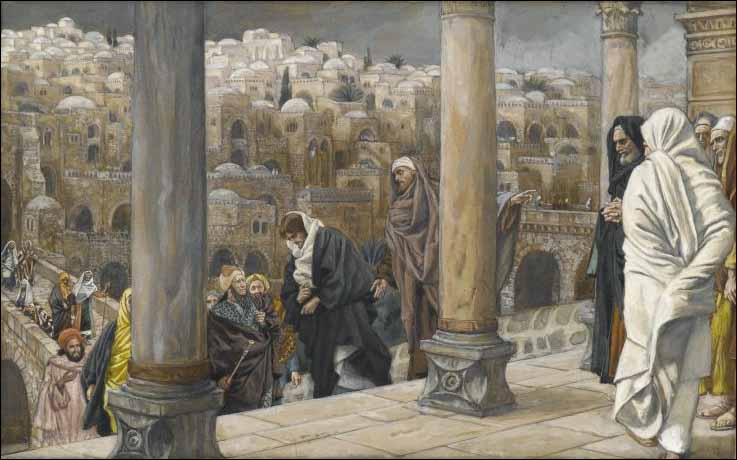 Now among those who went up to worship at the feast were some Greeks. So these came to Philip, who was from Bethsaida in Galilee, and asked him, “Sir, we wish to see Jesus.” Philip went and told Andrew; Andrew and Philip went and told Jesus. And Jesus answered them, “The hour has come for the Son of Man to be glorified. Truly, truly, I say to you, unless a grain of wheat falls into the earth and dies, it remains alone; but if it dies, it bears much fruit. Whoever loves his life loses it, and whoever hates his life in this world will keep it for eternal life. If anyone serves me, he must follow me; and where I am, there will my servant be also. If anyone serves me, the Father will honor him. (Joh 12:20-26)
The Greeks wanted to see Jesus. They made a big deal about seeing him. As if they were important and were worth an audience with Him. The fact that they used intermediaries to see Jesus indicates they were men of station and means. In the oriental world important people would always use intermediary agents. As important men they would never go directly to Jesus. They required an introduction.
- Man’s Status is not an element of the Gospel.
- Only Dying Slaves have Status with God
Jesus answered Philip and Andrew’s request by referring to His approaching Glory.
John 12:23 And Jesus answered them, “The hour has come for the Son of Man to be glorified.”
His glory is not based upon His status or rank, but simply upon His death. Jesus answered their request with a grain of wheat, and how it must die to bear fruit. If anyone wants to see Jesus, they must hate their life and their status, and follow Him as a slave, a person with no status.
God will honor all those who hate this life and follow Jesus as a slave.
2. The Pharisees & the Crowd
One more time Jesus speaks of glory.
“Now is my soul troubled. And what shall I say? ‘Father, save me from this hour’? But for this purpose I have come to this hour. Father, glorify your name.” Then a voice came from heaven: “I have glorified it, and I will glorify it again.” (Joh 12:27-28)
And the crowd heard the voice of God. Jesus said further, When I am lifted up from the earth, I will draw all people to myself.”
 But the people didn’t understand. They said the Law teaches that Christ will abide forever. How could the Son of Man die? Their eyes were blind to Jesus. Their hearts were hardened to Jesus being the Messiah. The Pharisees and the crowd could not see Jesus as Lord because they were too focused on their standing, and what they thought should be the standing of the Messiah.
The word spoken by the prophet Isaiah might be fulfilled: “Lord, who has believed what he heard from us, and to whom has the arm of the Lord been revealed?” Therefore they could not believe. For again Isaiah said, “He has blinded their eyes and hardened their heart, lest they see with their eyes, and understand with their heart, and turn, and I would heal them.” Isaiah said these things because he saw his glory and spoke of him. Nevertheless, many even of the authorities believed in him, but for fear of the Pharisees they did not confess it, so that they would not be put out of the synagogue; for they loved the glory that comes from man more than the glory that comes from God. (Joh 12:38-50)
The Pharisees could not see the Glory of God because they loved the glory of man. They put their own concepts of standing and status before God’s. They could not see the glory of God hanging on the cross. It was a foreign concept to them. It kept their eyes blind and their hearts hard.
Do you seek man’s glory? Do you like the admiration of men? Does it bother you when men think bad of you, or look down on you?
Is standing important to you? Do position, influence and power matter to you? If you answered even a tiny ‘yes’ to any of those things, you might not understand the Gospel. Your eyes might be blind to the power of the Gospel. Your heart might be hardened to the power of the Gospel.
But the real test of whether the Gospel is impacting your life is in the third group, the Disciples.
3. The Disciples
 Money and things can harden our heart to the message of the Gospel.
Mark 14:4-9 There were some who said to themselves indignantly, “Why was the ointment wasted like that? For this ointment could have been sold for more than three hundred denarii and given to the poor.” And they scolded her. But Jesus said, “Leave her alone. Why do you trouble her? She has done a beautiful thing to me. For you always have the poor with you, and whenever you want, you can do good for them. But you will not always have me. She has done what she could; she has anointed my body beforehand for burial. And truly, I say to you, wherever the gospel is proclaimed in the whole world, what she has done will be told in memory of her.”
To show you how hard hearts can get over money, look what Mark records as happening next:
Mark 14:10-11 Then Judas Iscariot, who was one of the twelve, went to the chief priests in order to betray him to them. And when they heard it, they were glad and promised to give him money. And he sought an opportunity to betray him.
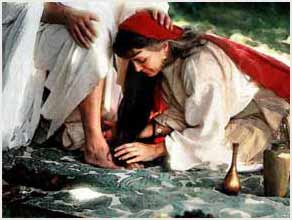
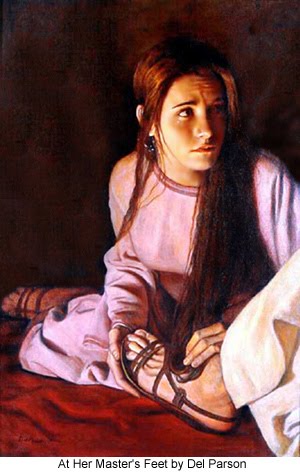
 Jesus is being honored because He brought Life to a dead man. He raised a dead man to life. Not a sick man, not a comatose man, but a dead rotting in the ground, stinking to high heaven man. Jesus had brought life to a dead man, and all the disciples could worry about was how wasteful this woman was. A woman (Mary) took an alabaster flask of spikenard and used it to anoint the head and feet of Jesus. She even used her hair to wipe his feet. The disciples reacted indignantly, especially Judas. They said this is such a waste, it should have been sold for a year’s worth of wages and given to the poor.
The Gospel is Never “Rational”
What she did was so unusual, that most ‘normal, rational Christians’ would find it a waste. They shake their heads and turn the judgmental faucet on. Jesus reacted with some stern comments. His comments will shed some insight into the Gospel that you and I believe in. I want to unwrap His comments so we can learn the power of the Gospel in our everyday lives.
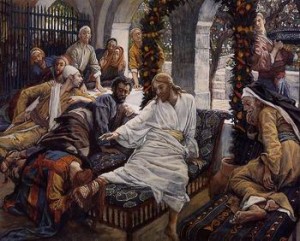 Why was the ointment wasted like that? Why this Waste?
Waste-apóleia; gen. apōleías, fem. noun from apóllumi , to destroy fully. Used trans. the losing or loss (Matt. 26:8), intrans. perdition, ruin. In the NT, apóleia refers to the state after death wherein exclusion from salvation is a realized fact, wherein .[1]
In 1 Tim. 6:9 the words ólethros and apóleia occur together referring to those who determine to be rich. In this instance, ólethros refers to the actual physical death of those who desire to be rich by any means such as Judas, Ananias and Sapphira. Apóleia, on the other hand, refers to separation from God Himself in fulfillment of our Savior’s warnings that the rich enter the kingdom of heaven with difficulty (Matt. 19:23, 24; Mark 10:25). [2]
Jesus responds to His blind and hardened disciples:
1. Leave her alone
 Jesus issued a stern rebuke to His disciples. Give it up guys! Stop it! You are so wrong Guys. You just don’t get it! Jesus wanted his men to see something amazing about the Gospel. It is a foundational principle of God’s character revealed in the Gospel. It is a principle which must be applied to our life if we are to experience the power of Jesus Christ.
Sometimes we are quick to judge someone, especially because of something they do that seems to be stupid or dumb. God often has a lesson for us to see and understand. God’s ways are not our ways, and we must learn to see God in those moments that seem such a waste.
Have you ever said something or thought something about what someone has done and you say, I know I should say this, or I don’t mean any disrespect… Jesus is telling you to “Leave Her Alone”
2. Why do you trouble her. (Cause her pain)
 The disciples probably thought they were something else. They had already argued about who was going to sit at the right hand of Christ. So they thought they were entitled to look down their noses at this poor unfortunate woman.
Jesus said stop causing her pain. Spiritual pride gets in the way of the work of the Spirit. It can cause pain in the body. The idea of this Greek word for cause is ‘minister’.
- The disciples were ministering pain to the body.
 The Gospel is about Honoring Jesus Christ through your life. You can touch and encourage people and other disciples. You can strengthen others with your words and your actions. But when you allow things to darken your eyes, you can say and do things that bring pain to the body, to other believers. You cause pain to Jesus Christ. He says, why do you trouble her.
3. She has done a beautiful thing to me
Mark 14:6 καλὸν kalon ἔργον ergon ἠργάσατο ērgasato ἐν en ἐμοί. emoi –A GOOD WORK SHE HAS PERFORMED ON ME
expresses beauty as a harmonious completeness, balance, proportion. Good as to effect or influence, useful, profitable, equivalent to hálas, salt[3]
 We are to be salt to this world and to each other. And if we do it to honor Christ, the world will say that is so wasteful.
Here was a woman who wasted her beauty on the beauty of Jesus Christ. Her future as a wife and mother was bound up in that alabaster jar. It was her dowry given for marriage. She considered honoring Jesus so important that she poured out her beauty, her future, her everything upon his dirty feet, his dirty hair.
To give your life to Jesus Christ as a living sacrifice. To give Him your future, your reputation, your desires, and your dreams is a beautiful thing to God. It is considered your obligation as a follower of Jesus Christ. But if you want to do something really beautiful to Jesus, you must waste something. You must do something so ‘irrational’ that even disciples will say, “what a waste.”
4. She did what she could.
 This single woman, who a few days before had been scolding Jesus for not coming sooner to heal sick Lazarus. She even blamed Jesus for his death. Now she was so touched by His compassion and love, that she was willing to give Him her future. Here was her dowry, reserved for the day of her betrothal, and now she was willingly pouring it upon her Savior.
She did it willingly, sacrificially, but most importantly, she did it! There was no delay, no hesitation, no doubt. If she had waited but a week, Jesus would have been dead.
Parents, Grandparents, are you doing anything wasteful for your family. Are you doing anything wasteful for God? What you can do should always be a waste. We do not limit our discipleship by what is rational or even prudent. We do what we can. We waste our lives, our possessions for the sake of the gospel.
5. She demonstrated the Gospel.
 How did a foolish, wasteful act by an obviously desperate single woman display the Gospel? Why was this seemingly foolish act so important that Jesus said it would be told alongside the Gospel for the rest of time? The Gospel will be proclaimed throughout eternity.
- She died to her future.
- She broke the bottle of her substance
- She poured out her life to be united with Jesus
- A sweet fragrance covered the Savior and filled the room.
What is waste?
Waste means giving more than necessary. If something costs a dollar and you pay $5, it is a waste. If a pint will be enough to paint, a gallon would be a waste. Waste means you give something too much for something too little. If someone is receiving more than he is worth, that is a waste.
But the action of Mary would go wherever the Gospel is preached. Why? Christ wants all those who respond to the Gospel to waste themselves on Him.
Adoniram Judson
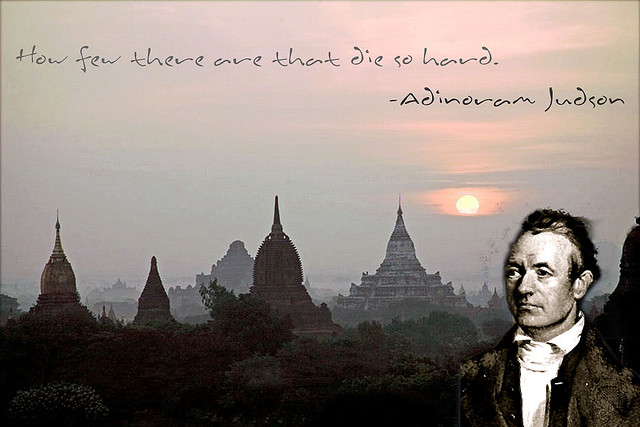 Adoniram Judson labored in Burma in the early 1800’s. He was bright, ambitious, and could have been very successful in his life. Instead, he chose to be a missionary for Jesus Christ.
Life in Burma was beyond hard. This was a ‘hard’ mission field. It was six years before his first convert. The hardships he and his family experienced were deadly.
Adoniram buried two young wives and six young children, victims of the diseases and rigors of Burma. He was imprisoned to the point of starvation and death. He was tortured mercilessly. He labored long hours suffering from fever, headaches, poor eyesight, all due to the conditions he lived in. He had only one furlough in 38 years. After being imprisoned for 17 months, and upon being released experiencing the death of his wife and infant, and hearing of the death of his father, he even suffered a crisis of despair and lost faith.
“God is to me the Great Unknown. I believe in him, but I find him not.[4]
He even dug a grave in the tiger infested jungle and for 30 days would retreat there and contemplate his wasted life. He despaired to the point of desiring death. As God and some Burmese worked to pull him out of his despair, his faith slowly returned. The next year (1831) saw a miraculous outpouring of God’s Holy Spirit as hundred turned to Christ.
- It took Judson 12 years to make 18 converts.
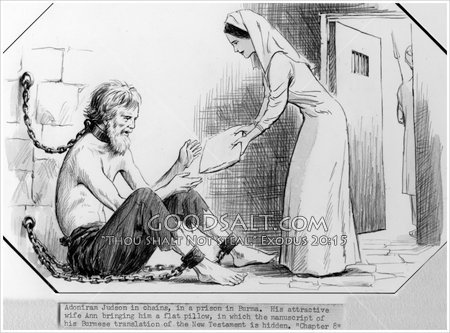 When Judson began his mission in Burma, he set a goal of translating the Bible and founding a church of 100 members before his death. When he died, he left the Bible, 100 churches, and over 8,000 believers.
Adoniram Judson “hated his life in this world” and was a “seed that fell into the ground and died.” In his sufferings “he filled up what was lacking in Christ’s afflictions” in unreached Burma. Therefore his life bore much fruit and he lives to enjoy it today and forever. He would, no doubt, say: It was worth it.
In the world’s view, giving yourself to Christ and serving as a Pastor or a Missionary is a waste of ability. If someone of great natural ability surrenders that to serve the Lord, his friends will say “such a waste”.
Are you experiencing the power of the Gospel? Are you more in love with Jesus today than last year, or even 20 years ago? Would He say you have done a beautiful thing for Him? Would He say you have done what you could?
What are you willing to waste for the sake of Jesus Christ?
Don’t let your love of money harden you. Don’t let your love of status or reputation blind you. Don’t let men influence you as to what is proper. Do you want to see the glory of Jesus Christ? Do you want to hear Him say, “You did what you could”? Then ask Him what you can waste for Him.
John 12:36 While you have the light, believe in the light, that you may become sons of light.”
[2] Spiros Zodhiates, The Complete Word Study Dictionary – New Testament, (Chattanooga, TN: AMG Publishers, 1993), WORDsearch CROSS e-book, 246.
[3] Spiros Zodhiates, The Complete Word Study Dictionary – New Testament, (Chattanooga, TN: AMG Publishers, 1993), WORDsearch CROSS e-book, 814.
[4] Anderson, To the Golden Shore, 398-399.
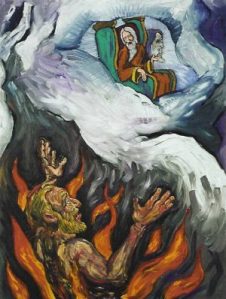
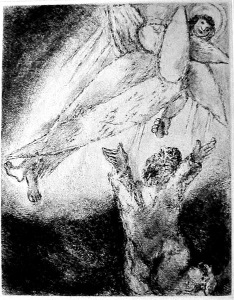
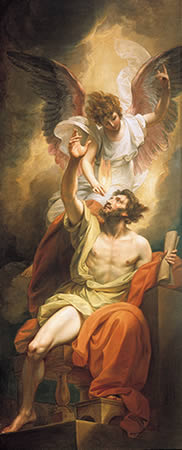
 In the year that king Uzziah died I saw also the Lord sitting upon a throne, high and lifted up, and his train filled the temple. Above it stood the seraphims: each one had six wings; with twain he covered his face, and with twain he covered his feet, and with twain he did fly. And one cried unto another, and said, Holy, holy, holy, is the LORD of hosts: the whole earth is full of his glory. And the posts of the door moved at the voice of him that cried, and the house was filled with smoke. Then said I, Woe is me! for I am undone; because I am a man of unclean lips, and I dwell in the midst of a people of unclean lips: for mine eyes have seen the King, the LORD of hosts. Then flew one of the seraphims unto me, having a live coal in his hand, which he had taken with the tongs from off the altar: And he laid it upon my mouth, and said, Lo, this hath touched thy lips; and thine iniquity is taken away, and thy sin purged. Also I heard the voice of the Lord, saying, Whom shall I send, and who will go for us? Then said I, Here am I; send me. Isaiah 6:1-8
 Isaiah’s Vision was Three-Fold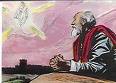

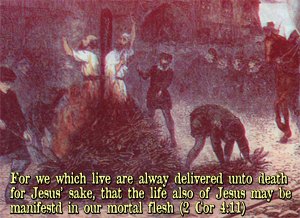 As followers of Christ we are to seek to see Jesus manifested in our flesh. This is what Paul says in 2 Cor 4:11: “
 A man delivered unto death has no power over his own life. He has no power to act on his own. Adam in the garden was to be dependent upon God and all that God gave him to have power over. Adam was to have no power over the fruit of two trees in the midst of the garden-the tree of the Knowledge of Good and Evil, and the tree of Life. Adam was to depend totally upon God for life, and totally upon God for the knowledge and power to live this life. Adam was not to live independently of God. Adam was not to know about evil and good, and thereby have the power to act independently of God.
  God and the knowledge of Him was to be Adam’s life.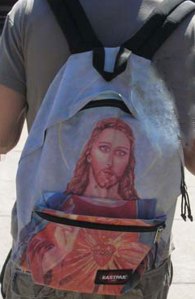
 We say we desire to give glory to God with our lives, yet by acting under our own power, we give glory to ourselves. We fool ourselves into thinking we are living in Christ when there is very little we do that does not require His power to act. We live, eat, work and play with Jesus carefully tucked in our backpack, or tattooed on our body.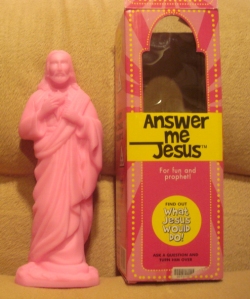
 Because we are acting under our own power, we live a self-assured, yet self-possessed Christian life. In such a life, Jesus Christ cannot be revealed. Too often we have decided, acted, and had power apart from Him. The Christ we manifest is too small because in ourselves we have grown too big.
 It is time to cross the Jordan River.
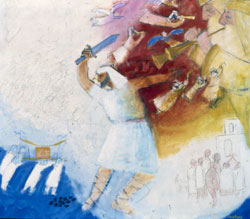
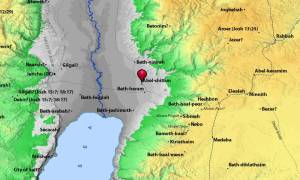 It is time to go through the Jordan River. The Israelites could not build a bridge. They could not go around. They had to go through the Jordan. The reason is because the Jordan River represents death. As we learned last week the entire purpose of the wilderness wanderings was to teach them that they had to put off the old man, the old flesh, and live by the power of God. Joshua in particular had to align himself with the Captain of the Hosts, He had to die to what he thought was best, and follow what God wanted to do. In that respect Joshua represents a man who has joined himself with the power of the Holy Spirit.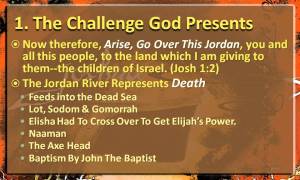
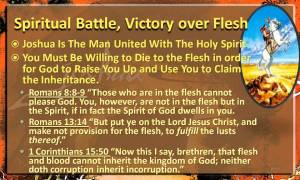 The challenge that God presents is that this inheritance, this rest can only be claimed by dying to the flesh, dying to what you want, and by living in the power of the Holy Spirit! The Jordan is a picture of the Cross. You always have to die by passing through Jordan to get to Canaan. The only way to be born again is to experience the Cross. When you are willing to die, then you are in the place where God raise you up and use you.
 You Must Be Willing to Die to the Flesh in order for God to Raise You Up and Use You to Claim the Inheritance.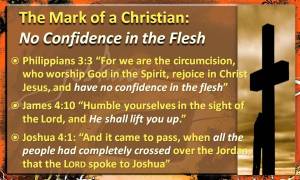
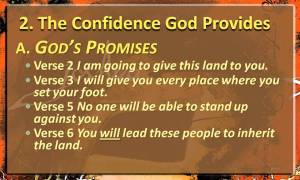 When God presents a challenge to us, a challenge to die to what we want, and to live in His power, He always gives us the confidence of a promised victory! God provides us three-fold ammunition to assure us of victory:Promises, Presence, Past Performance
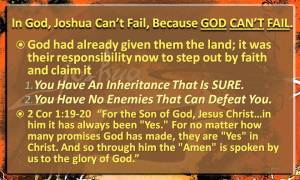 God has given
 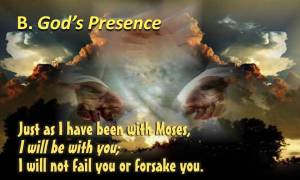 Joshua 1:5 “I will not leave you nor forsake you.” What a promise God gave to Joshua! “As I was with Moses, so I will be with you; I will never leave you or forsake you” (Josh 1:5, NIV). God had given a similar promise to Jacob (Gen. 28:15), and Moses had repeated God’s promise to Joshua (Deut. 31:1-8). God has given this promise to His people today! The Gospel of Matthew opens with “Emmanuel…God with us” (1:23) and closes with Jesus saying, “Lo, I am with you always” (28:20 NKJV).
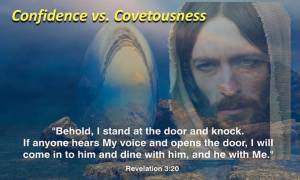 He relates confidence in God’s presence to lack of covetousness or fondness for money. Christians have come a long way since that moment when Joshua led the people across the Jordan. Our confidence is too often in our money our possessions. If you want God’s presence in your life, you confidence must be in Him alone. Many Christians have a real fondness for their possessions, their money. They watch it all the time. Here God was bringing Israel into a place where money was not going to do the job. It was an impossible task. God offered Joshua the promise of His presence, and in so doing, there can be no confidence in anything else!
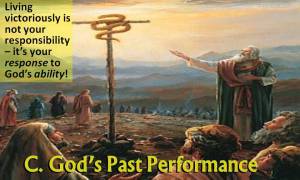 Joshua knew the history of God’s faithfulness to his people. He had heard how God had steadfastly worked in Abraham’s, Isaac’s, Jacob’s and Joseph’s lives. He had heard the stories over and over again of God’s protection, God’s provision and God’s power on behalf of his people. As a very young man he had witnessed the miracles of the plagues in Egypt, the saving of the first-born Israelites from the angel of death, the miraculous crossing of the Red Sea, and the manna from the skies. God had proven himself faithful.
 THE PROMISES ARE NOT A PILLOW BUT A PROD
 OUR COVENANT RELATIONSHIP
 The modern ideal is individualism, self-interest, and self-centeredness. We glory in the philosophy that says, “I will do what I want to do, when and how I want to do it, and I don’t care what anyone else thinks.” But the moment we are converted, such life must come to an end, for as Christians we are called to live in covenant relationship with God and with each other. A covenant is an agreement between two or more persons; therefore, covenant life is community life, and a covenant person will seek, not his own interest, but that of the entire community. So a husband will look after the interests of his wife; parents will look after the interests of their children; and a believer in Christ will look after the interest of the whole community of believers of which he is a part.
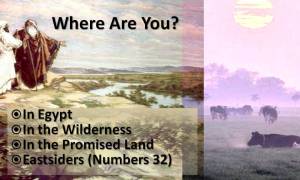 Each of us is on our own spiritual journey that will ultimately end in either Rest and Reward, or Punishment and Pain. I wish it were that easy. Good and Bad, Life or Death, Heaven or Hell, Black or White. But life is far from easy. In this life on earth we are usually in one of four places:
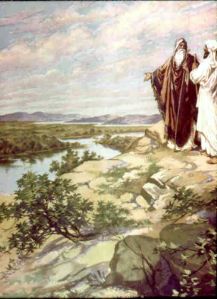 JUST LIKE LOT: many centuries before. Genesis 13:10-11 tells us that “Lot looked up and saw that the whole plain of the Jordan was well watered, like the garden of the Lord, like the land of Egypt . . . So Lot chose for himself the whole plain of the Jordan.” Lot made his choice based on one reason – he owned many cattle. Lot based his decision on sight, not on faith.
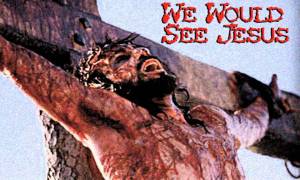 A little boy was sick on Palm Sunday and stayed home from church with his mother. His father returned from church holding a palm branch. The little boy was curious and asked, “Why do you have that palm branch, dad?” “You see, when Jesus came into town, everyone waved Palm Branches to honor him, so we got Palm Branches today.” The little boy replied, “ Aw Shucks! The one Sunday I miss is the Sunday that Jesus shows up!”
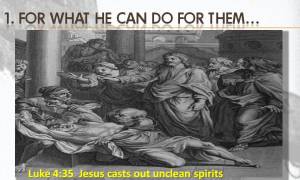
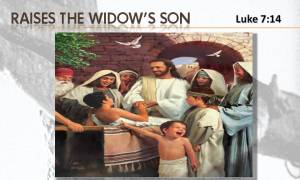
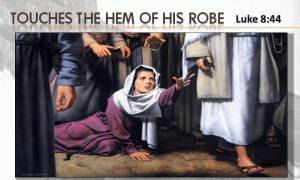
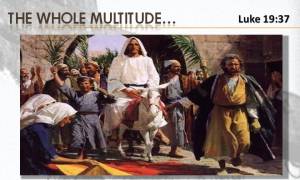
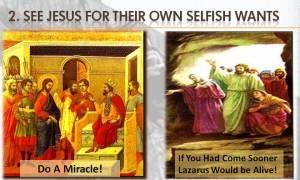
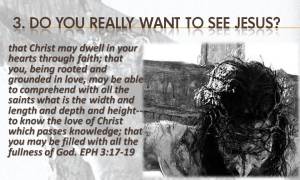 Do you want to see the real Jesus Christ? Do you want to know the Son of God? Do you desire as Paul Prayed in Ephesians…
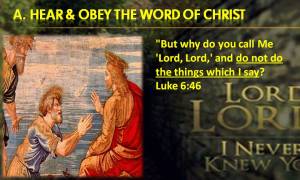 IN OUR TEXT
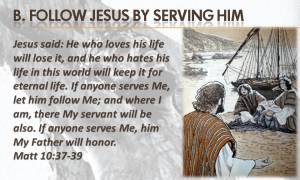 In our text
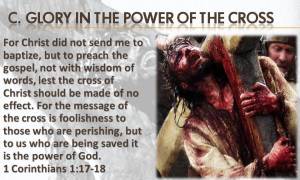 IN OUR TEXT
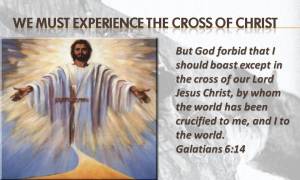 This is where most pretend followers fail. Like Judas, like Demas. Paul tells us we IDENTIFY with the Cross. Paul tells us that the Cross must be central in our life, It must be the core belief in our Walk with Jesus Christ. If we are to See Jesus on a Daily Basis, we must take up the cross DAILY, without complaint, without regret.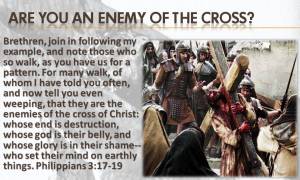
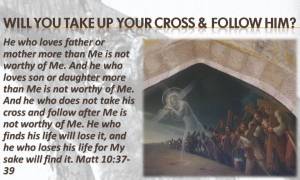 But Jesus adds something else, that only the Son of God can say. He says, “Follow Me”.
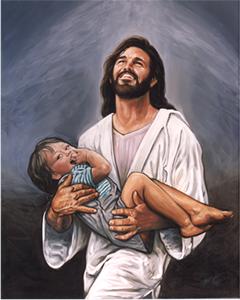 Her first day of Sunday school the teacher walked in
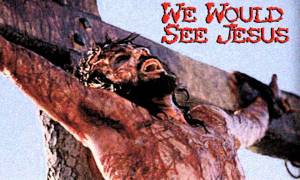 DO YOU REALLY WANT TO SEE JESUS?


 Loving the Word with the MudPreacher