As a young boy, David prayed to the unseen, invisible God who met with him out in the fields near Bethlehem, as David kept watch over his father’s herds of goat and sheep. It was an important job, but a dirty job nonetheless. David would not be able to worship at Jerusalem, for most of the time he would be unclean due to the bloody and dirty duties of a shepherd. Most families hired out this job, but David volunteered. His older brothers said, sure, go ahead and be a dirty shepherd. We will go off to fight a war with the Philistines.

It was there, in the loneliness of the fields, that David grew to know this awesome, invisible God.

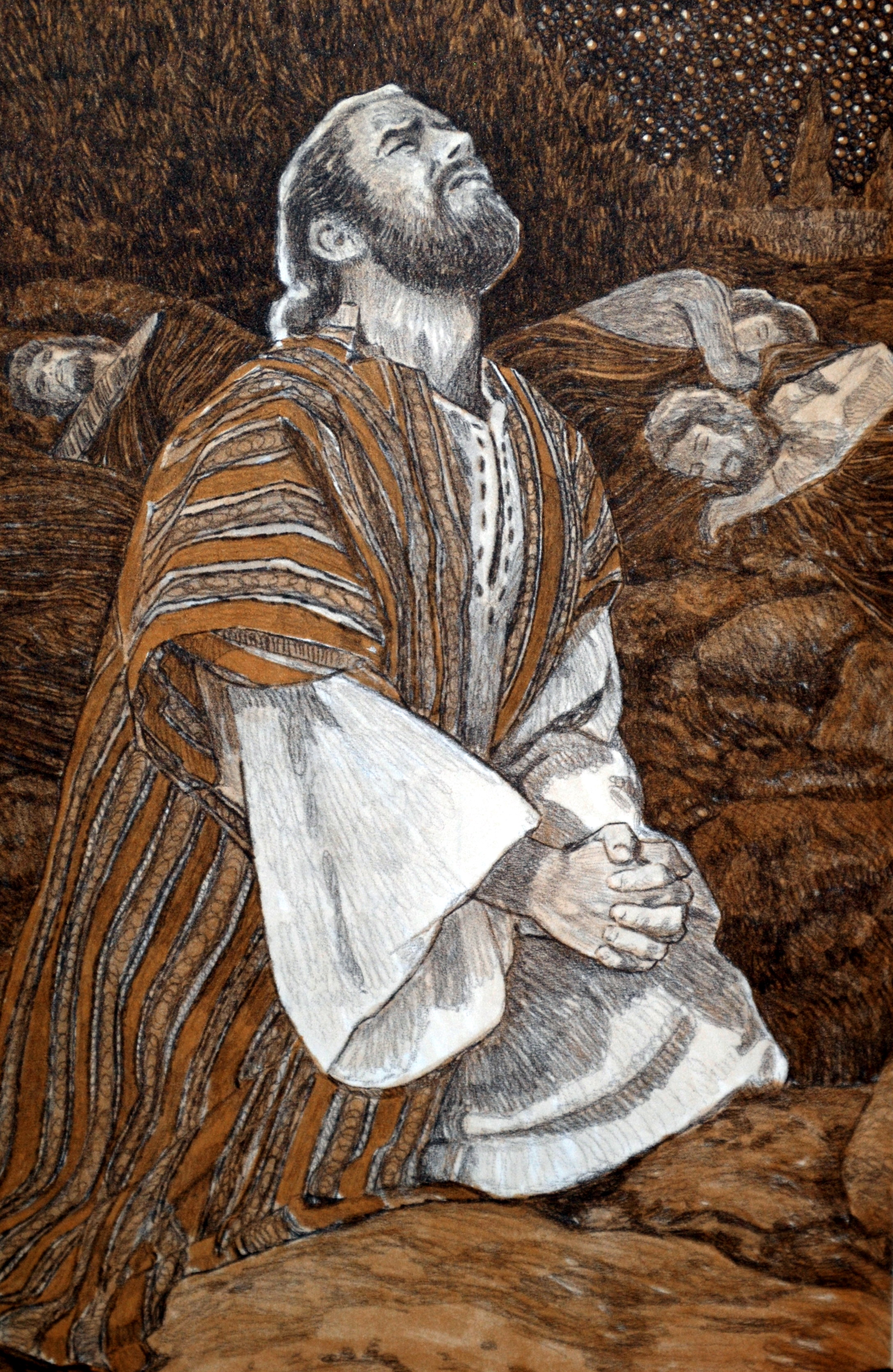
One day he got into trouble. Perhaps it was wild animals, perhaps it was thieves, but he found himself in danger. In that foxhole of danger, this young boy looked up to heaven and cried out:
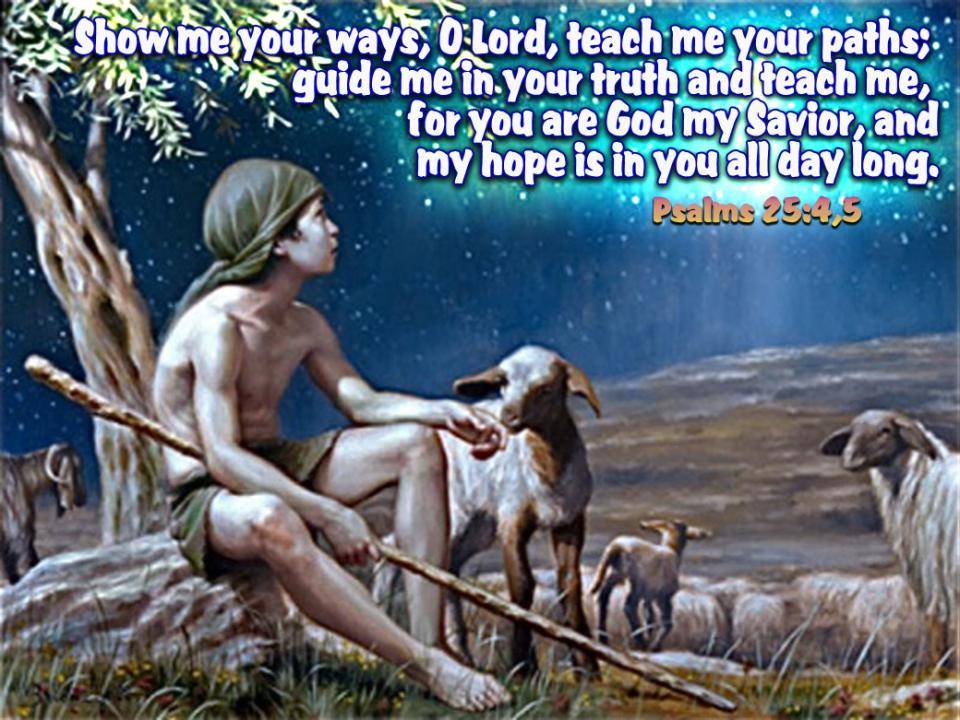
Psalms 25:1-5 (NIV) 1 To you, O Lord, I lift up my soul; 2 in you I trust, O my God. Do not let me be put to shame, nor let my enemies triumph over me. 3 No one whose hope is in you will ever be put to shame, but they will be put to shame who are treacherous without excuse. 4 Show me your ways, O Lord, teach me your paths; 5 guide me in your truth and teach me, for you are God my Savior, and my hope is in you all day long.

David declared His trust and hope in this invisible God. He declared that this invisible God was his Savior. However, David wanted much more than salvation, much more than deliverance from a treacherous situation. David declared his lifelong devotion to know and understand this awesome invisible God.

He cried, “Show me your ways O Lord, and teach me your paths”.

David said, “I not only need saving right now, I need to know your paths for my life. I want to understand your ways O Lord, so that I can walk in your paths”.

I have often said that the decisions you make as a young man or woman will determine where you will end up when you are in your 50’s. Those decisions have life altering effect.

Here is this message in video:

Little did David realize what he was asking for, how much trouble and pain he was going to endure to know the ways of God. God showed this young man His ways. Moreover, David records a summary of what he had learned, something that I have been talking about the last couple of weeks.

Psalms 33:5 (ESV) He loves righteousness and justice; the earth is full of the steadfast love of the Lord.

Psalms 89:14 (ESV) Righteousness and justice are the foundation of your throne; steadfast love and faithfulness go before you.

David saw that the ways of God center upon hesed, mishpat and tsedaqah. Little did that young boy know that by asking to know the ways of God, and to walk in his paths, that those paths would lead to the Throne over all Israel. Moreover, because of that one little decision that David made as a young boy, this is what God’s Word says about David’s reign:

2 Samuel 8:15 (HCSB) So David reigned over all Israel, administering justice and righteousness for all his people.

In addition, because of that young boy’s decision, he would one day lead his “House” in declaring:

Psalms 106:1-3 (ESV) 1 Praise the Lord! Oh give thanks to the Lord, for he is good, for his steadfast love endures forever! 2 Who can utter the mighty deeds of the Lord, or declare all his praise? 3 Blessed are they who observe justice, who do righteousness at all times!
From David’s Last Words

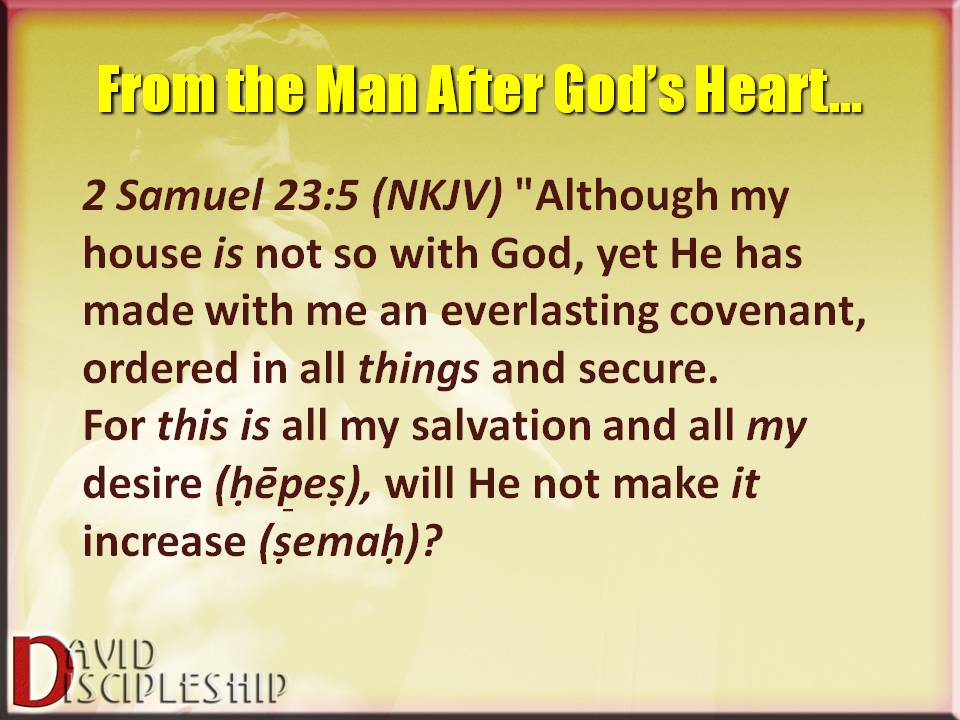
2 Samuel 23:5 (NKJV) “Although my house is not so with God, yet He has made with me an everlasting covenant, ordered in all things and secure. For this is all my salvation and all my desire (ḥēp̠eṣ), will He not make it increase (ṣemaḥ)?
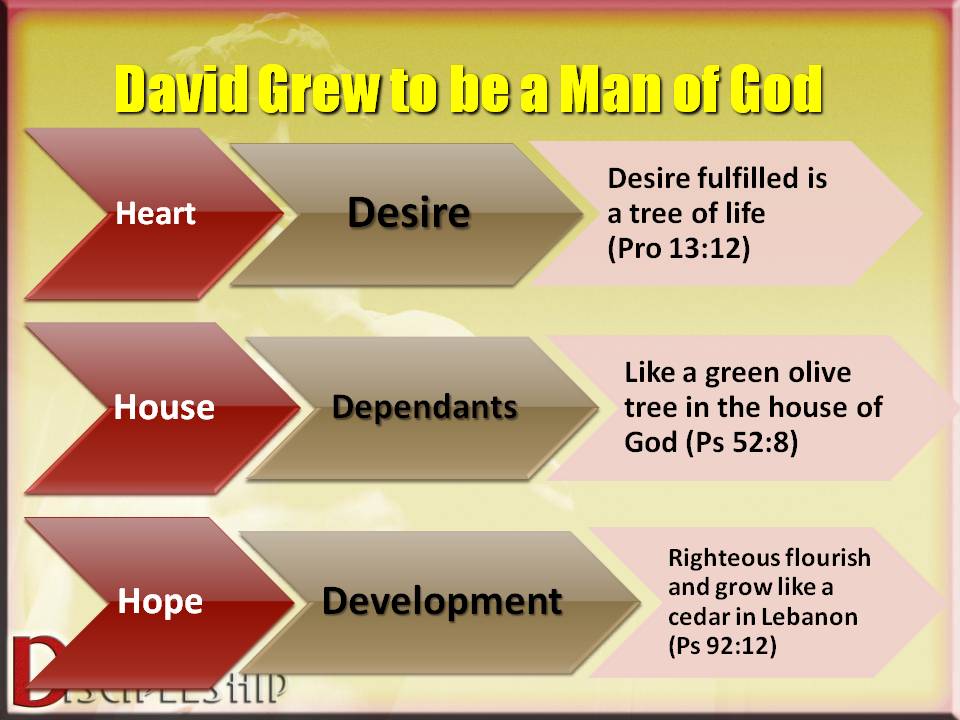
  1. Heart (For all my desire)
  2. House (A Covenant with me and my House)
  3. Hope (He will make it Grow)

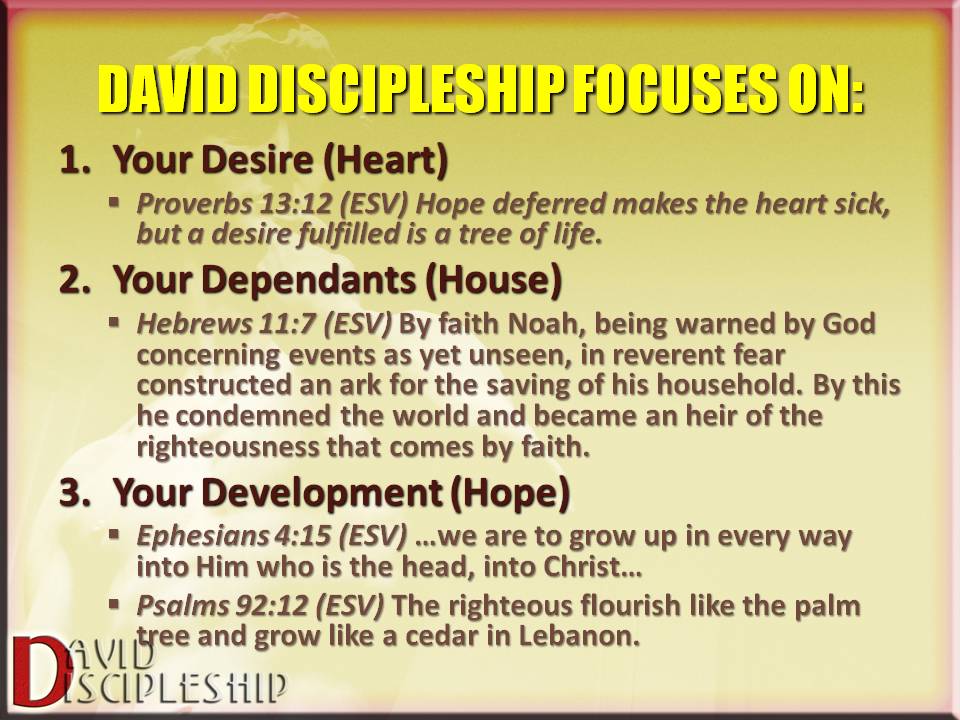
Discipleship MUST FOCUS on three areas of your life:

  1. Your Desire. (For this is all my salvation and all my desire)
  2. Your Dependants. (Responsible for your House)
  3. Your Development. (Will He not make it grow?)

God’s Plan for Discipleship…

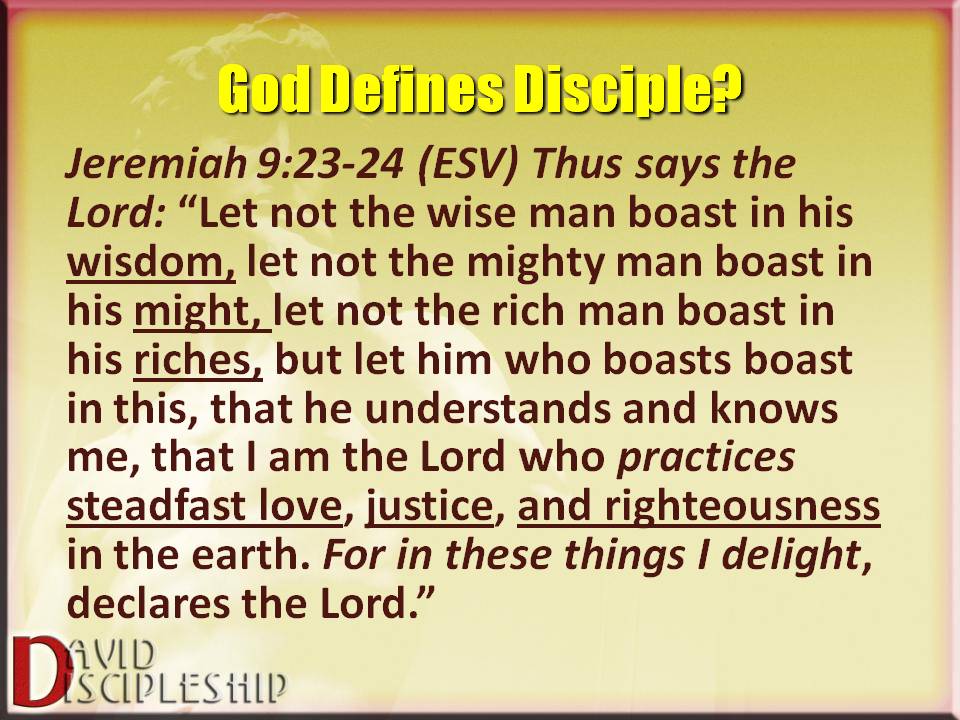
Jeremiah 9:23-24 (ESV) 23 Thus says the Lord: “Let not the wise man boast in his wisdom, let not the mighty man boast in his might, let not the rich man boast in his riches, 24 but let him who boasts boast in this, that he understands and knows me, that I am the Lord who practices steadfast love, justice, and righteousness in the earth. For in these things I delight, declares the Lord.”
Discipleship requires a Choice…

The spirit of Babylon is diametrically opposed to being a disciple. The spirit of Babylon will trip you up on your journey to gain Christ!

Wise Man – Boasts in Wisdom – Splendor (God employed wisdom as His master craftsman to create all things[1] (Psalms 104:24 (ESV) O Lord, how manifold are your works! In wisdom have you made them all; the earth is full of your creatures.)

Mighty Man – Boasts in Might – Status

Rich Man – Boasts in Riches – Success

Here God takes direct aim at the spirit of Babylon and says it has no place among His people. These cannot be any part of His Discipleship plan! Then He says, if you are going to boast, boast in this, that you understand and know me, that you know what I delight in!

Discipleship should lead us to delight in what God Delights in, to knowing and understanding God!

David’s First Words

He Desires to be a Mighty Tree

Psalms 1:1-6 (ESV) 1 Blessed is the man who walks not in the counsel of the wicked, nor stands in the way of sinners, nor sits in the seat of scoffers; 2 but his delight is in the law of the Lord, and on his law he meditates day and night. 3 He is like a tree planted by streams of water that yields its fruit in its season, and its leaf does not wither. In all that he does, he prospers. 4 The wicked are not so, but are like chaff that the wind drives away. 5 Therefore the wicked will not stand in the judgment, nor sinners in the congregation of the righteous; 6 for the Lord knows the way of the righteous, but the way of the wicked will perish.

Walk not in the counsel of sinner – Do not get seduced by the ‘splendor of this world and its wisdom and beauty’. They will infect your heart and your desires.

Do not stand in the way of sinners – do not be caught up in what they think brings status and worth; do not hang around them and what they go after. You may think that it is just a little fun, that no one will get hurt, or you deserve it. But do you want that in your HOUSE? Will it bring your HOUSE closer to God?

Do not sit in the seat of the scorners-do not think because you have success that you can scoff at God. When you sit in the seat of the scorners you no longer develop the virtue of Christ, you no longer have Christ as your Hope. You become worthless to God!

Like a REDWOOD TREE

The root system of the redwood tree is surprisingly shallow, especially given the great height the mature tree attains. There is no taproot and the other roots may reach no deeper than 6-12 feet. The major roots are about 1 inch in diameter. And they typically spread 50 to 80 feet. One way in which the trees are able to remain upright for millennia is by growing close together with other redwood trees, intermingling root systems. In the picture below, a number of redwoods crowd together in a typical grove.[2]

Chose to be Disciple or become Worthless to God
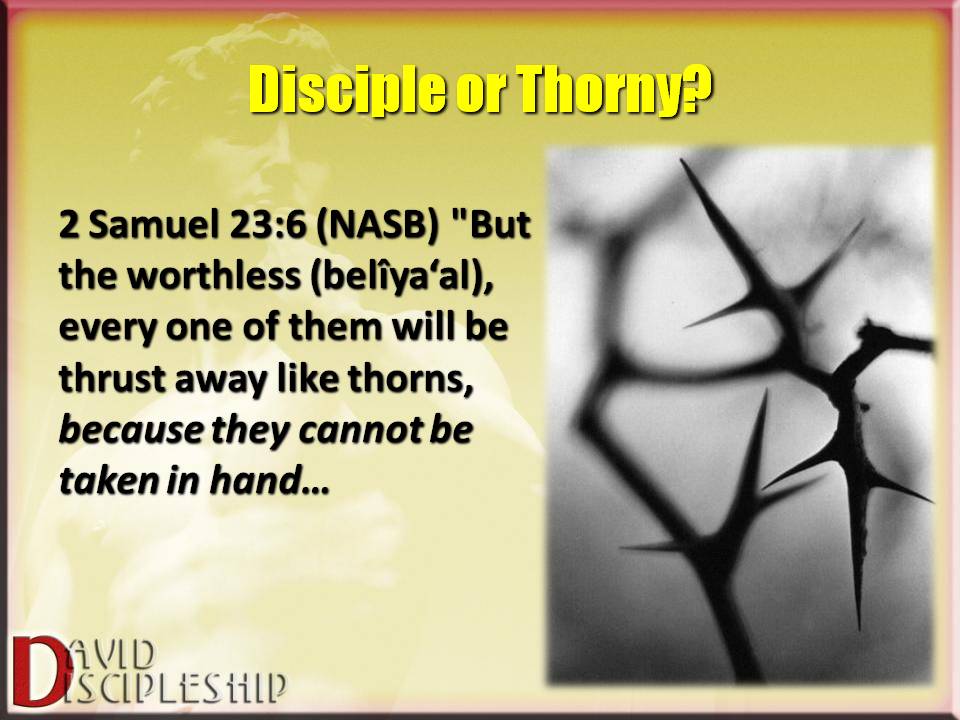
2 Samuel 23:6 (NASB) “But the worthless (belîya‘al), every one of them will be thrust away like thorns, because they cannot be taken in hand;

Belîya‘al. Worthlessness. Belial from belî and yaʿal: “not, without” and “to be of use, worth, or profit”. This concept of Belial became a proper name for the prince of evil, Satan, in the pseudepigraphal literature, the Zadokite Document, and the War Scroll of the Dead Sea Scrolls. See also 2 Cor. 6:15 and 2 Thes. 2:3[3].

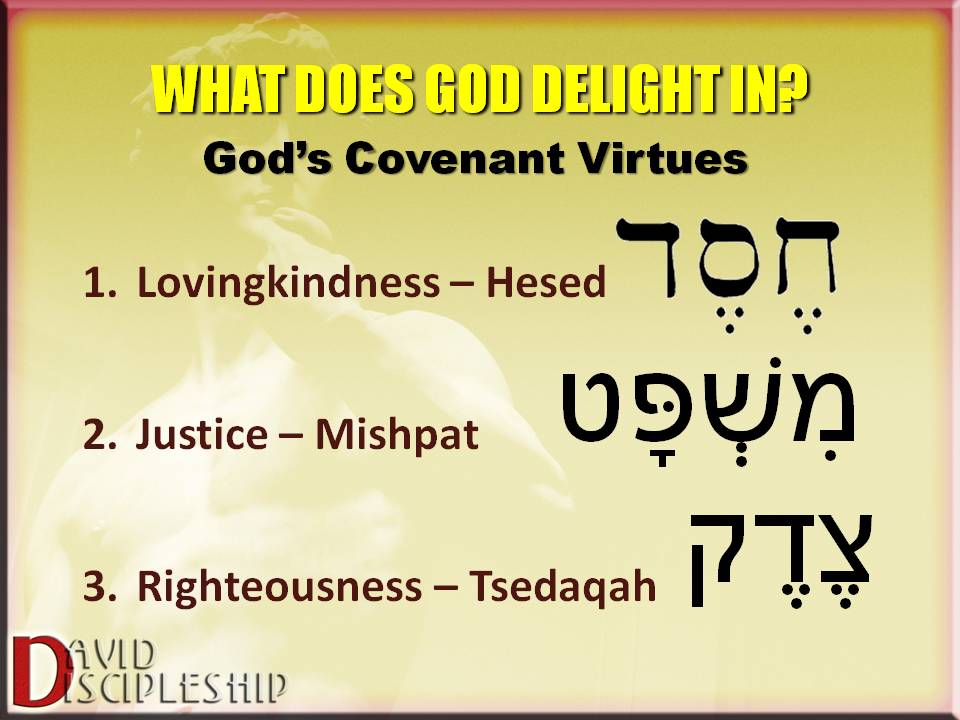
What Does God Delight in?

  • Lovingkindness – Hesed
  • Justice – Mishpat
  • Righteousness – Tsedaqah

‏These are God’s Covenant Virtues

חֶסֶד‎ HESED

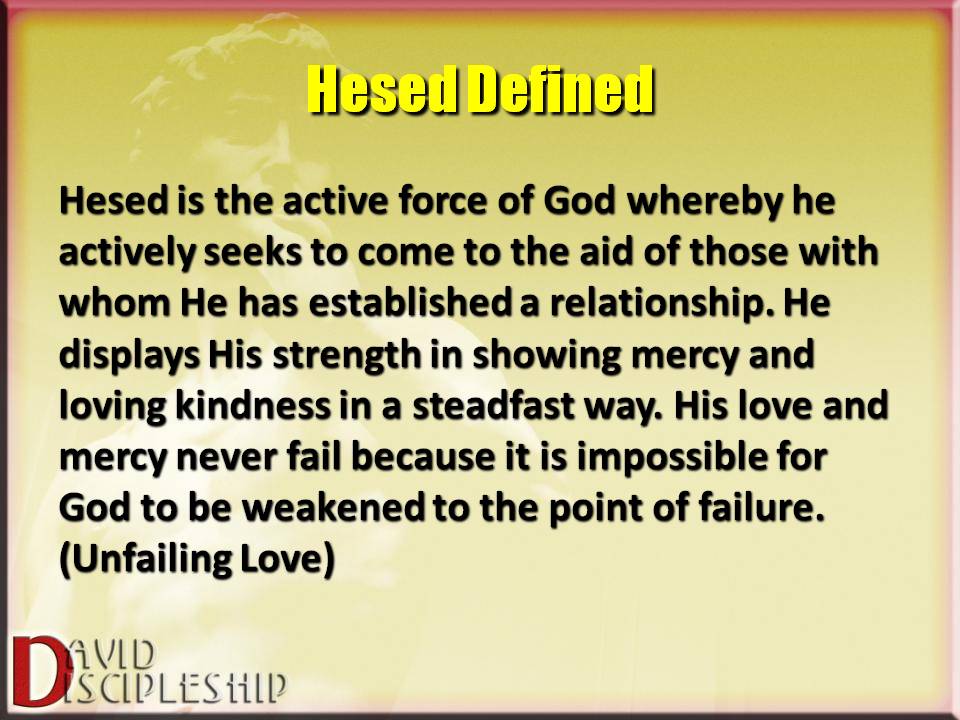
Hesed is the active force of God whereby he actively seeks to come to the aid of those with whom He has established a relationship. He displays His strength in showing mercy and loving kindness in a steadfast way. His love and mercy never fail because it is impossible for God to be weakened to the point of failure. (Unfailing Love)  

This word is used 240 times in the Old Testament, and is especially frequent in the Psalms. Is that any surprise since the Psalms were written by a man after God’s Heart.

Hesed has three components working together: “strength”, “steadfastness”, and “love”. Take one away and His hesed is not complete. Any understanding of the word that fails to suggest all three inevitably loses some of its richness.

Ḥesed implies personal involvement and commitment in a relationship beyond the rule of law.
Marital love is often related to hesed. The prophet Hosea applies the analogy to Yahweh’s hesed to Israel within the covenant (e.g., Hosea 2:21). Hence, “devotion” is sometimes the single English word best capable of capturing the nuance of the original. The RSV attempts to bring this out by its translation, “steadfast love”.[4]

However, ḥesed is not only a matter of obligation; it is also of generosity. It is not only a matter of loyalty, but also of mercy. Hesed describes God’s devotion to those He has a relationship with. It is an active, seeking love that is based upon strength and resolve. It is devotion of the heart. Hesed comes from the very heart of God! It is His desire for His people!

Hesed is the Active force of God whereby he actively seeks to come to the aid of those whom He has established a relationship. He displays His strength in showing mercy and loving-kindness in a steadfast way. His love and mercy never fail because it is impossible for God to be weakened to the point of failure. (Jim Tompkins)

Hesed is the Heart & Desire of God

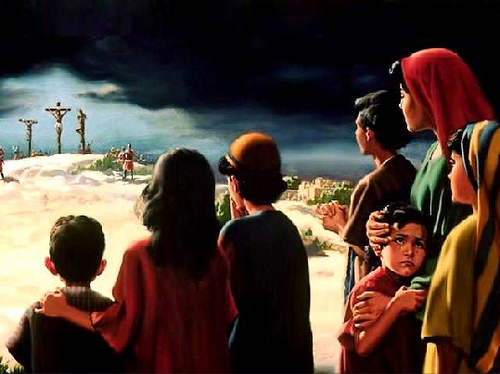
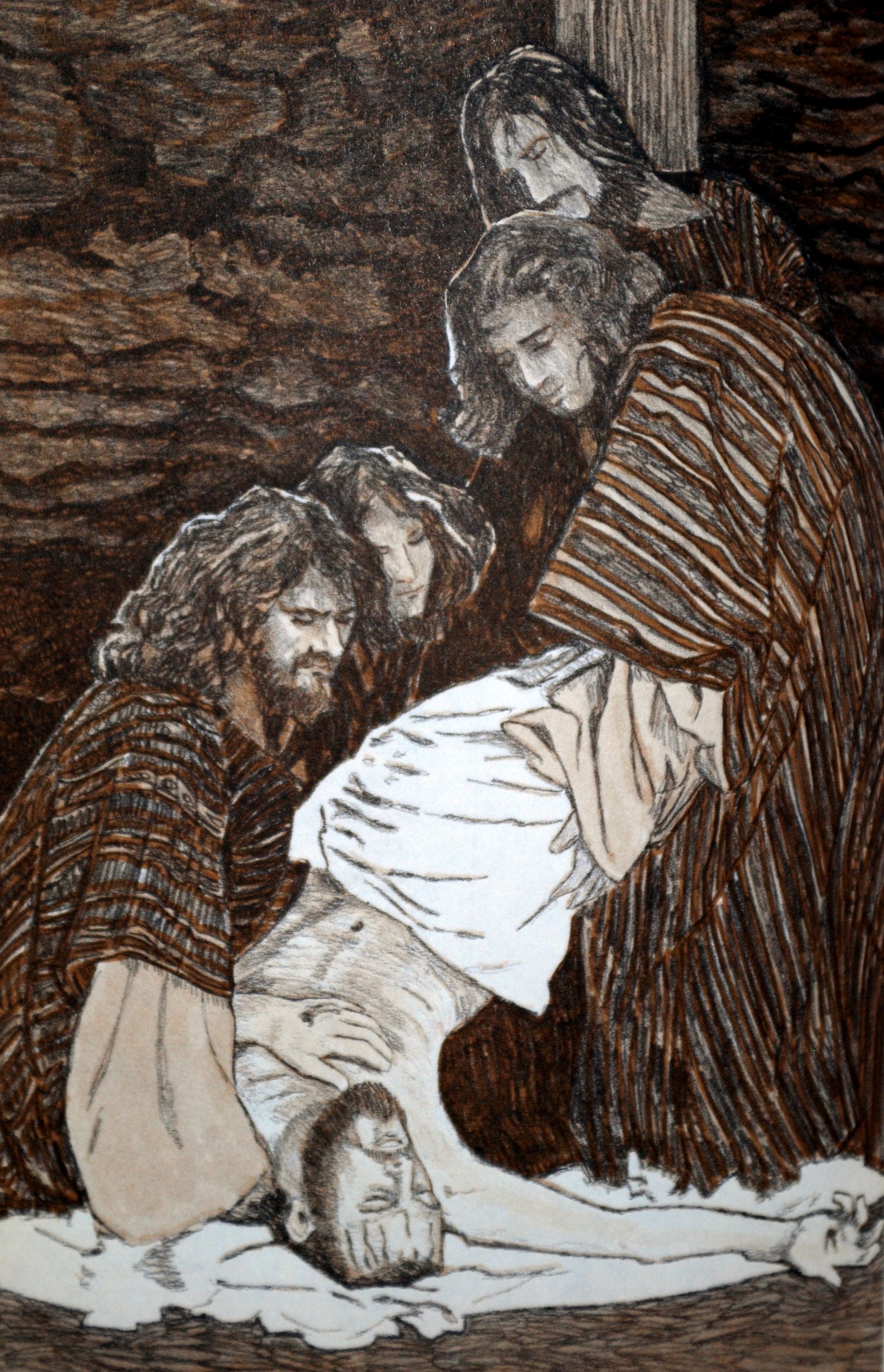
Jesus Christ on the Cross is the visible expression of the Heart and Desire of God! Discipleship begins with our Heart and our Desires committed to following God’s Heart and God’s Desires!

The Spirit of Babylon (Satan) seeks to steal your devotion away from God by corrupting your heart by the foolish wisdom of man and the corrupted splendor of the world. He wants you to desire what this world has to offer! He wants you to think your desires are OK and actually wise!
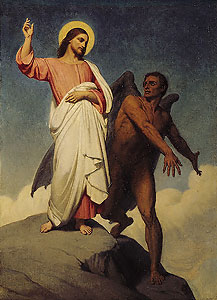
When Satan tempted Christ to turn the stones into bread so He could eat, Satan was using the most simple, basic splendor of this world to cause our Savior to sin. However, Jesus demonstrated the hesed of God when He refused, Matthew 4:4 (ESV) But he answered, “It is written, “‘Man shall not live by bread alone, but by every word that comes from the mouth of God.’ ”  Our Life is not in the Splendor of the things that this world has, even basic splendor like Bread.

Our Life is in the Splendor of God and His Word, for it expresses the Hesed of His heart! So when your Heart and your desires desire God’s hesed above all, you will begin your discipleship journey!

‏מִשְׁפָּט‎ mishpāṭ

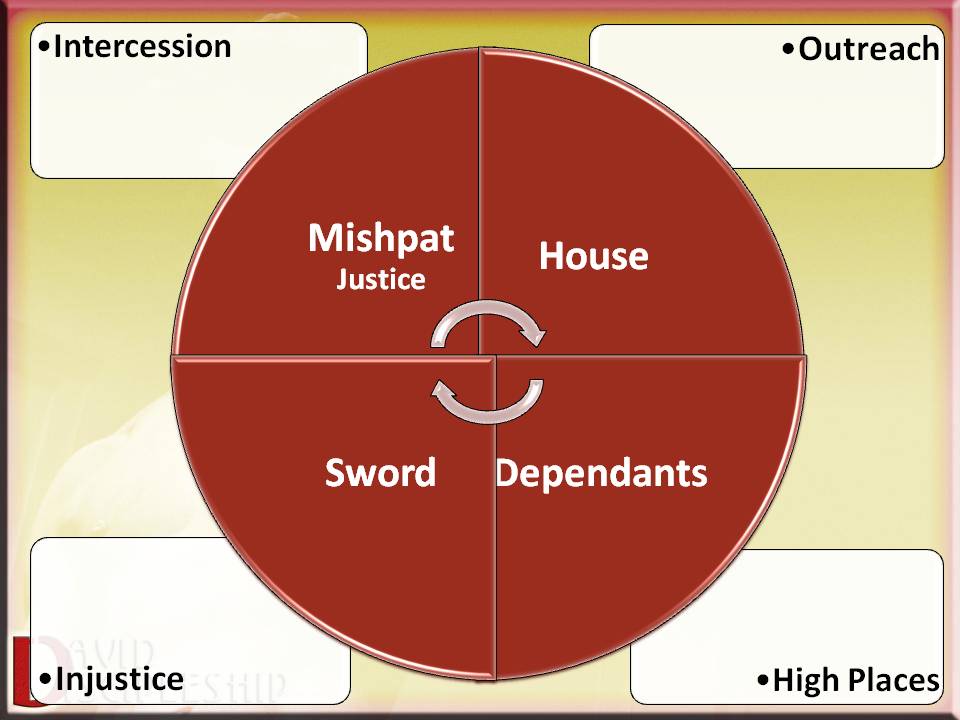
Mishpat is God’s Kingdom design in place within man through the reign of Christ in our hearts. His Kingdom design must grow to encompass our life, our family, our church –  our ‘House’. (Justice)

Mishpat begins in the external and transforms the internal (Describes the design and function of the Tabernacle)

God has a Kingdom in His heart, a kingdom of justice, of order, a kingdom that is at work in heaven and his desire is for it to be so on earth.

The Tabernacle was an earthly type of the Justice that God seeks on the earth. (Exodus 26:30; 1 Kings 6:38; and Ezekiel 42:11 this word is used in reference to the design of the tabernacle, the temple of Solomon, and the future temple prophesied by Ezekiel, respectively. Significantly, in all these passages it refers to the design or arrangement of God’s dwelling place.)
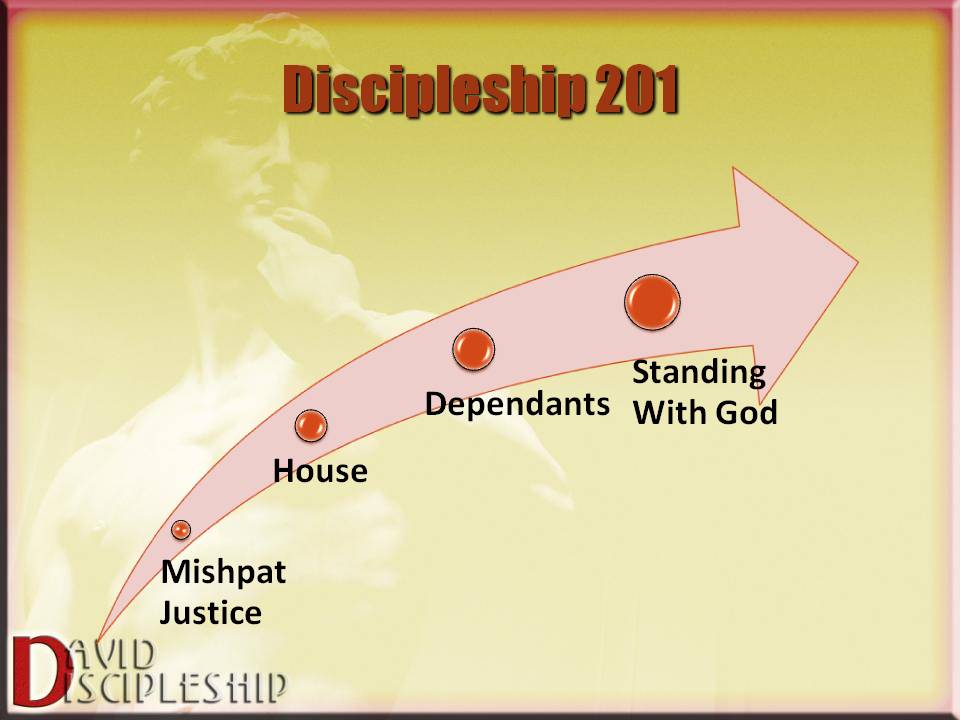
When His Son came to earth, He did what was necessary to empower this justice on earth. One day He will claim this inheritance and establish God’s Justice on earth. Until that day, we as His children, have an earthly tabernacle in which the Holy Spirit dwells. God can establish His justice in our lives. His Son can reign in our hearts and everywhere our foot trods. Mishpāṭ, as justice, i.e. rightness rooted in God’s character, ought to be an attribute of man in general and of judicial process among them (Psalm 106:37).

Mishpat expresses the nature of God and the demands of God. He desires His mishpat to reign on earth, and to reign in the hearts of mankind. His mishpat is what condemns us; His mishpat is what Jesus Christ satisfied upon the Cross. When God’s mishpat reigns in your heart through faith in Jesus Christ, you stand before God uncondemned. You have standing before God. You have the very ear of God because you delight in the mishpat of Jesus Christ!

Your standing in mishpat is for the benefit of your House, for your dependants. Jesus died to bring many sons to salvation. Jesus desired to bring mishpat to His House, this earth, and right now is building mansions for us to bring to the New Earth where He will rule over His House in mishpat!

mishpāṭ. This justice is primarily an attribute of God all true mishpāṭ finding its source in God himself and therefore carrying with it his demand. “When therefore the Scripture speaks of the mishpāṭ of God, as it frequently does, the word has a particular shade of meaning and that is not so much just statutes of God as the just claims of God. God, who is the Lord, can demand and He does demand” (Koehler, OT Theology, pp. 205-206). All the right (justice, authority, etc.) there is his, “because Jehovah is the God of justice” (Isaiah 30:18, cf. Genesis 18:2

Satan tempted Christ to throw himself from the tower overlooking Jerusalem. Certainly, God would honor His word and protect His own son, as Psalms said. Satan was saying, OK, if you live by the Word of God, let me see if you really believe. However, Jesus responded by quoting Deut 6:16, “You shall not put the Lord your God to the test”.

Jesus realized something that we need to embrace. God’s mishpat reigns! God desires to order this world according to His mishpat. It begins in our heart and our life. It is not to be scoffed at, questioned, and argued with. God is not someone you can trifle with and presume upon His mercy (hesed). God’s Justice is certain.

Even Jesus, the only son of God was not about to presume upon God’s mercy if He fell from the tower. Jesus knew that His Father was Just, and His Mishpat would reign.

You must understand that God delights in Justice. He delights in proper standing with Him. We have no proper standing with God. We have no special status with God. God’s justice is totally blind, even when it came to his son. So for you to seek after status and hope it will put you in better standing with God is ridiculous. You are tempting the Lord God. You have no concept of what He is about. You are doomed, and your house will be in shambles!

When the mishpat of God is the standing and status you seek for yourself and your house; your dependents will be established along with you in the House of God! When you desire Right Standing before God, this is the beginning of discipleship!

Tṣedāqâh

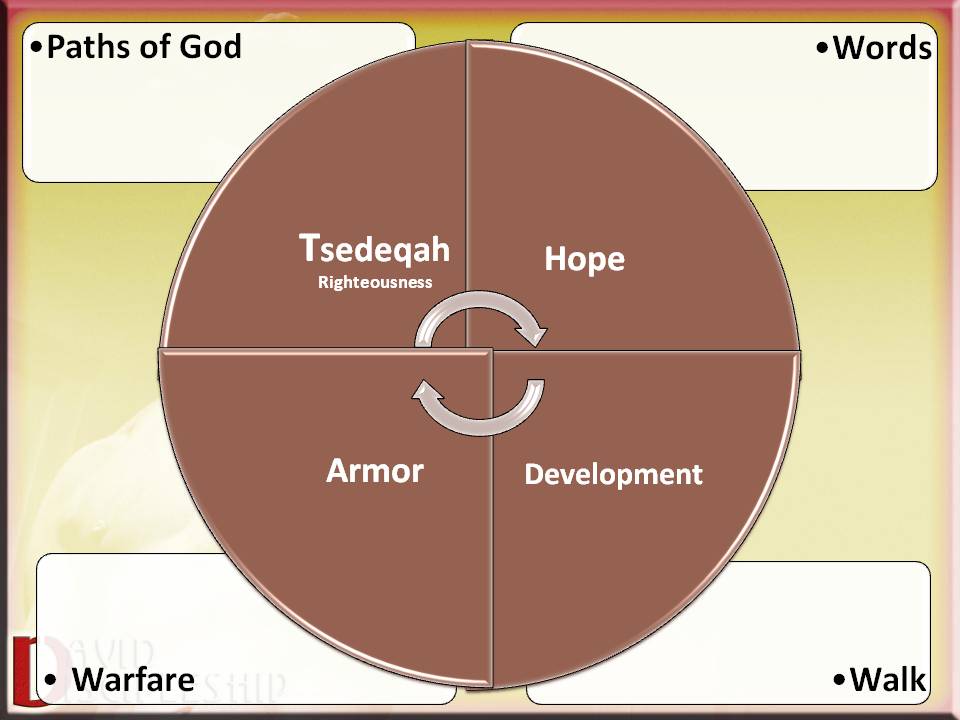
Because of our right relationship with God, we are free to embrace His righteousness. His righteousness transforms our lives and our environment. The righteousness of Christ within prevails and causes us to outwardly triumph!

Right Behavior and Attitudes that grow from a Right Relationship.

Conquering Righteousness In Action

Tsedaqa begins in the internal and transforms the external.(JT)

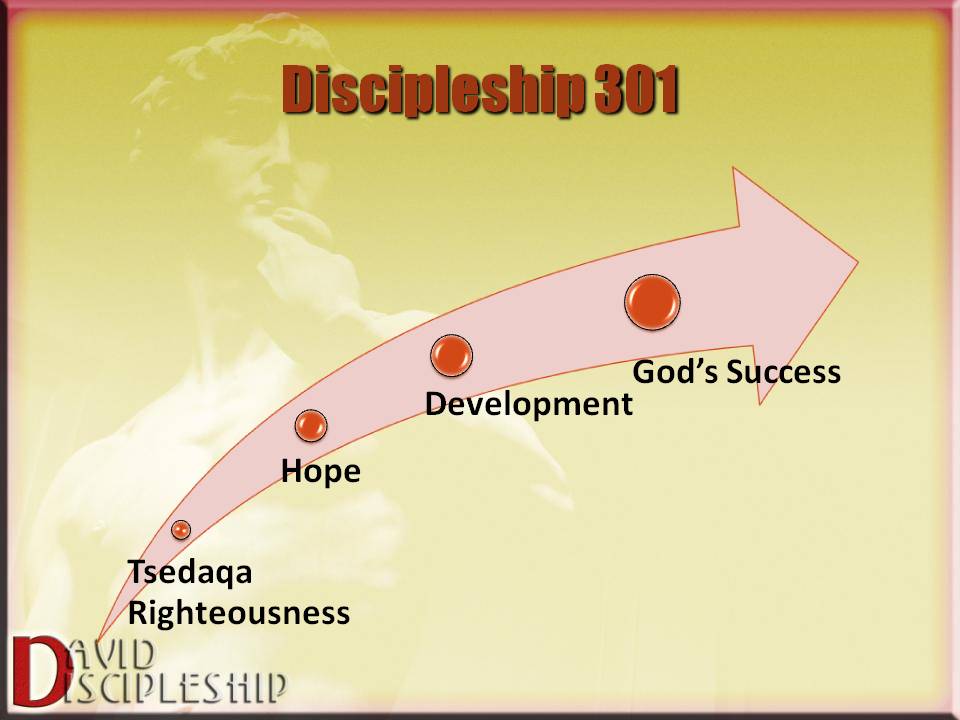
The difference between mishpat and tsedaqa is that mishpat begins in the external and transforms the internal. God’s justice becomes ingrained in our character. Tsedaqa begins in the internal and transforms the external. The justice of God in our heart becomes righteousness that transforms our lives and our environment. Inner righteousness prevails and causes us to outwardly triumph!

Tṣedāqâh implies relationship. A man is righteous when he meets certain claims which another has on him in virtue of relationship”. It is that which “triumphs and prospers” deliverance, salvation or triumph — tṣedāqâh (reaches, relates, rewards– delivers, saves and causes to triumph) The word describes the attitude and actions God had and expected His people to maintain. He is unequivocally righteous;
Satan’s third temptation was to show Jesus all the Kingdoms of the World and their glory. Satan would give all these to Jesus if He would fall down and worship him. Jesus. Matthew 4:8-10 (ESV) 8 Again, the devil took him to a very high mountain and showed him all the kingdoms of the world and their glory. 9 And he said to him, “All these I will give you, if you will fall down and worship me.” 10 Then Jesus said to him, “Be gone, Satan! For it is written, “You shall worship the Lord your God and him only shall you serve”.

Satan was offering Christ “SUCCESS” without the sacrifice of the Cross. God was going to give Jesus all the Nations, so why not go ahead with what Satan wanted.

Christ had a purpose, to worship His Father God with His life. Christ came to serve His Father in fulfilling His will. That was SUCCESS to Christ, serving His Father, whatever it cost, even his life. Success is in Development into what God desires for our life. Success is based upon being conformed to the Hope of Jesus Christ!

So let us build the Foundational Wall of David Discipleship.
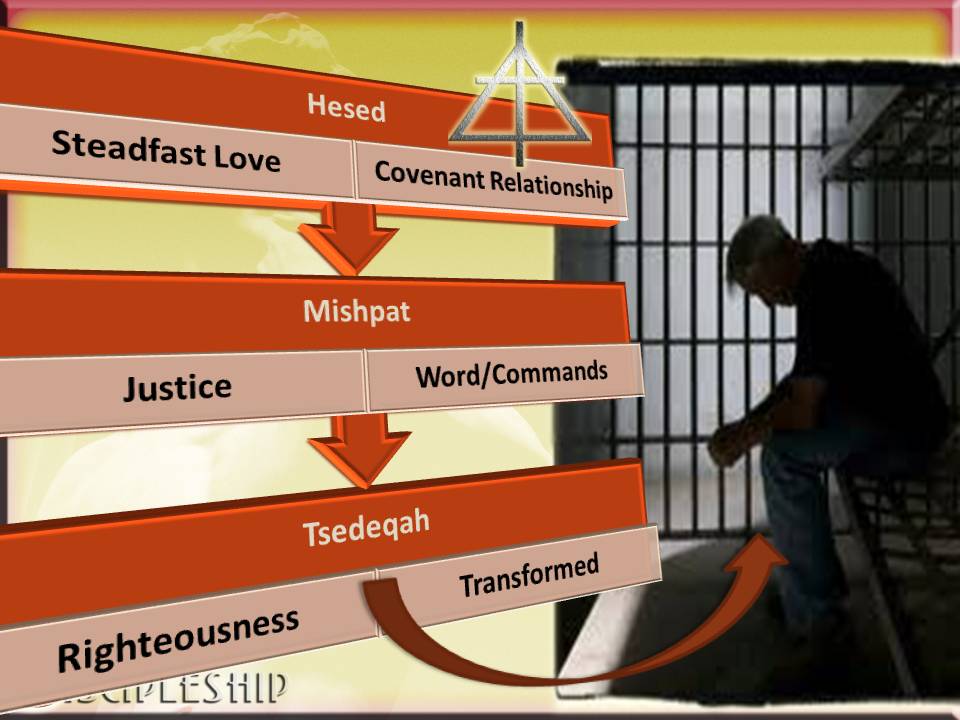
A Disciple is one whose Heart is given to God, whose Status is in Christ, whose Life is Developing into Jesus Christ, and every aspect of his life is based upon the Hope of Jesus Christ.

The World says Seek Splendor, all the beauty and bling the world can offer. The world says to promote yourself, seek status even if it means the sacrifice of your family. The world says seek success and display it to the world, the more you have the more successful you are. You can be a Christian without being a disciple.

We find Jeremiah 9:24 in the New Testament as well.

Jer 9:24 is in SALVATION: Ephesians 2:8-10

Ephesians 2:8-10 (ESV) 8 For by grace you have been saved through faith. And this is not your own doing; it is the gift of God, 9 not a result of works, so that no one may boast. 10 For we are his workmanship, created in Christ Jesus for good works, which God prepared beforehand, that we should walk in them.  

‘By grace you have been saved’ is God’s hesed, ‘we are His workmanship’ is his mishpat, ‘good works…walk in them’ is His tsedaqah! These are the foundational virtues of His Covenant of Salvation through the Blood and Body of Jesus Christ!

Jesus Puts Discipleship in perspective:

Discipleship is a Feast that you must sacrifice to attend

Luke 14:12-33 (ESV) 12 He said also to the man who had invited him, “When you give a dinner or a banquet, do not invite your friends or your brothers or your relatives or rich neighbors, lest they also invite you in return and you be repaid. 13 But when you give a feast, invite the poor, the crippled, the lame, the blind, 14 and you will be blessed, because they cannot repay you. For you will be repaid at the resurrection of the just.” 15 When one of those who reclined at table with him heard these things, he said to him, “Blessed is everyone who will eat bread in the kingdom of God!” 16 But he said to him, “A man once gave a great banquet and invited many. 17 And at the time for the banquet he sent his servant to say to those who had been invited, ‘Come, for everything is now ready.’ 18 But they all alike began to make excuses. The first said to him,(Status) ‘I have bought a field, and I must go out and see it. Please have me excused.’ 19 And another said, (Success) ‘I have bought five yoke of oxen, and I go to examine them. Please have me excused.’ 20 And another said, (Splendor) ‘I have married a wife, and therefore I cannot come.’ 21 So the servant came and reported these things to his master. Then the master of the house became angry and said to his servant, ‘Go out quickly to the streets and lanes of the city, and bring in the poor (success/righteous) and crippled (standing/justice) and blind (splendor/singleness of desire) and lame.’ 22 And the servant said, ‘Sir, what you commanded has been done, and still there is room.’ 23 And the master said to the servant, ‘Go out to the highways and hedges and compel people to come in, that my house may be filled. 24 For I tell you, none of those men who were invited shall taste my banquet.’ ” 25 Now great crowds accompanied him, and he turned and said to them, 26 If anyone comes to me and does not hate his own father and mother and wife and children and brothers and sisters, yes, and even his own life, he cannot be my disciple. 27 Whoever does not bear his own cross and come after me cannot be my disciple. 28 For which of you, desiring to build a tower, does not first sit down and count the cost, whether he has enough to complete it? 29 Otherwise, when he has laid a foundation and is not able to finish, all who see it begin to mock him, 30 saying, ‘This man began to build and was not able to finish.’ 31 Or what king, going out to encounter another king in war, will not sit down first and deliberate whether he is able with ten thousand to meet him who comes against him with twenty thousand? 32 And if not, while the other is yet a great way off, he sends a delegation and asks for terms of peace. 33 So therefore, any one of you who does not renounce all that he has cannot be my disciple.

The ones that were initially invited to the feast gave excuses which corresponded to the three ‘Spirit of Babylon’ components. The three temptations of Christ focused on those very same things. In response to the declined invitations, the servants were told to go and seek poor people, for they are open to the success of God through His righteousness. They realize they have no righteousness of their own. They invited the crippled and lame, for they realize their need for God’s status, for they have no standing of their own. Then they invited the blind, for they would be most open to seeing the Splendor of God. They are not distracted by the splendor of man.

Many ask to be excused because they have been infected with the ‘spirit of Babylon’. Discipleship begins with a heart given totally to God and His desires. There can be no ‘hold backs’! There can be no hesitation. Discipleship begins with a need for Jesus Christ to be our life!

Discipleship begins with a Decision to Yoke and Learn

Matthew 11:25-30 (ESV) 25 At that time Jesus declared, “I thank you, Father, Lord of heaven and earth, that you have hidden these things from the wise and understanding and revealed them to little children; 26 yes, Father, for such was your gracious will. 27 All things have been handed over to me by my Father, and no one knows the Son except the Father, and no one knows the Father except the Son and anyone to whom the Son chooses to reveal him. 28 Come to me, all who labor and are heavy laden, and I will give you rest. 29 Take my yoke upon you, and learn from me, for I am gentle and lowly in heart, and you will find rest for your souls. 30 For my yoke is easy, and my burden is light.”

Rest which is given –  Rest which must be found

Discipleship is never given. It is granted only as you let go of those thorns of Babylon and take His yoke, and learn of Him!

If you try to put the yoke on and still have some thorns, that yoke will hurt. It will be so uncomfortable. You will not last. However, if those thorns are cast down, you will discover his burden is light, his yoke is easy.

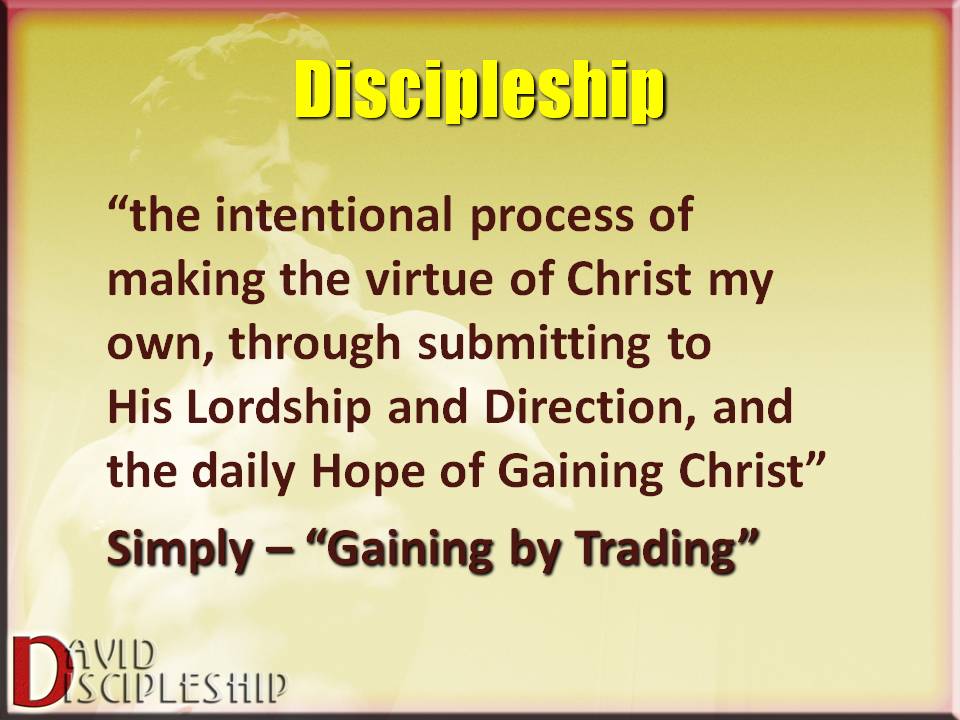
Discipleship – “the intentional process of making the virtue of Christ my own, through submitting to His Lordship and Direction, and the daily Hope of Gaining Christ”

Discipleship is simply gaining by trading (diapragmateúomai)[5];

Do you want to trade your life, your comfort for Jesus?


[1] Warren Baker and Eugene Carpenter, The Complete Word Study Dictionary – Old Testament, (Chattanooga, TN: AMG Publishers, 2003), WORDsearch CROSS e-book, 337.

[3] R. Laird Harris, Gleason L. Archer, Bruce K. Waltke, ed., “246: ‏בָּלָה‎,” in Theological Wordbook of the Old Testament, (Chicago: Moody Press, 1980), WORDsearch CROSS e-book, 111.

[4] William E. Vine, Vine’s Expository Dictionary of Old Testament and New Testament Words, (Nashville, TN: Thomas Nelson, 1940), WORDsearch CROSS e-book, Under: “Loving-kindness”.

[5] Spiros Zodhiates, The Complete Word Study Dictionary – New Testament, (Chattanooga, TN: AMG Publishers, 1993), WORDsearch CROSS e-book, Under: “megauploaddiapragmateúomai”.

When Paul wrote to the Corinthians (1:17) “For Christ did not send me to baptize but to preach the gospel, and not with words of eloquent wisdom, lest the cross of Christ be emptied of its power”, he was slowly lifting the veil from the majesty and beauty of the wisdom of God as revealed in the Cross.

Paul was holding up the beauty of the cross to a people who had been conditioned to not even speak of the crucifixion which it signified. Crucifixion was so horrible, it was not even mentioned among polite society. Yet here Paul is, displaying the cross as the ‘wisdom of God!’ This Wisdom of God was being held up as a means of uniting a church that had become weakened through fleshly divisions. The message of the Cross is the means  to uniting and empowering a divided church. Unless we fail to see the wisdom of it.

The power of the cross can be made null and void when we ignore it, or when we try to dress it up, or when we minimize it. Here Paul is, fully aware that this church has been so influenced by the world that it is fractured, fumbling and failing. His advice to them is to glory in the raw, uncensored message of the cross. That which causes the world to shudder and turn away is the very wisdom and glory of God!

We are so removed from the culture of Paul’s world that we have no conception of how obscene it was to tell people that your “God” had been crucified on a Roman cross. The wisdom of God was for Paul to preach using an object lesson so obscene that most intelligent Gentile’s would consider utterly ridiculous. Imagine an evangelist coming to Farmland, USA and telling them to believe in a convicted pedophile as their Savior. You might get a sense of the reactions Paul’s preaching produced.

Rome and have been so exposed to the crucifixion that we cannot fathom how ridiculous the Empire’s policies on crucifixion conditioned Roman citizens to view crucified men with universal contempt. The crucified were either rebellious slaves, the lowest of criminals, or defeated and humiliated foes of the empire[1].

In light of the crucified’s degraded status and the heinous nature of the punishment, Gentiles understandably and not surprisingly viewed the victim with the utmost contempt. Indeed, “crucifixion” was a virtual obscenity not to be discussed in polite company. The cultured world did not want to hear about crucifixion, and consequently, as a rule, they kept quiet about it[2].

Indeed, the noted orator, Cicero, once plead for his client before the jury, “The very word ‘cross’ should be far removed not only from the person of a Roman citizen, but from his thoughts, his eyes, his ears.[3]

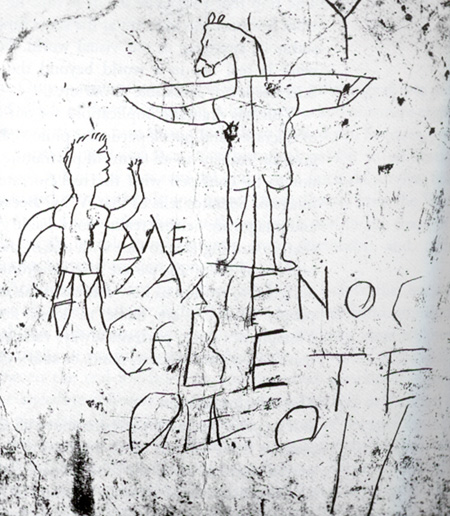
We can see in graphic form, what Gentiles thought of worshipping a god who had been crucified. A drawing  titled “graffito blasfemo” is ancient graffito dating back to the Roman Empire inscribed on a wall near the Palatine Hill in Rome, discovered again in 1857. It is the first known depiction of the Crucifixion of Christ, and notably, in mockery. The inscription depicts the crucified Jesus with the head of an ass, and reads “Alexamenos sebete theon”, meaning either “Alexamenos worships his god” or perhaps a command “Alexamenos, worship your god!”[4]

The drawing illustrates the contempt Gentiles had for the message that a god had been crucified. He was no god, he was an ass. But such is the wisdom of God!

The Offensive Beauty of the Cross is the Wisdom of God

Paul doesn’t dress the cross up with eloquent words, nor water down its message with something more “people pleasing”. That would make the power of the cross empty and void.

Instead Paul writes “For the word of the cross is folly to those who are perishing, but to us who are being saved it is the power of God!”

Then Paul lifts the veil on the wisdom of God:

 (19) For it is written, “I will destroy the wisdom of the wise, and the discernment of the discerning I will thwart.” (20) Where is the one who is wise? Where is the scribe? Where is the debater of this age? Has not God made foolish the wisdom of the world? (21) For since, in the wisdom of God, the world did not know God through wisdom, it pleased God through the folly of what we preach to save those who believe.

Wisdom is never man-centered. Mankind had plenty of opportunities to know God through ‘wisdom’. Still mankind did not come to know God. Indeed, God had made the wisdom of man to be foolish, time after time.

Solomon wrote: “Doing wrong is like a joke to a fool, but wisdom is pleasure to a man of understanding”. Proverbs 10:23. In the wisdom of man, Jesus is displayed as a crucified ass.  In the wisdom of God, the crucified Jesus is the power of salvation!

God established the Societies of the Earth through His wisdom.

It is he who made the earth by his power, who established the world by his wisdom, and by his understanding stretched out the heavens. Jeremiah 10:12 (ESV)

When men reject His wisdom, standards of behavior breakdown, and that which is wrong is OK, it’s funny, it’s “horse-play”.[5] When men reject His wisdom, they laugh and cheer when a ‘thug’ beats an old man unconscious on a crowded Chicago subway platform.[6]

Paul proudly proclaims the message of the cross, for He knows it is the wisdom of God that has established this world, and will save this world. His message is confrontational. It is not “seeker-friendly”. It is neither inclusive nor politically correct. He acknowledges the difficulty of his message,

(22) For Jews demand signs and Greeks seek wisdom, (23) but we preach Christ crucified, a stumbling block to Jews and folly to Gentiles

Crucifixion was ridiculous to the point of obscene to Gentiles. But to Jews, the obstacles were even greater to seeing Jesus Christ as the Messiah of God.

“Stumbling block” comes from the Greek term σκάνδαλον. (skandalon), which refers to a “temptation to sin” or “an enticement to apostasy and unbelief.” A stumbling block was “an obstacle in coming to faith and a cause of going astray in it.”

For a Jew to believe in the crucified Jesus as Messiah, he would have to “stray” from his faith. Since their faith was their identity, it was scandalous for a Jew to confess a crucified Jesus as Messiah. The  offense of the cross was seen as the means of stripping a Jew of his cultural and religious identity. The crucifixion hindered Jews from coming to saving faith. They simply could not overcome their preconceived notions about what the crucifixion signified. The words of Deuteronomy were too contradictory:

(22) “And if a man has committed a crime punishable by death and he is put to death, and you hang him on a tree, (23) his body shall not remain all night on the tree, but you shall bury him the same day, for a hanged man is cursed by God. You shall not defile your land that the LORD your God is giving you for an inheritance. Deuteronomy 21:22-23 (ESV)

Jesus could never be the Messiah, for he was a man cursed by God! God would never curse the Messiah to Hades! As one writer states, “He who is placed there for faith Himself becomes an obstacle to faith.” [7]The very content of Paul’s message caused Jews to turn away.

When Paul boasted in 1 Cor 1:23 that he preached “Christ crucified,” he understood that his message cut deeply against the grain of his culture. Yet the apostle was undeterred. Paul understood that cultural expectations did not alter his responsibility to preach the truth, nor did those expectations hinder the power of the gospel to save[8].

Despite these cultural obstacles, Paul never altered the message of the cross to be more palatable or less socially and religiously offensive. Rather that cloak the cross in seeker-friendliness, he boldly displayed it even though it often turned hearers away.

So the wisdom of God was a stumbling block to Jews, and foolishness to Gentiles. And yet the wisdom of God as preached in the Cross changes the world, and saves sinners from hell.

“For the word of the cross is folly to those who are perishing, but to us who are being saved it is the power of God”. 1 Corinthians 1:18 (ESV)

As Donald Green wrote:

“this verse shows the church of Jesus Christ that it must return to cultural confrontation with its gospel preaching instead of pursuing cultural accommodation. “Christ crucified” was not a “seeker-friendly” message in the first century. It was an absurd obscenity to Gentiles and a scandalous oxymoron to Jews. The gospel guaranteed offense.

1 Cor 1:23 shows that allegiance to the truth supersedes any desire to please men. Far better to live under the smile of God than to dilute the gospel for the approval of men and thereby empty the cross of its power (1 Cor 1:17)[9].

The Wisdom of God is seen in the offensive Cross.

  • God alone knows where wisdom dwells and where it originates (Job 28:12, 20);
  • No other living being possesses this knowledge about wisdom (see Job 28:21).
  • For humans, the beginning of wisdom and the supreme wisdom is to properly fear and reverence God (Job 28:28; Prov. 1:7; cf. Prov. 8:13);
  • God is the master, creator, and giver of wisdom (see Job 28:27; Prov. 8:22, 23).
  • He employed wisdom as His master craftsman to create all things (Ps. 104:24; Jer. 10:12).
  • Rulers govern wisely by means of wisdom provided by God (1 Ki. 3:28; cf. Prov. 8:15, 16).
  • Wisdom keeps company with all the other virtues: prudence, knowledge, and discretion (Prov. 8:12).
  • The portrayal of wisdom in Proverbs 8:22-24 lies behind Paul’s magnificent picture of Christ in Colossians 1:15, 16, for all the treasures of wisdom are lodged in Christ (cf. Col. 2:3).[10]

I have taught you the way of wisdom; I have led you in the paths of uprightness. Proverbs 4:11 (ESV)

1. Wisdom of the Cross Exalts God

25 For the foolishness of God is wiser than men, and the weakness of God is stronger than men.

 “Worthy is the Lamb who was slain, to receive power and wealth and wisdom and might and honor and glory and blessing!”  Revelation 5:12 (ESV)

Philippians 2:8-9 (ESV)  And being found in human form, he humbled himself by becoming obedient to the point of death, even death on a cross. Therefore God has highly exalted him and bestowed on him the name that is above every name…

2. The Wisdom of the Cross Humbles Us

Paul presents the cross to a church that is divided and worldly. Instead of glorying in the offensive message of the Cross, they are wrapping themselves in the corrupted wisdom of the world. Paul tells them to look around and consider who they really are…

1 Cor 1:26 For consider your calling, brothers: not many of you were wise according to worldly standards, not many were powerful, not many were of noble birth. 27 But God chose what is foolish in the world to shame the wise; God chose what is weak in the world to shame the strong; 28 God chose what is low and despised in the world, even things that are not, to bring to nothing things that are,

Look who God uses: Foolish,Weak, Despised, and ‘are Nots’. These are the ones who come to this offensive cross. People who have nothing else to lose, people who have everything to gain. The cross is not offensive to the nothings, to the ‘are nots’, for they can relate to its message. They understand the message of a God who became as they are. This God loved them so much that He became like them, even worse than them. He became cursed for them.

This is the wisdom of God that was before the foundation of the world! God would hang His own son on a tree, and there Jesus would be cursed with all the sin and ugliness of mankind. His son would become lower than a worm, hardly a man. Yes, Jesus became a nothing, an ‘are not’, in order to reveal to the world the wisdom of God. That wisdom is about humbling ourselves to the cross, the place where the pride of man is stripped away. The place where there is no glory for man. The place where we can only behold the beauty of the crucified one!

We must be brought to nothing to receive the wisdom of God! We must kneel as nothings before the cross of shame and folly.

When the Lord’s people embrace the “nothing” message, the world views them as nothing. But in the next age God will shame the wise and the strong and bring to nothing the things that in this age are viewed as something.

The Cry of the Wisdom of the Cross is:

“so that no human being might boast in the presence of God”. (1 Cor 1:29)

We must humble ourselves before the cross, for the cross is the mercy seat, the place where Christ’s blood was shed before His Father, and where our sins are forgiven. But we must realize our need first, and then we must humble ourselves before the cross. There is no salvation without the Cross!

2 Corinthians 4:7 (ESV) But we have this treasure in jars of clay, to show that the surpassing power belongs to God and not to us.

3. The Wisdom of the Cross Transforms Us.

Through the wisdom of the Cross, we have access to all that is Christ’s. The Cross allows God to place us IN CHRIST. The Cross gives us His wisdom. The Cross is the gateway for the righteousness, sanctification and redemption of Christ to be ours!

30 And because of him you are in Christ Jesus, who became to us wisdom from God, righteousness and sanctification and redemption, 31 so that, as it is written, “Let the one who boasts, boast in the Lord.”  

By the Father’s doing, believers are placed in Jesus Christ. Because of this we possess the wisdom of God—Christ crucified, the very essence of God’s wisdom. Through this wisdom, we have justification at God’s court, sanctification before His presence, and total redemption. More than that, we have all the wealth and power and beauty of Jesus Christ. It is as if the kneeling at the Cross entitles us to this huge blank check that will provide us everything that is Christ’s. It is a check that never expires. If only those Jews could see what is on the other side of the cross!

The Cross is to be gloried in daily as we present ourselves as living sacrifices, holy and acceptable to God. God delights in the ‘are not’s! God uses ‘are not’s to accomplish His will in this world!

 (1) I appeal to you therefore, brothers, by the mercies of God, to present your bodies as a living sacrifice, holy and acceptable to God, which is your spiritual worship. (2) Do not be conformed to this world, but be transformed by the renewal of your mind, that by testing you may discern what is the will of God, what is good and acceptable and perfect. Romans 12:1-2 (ESV)

 We Must Keep our Focus on the Cross

(10) We have an altar from which those who serve the tent have no right to eat. (11) For the bodies of those animals whose blood is brought into the holy places by the high priest as a sacrifice for sin are burned outside the camp. (12) So Jesus also suffered outside the gate in order to sanctify the people through his own blood. (13) Therefore let us go to him outside the camp and bear the reproach he endured. (14) For here we have no lasting city, but we seek the city that is to come. (15) Through him then let us continually offer up a sacrifice of praise to God, that is, the fruit of lips that acknowledge his name. (16) Do not neglect to do good and to share what you have, for such sacrifices are pleasing to God. Hebrews 13:10-16 (ESV)

 The folly, reproach and shame of the Cross is to be our guide for service! We are not to embrace a culturally acceptable cross, but to follow Christ outside the camp, where the dirty, the despised and dangerous dwell. We are to take the message of the Cross to the “Are Nots!” It is not the popular ministry. But it is the Ministry of the Cross!


[1] Donald Green, “THE FOLLY OF THE CROSS” , http://www.tms.edu/tmsj/tmsj15c.pdf

[2] Martin Hengel, Crucifixion (Philadephia: Fortress, 1977) 38.

[3] Cicero, “The Speech In Defence of Gaius Rabirius,” sec. 16, in The Speeches of Cicero, trans. H. Grose Hodge, The Loeb Classical Library (New York: G. P. Putnam’s Sons, 1927) 467.

[7] Gustav Stahlin, “σκάνδαλον” in Theological Dictionary of the New Testament, ed. Gerhard Friedrich, trans. and ed. Geoffrey W. Bromiley (Grand Rapids: Eerdmans, 1971) 7:352.

[8] Hengel, Crucifixion, 5.

[9] Donald E Green, “The Folly of the Cross” as seen at http://www.tms.edu/tmsj/tmsj15c.pdf

[10] Warren Baker and Eugene Carpenter, The Complete Word Study Dictionary – Old Testament, (Chattanooga, TN: AMG Publishers, 2003), WORDsearch CROSS e-book, 337.


My time in Bible College was tumultuous at best. The emphasis was on outward conformity to rigorous (and silly) rules. Discipleship was a matter of conformity. Fortunately, I started reading books by Watchman Nee, reading sermons by Charles Finney and RA Torrey. I learned from these men that being a disciple is much more than knowledge and outward conformity. I learned about the Holy Spirit. I learned about grace!  Christ wanted to live in and through my life. This was the basis of Galatians 2:20. His life in me is True Discipleship. Outward conformity is false discipleship, dangerous, prideful and destructive.

Now that I am a pastor, how do I take this conviction and use it to make disciples in my church? Strangely, God has led me to explore the life of David. When I looked at the ‘last words of David’, some concepts just popped out at me, and God showed me a foundation for discipleship in the church.

DISCIPLESHIP from the LAST WORDS of DAVID

2 Samuel 23:5 (NKJV) “Although my house is not so with God, Yet He has made with me an everlasting covenant, Ordered in all things and secure. For this is all my salvation and all my desire(hepes); Will He not make it increase(semah)?

WHAT DAVID IS SAYING

It is the end of his life, and David is praising God for the Covenant He has made with him, (2 Sam 7). He is praising God for his faithfulness, even though neither he nor his family had been like the tender grass springing up from the ground and flourishing by the united influences of the sun and rain.

Because of God’s covenant with him, his house would be ordered and secured, his desires would be met, and God would cause his house to spring up and grow!

He acknowledges his failures, (my house is not so) and prophetically looks forward to God’s Covenant of Salvation. (Indeed, the writer of Hebrews calls David a prophet ahead of Samuel in Hebrews 11:32). It is though David, in his last recorded message, is saying:

“My house is not like that; I am a very faulty man; but God has the One Who satisfies Him on my behalf”.

There is no doubt about it that in his last words David was lifting up his eyes from his own failure, his own coming short, his own weakness, yes, his own grievous sins, and at the end of his life he is saying with Job, “I know that my Redeemer liveth” (Job 19:25). As David wrote in Psalms 138:8 ‘I see the One Who will complete my life and “will fulfill His purpose for me” (Psa. 138:8), and make good on my behalf where I have failed.’

These are the words of a true Disciple. In his words are revealed the secrets of a lifelong journey of discipleship. Discipleship grows from total dependence upon the Promises of God. Discipleship changes our Heart, our House and our Hope!

The three areas of David’s Life in Which David Grew to Be a Man of God are seen in his last words:

1. Heart (For all my desire)

  • Psalms 57:7 (ESV) My heart is steadfast, O God, my heart is steadfast! I will sing and make melody!
  • 1 Kings 3:6 (ESV) And Solomon said, “You have shown great and steadfast love to your servant David my father, because he walked before you in faithfulness, in righteousness, and in uprightness of heart toward you
  • Psalms 119:2 (KJV) Blessed are they that keep his testimonies, and that seek him with the whole heart.

2. House (A Covenant with me and my House)

  • Ps 26:8 Lord, I love the habitation of Your house, and the place where Your glory dwells.
  • Ps 101:2 I will ponder the way that is blameless. Oh when will you come to me? I will walk with integrity of heart within my house;
  • Ps 112:3 Prosperity and welfare are in his house, and his righteousness endures forever.
  • Ps 127:1 Except the Lord builds the house, they labor in vain who build it; except the Lord keeps the city, the watchman wakes but in vain.
  • Ps 128:3 Your wife shall be like a fruitful vine in the innermost parts of your house; your children shall be like olive plants round about your table.

3. Hope (He will make it Grow)

  • Psalms 71:5 (ESV) For you, O Lord, are my hope, my trust, O Lord, from my youth.
  • Psalms 119:114 (ESV) You are my hiding place and my shield; I hope in your word.  
  • Psalms 119:116 (ESV) Uphold me according to your promise, that I may live, and let me not be put to shame in my hope!  
  • Psalms 130:5 (ESV) I wait for the Lord, my soul waits, and in his word I hope;  

DAVID DISCIPLESHIP

Discipleship MUST FOCUS on three areas of your life:

1. Your Desire. (For this is all my salvation and all my desire)

Proverbs 13:12 (ESV) Hope deferred makes the heart sick, but a desire fulfilled is a tree of life.

What are the desires of your heart? What gets you emotionally excited? What or who do you incline yourself toward? What are you fixed upon? Desires centered upon God and His Word are Life-Giving!

Desire (hepes)- A masculine noun meaning delight, pleasure, desire, matter. The root idea is to incline toward something[1]; it means “to experience emotional delight.” This delight may be felt by men or by God. Men are said to experience it in respect to women. Shechem, son of Hamor, had “delight” in Jacob’s daughter Dinah (Genesis 34:19). The contestants in King Ahasuerus’s beauty contest did not return to him after the first viewing unless he had “delight” in them (Esther 2:14))[2].

2. Your Dependants. (Responsible for your House)

Discipleship is never isolated. It is not for the benefit of one person. Discipleship builds your house. Discipleship benefits those who either depend upon you, or are influenced by you.

  • Hebrews 3:4-6 (ESV) 4 (For every house is built by someone, but the builder of all things is God.) 5 Now Moses was faithful in all God’s house as a servant, to testify to the things that were to be spoken later, 6 but Christ is faithful over God’s house as a son. And we are his house if indeed we hold fast our confidence and our boasting in our hope.
  • Hebrews 11:7 (ESV) By faith Noah, being warned by God concerning events as yet unseen, in reverent fear constructed an ark for the saving of his household. By this he condemned the world and became an heir of the righteousness that comes by faith.
  • Acts 18:8 (ESV) Crispus, the ruler of the synagogue, believed in the Lord, together with his entire household. And many of the Corinthians hearing Paul believed and were baptized.

3. Your Development. (Will He not make it grow?)

Discipleship takes place over a lifetime. It is to develop you into the man or woman God wants you to be. It is an up and down thing. It is a series of growth failures and successes, but the end result is that you develop the character of Jesus Christ! Christ is the Hope of your daily Life! He is the Reason you Grow!

  • This word is one of the names of Christ – He is the Branch (Zech 3:8)
  • Ephesians 4:15 (ESV) …we are to grow up in every way into Him who is the head, into Christ…
  • Psalms 92:12 (ESV) The righteous flourish like the palm tree and grow like a cedar in Lebanon.

Grow (semah – A verb meaning to grow, to spring forth, to sprout. It refers to a plant as it breaks forth out of the ground)[3] This word is one of the Titles for the coming Messiah:  Zechariah 3:8 (ESV) Hear now, O Joshua the high priest, you and your friends who sit before you, for they are men who are a sign: behold, I will bring my servant the Branch (semah)

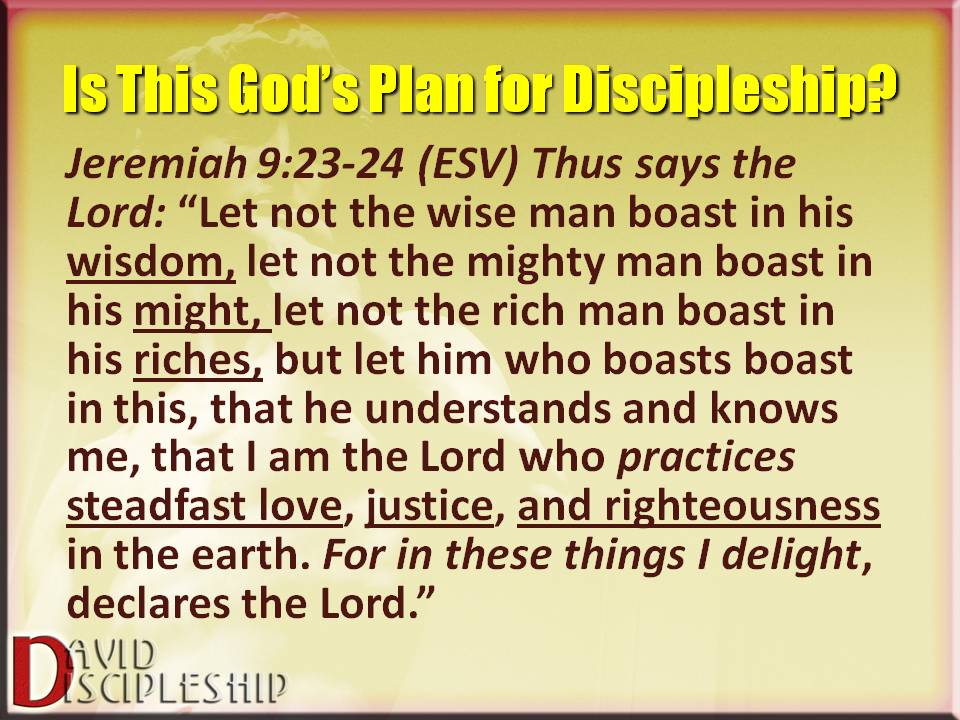
Is This God’s Plan for Discipleship?

I believe this folds perfectly into what God desires for His people. Discipleship is about becoming one who knows and understands our God and Savior Jesus Christ. Jeremiah 9:24 reveals what God delights in. If we are to know and understand God, then our discipleship ‘program’ should allow us to know and understand what God delights in, and make those our delights!

Jeremiah 9:23-24 (ESV) 23 Thus says the Lord: “Let not the wise man boast in his wisdom, let not the mighty man boast in his might, let not the rich man boast in his riches, 24 but let him who boasts boast in this, that he understands and knows me, that I am the Lord who practices steadfast love, justice, and righteousness in the earth. For in these things I delight, declares the Lord.”

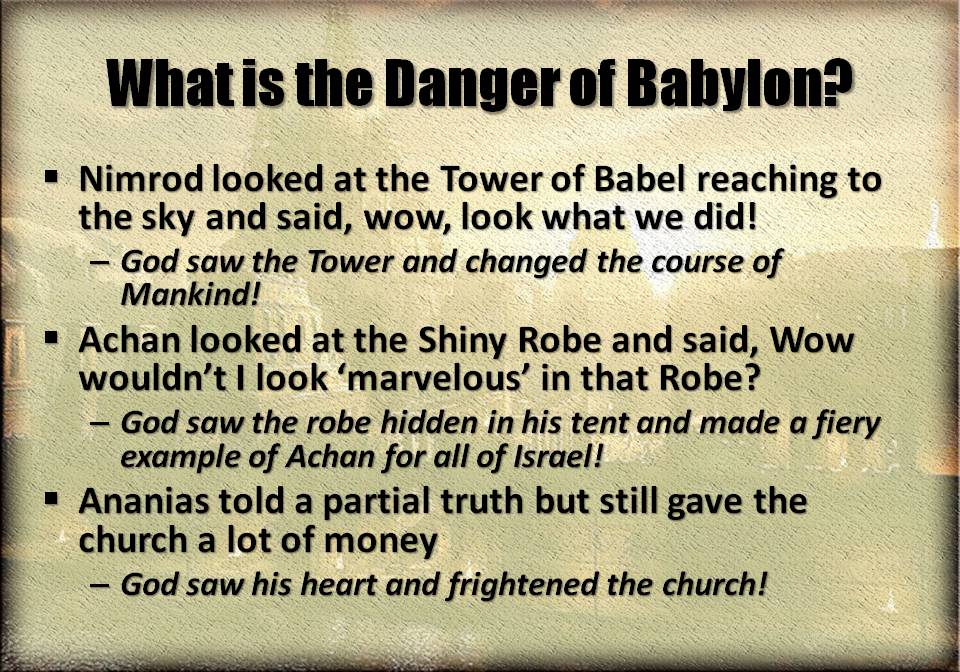
REMEMBER BABYLON?

Recently we wrote about Biblical Babylon, and how it represents much more than a city, or a region. It represents man robbing God of His glory. It represents man trying to minimize God’s impact in his life by seeking after Splendor, Status and Success.

  • Instead of focusing on a heart that is set upon God, we focus on things that are beautiful, exciting, fun. Our heart desires all the beauty of this world.
  • Instead of focusing on our dependants, our House, and how our life can benefit them, we focus on our self, on our own status, what makes us look good to the world.
  • Instead of focusing on developing a life dependent upon our God and Savior Jesus Christ, we focus on success, on things that make us look successful.

The spirit of Babylon is diametrically opposed to being a disciple. The spirit of Babylon will trip you up on your journey to gain Christ!

  • Wise Man –> Boasts in Wisdom -> He is focusing on man’s Splendor, After all God used wisdom to create the world. (God employed wisdom as His master craftsman to create all things[4] (Psalms 104:24 (ESV) O Lord, how manifold are your works! In wisdom have you made them all; the earth is full of your creatures.)
  • Mighty Man –> Boasts in Might –> Might is another word for Status. Men of ‘might’ are men of status.
  • Rich Man –> Boasts in Riches –> Riches are synonymous with Success in today’s society.

Here God takes direct aim at the spirit of Babylon and says it has no place among His people. God follows the negative with positives that we should pay close attention to. God says: if you are going to boast, boast in this, that you understand and know me, that you know what I delight in! David was a man after God’s own heart. He made it the priority of his life to know and understand God. Isn’t that what a disciple does? A disciple gets to know and understand Jesus Christ! That knowledge and understanding comes from a personal relationship. David certainly projects a man who had a close, personal relationship with God. God further states there are three things He delights in. He delights in unfailing love (hesed), justice (mishpat), and righteousness (tsedaqah). So if David’s intent was to make the delights of God his own (a man after God’s heart), shouldn’t that be reflected in David’s life, and what he aspired to? Should we not find evidence of God’s delights in David’s life? Yes we should and yes we do!

An amazing insight was granted me as I looked at David’s last words. As I saw what his life had culminated in, I saw what had been driving him all his life. The God brought Jeremiah 9:23 & 24 to my mind. There was a connection, and I had to seek it. Then my eyes were opened. David’s last words were also an expression of Hesed, Mishpat and Tsedaqah! David had built his life around what God delighted in!

David is the ultimate example of a disciple of Jesus Christ! David’s life is our pattern for discipleship! Discipleship must focus upon Hesed, Mishpat and Tsedaqah!

Discipleship should lead us to delight in what God Delights in, to knowing and understanding God!

Discipleship should lead us to Jesus Christ, and to the hope of gaining Him!


[1] Warren Baker and Eugene Carpenter, The Complete Word Study Dictionary – Old Testament, (Chattanooga, TN: AMG Publishers, 2003), WORDsearch CROSS e-book, .

[2] R. Laird Harris, Gleason L. Archer, Bruce K. Waltke, ed., “712: ‏חָפֵץ‎,” in Theological Wordbook of the Old Testament, (Chicago: Moody Press, 1980), WORDsearch CROSS e-book, 310.

[3] Warren Baker and Eugene Carpenter, The Complete Word Study Dictionary – Old Testament, (Chattanooga, TN: AMG Publishers, 2003), WORDsearch CROSS e-book,

[4] Warren Baker and Eugene Carpenter, The Complete Word Study Dictionary – Old Testament, (Chattanooga, TN: AMG Publishers, 2003), WORDsearch CROSS e-book, 337.


If you hear a tinkling cymbal when your pastor preaches, you can bet God has not heard struggle in prayer.

Pastors are much more than their sermons or programs. Sermons are the outflow of your life, just as God’s Word is the outflow of His being. Programs are the outflow of your heart, just as the practices of God are the outflow of His heart. Prayer connects the Heart of a pastor with the heart of God.

Long after the words of the sermon have been forgotten, the touch from the heart of the pastor lives on.

Fleshly pastors produce fleshly people, and the flesh is death to God (Rom 8:13)

God does not come into the pastor’s work simply because he is a pastor. God comes by prayer and an expression of need.

That God is found of us in the day we seek Him with our whole heart is as true of the pastor as of the repentant.

A prayerful ministry is the only ministry that brings the pastor into communion with both God and the needs of his people.

Prayer unites the pastor’s heart as much with his people as it does with His Abba, Father.

Timid, men-pleasing pastors are transformed into fearless prophets through prayer. Pastors of Prayer are met with fear by fleshly people. (1 Sam 16:4)

Pastors are not made in the seminary. Pastors are made in the prayer closet.

Great learning makes a proud pastor. Great praying makes a pastor a man of God.

The sweetest spirit by the slightest perversion may bear the bitterest fruit. So the sweetest pastor by lack of prayer may bear the most shallow ministry.

The pastor must be God-touched, God-enabled and God-made. (2 Cor 3:5-6)

Prayer gives the preaching of the pastor life, life as the springs give life. Prayer is the conduit for the spring of living water.

Prayer keeps the pastor thirsting for the life-giving power of God.

Without prayer, the life-giving spring of a pastor’s life becomes a trickle of apathy and insignificance.

Tears produced by Spiritless preaching are but summer’s breath on a snow man, nothing but surface slush.

A pastor’s sermon may appear to be heart-felt and earnest, but without the power of prayer, it is the emotion of an actor and the earnestness of an attorney.

The sermon may glow with the intelligence and verbal skill of a well-trained pastor, but without the Holy Spirit, the glow and glitter will be as barren as a field sown with thistles.

A Prayerless pastor exalts self in the Holy of Holies.

A Prayerless pastor has been disconnected from the divine current.

Prayerlessness violates and defames the power of the Holy of Holies in the church of God.

A life-giving pastor costs much – death to self, crucifixion to the world and travail of soul in prayer.

Without the life of the Spirit, beautiful words of a sermon are but the beautiful flowers surrounding the coffin.

Prayer transforms the pastor into the pastor God needs him to be.

Prayerless pastors are death to a Spirit-filled church.

The pastor feeble in prayer is feeble in the Life-giving Spirit!

Fleshly pastors can draw people to themselves and to his church, but the church will be a graveyard, not an embattled army.

Fleshly pastors advance sin, not holiness, and populate hell, not heaven.

Prayerless preaching is life-sucking.

Apart from prayer, pastors tend to a dead flock.

Feeble sheep follow prayerless pastors.

Unless the pastor is the greatest of prayers, he will become the greatest of backsliders.

It is impossible for a pastor to keep his spirit in harmony with the heart of God without much prayer.

The work of the ministry will harden the pastor’s heart if devoid of prayer.

Pastors weak in prayer are to be pitied by their people.

Prayerless pastors build prayerless churches.

Powerful ministry is not flavored by prayer, but embodied by prayer.

Effectual prayer builds an effectual ministry.

Prayer that is made much of produces sermons that are made much of.

Minor prayers make minor pastors.

Life-giving pastors are graduates of the school of prayer.

Talking to men for God can be done by anyone. Talking to God for men is done by few.

Pastors coat their sermons with prayer, but God wants us to bathe them in prayer.

Powerful sermons flow from prayer; dead sermons are bookended by it.

The pastor’s study must become a closet, and altar, a ladder, that every thought ascend God-ward before it goes man-ward.

Sermons are scented by God through prayer.

Sermons are lifeless and still until prayer provides the energy of life

A Pastor must move God toward his people before he can move his people to God.

Access to God through prayer gives a pastor access to the hearts of his people

True praying is born of oneness with Christ and fullness of the Holy Spirit.

Pastors empowered by true praying carry the true seeds of eternal life to their people.

Popular pastors are often prayerless pastors.

Prayerless pastors see no urgent need for the power of the Holy Spirit.

Pastors who are mightiest in their closets with God are the mightiest in their pulpits with men.

Pastors weak in prayer preach as tinkling cymbals

Today’s pastor feels pressured to focus on man’s methods and plans for advancing his church. Instead, he should feel pressure to seek the heart of God through prayer. It is God who gives the increase.

God gives His increase not through methods and machines, but through men whose hearts are fully committed to Him.

Advancing the church is not a matter of methods, but a matter of the hearts of your people. Prayer changes the hearts of men.

With inspiration from E.M. Bounds and his book “The Preacher and Prayer” http://temcat.com/08A-Prayer-Prom/Preach-Prayer.PDF


When I owned an Asphalt Paving company we decided to get into concrete, and so we did in a big way. We even did footings, slabs and walls for new construction. I learned a great deal about foundations for commercial buildings. You don’t just dig a trench and pour concrete. You must consider where the main support beams are placed, what the weight load of the walls will be, what type of soil the foundation is on, and many other factors. The foundation is a really big deal that I had taken for granted. Good concrete alone is not enough for a solid foundation. You must use steel re-bar, and the amount and configuration of the re-bar depends upon the load at that point. Even concrete slabs have to consider the weight of the objects they will support. As part of our foundation work we did some banks which had bank vaults. Most vaults nowadays are actually pre-fab concrete units that are shipped in and moved in place. The vault door is added later. But the slab of the vault is poured 12″ to 24″ thick, with 2 to 3 layers of 3/4″ re-bar tied on 12″ centers. (We did one with 6″ centers). They do not want the vault going anywhere! It also indicates the weight (and importance) of the bank vault. Before concrete, I never thought about foundations. Now I consider them wherever I go. I even took this picture of some awesome re-bar for a building going up in Addis Ababa, Ethiopia. Judging by the re-bar pile, they still had a lot of tying to do!

The church of today is so often about programs. We need programs to keep drawing crowds and making people ‘feel’ like they are Christians. So often ministry programs for children, seniors, life groups, special events, and whatever must pass the “feel good” test. Will it “minister to a felt need” and make everyone “feel good”. Modern ministry must have an emotional draw or it usually dies.

The church that Jesus began and the Apostles modeled was centered around discipleship, making disciples. Emotional feelings quickly fade in the face of persecution. There must be something more about being a church than “feel good” programs. That more is true discipleship. We tried to get a “discipleship program” going within a year after coming to my present church, Pleasant Prairie. But we were only 3 years removed from a tragic ‘split’ that nearly destroyed a church that had been there for 36 years at the time. The people were not ready for a discipleship program that did not meet the need to rebuild their emotional being. There were emotional scars of bitterness and unforgiveness that needed attention before discipleship could begin. Inward hurts hinder the ability to look upward and outward!

God has recently burdened me that it is time to more clearly define the mission of our church. God has been sending some great men and families our way, but we need to have a clearly defined discipleship path. Our church is ready to stand and embrace discipleship as our core value, but I do not want it to be a “program”. Discipleship does not automatically have a “feel good” component that builds excitement. Most Christians seem to view discipleship as something for Paul’s and Timothy’s, people who serve in a major capacity. Even leaders in the church seem to shy away from intentional discipleship. Too often Christians are ‘comfortable’ where they are at. Convenience and comfort are often core values of most American Christians.

The Holy Spirit was leading me to preach on the Life of King David. He is a great example of a man of God. There is no more transparent life in the Bible than King David. But the Holy Spirit was also burdening me with the need for a clearly defined discipleship path in our church. For some reason He led me to the ‘last saying’ of King David in 2 Samuel 23:5. I won’t get it to it in this writing, but through this, the Holy Spirit is revealing some awesome revelations about discipleship and how the church can embrace it, accomplish it and even have a “feel good”  component at the same time. 

So the next few posts will be the “Laying of the Foundation” of what I am calling “David Discipleship”. We don’t often associate King David with discipleship, but I believe his life is the very definition of discipleship, beginning with the revelation of His last words.

Now to bend and tie the “re-bar” of David Discipleship:

If the church is not to be about “programs” but about making disciples, what is a disciple? 

Disciple: One who embraces and assists in spreading the teachings of another. In the New Testament, the word is Mathētés. Here it means more than a mere pupil or learner. It is an adherent who accepts the instruction given to him and makes it his rule of conduct[1]. The general designation of mathētés was given to those who believed on Christ. Jesus clearly defines disciple in John 8:31: (ESV) So Jesus said to the Jews who had believed in him, “If you abide in my word, you are truly my disciples”.

What is Discipleship?

If a disciple is an adherent of another person’s teachings, what is discipleship?

A consensus of definitions produces this: Discipleship is the process of learning about the teachings of another, internalizing them and then acting upon them. Most discipleship programs focus on the learning process, with the emphasis on knowledge.

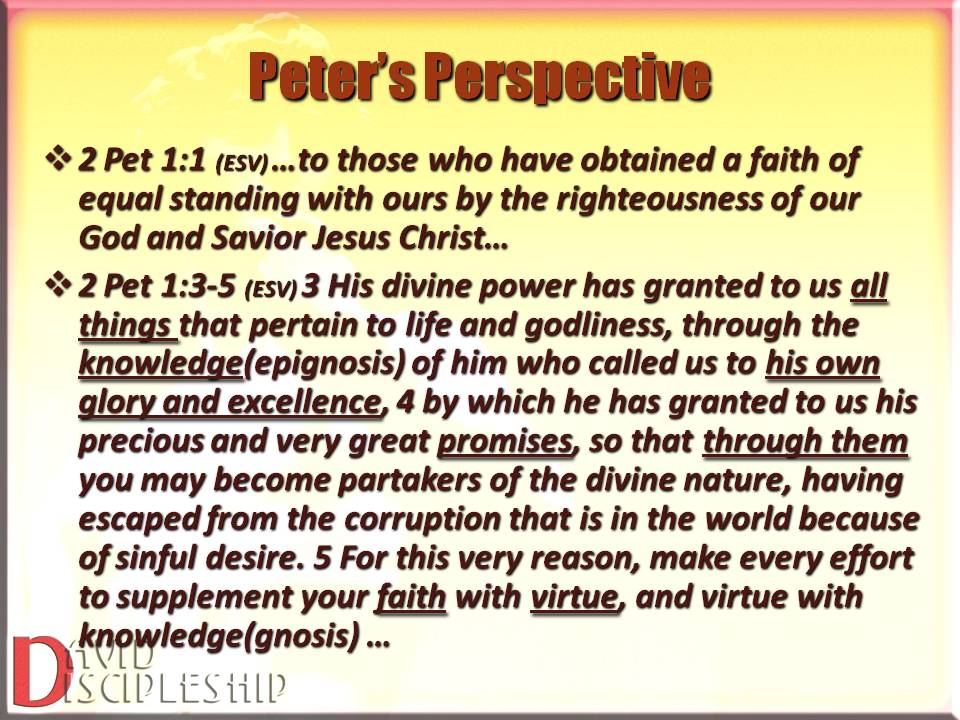
Peters Perspective on the Discipleship Process

Peter turned out to be the most dynamic of the early disciples of Christ. He had learned a great deal after spending three years at the feet of the Master Teacher. Yet when it was time for the rubber to meet the road, Mighty Peter failed, and denied his Master in a dramatic fire. Where was that knowledge then? What good did his earlier confession do at the moment when it mattered most? Peter sheds a glaring light upon what a discipleship program should be about.

2 Peter 1:1 (ESV) Simeon Peter, a servant and apostle of Jesus Christ, To those who have obtained a faith of equal standing with ours by the righteousness of our God and Savior Jesus Christ…

2 Peter 1:3-5 (ESV) 3 His divine power has granted to us all things that pertain to life and godliness, through the knowledge (epignosis)[2] of him who called us to his own glory and excellence, 4 by which he has granted to us his precious and very great promises, so that through them you may become partakers of the divine nature, having escaped from the corruption that is in the world because of sinful desire. 5 For this very reason, make every effort to supplement your faith with virtue, and virtue with knowledge(gnosis) …

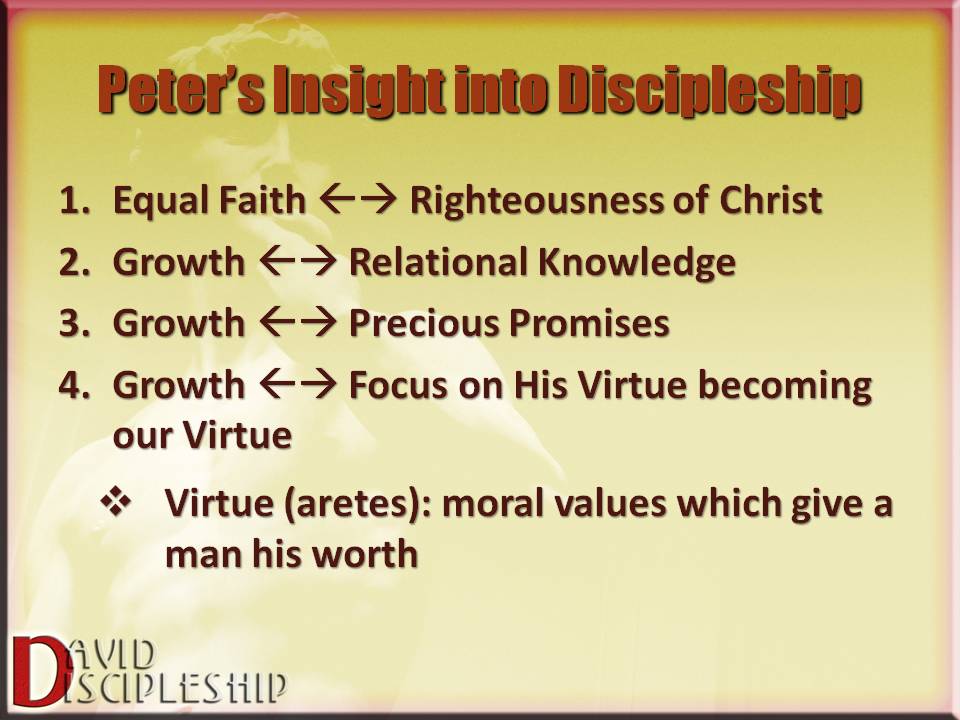
Peter’s Insights into Discipleship:

1. Equal Faith <–> Righteousness of Christ

  • Discipleship grows from Faith that is provided by the righteousness of our Savior Jesus Christ. That faith makes each believer equal in the sight of God. That equality is not based upon knowledge, but upon the righteousness provided us by our God and Savior Jesus Christ!

2. Growth <–> Relational Knowledge

  • Our growth in life and godliness is by His divine power and only through knowing Him in His glory and excellence.

3. Growth <–> Precious Promises

  • Our growth is only by His divine nature becoming our nature through the power of the Word and His precious promises.

4. Growth <–> Focus on His Virtue becoming our Virtue

  • Discipleship must focus on His Virtue becoming our Virtue. We first add virtue to our faith, and knowledge to virtue.

VIRTUE is the Greek “areté” which denotes in a moral sense what gives man his worth[3]

Why is Virtue Important to Discipleship?

There are four synonyms to Areté in the Greek according to Zodhiates…

  • dóxa – glory;
  • dúnamis – power;
  • chárisma – gift;
  • ōphéleia – usefulness[4]

Virtue is a quality that is difficult to define, but definite in its impact. From the synonyms we glimpse the power of this little word. Here is my humble attempt at a definition.

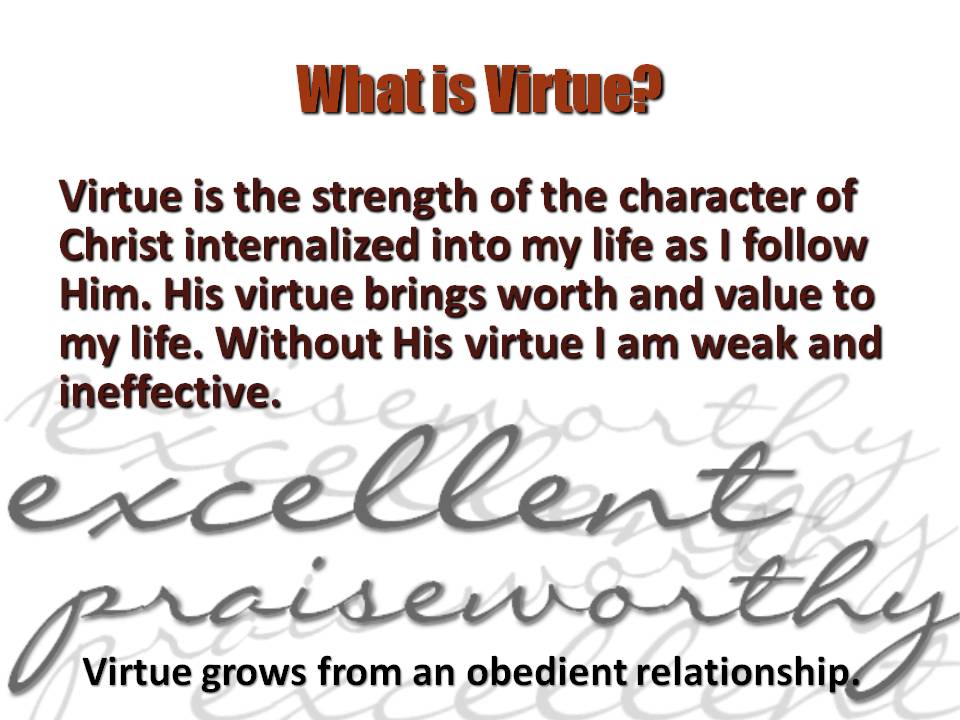
Virtue is the strength of the character of Christ internalized into my life as I follow Him. Virtue brings worth and value to my life. Without His virtue I am weak and ineffective.

Virtue grows from an obedient relationship!

Discipleship programs are not effective if their focus is primarily upon knowledge (ginosis). It must be knowledge that grows from a personal on-going relationship with Jesus Christ Himself! (epiginosko). I know far too many graduates of Christian Schools and Colleges that display little if any of the life of Jesus Christ. A surprising number no longer go to church. Knowledge is not enough to become a disciple of Jesus Christ. Look at Judas. He had three years of instruction from Jesus Christ, and yet there was no changed life!

Discipleship is Life-Changing only if it is Life-Giving!

Discipleship must lead believers into a life that is above the natural, a life that is empowered by the Righteous Life of Jesus Christ. His virtue of LIFE becomes our virtue by our dying.

We Have No Virtue worth Propping up

Discipleship is not a self-improvement course. It is not a way of “improving” your Christian walk! We are ugly before we are saved, we are ugly after we are saved. The only beauty we can ever have is the beauty of Jesus Christ.

COULD YOUR HEART PASS THE HOLE IN THE WALL TEST?

God told Ezekiel to dig a hole in the King’s wall. He was startled by the abominations being committed by the ‘supposed’ righteous leaders of Israel.

Ezekiel 8:8-13 (ESV) 8 Then he said to me, “Son of man, dig in the wall.” So I dug in the wall, and behold, there was an entrance. 9 And he said to me, “Go in, and see the vile abominations that they are committing here.” 10 So I went in and saw. And there, engraved on the wall all around, was every form of creeping things and loathsome beasts, and all the idols of the house of Israel. 11 And before them stood seventy men of the elders of the house of Israel, with Jaazaniah the son of Shaphan standing among them. Each had his censer in his hand, and the smoke of the cloud of incense went up. 12 Then he said to me, “Son of man, have you seen what the elders of the house of Israel are doing in the dark, each in his room of pictures? For they say, ‘The Lord does not see us, the Lord has forsaken the land.’ ” 13 He said also to me, “You will see still greater abominations that they commit.”

No matter how ‘spiritual’ we pretend to be, or how much ‘Bible knowledge’ we possess, no one can pass the “Hole in the Wall” test. Our hearts are full of abominations through sin. The harder we try to be a good disciple, the further we alienate ourselves from the heart of God! The heart of God is centered around the virtue of His Son, Jesus Christ! The only virtue worth having is not man-centered but Christ-centered!

Discipleship finds all that we need in Jesus Christ

1 Corinthians 1:30-31 (NIV) 30 It is because of him that you are in Christ Jesus, who has become for us wisdom from God–that is, our righteousness, holiness and redemption. 31 Therefore, as it is written: “Let him who boasts boast in the Lord.”

Discipleship which focuses on knowledge will always lead to pride and self-effort. Discipleship which focuses on virtue will always lead to humility and dependence.

Therefore I define Discipleship as:

Discipleship – “the intentional process of making the virtue of Christ my own, through submitting to His Lordship and Direction, and the daily Hope of Gaining Christ”

Discipleship is simply gaining by trading (diapragmateúomai)[5];

The King will demand an accounting of what you have GAINED by trading

Luke 19:15 (ESV) When he returned, having received the kingdom, he ordered these servants to whom he had given the money to be called to him, that he might know what they had gained by doing business.

I believe we will be judged at the ‘bema seat’ and our judgment will simply be an accounting of what we traded to gain for the sake of becoming like Jesus Christ! We will be judged for how we ‘gained’ Jesus Christ! Christians are to be about the business of trading their lives to gain Jesus Christ!

Paul said it best in Philippians 3:8: Philippians 3:8 (ESV) Indeed, I count everything as loss because of the surpassing worth of knowing Christ Jesus my Lord. For his sake I have suffered the loss of all things and count them as rubbish, in order that I may gain Christ

So the ‘re-bar’ of discipleship is the Virtue of Jesus Christ! Any substitution or absence of His virtue will result in a foundation that is weak and doomed to fail.

Our Hope of Glory is Christ IN me

Colossians 1:27 (ESV) To them God chose to make known how great among the Gentiles are the riches of the glory of this mystery, which is Christ in you, the hope of glory.


[1] Spiros Zodhiates, The Complete Word Study Dictionary – New Testament, (Chattanooga, TN: AMG Publishers, 1993), WORDsearch CROSS e-book, 936.

[2] Epígnōsis: In the NT, it often refers to knowledge which very powerfully influences the form of religious life, a knowledge laying claim to personal involvement. When used as an obj. (Eph. 1:17; 4:13; Col. 1:9, 10; 2:2; 1 Tim. 2:4; 2 Tim. 2:25; 3:7; Titus 1:1; Heb. 10:26; 2 Pet. 1:2, 3), it shows the relationship of the learner to the object of his knowledge (2 Pet. 1:8). Spiros Zodhiates, The Complete Word Study Dictionary – New Testament, (Chattanooga, TN: AMG Publishers, 1993), WORDsearch CROSS e-book, 624.

[3] Spiros Zodhiates, The Complete Word Study Dictionary – New Testament, (Chattanooga, TN: AMG Publishers, 1993), WORDsearch CROSS e-book, 252-251.

[4] Spiros Zodhiates, The Complete Word Study Dictionary – New Testament, (Chattanooga, TN: AMG Publishers, 1993), WORDsearch CROSS e-book, 252.

[5] Spiros Zodhiates, The Complete Word Study Dictionary – New Testament, (Chattanooga, TN: AMG Publishers, 1993), WORDsearch CROSS e-book, Under: “megauploaddiapragmateúomai”.