Posts Tagged ‘David’


David Discipleship…

  • Begins with a Heart Decision
  • Grows from knowing the ways of God
  • Develops as we practice mercy, justice and righteousness
In a short period of time, David faced Goliath, King Saul, Doeg and Achish. God had David on a fast-track course of discipleship. It began with his decision to give God his whole heart, and seek to know God’s heart. It grew as he diligently applied himself to knowing the ways of God. But through his trials with Saul, Doeg and Achish, David developed into a Mighty Man of God. David developed because David paid attention and learned.

The lessons that God wanted David to learn and live he recorded in three Psalms that David wrote after those experiences.

I believe one of the greatest gifts you can leave your children and grand-children is a record of the discipleship lessons God has taught you. Do you keep a record of what God is teaching you? Do you take notes? If you are not paying attention to what God is teaching you, He will stop teaching you. Thank God David paid attention. The three lessons David learned after Saul, Doeg and Achish were recorded in Psalms 34, 52 and 56. Those three lessons parallel the three things God most delights in and wants His disciples to know and understand – hesed, mishpat and tsedeqah.

1. Fear God Above All
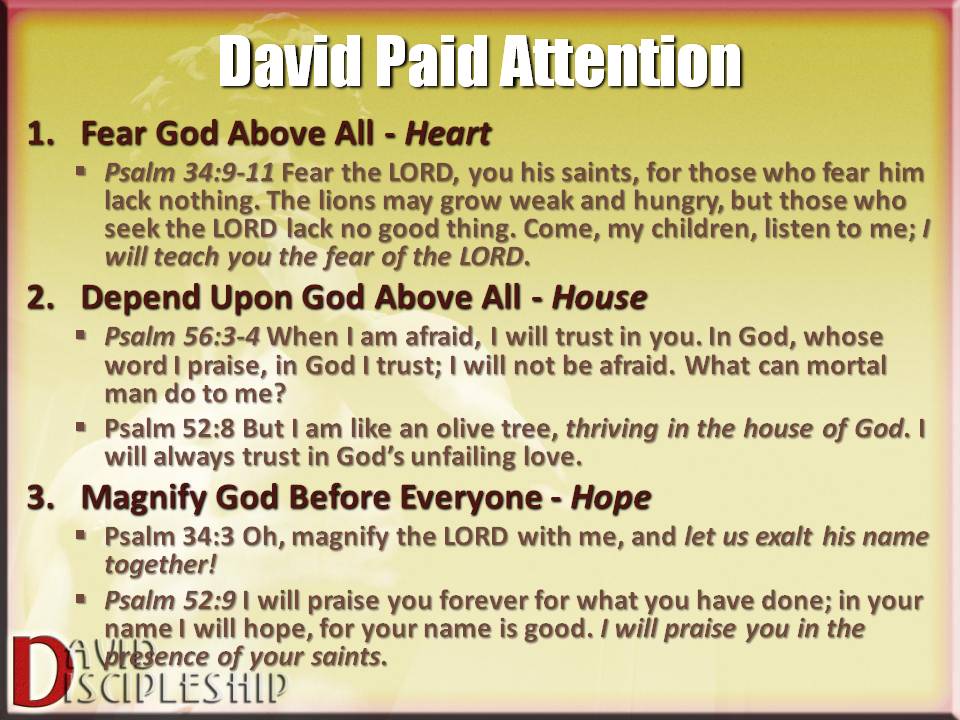
David realized that he must fear God above man. His heart was firmly fixed upon God. His heart feared God when everyone around him feared man. David knew the hesed (unfailing Love) of  God would keep Him in God’s care.

Psalm 34:9-11 Fear the LORD, you his saints, for those who fear him lack nothing. The lions may grow weak and hungry, but those who seek the LORD lack no good thing. Come, my children, listen to me; I will teach you the fear of the LORD.

2. Depend Upon God Above All

Early in his youth David learned that God’s House is a special place, and saw how God designed His house to be a certain way. David desired the justice of God’s house to be in his life, and to be in his house. To know God’s justice, David learned to depend upon God above anyone or anything in this world, including himself.

Psalm 56:3-4 When I am afraid, I will trust in you. In God, whose word I praise, in God I trust; I will not be afraid. What can mortal man do to me?

Psalm 52:8 But I am like an olive tree, thriving in the house of God. I will always trust in God’s unfailing love.

3. Magnify God Before Everyone

David learned that God would provide His righteousness for Him. David learned that God was His hope and his righteousness, and that he must exalt Him before everyone, that they might know the hope of his heart.

Psalm 34:3 Oh, magnify the LORD with me, and let us exalt his name together!

Psalm 52:9 I will praise you forever for what you have done; in your name I will hope, for your name is good. I will praise you in the presence of your saints.

Let’s see how these lessons are demonstrated in I Samuel 22 & 23.
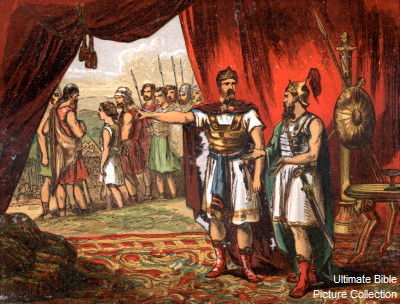
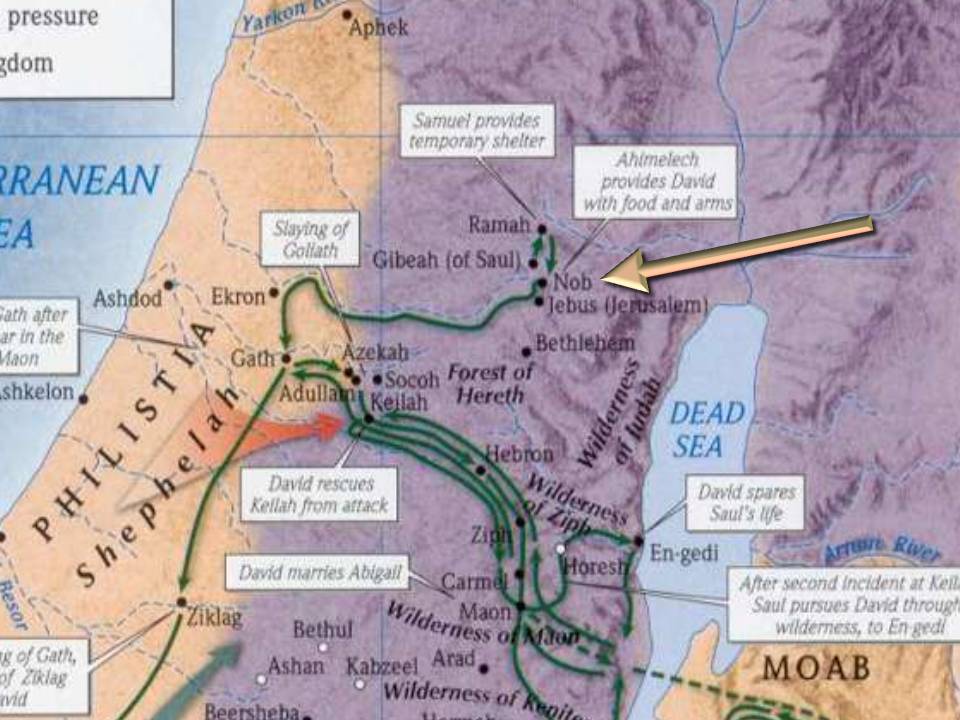
Last week we left David at Nob, where Ahimelech gave him the Holy Bread and the sword of Goliath. After enquiring of the Lord, the Lord said to go to Gath and seek help from Achish, King of Gath. I assume God told him, because God wanted David to learn not to fear. David may have thought he might get some respect from Saul’s enemy, especially since David had killed their great warrior. Instead, King Achish seized David, and would have killed him, but David started acting like he was insane.

1 Samuel 21:12-13 And David took these words to heart and was much afraid of Achish the king of Gath. So he changed his behavior before them and pretended to be insane in their hands and made marks on the doors of the gate and let his spittle run down his beard.

Jewish tradition says that Achish had a wife and daughter who were both ‘crazy’ and that is why he reacted the way he did:

1 Samuel 21:15 Don’t you think I have enough crazy people to put up with as it is without adding another? Get him out of here!”(MSG)

David’s House Grows
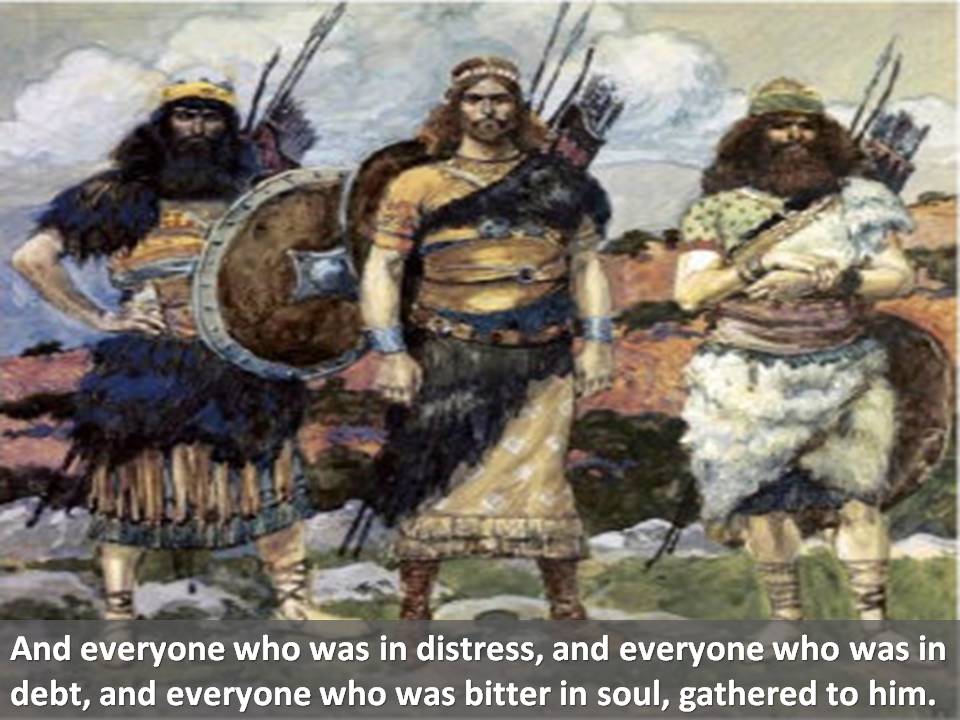
A few miles away David sought a hiding place in the caves of Adullam. It was close to his home in Bethlehem, and so his family came to see him. Word got out about David, and around 400 men sought him out.

1 Samuel 22:1-2 David departed from there and escaped to the cave of Adullam. And when his brothers and all his father’s house heard it, they went down there to him. And everyone who was in distress (māṣôq), and everyone who was in debt נָשָׁא‎ (nāshâ), and everyone who was bitter in soul (mar nephesh), gathered to him. And he became captain over them. And there were with him about four hundred men.

  • māṣôq: A masculine noun meaning distress, anguish. It refers to hardships and anxiety (Deut. 28:53, 55, 57; Jer. 19:9); especially brought on from disobeying the Lord but also from general social and political conditions (1 Sam. 22:2). The psalmist suffered anguish, relieved only by following the Lord’s delightful Law (Ps. 119:143)[1].

In four of those times, the King James translates it “straitness”, and in each of those four times, it is talking about the kind of distress a person will experience when they are in such a horrible time of famine that they would have to actually resort to eating their own children (Deut. 28:53,55,57; Jer. 19:9).  It describes people who are so desperate that they will do anything.

Psa 119:143  Trouble and anguish have taken hold on me: yet thy commandments are my delights.

Deuteronomy 28:53 And you shall eat the offspring of your own body, the flesh of your sons and daughters, whom the LORD your God has given you, in the siege and in the distress with which your enemies shall distress you.

  • נָשָׁא‎ (nāshâ) lend on interest or usury[2] – people who were in great debt, being charged high interest by fellow jews, which was contrary to the law.
  • mar-nephesh, “bitter of spirit,” used of Hannah, deprived of a child, in 1:10, and of David’s soldiers, whose women and children the Amalekites had seized (30:6). Cf. also 2 Sm 17:8. David becomes a hero for those who have endured loss or deprivation.

These men were bitter in their soul, feeling cut off from the mercy of God.

These men were overwhelmed with debt, that because of unlawful interest rates, made it impossible to repay. They had been taken advantage of by unjust men. Now they couldn’t provide for their ‘house’ – their families.

These men were in distress due to circumstances beyond their control. Their hopes had been dashed and they felt there was no place to go.

So these men needed to know mercy (hesed), they needed to experience justice (mishpat) and they needed to know the hope of righteousness (tsedeqah).

They needed a leader to restore the love of God to their heart, to restore justice to their house, and to bring rightness and hope back to their disillusioned lives.

“Herein David became a type of Christ, the Captain of our salvation, who cried, ‘Come unto me, all ye that are weary.’” (Trapp)

I believe God called these men to David, because God saw some great things in them. He saw what they could be, if they only had someone to show them. They needed a captain, a Captain that could teach them through his life. David was indeed a man on the run, but he was a man after God’s heart. And in so following and learning from David, these men were transformed into “Gibbor” – “Mighty Men”

Discipleship develops Kings, Priests and Mighty Men!

Jesus came to this earth to reach exactly the kind of men that flocked to David:

Luke 4:18 “THE SPIRIT OF THE LORD IS UPON ME, BECAUSE HE ANOINTED ME TO PREACH THE GOSPEL TO THE POOR. HE HAS SENT ME TO PROCLAIM RELEASE TO THE CAPTIVES, AND RECOVERY OF SIGHT TO THE BLIND, TO SET FREE THOSE WHO ARE OPPRESSED,

These men were poor, they would have been held captive because of debts, and they were oppressed by circumstances.

Remember These Men. We Will Draw Some Truths From Them, But First We Have To Get To The Rock!
David took his family to safety in Moab:
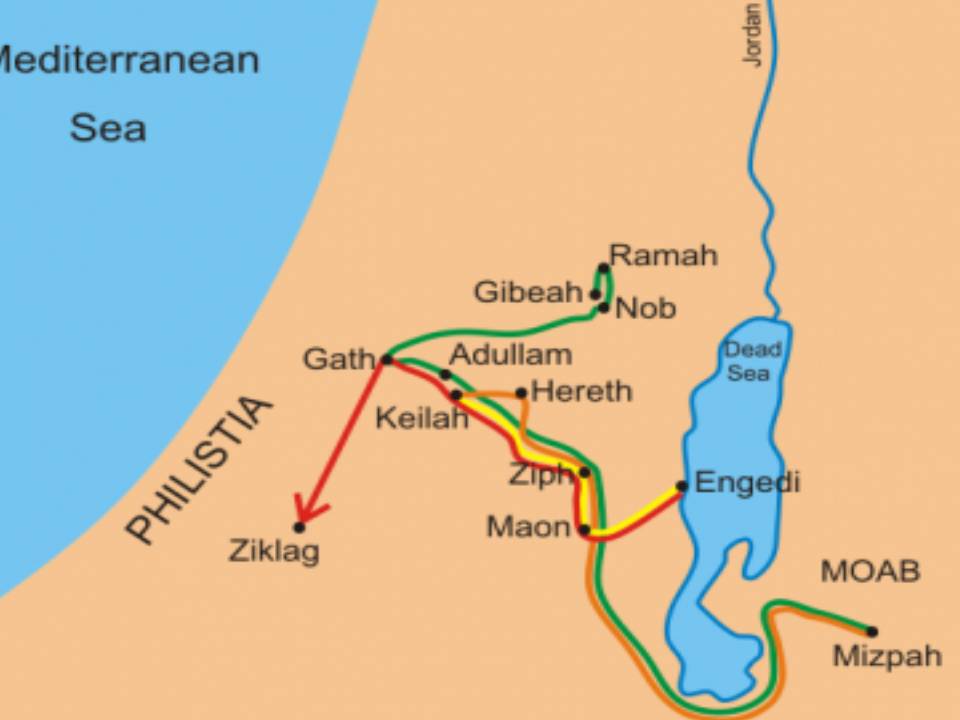
1 Samuel 22:3 And David went from there to Mizpeh of Moab. And he said to the king of Moab, “Please let my father and my mother stay with you, till I know what God will do for me.”

Verse 3. “Mizpeh” signifies a watchtower, and it is evident that it must be taken in this sense here, for it is called “the hold” or fort (1Sa 22:4). The king of Moab was an enemy of Saul (1Sa 14:47), and the great-grandson of Ruth, of course, was related to the family of Jesse.[3] 

Abiathar son of Ahimelech, Joins David

1 Samuel 22:20-23 But Abiathar, a son of Ahimelech son of Ahitub, escaped and fled to join David. He told David that Saul had killed the priests of the LORD. Then David said to Abiathar: “That day, when Doeg the Edomite was there, I knew he would be sure to tell Saul. I am responsible for the death of your father’s whole family. Stay with me; don’t be afraid; the man who is seeking your life is seeking mine also. You will be safe with me.”

With me, you are in a guarded place! I can see Him who is invisible, and as long as I fear Him more than man, He will guard me…If you are with me, He will guard you as well.

Psalm 34 “In my desperation I prayed, and the LORD listened; he saved me from all my troubles. For the angel of the LORD is a guard; he surrounds and defends all who fear him…Fear the LORD, you his godly people, for those who fear him will have all they need…Come, my children, and listen to me, and I will teach you to fear the LORD”.

Would anyone in their right mind believe they would be kept safe simply by staying with the most wanted man in Israel? David had such a trust in God that he could boldly profess God’s protection. His men began to trust David as they saw God work!

David Demonstrated That The Fear Of The Lord Keeps Us In Safety

David was settling down in Moab. God wanted these men to be pushed to the limit as far as trust in God was concerned. He wanted them to trust  Him even in the midst of evil and danger. So God sent a prophet to tell David to leave Moab and return to Judah.

1 Samuel 22:5 Then the prophet Gad said to David, “Do not remain in the stronghold; depart, and go into the land of Judah.” So David departed and went into the forest of Hereth.

God did not want David to remain outside the country of Judah. God wanted to demonstrate His power to David and to the men who were with him. God knew that all of Israel would be watching. God wanted them to see His power! God was telling David, “it is too easy to protect you so far away from Saul. That’s not much of a testimony of my Greatness! Come on back to Judah, where Saul has thousands of spies to tell him where you are at. This will give me a great opportunity to show you how I can protect you and keep you”.

In fact, 1 Samuel 23:3 reveals that David’s men really needed to learn this: They told him, “we are afraid here in Judah”. They were not worthy of being called “Mighty” yet!

David Demonstrates His Total Dependence Upon God

David did so by always inquiring of the Lord!

Verse 2:  Therefore David inquired of the LORD,

Verse 4: Then David inquired of the LORD again.

Verses 10, 11 & 12  Then said David, “O LORD, the God of Israel, your servant has surely heard that Saul seeks to come to Keilah, to destroy the city on my account.  Will the men of Keilah surrender me into his hand? Will Saul come down, as your servant has heard? O LORD, the God of Israel, please tell your servant.” And the LORD said, “He will come down.”  Then David said, “Will the men of Keilah surrender me and my men into the hand of Saul?” And the LORD said, “They will surrender you.”

Finally, when things got really heated, and Saul was close on his heels, David did what we all must do, he went to the Rock!

Verse 25:  And Saul and his men went to seek him. And David was told, so he went down to the rock and lived in the wilderness of Maon.

Every time David needed direction, he inquired of the Lord. His fear of the Lord was so great, that he did  not want to do anything counter to His will. His dependence upon the Lord was such that He would not make a move without clear direction from God.

To those men who said “we are afraid here in Judah”, what kind of testimony did that provide them?

Here is a man of obvious cunning and skill, and yet he is always asking God what to do! David demonstrated that he trusted God in everything, trusted enough to ask God what God wanted before he did it!

A Visit from Jonathan Strengthens David

Even David’s need Jonathan’s!

1Sa 23:16  And Jonathan, Saul’s son, rose and went to David at Horesh, and strengthened his hand in God. And he said to him, “Do not fear, for the hand of Saul my father shall not find you. You shall be king over Israel, and I shall be next to you. Saul my father also knows this.”
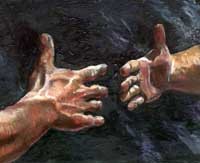
Strengthened – chazaq – to strengthen, prevail, harden, be strong, become strong, be courageous, be firm, grow firm, be resolute, be sore.  The form in Hebrew is a “Piel” stem, meaning an “intensive” form.  He really, really strengthened David.

The Writer of Hebrews used similar words to strengthen the heart of the Jewish Christian in Rome. He said: Hebrews 13:5 Keep your life free from love of money, and be content with what you have, for he has said, I will never leave you nor forsake you.”

It is a reference to the promise God gave Joshua just before he crossed over the Jordan to enter the Promised Land:

“as I was with Moses, so I will be with thee: I will not fail thee, nor forsake thee. Be strong and of a good courage…Only be thou strong and very courageous, that thou mayest observe to do according to all the law, which Moses my servant commanded thee: turn not from it to the right hand or to the left, that thou mayest prosper whithersoever thou goest. This book of the law shall not depart out of thy mouth; but thou shalt meditate therein day and night, that thou mayest observe to do according to all that is written therein: for then thou shalt make thy way prosperous, and then thou shalt have good success. Have not I commanded thee? Be strong and of a good courage; be not afraid, neither be thou dismayed: for the LORD thy God is with thee whithersoever thou goest. (Jos 1:5-9)

When things get scary, even overwhelming, cry out to Jesus Christ. He promised to never leave you nor forsake you. Be strong and of good courage. Do not be afraid. David, the man who feared God rather than man, sent a message loud and clear to his men – as long as we depend upon and follow God, we will be safe. We have nothing to fear.

  • God is greater than King Saul.
  • God is greater than his armies,
  • God is greater than all the spies.
  • God is a Rock that is higher than anyone

So we find 1 Sam 23:25: “When David heard that Saul and his men were searching for him, he went even farther into the wilderness to the great rock”.(NLT)

I’m sure David had this in mind when he wrote Ps 61:2 “From the end of the earth will I cry unto thee, when my heart is overwhelmed: lead me to the rock that is higher than I“.

David Declares His Hope and Magnifies God
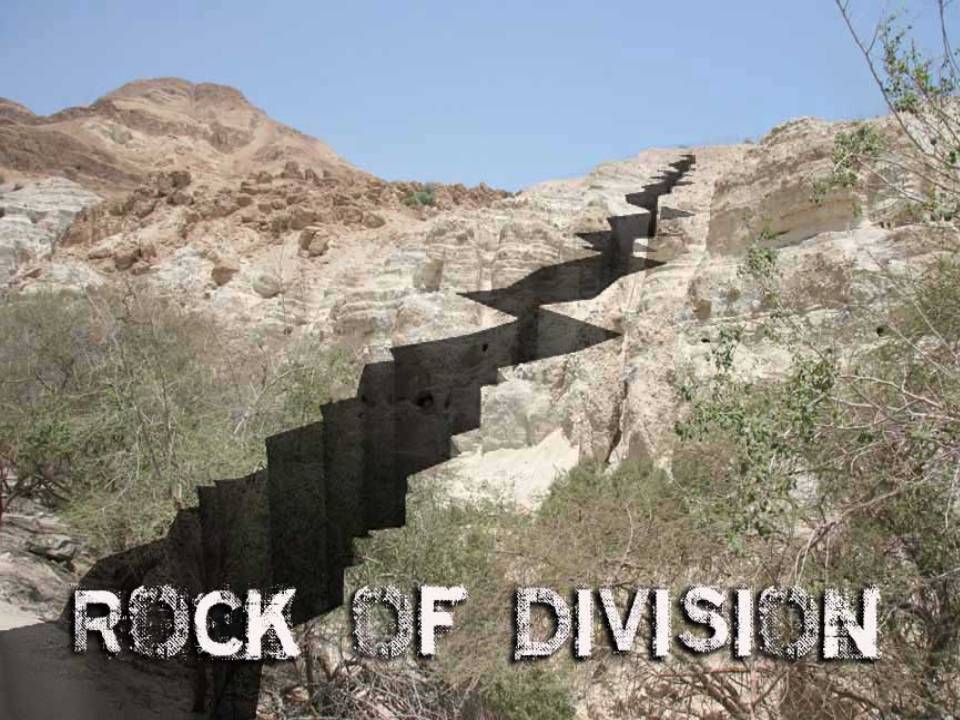
1 Samuel 23:26-28 tells us what happens next:

Saul and David were now on opposite sides of a mountain. Just as Saul and his men began to close in on David and his men, an urgent message reached Saul that the Philistines were raiding Israel again. So Saul quit chasing David and returned to fight the Philistines. Ever since that time, the place where David was camped has been called the Rock of Escape. (NLT)

You can see David there, his men all frightened, and David looking heavenward and praying out loud: “Bow down thine ear to me; deliver me speedily: be thou my strong rock, for an house of defense to save me. For thou art my rock and my fortress; therefore for thy name’s sake lead me, and guide me”. Psalm 31:2-3

When they hear Saul’s army leave, the men heard David shout:

 The LORD lives, and blessed be my rock, and exalted be the God of my salvation! Psa 18:46 

The Rock of Escape is the Hebrew word: Sela-hammahlekoth which is the combination of two words. Joined, they are actually translated “Rock of divisions”

Jesus is our Rock.

Paul declared that Jesus is our Rock, and He is typified by the rock from which water flowed after Moses struck it. 1 Cor 10:4  “And did all drink the same spiritual drink: for they drank of that spiritual Rock that followed them: and that Rock was Christ”.

Peter declares that Jesus is a rock, but a rock of offence: 1 Pet 2:8  And a stone of stumbling, and a rock of offence, even to them which stumble at the word, being disobedient: whereunto also they were appointed.
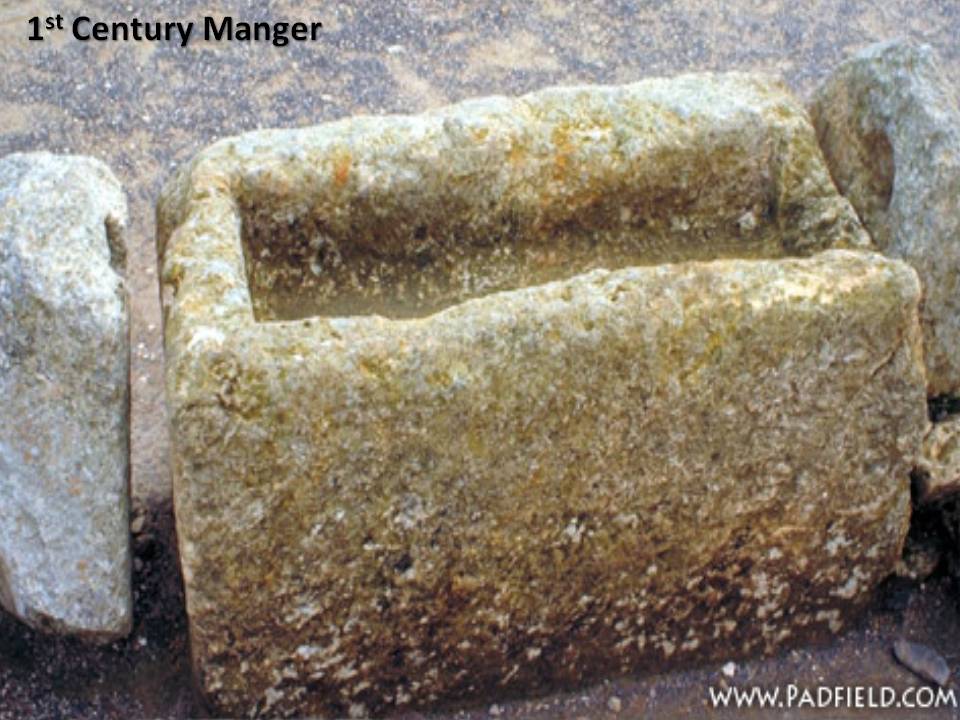
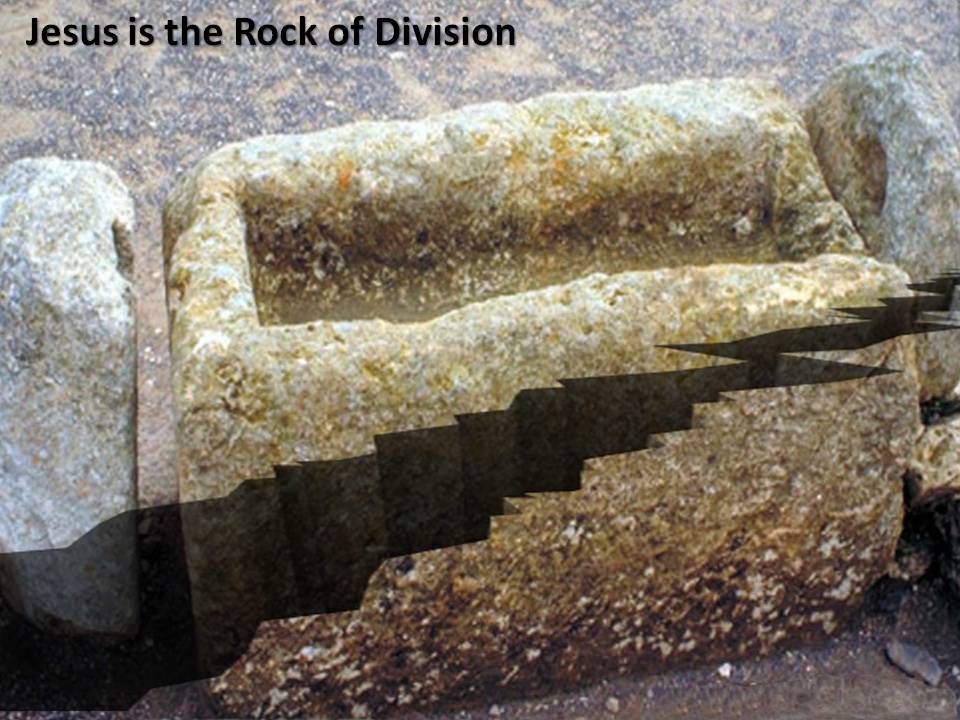
Most pictures of Jesus birth have him in a wooden manger. Archaeologist have discovered many stone mangers (or feeding troughs) from the time of Christ. Due to the abundance of stone and scarcity of trees around Bethlehem, it is most likely the manger Mary placed Jesus in was made from stone. It would be God’s doing if that rock came from Sela-hammahlekoth. For truly the manger represents the “Rock of Division”. Even our Calendar is divided by the manger. The very year we are in (AD 2011) means this is the 2011th year since the birth of Jesus “anno domini”. The day before was BC or “before Christ”.

I believe the manger was made of rock, whether in a cave or the lower level of a home, or a corral behind a home. I believe the manger represents this “rock of Division” that God used to rescue his beloved on.

Rock of Division

There is a Rock of Division that runs throughout the Old and New Testaments.
  • There is the Rock that Abraham climbed with his son Isaac. The rock that divided Abraham from trusting in God or trusting in himself. The rock upon which he placed Isaac in obedience to God.
  • There is the Rock on which Moses stood to receive the Law from the hand of God. The rock that divided his people from the world and separated them unto God.
  • There was a rock, a cornerstone, that the builders rejected and hung upon a cross, on the rock called Golgotha. That rock divided two men, one died in his sins and is burning in Hell even today. The other man trusted in the rock, and joined Him that day in Paradise!
  • There is a rock that was rolled away and a Triumphant Jesus Christ stepped forth. That rolling rock meant that Satan had been conquered, and sin and death could hold us no longer.  That rolling rock meant that no grave will hold us, no demon of hell will grab us, for we have trusted in this Risen Savior!
One day there will be a mighty stone cast upon the earth, and it will destroy the great whore Babylon, and all those who worshipped her. He that judges will cast Satan and all those who rejected the cornerstone into the lake of Fire for all eternity.

One Day a building made of precious stones will descend rom Heaven, and all those who have trusted in the Chief Cornerstone will find a mansion to live in for all eternity.

Yes Jesus was placed on a rock of division. He was not just a baby. He was not just “the reason for the season”.

Jesus Christ is the very Rock of Division. He is the Divider of Mankind.

John 14:6 Jesus said to him, “I am the way, and the truth, and the life; no one comes to the Father, but by me.

This Christmas, everyone you meet, every family member you hug, is on one side or the other of the Rock of DIvision. They are either clinging to the Rock, or they are clinging to something else, or trying to make it on their own. They either trust the Rock for their salvation, or they are lost and on their way to Hell. There is no in between, no purgatory, no second chance. We all face the rock of division. We either see the Rock of Jesus Christ as our only Hope, our only righteousness, and our only salvation, or we have no protection, we are trying to walk on sifting sand, sand that is slowly sifting to Hell.

Hurting Men became Mighty Men

David had a group of men whom the world had rejected. They were hopelessly beaten down, drowning in debt, and broken in soul. They came to David, a man whose Heart was given totally to following God. A Man building a House whose Foundation was God’s Word, and a Man whose Hope was in the Righteousness of God. As these men followed David, there lives were changed, they became alive to God, to trusting in God, and David called them his Gibborim, his Mighty Men!

They became followers of  El-Gibbor – The mighty God.

Mighty Men:

Fear God Above All – Heart

David taught them to fear the Lord above all I will teach you the fear of the LORD.

Depend Upon God Above All – House

David built his house with men who became mighty because their strength came from Mighty God

Magnify God Before Everyone – Hope

Psalm 52:9 I will praise you forever for what you have done; in your name I will hope, for your name is good. I will praise you in the presence of your saints.

Do You want to be a Mighty Man or Woman? Do you want to get on the winning side of the Rock? Do you see your need for a Savior?

1. Come as you are.

  • Are you in distress over this life?
  • Do you realize you owe a debt you can never repay? Jesus died for your sins, sins that meant you deserve condemnation in Hell. He redeemed you, paid the price to free you from your sins. You owe Him a debt you can never repay. Come to Him.
  • Are you carrying a heavy weight in your soul. Has life been so unjust that you ache.

2. Come to the Son of David, Jesus Christ

3. Come and bring your Sword!

  • Jesus is building an army of mighty men and women willing to take on the world! Discipleship is never passive, but always offensive!

[1] Warren Baker and Eugene Carpenter, The Complete Word Study Dictionary – Old Testament, (Chattanooga, TN: AMG Publishers, 2003), WORDsearch CROSS e-book, 654.

[2] R. Laird Harris, Gleason L. Archer, Bruce K. Waltke, ed., “1424: ‏נָשָׁא‎,” in Theological Wordbook of the Old Testament, (Chicago: Moody Press, 1980), WORDsearch CROSS e-book, Under: ” nāshâ“.

[3] Robert Jamieson, A.R. Fausset, David Brown, A Commentary: Critical, Experimental, and Practical on the Old and New Testaments, (Toledo, OH: Jerome B. Names & Co., 1884), WORDsearch CROSS e-book, Under: “1 SAMUEL”.


I am not against dogs. I love dogs. My only use of ‘dog’ when it comes to “Doeg” is for ease of remembering and to gain an understanding of how David felt as he realized he was now a wanted man, being pursued by “Doeg’s”. Everyone who desires to be a Disciple of Jesus Christ, must realize there are “Doeg’s” that will work to cause us to stumble from the “way of a disciple”. David encountered Doeg in 1 Samuel 21. Let’s see what lessons on Discipleship can we learn.

The very first lesson God taught fleeing David took place at Nob. He had an encounter with a ‘Dog’ (Doeg). (This is not to condemn “Dog the Bounty Hunter“). He is a just a scary looking “Dog” and he pursues relentlessly.

After David left Jonathan at Gibeah, he fled to Nob, the place of the Tabernacle, the city of Priests. Thus began his ‘life as a fugitive’ from Saul, a period of ten years during which he was ‘public enemy number one’ in all of Israel! (1 Sam 21:1-29:11).

God used this time of forced exile to develop David into the Disciple worthy of the Kingdom, in fact, a Disciple worthy of leading the Kingdom. God wanted David to face various tests of his faith, trust and hope. God wanted David to lay the foundation of a Kingdom that one day His very Son would rule over. So that foundation must not be in anything of man, or man’s working. The Foundation of the Kingdom of Christ must be in His Justice and His Righteousness. Therefore David had lessons that God wanted him to learn, lessons that would develop David into the Disciple worthy of establishing the Kingdom of His Son!

The Psalms that David wrote during these 10 years offer insight into David’s Discipleship. While it’s difficult to determine the background of every psalm, it’s likely that David’s fugitive years are reflected in Psalms 7, 11-13, 16-17, 22, 25, 31, 34-35, 52-54, 56-59, 63-64, 142-143[1].

God Wanted David to Rely Solely on Him

Psalm 18 is the Psalm he wrote when the LORD delivered him from the hand of all his enemies and from the hand of Saul. It reveals the Diploma David earned after 10 years of extreme Graduate School!

He began his Psalm of praise with a strange statement coming from a “mighty warrior” who had eluded Saul’s vast army for 10 years. This is not the kind of thing you would hear today from a WWE champion like ” Triple H” aka “The King of Kings”.

 “I love you, O LORD, my strength. The LORD is my rock and my fortress and my deliverer, my God, my rock, in whom I take refuge, my shield, and the horn of my salvation, my stronghold. I call upon the LORD, who is worthy to be praised, and I am saved from my enemies”. Psalm 18:1-3 (ESV)

Becoming a Disciple is about learning not to rely on your own strength, but to rely on the one who is greater than everything!

David’s Experience with Doeg

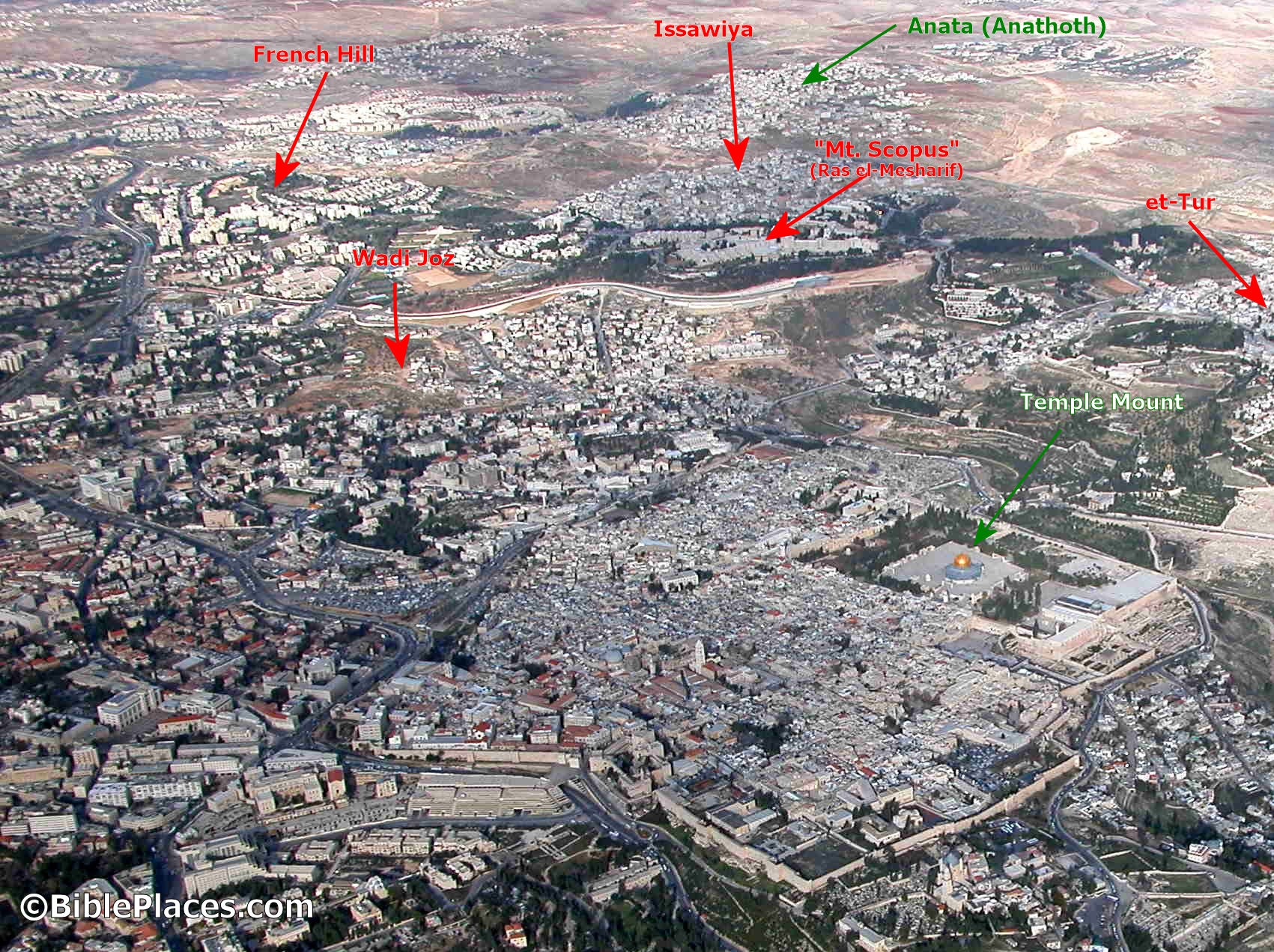
 Then David came to Nob <means fruit[2]; Nob was in the neighborhood of Jerusalem, near the Mount of Olives >[3]. to Ahimelech <means ‘my brother is King’ [4]>, the priest. And Ahimelech came to meet David trembling and said to him, “Why are you alone, and no one with you?”

Nob was known as the town of Priests. The Tabernacle was here and because of David’s relationship with Samuel, he thought he would be welcome here. It was also the responsibility of the Priests to keep provisions on hand for those in need. It was an hour and half walk from Gibeah. It probably took David longer for he had to travel at night, without light, to escape those seeking him. It was the morning of a Sabbath when he suddenly presented himself, alone, unarmed, weary, and faint with hunger before the high-priest.

Ahimelech was frightened to see David looking so, without his usual delegation.

And David said to Ahimelech the priest, “The king has charged me with a matter and said to me, ‘Let no one know anything of the matter about which I send you, and with which I have charged you.’ I have made an appointment with the young men for such and such a place.

He may or may not have been aware of the conflict between David and Saul. But certainly he thought something was up. However, David had reasonable answer’s for all of his questions. The King’s business had been so pressing and secretive that David was forced to leave without adequate provisions and weapons.

David Needed Mercy in the Form of Provisions

Now then, what do you have on hand? Give me five loaves of bread, or whatever is here.” And the priest answered David, “I have no common bread on hand, but there is Holy bread— if the young men have kept themselves from women.” And David answered the priest, “Truly women have been kept from us as always when I go on an expedition. The vessels of the young men are holy even when it is an ordinary journey. How much more today will their vessels be holy?” So the priest gave him the holy bread, for there was no bread there but the bread of the Presence, which is removed from before the LORD, to be replaced by hot bread on the day it is taken away.

David was on the run, homeless, penniless, and had likely been three days without food. He came to the place where he had prayed to so many times. He needed mercy from God. He didn’t need a lecture or a sermon. He needed God’s mercy!

This little incident allows us to evidence the decay into which the priesthood and offerings of the people had fallen. The fact that there was nothing to offer David except the shewbread reveals the poverty of the priesthood, and the neglect of such by the people. If people would have been offering sacrifices, there would be plenty of food.

The Table of Shewbread

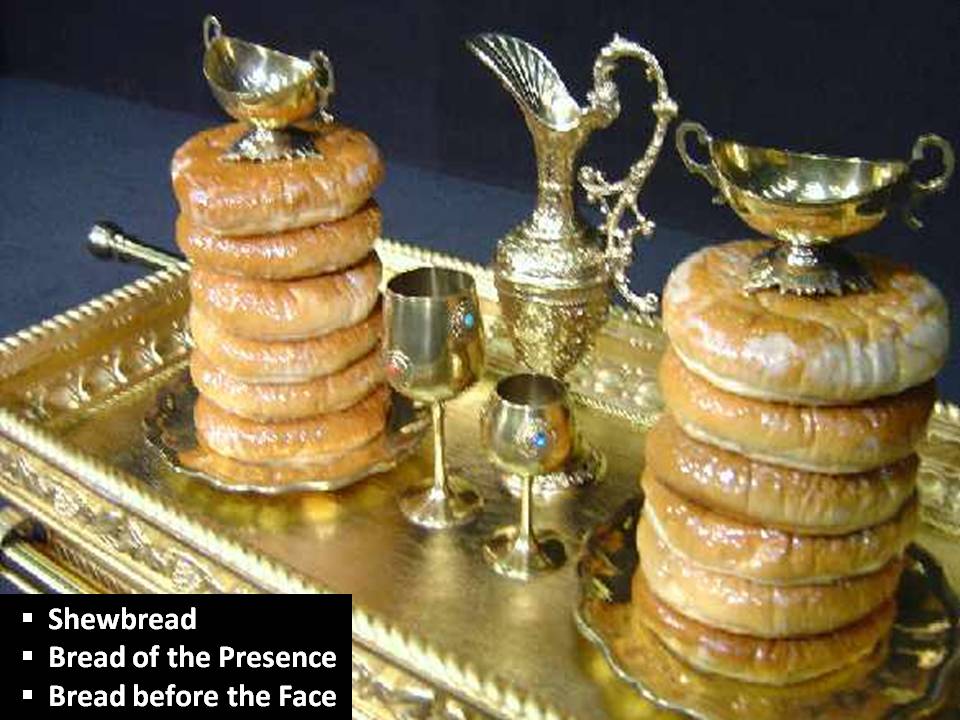
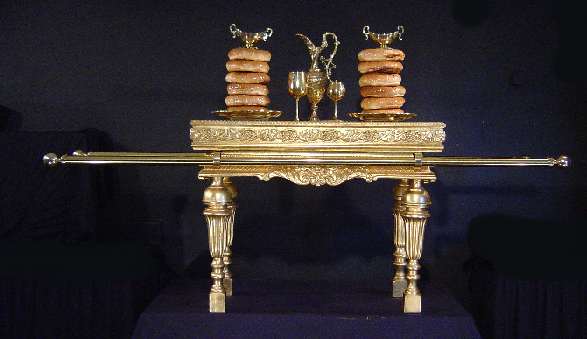
When you walk into the tabernacle you enter a door that leads to the holy place. The priest had at his right hand the table of shewbread or also referred to as the table of the presence. It was made of acacia wood overlaid with pure gold. Its size was 2 cubits (3 feet) in length by one cubit (1 1/2 feet) in breadth and a height of 1 1/2 cubits (2 1/4 feet). Around the table was a border of gold and then a little further in, on the table top, an additional border which would hold the contents in place. The table had four legs, and two gold-plated poles were inserted through golden rings attached to the legs for transporting.

  • “And you shall set the showbread on the table before Me always.”

The purpose of the golden table was to hold 12 cakes of bread made of fine flour. They were placed there in two stacks (or rows) of six, each loaf representing one of the tribes of Israel (Lev. 24:8).

  • Lev 24:5-9 And you shall put pure frankincense on each row, that it may be on the bread for a memorial, an offering made by fire to the LORD. Every Sabbath he shall set it in order before the LORD continually, being taken from the children of Israel by an everlasting covenant. And it shall be for Aaron and his sons, and they shall eat it in a holy place; for it is most holy to him from the offerings of the LORD made by fire, by a perpetual statute.”

Significance of the Bread of Presence

  • Fine Flour (from the earth)
  • Baked (agony and suffering)
  • Unleavened (nothing artificial)
  • Sprinkled with pure frankincense[5]

Bread Sprinkled with Pure Frankincense

Frankincense was given to Baby Jesus, and symbolizes His office as High Priest, offering prayers of intercession before the Father for us. Here, sprinkled upon the bread that is to be always before the face of God, it illustrates the truth of what Jesus declared in John 6.

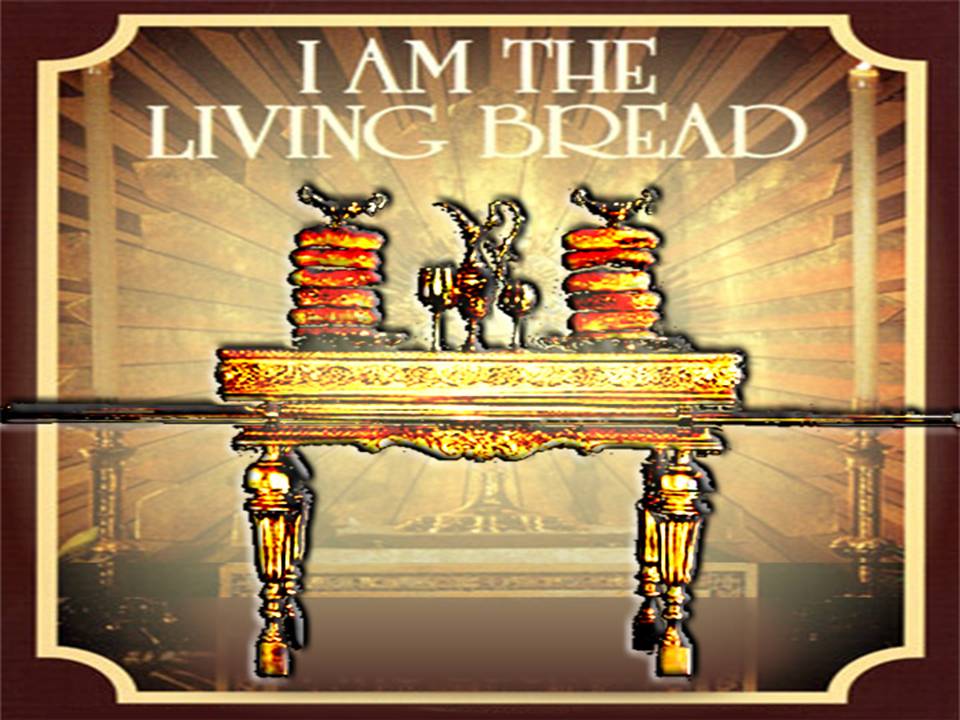
I AM the Living Bread

John 6:51-58 “I am the living bread which came down from heaven. If anyone eats of this bread, he will live forever; and the bread that I shall give is My flesh, which I shall give for the life of the world. As the living Father sent Me, and I live because of the Father, so he who feeds on Me will live because of Me. This is the bread which came down from heaven– not as your fathers ate the manna, and are dead. He who eats this bread will live forever.”

When David ate the Shewbread, he was prophetically eating a symbol of the Savior that he hoped in, and who offered his body a broken sacrifice for him. That broken body is ever before the face of God, offering prayers on our behalf! This is a picture of how our Hope is not in our own strength, but the strength that comes from the Bread of Life!

Recent studies by an international team of scientists, including researchers from Johns Hopkins University and the Hebrew University in Jerusalem, have indicated that burning frankincense resin helps to alleviate anxiety and depression. The University of Munich found the anti-inflammatory properties of frankincense very effective as a treatment for joint pain and arthritis[6]

 2000 Years Later, Jesus faced a similar situation:

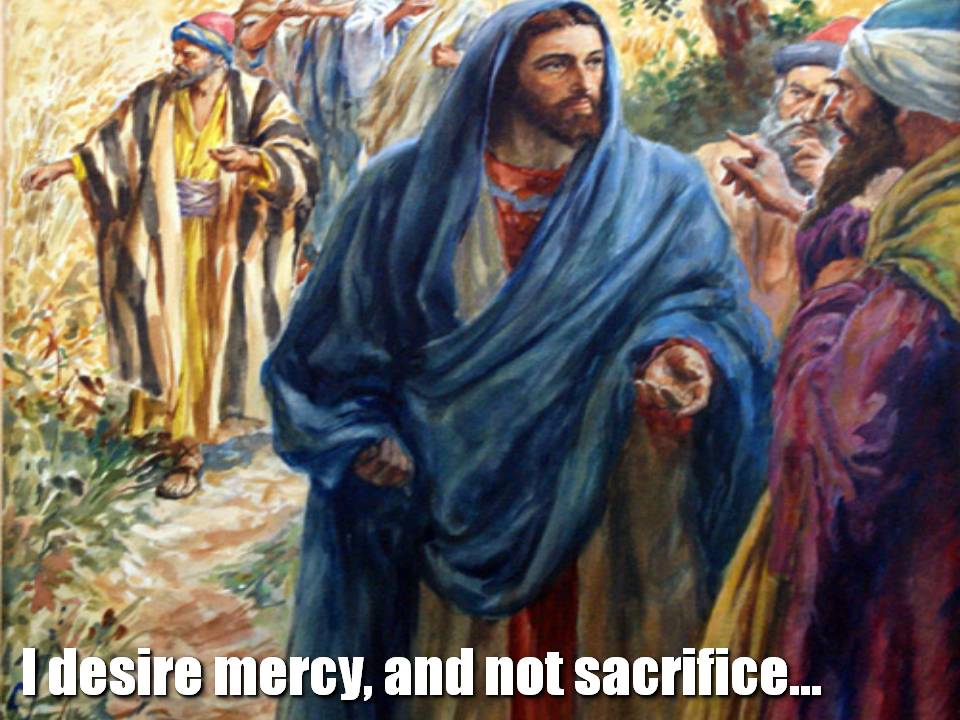
Jesus is walking with his disciples through a corn/wheat field. It was on a Sabbath, and they were very hungry. So they plucked the grain and ate it. (I’ve eaten freshly plucked wheat, so I know they must have been very hungry to eat it). Some Pharisees watched and immediately cried “law breakers’!

According to the Pharisees, the disciples reaped a crop. They threshed it by rubbing the berries in their hands and breaking the hulls off. Then they winnowed it by blowing the hulls away. By doing so, they were guilty of preparing a meal.

Jesus said to them, “Have you not read what David did when he was hungry, and those who were with him: (4) how he entered the house of God and ate the bread of the Presence, which it was not lawful for him to eat nor for those who were with him, but only for the priests? (5) Or have you not read in the Law how on the Sabbath the priests in the temple profane the Sabbath and are guiltless? (6) I tell you, something greater than the temple is here. (7) And if you had known what this means, ‘I desire mercy, and not sacrifice,’ you would not have condemned the guiltless. (8) For the Son of Man is lord of the Sabbath.” Matthew 12:1-8 (ESV)

Jesus deliberately drew attention to one of the Sabbath’s main purposes: It is a day of mercy and not a day of sacrifice.

Christ’s referred to 1 Samuel 21-when David ate the showbread. He wanted the Pharisees to understand that the Sabbath is to benefit a mercy needing man. David benefited from the Mercy of Ahimelech in giving him the showbread at a time when he was starving and weak. Mercy for the weak and hurting trumped the Law. Christ is always about Life, not Death.

The Pharisees didn’t understand Jesus. They did not see the Life He offered.

The Sabbath is a Day of Mercy for it is a Day of Hope!

David was about to learn the need for Hope!

The Doeg

Now a certain man of the servants of Saul was there that day, detained before the LORD. His name was Doeg the Edomite, the chief of Saul’s herdsmen.

It so happened in the Providence of God, that on this special Sabbath, one of Saul’s principal officials, the “chief over the herdsmen,” was in Nob, “detained before Jehovah.” The expression implies that Doeg was obliged to remain in the sanctuary in consequence of some religious ceremony—whether connected with his admission as a proselyte, for he was by birth an Edomite, or with a vow, or with some legal purification. (22:22)[7].

Doeg’s presence at the tabernacle is a mystery. He was an Edomite and whose presence would not normally be welcomed. He was “detained before the Lord” at the sanctuary (1 Sam. 21:7). Perhaps he had become a Jewish proselyte and was following the Hebrew faith in order to hold his job. As Saul’s chief shepherd, Doeg could easily have become defiled so that he had to bring a sacrifice to the Lord.

David knew that Doeg would report to Saul what he had seen at Nob and that this would mean trouble.Perhaps that is why he was not being honest with Ahimelech, so as to insulate him from the wrath of Saul.

Doeg Tells Saul

1 Samuel 22:6-19 reveals the Destructiveness of Doeg

(6) Now Saul heard that David was discovered, and the men who were with him. Saul was sitting at Gibeah under the tamarisk tree on the height with his spear in his hand, and all his servants were standing about him. (7) And Saul said to his servants who stood about him, “Hear now, people of Benjamin; will the son of Jesse give every one of you fields and vineyards, will he make you all commanders of thousands and commanders of hundreds, (8) that all of you have conspired against me? No one discloses to me when my son makes a covenant with the son of Jesse. None of you is sorry for me or discloses to me that my son has stirred up my servant against me, to lie in wait, as at this day.” (9) Then answered Doeg the Edomite, who stood by the servants of Saul, “I saw the son of Jesse coming to Nob, to Ahimelech the son of Ahitub, (10) and he inquired of the LORD for him and gave him provisions and gave him the sword of Goliath the Philistine.” (11) Then the king sent to summon Ahimelech the priest, the son of Ahitub, and all his father’s house, the priests who were at Nob, and all of them came to the king. (12) And Saul said, “Hear now, son of Ahitub.” And he answered, “Here I am, my lord.” (13) And Saul said to him, “Why have you conspired against me, you and the son of Jesse, in that you have given him bread and a sword and have inquired of God for him, so that he has risen against me, to lie in wait, as at this day?” (14) Then Ahimelech answered the king, “And who among all your servants is so faithful as David, who is the king’s son-in-law, and captain over your bodyguard, and honored in your house? (15) Is today the first time that I have inquired of God for him? No! Let not the king impute anything to his servant or to all the house of my father, for your servant has known nothing of all this, much or little.” (16) And the king said, “You shall surely die, Ahimelech, you and all your father’s house.” (17) And the king said to the guard who stood about him, “Turn and kill the priests of the LORD, because their hand also is with David, and they knew that he fled and did not disclose it to me.” But the servants of the king would not put out their hand to strike the priests of the LORD. (18) Then the king said to Doeg, “You turn and strike the priests.” And Doeg the Edomite turned and struck down the priests, and he killed on that day eighty-five persons who wore the linen ephod. (19) And Nob, the city of the priests, he put to the sword; both man and woman, child and infant, ox, donkey and sheep, he put to the sword. 1 Samuel 22:6-19 (ESV)

Doeg, wanting to gain from Saul, (Saul had just mentioned what he could give people), told about David being offered help by the Priests in Nob. He did not reveal that David had gained the help by misleading Ahimelech. He knew his information would better him at the expense of the Priests.

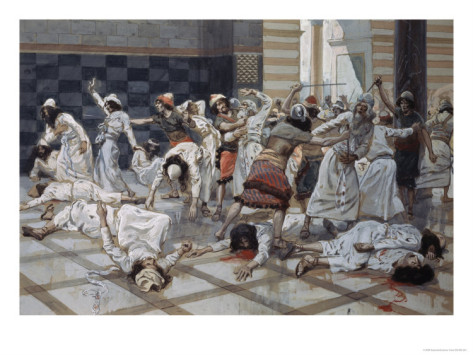
When all of Saul’s servants refused to go against the Priests, Saul turned to Doeg, and he not only killed all the priests, but he went to Nob and killed everyone there, boys, girls, mothers, even infants. He totally wiped the city of Nob from the face of the earth. Doeg was not only a Doeg, but he was a Destroyer.

Doeg is a Disciple killer

David had faced Goliath, and defeated him with a single stone. David’s heart was so united with God’s that there was nothing of this world that could defeat him. Now David was on the run from his authority, the anointed King of Israel. David had the love of Jonathan, and a few servants, but no one else to aid him, except God. So he came to the Tabernacle for food, provisions, and to inquire of the Lord for guidance. There he encountered Doeg, and David knew he was evil, but he had no idea what would happen. Perhaps he had an inkling, and that is why he did not tell Ahimelech the truth.

As a David Disciple you will encounter Goliath’s, you will encounter Saul’s, and you will encounter Doegs.

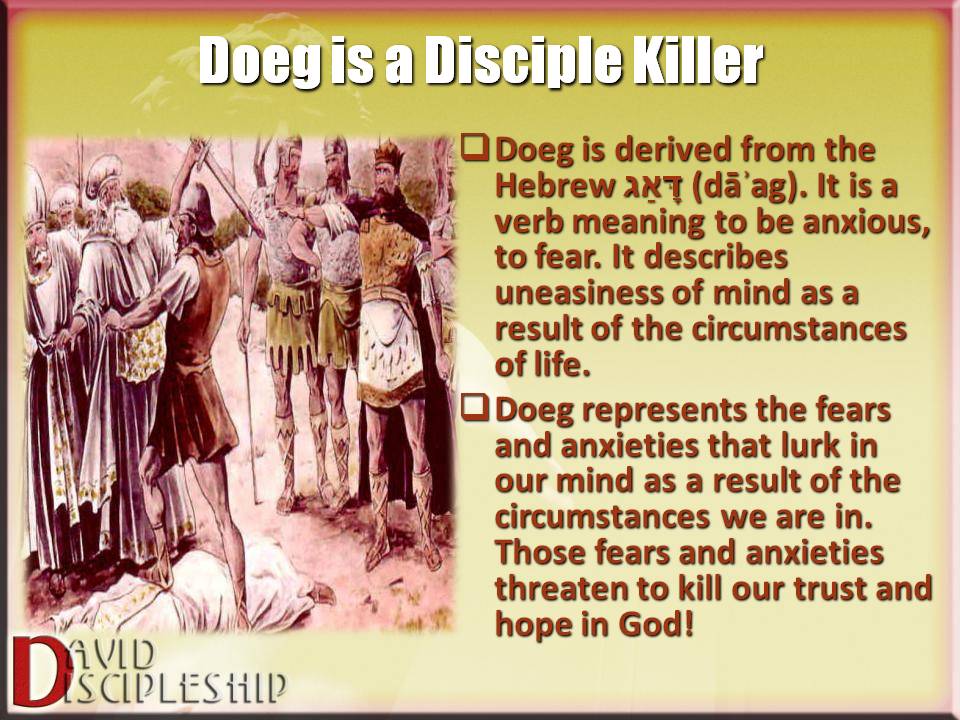
Doegs are very dangerous to Disciples, for they lurk in the shadows. They don’t come directly at you. Often they are an unseen enemy. But Doegs are very deadly. Doeg is derived from the Hebrew ‏דָּאַג‎ (dāʾag). It is a verb meaning to be anxious, to fear. This word describes uneasiness of mind as a result of the circumstances of life[8].

Doeg represents the fears and anxieties that lurk in our mind as a result of the circumstances we are in. Those fears and anxieties threaten to kill our trust and hope in God!

David described how his sin made him ‘dāʾag

I confess my iniquity; I am troubled (dāʾag) by my sin. Psalm 38:18 (NIV)

 Jeremiah used the word ‘dāʾag’ to illustrate how Disciples are to be:

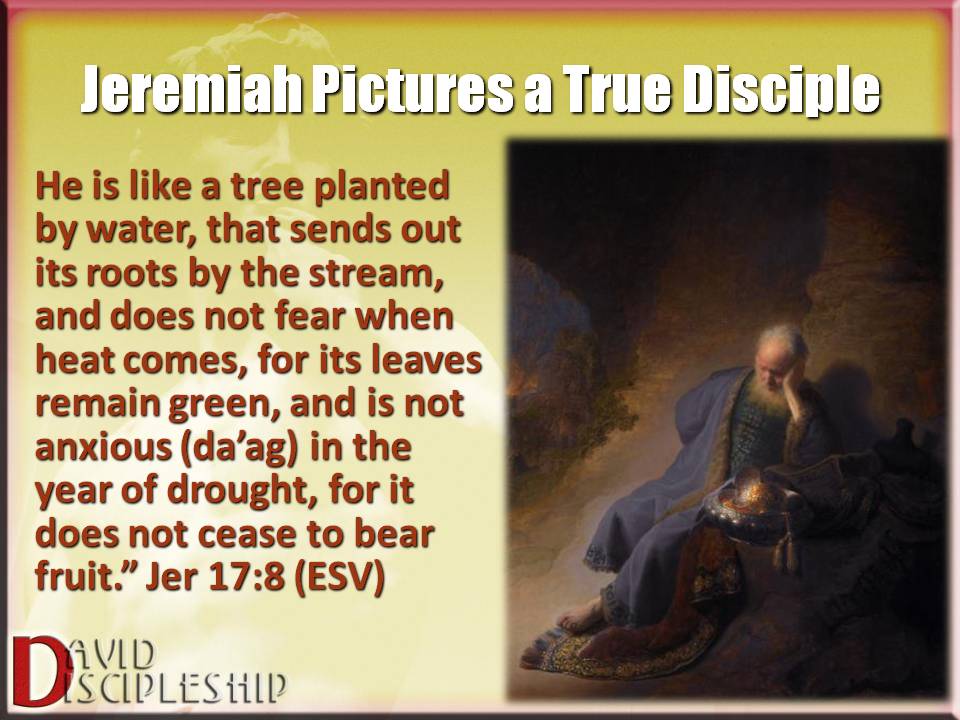
He is like a tree planted by water, that sends out its roots by the stream, and does not fear when heat comes, for its leaves remain green, and is not anxious (dāʾag) in the year of drought, for it does not cease to bear fruit.” Jeremiah 17:8 (ESV)

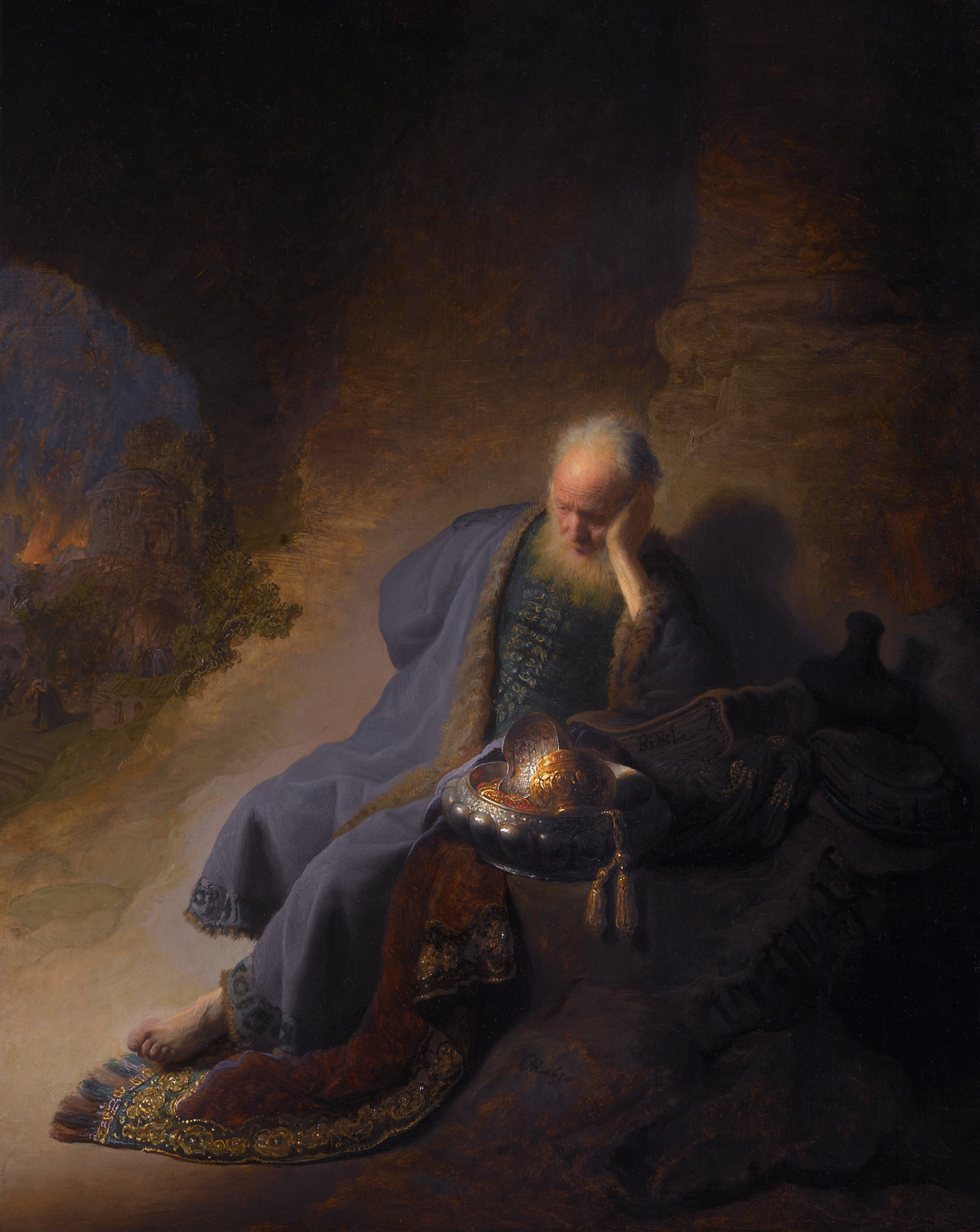
Jeremiah was called the weeping prophet. One poignant moment immortalized by Rembrandt depicts Jeremiah grieving over the destruction of Jerusalem and the First Temple by Nebuchadnezzar. Tradition has him in a grotto just outside the North Wall of Jerusalem. It is under the hill called Golgotha. He wrote the five poems of Lamentations near the  place where our Savior was crucified.

Jeremiah’s sermons and prophecies were ignored and scoffed at by the leaders of Jerusalem. Jeremiah (in a message from God) encouraged the soldiers to surrender to Nebuchadnezzar to save the city. They threw him into an empty cistern in the King’s palace prison and he sank in mud up to his armpits. They left him there to starve to death, hoping to silence him. Still he kept on preaching the Word of the Lord. Fortunately an Ethiopian man, a court official, persuaded the King to release Jeremiah. It took thirty men with ropes to pull Jeremiah out of that mud.

As much as Jeremiah was despised. As grief-stricken as he was when he wrote this:

How lonely sits the city that was full of people! How like a widow has she become, she who was great among the nations! She who was a princess among the provinces has become a slave. Lamentations 1:1 (ESV)

Jeremiah did something totally crazy:

While he was imprisoned, Jeremiah received a visit from his cousin Hanamel. Hanamel wanted to sell Jeremiah a piece of land in their hometown of Anathoth. It was a foolish request, for the land was already in control of the Chaldeans and Nebuchadnezzar. Furthermore, Jeremiah was in prison for treason, and unable to use the land. Jeremiah bought the land in front of many witnesses, saying:

‘Thus says the LORD of hosts, the God of Israel: Take these deeds, both this sealed deed of purchase and this open deed, and put them in an earthenware vessel, that they may last for a long time. For thus says the LORD of hosts, the God of Israel: Houses and fields and vineyards shall again be bought in this land.’ Jeremiah 32:14-15 (ESV)

In spite of his grief and despair over the circumstances he was in, Jeremiah never lost his Hope in God.

Jeremiah discovered a Hope that is greater than all our fears:

  •  The steadfast love of the LORD never ceases; his mercies never come to an end; they are new every morning; great is your faithfulness. “The LORD is my portion,” says my soul, “therefore I will hope in him.”  The LORD is good to those who wait for him, to the soul who seeks him. Lamentations 3:22-25 (ESV)
  • There is hope for your future,” says the LORD. “Your children will come again to their own land. Jeremiah 31:17 (NLT)

Jer 14:8 Calls out to the Hope of Israel – its Savior. Then He reveals the coming Hope:

Jeremiah’s Hope – The Lord our Righteousness

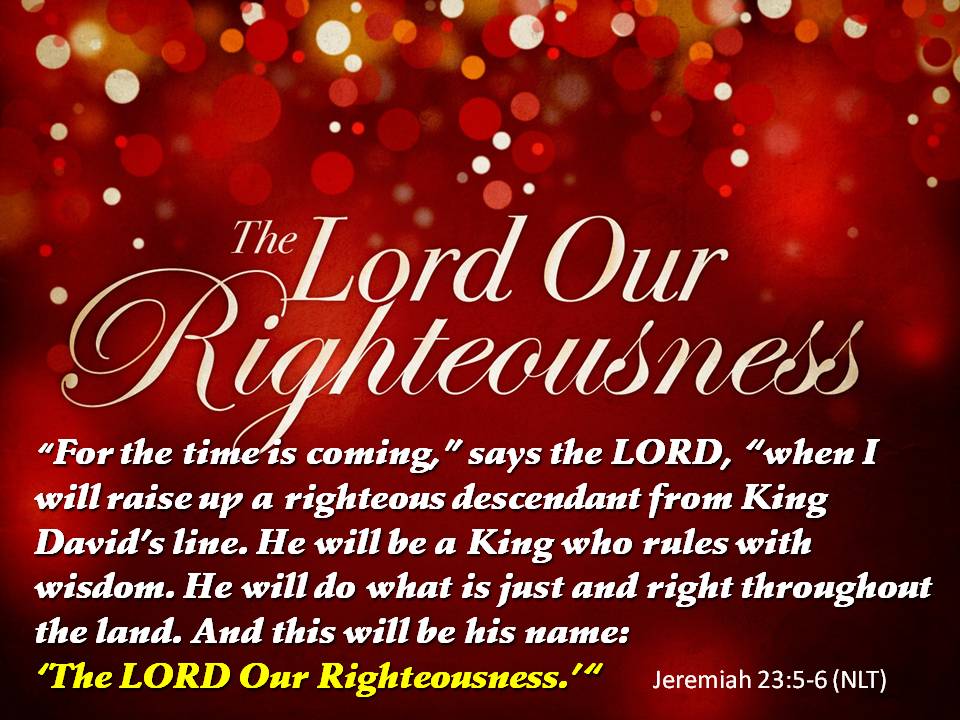
“For the time is coming,” says the LORD, “when I will raise up a righteous descendant from King David’s line. He will be a King who rules with wisdom. He will do what is just and right throughout the land. And this will be his name: ‘The LORD Our Righteousness.’ yehōwāh tṣid̠qēnû (from tsedaqah) Jeremiah 23:5-6 (NLT)

 Fear versus Hope (Doeg vs the Lord)

Discipleship is all about knowing the ways of God, embracing and understanding all that He delights in. He delights in hesed, mishpat and tsedaqah. (Jer 9:24)

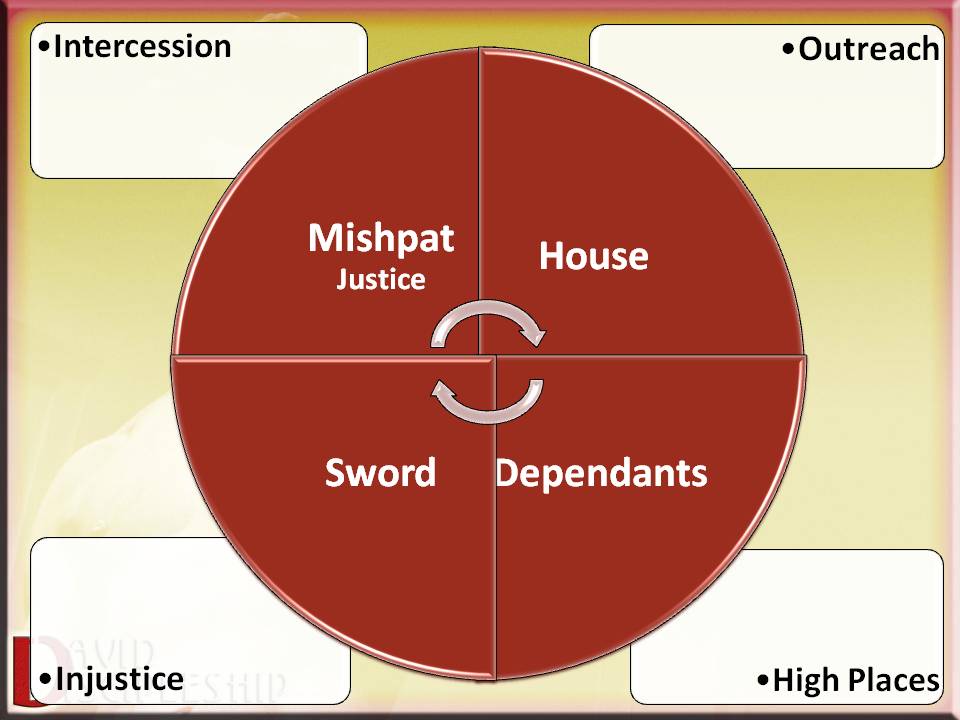
The hesed of God strengthens our heart to defeat Goliath. The mishpat of God enables us to endure the injustice of Saul, as we focus on our responsibility to build our house by reaching out to the lame and lost.

The Tsedaqah of God allows us to conquer the Doegs of life by focusing on the Hope we have in Christ, and His righteousness.

The Psalms that David wrote after these encounters reveal that David learned this exact lesson:

David wrote Psalm 52 when he learned of Doeg’s murderous actions

The Steadfast Love (hesed) of God Endures: To the choirmaster. A Maskil of David, when Doeg, the Edomite, came and told Saul, “David has come to the house of Ahimelech.”

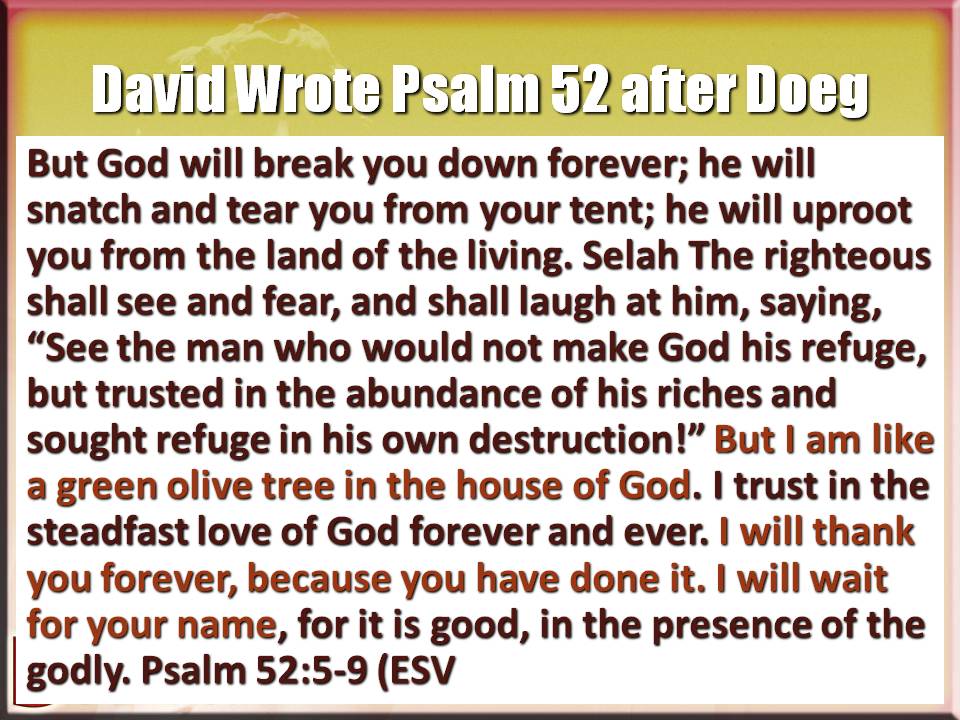
(5) But God will break you down forever; he will snatch and tear you from your tent; he will uproot you from the land of the living. Selah (6) The righteous shall see and fear, and shall laugh at him, saying, (7) “See the man who would not make God his refuge, but trusted in the abundance of his riches and sought refuge in his own destruction!” (8) But I am like a green olive tree in the house of God. I trust in the steadfast love of God forever and ever. (9) I will thank you forever, because you have done it. I will wait for your name, for it is good, in the presence of the godly. Psalm 52:5-9 (ESV)

God told David to go to Gath (when he inquired of Ahimelech), for God wanted David doubly learn this lesson. God wanted David to never forget!

After Being Seized in Gath

Psalm 34: “Of David, when he pretended to be insane in front of Abimelech, who sent him away”.

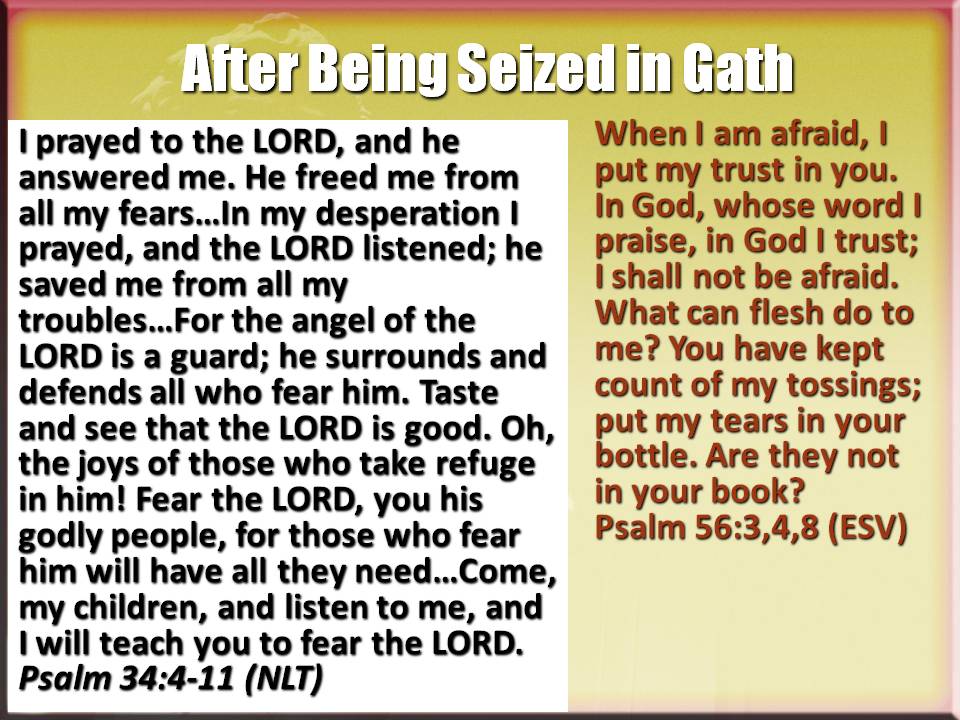
I prayed to the LORD, and he answered me. He freed me from all my fears…In my desperation I prayed, and the LORD listened; he saved me from all my troubles…For the angel of the LORD is a guard; he surrounds and defends all who fear him. Taste and see that the LORD is good. Oh, the joys of those who take refuge in him! Fear the LORD, you his godly people, for those who fear him will have all they need…Come, my children, and listen to me, and I will teach you to fear the LORD. Psalm 34:4-11 (NLT)

Psalm 56: In God I Trust “To the choirmaster:. A Miktam of David, when the Philistines seized him in Gath”.

When I am afraid, I put my trust in you. In God, whose word I praise, in God I trust; I shall not be afraid. What can flesh do to me? Psalm 56:3-4 (ESV)

David learned that the fear of the Lord conquers every other fear (vv. 9-16). When you walk in fear of the Lord, you walk in His Righteousness. When you walk in His righteousness, you are no longer walking in fear or anxiety. Doeg can never push you from the discipleship path!

How are you handling the Doegs of Life? Are circumstances getting to you? Is fear lurking in the corners of your mind? Have you been hoping in something that has let you down? Perhaps it is time to follow David, and learn the fear of the Lord, learn that Jesus is your Righteousness! Life is never meant to be up to us. There are too many “Doeg’s” that lurk in the shadows. Fear is a discipleship killer. There is no fear of man when we walk in fear of the Lord, when we walk in the Righteousness of Christ!


[1] Warren W. Wiersbe, The Bible Exposition Commentary – History, (Colorado Springs, CO: Victor, 2003), WORDsearch CROSS e-book, 264.

[2] James Strong, Strong’s Talking Greek & Hebrew Dictionary, (Austin, TX: WORDsearch Corp., 2007), WORDsearch CROSS e-book, Under: “5011”.

[3] Robert Jamieson, A.R. Fausset, David Brown, A Commentary: Critical, Experimental, and Practical on the Old and New Testaments, (Toledo, OH: Jerome B. Names & Co., 1884), WORDsearch CROSS e-book, Under: “1 SAMUEL”.

[4]Warren Baker and Eugene Carpenter, The Complete Word Study Dictionary – Old Testament, (Chattanooga, TN: AMG Publishers, 2003), WORDsearch CROSS e-book, Under:  “אֲחִימֶלֶךְ ’aḥiymelek̠”.

[7] Alfred Edersheim, Bible History Old Testament, (London: Religious Tract Society, 1890), WORDsearch CROSS e-book, Under: “CHAPTER 12”.

[8] R. Laird Harris, Gleason L. Archer, Bruce K. Waltke, ed., “393: ‏דָּאַג‎,” in Theological Wordbook of the Old Testament, (Chicago: Moody Press, 1980), WORDsearch CROSS e-book, Under: “‏דָּאַג‎”.


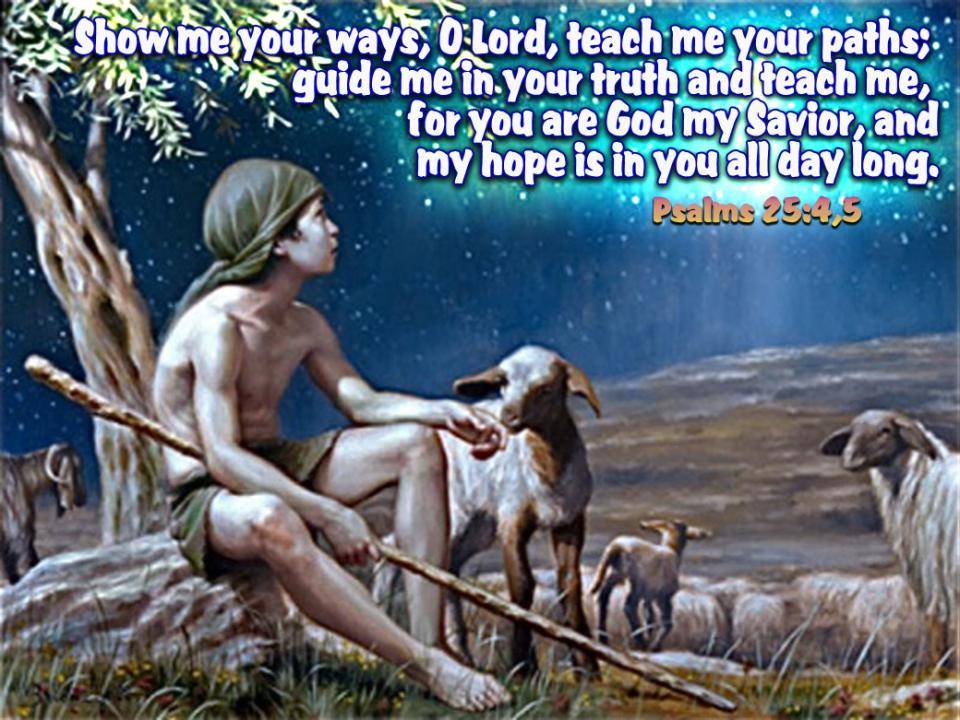
As a young boy, David prayed to the unseen, invisible God who met with him out in the fields near Bethlehem, as David kept watch over his father’s herds of goat and sheep. It was an important job, but a dirty job nonetheless. David would not be able to worship at Jerusalem, for most of the time he would be unclean due to the bloody and dirty duties of a shepherd. Most families hired out this job, but David volunteered. His older brothers said, sure, go ahead and be a dirty shepherd. We will go off to fight a war with the Philistines.

It was there, in the loneliness of the fields, that David grew to know this awesome, invisible God.

One day he got into trouble. Perhaps it was wild animals, perhaps it was thieves, but he found himself in danger. In that foxhole of danger, this young boy looked up to heaven and cried out:

Psalms 25:1-5 (NIV) 1 To you, O Lord, I lift up my soul; 2 in you I trust, O my God. Do not let me be put to shame, nor let my enemies triumph over me. 3 No one whose hope is in you will ever be put to shame, but they will be put to shame who are treacherous without excuse. 4 Show me your ways, O Lord, teach me your paths; 5 guide me in your truth and teach me, for you are God my Savior, and my hope is in you all day long.

David declared His trust and hope in this invisible God. He declared that this invisible God was his Savior. However, David wanted much more than salvation, much more than deliverance from a treacherous situation. David declared his lifelong devotion to know and understand this awesome invisible God.

He cried, “Show me your ways O Lord, and teach me your paths”.

David said, “I not only need saving right now, I need to know your paths for my life. I want to understand your ways O Lord, so that I can walk in your paths”.

I have often said that the decisions you make as a young man or woman will determine where you will end up when you are in your 50’s. Those decisions have life altering effect.

Here is this message in video:

Little did David realize what he was asking for, how much trouble and pain he was going to endure to know the ways of God. God showed this young man His ways. Moreover, David records a summary of what he had learned, something that I have been talking about the last couple of weeks.

Psalms 33:5 (ESV) He loves righteousness and justice; the earth is full of the steadfast love of the Lord.

Psalms 89:14 (ESV) Righteousness and justice are the foundation of your throne; steadfast love and faithfulness go before you.

David saw that the ways of God center upon hesed, mishpat and tsedaqah. Little did that young boy know that by asking to know the ways of God, and to walk in his paths, that those paths would lead to the Throne over all Israel. Moreover, because of that one little decision that David made as a young boy, this is what God’s Word says about David’s reign:

2 Samuel 8:15 (HCSB) So David reigned over all Israel, administering justice and righteousness for all his people.

In addition, because of that young boy’s decision, he would one day lead his “House” in declaring:

Psalms 106:1-3 (ESV) 1 Praise the Lord! Oh give thanks to the Lord, for he is good, for his steadfast love endures forever! 2 Who can utter the mighty deeds of the Lord, or declare all his praise? 3 Blessed are they who observe justice, who do righteousness at all times!

From David’s Last Words

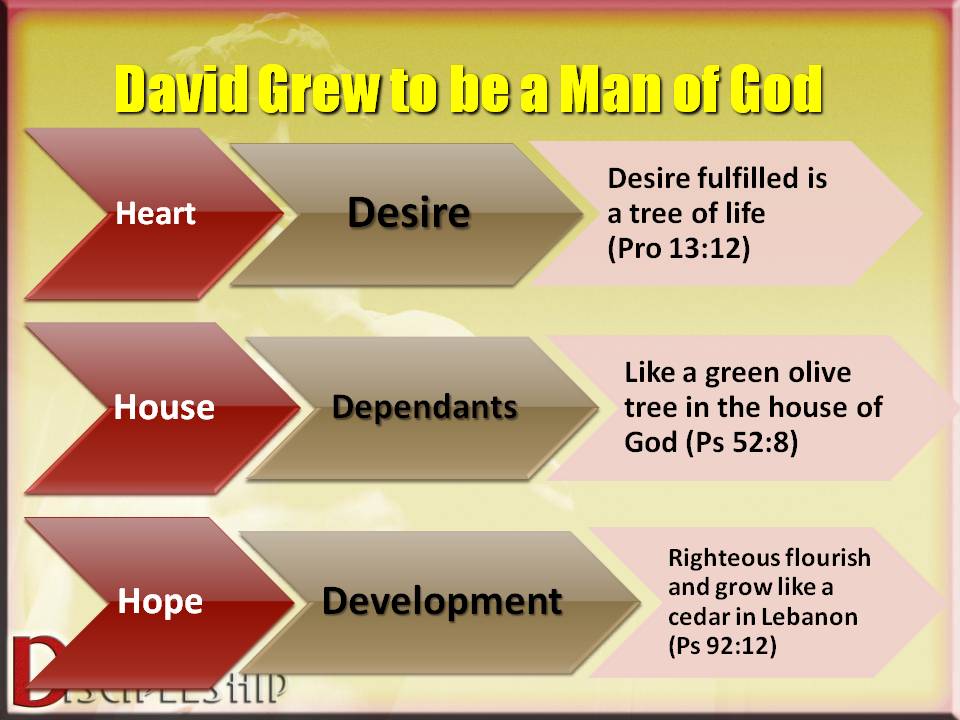
2 Samuel 23:5 (NKJV) “Although my house is not so with God, yet He has made with me an everlasting covenant, ordered in all things and secure. For this is all my salvation and all my desire (ḥēp̠eṣ), will He not make it increase (ṣemaḥ)?

  1. Heart (For all my desire)
  2. House (A Covenant with me and my House)
  3. Hope (He will make it Grow)

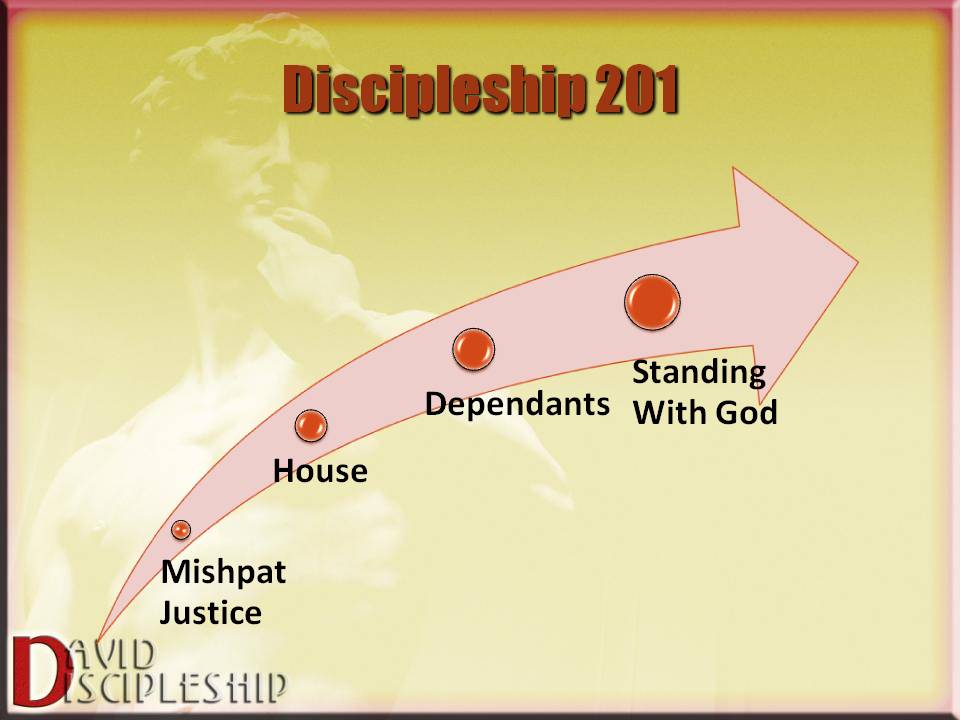
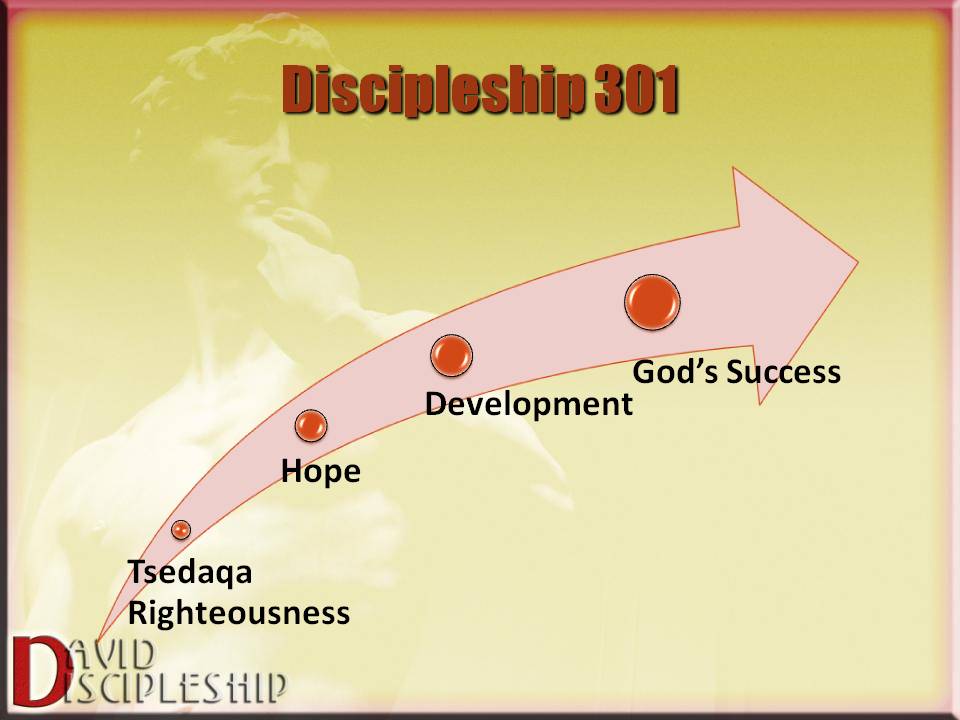
Discipleship MUST FOCUS on three areas of your life:

  1. Your Desire. (For this is all my salvation and all my desire)
  2. Your Dependants. (Responsible for your House)
  3. Your Development. (Will He not make it grow?)

God’s Plan for Discipleship…

Jeremiah 9:23-24 (ESV) 23 Thus says the Lord: “Let not the wise man boast in his wisdom, let not the mighty man boast in his might, let not the rich man boast in his riches, 24 but let him who boasts boast in this, that he understands and knows me, that I am the Lord who practices steadfast love, justice, and righteousness in the earth. For in these things I delight, declares the Lord.”

Discipleship requires a Choice…

The spirit of Babylon is diametrically opposed to being a disciple. The spirit of Babylon will trip you up on your journey to gain Christ!

Wise Man – Boasts in Wisdom – Splendor (God employed wisdom as His master craftsman to create all things[1] (Psalms 104:24 (ESV) O Lord, how manifold are your works! In wisdom have you made them all; the earth is full of your creatures.)

Mighty Man – Boasts in Might – Status

Rich Man – Boasts in Riches – Success

Here God takes direct aim at the spirit of Babylon and says it has no place among His people. These cannot be any part of His Discipleship plan! Then He says, if you are going to boast, boast in this, that you understand and know me, that you know what I delight in!

Discipleship should lead us to delight in what God Delights in, to knowing and understanding God!

David’s First Words

He Desires to be a Mighty Tree

Psalms 1:1-6 (ESV) 1 Blessed is the man who walks not in the counsel of the wicked, nor stands in the way of sinners, nor sits in the seat of scoffers; 2 but his delight is in the law of the Lord, and on his law he meditates day and night. 3 He is like a tree planted by streams of water that yields its fruit in its season, and its leaf does not wither. In all that he does, he prospers. 4 The wicked are not so, but are like chaff that the wind drives away. 5 Therefore the wicked will not stand in the judgment, nor sinners in the congregation of the righteous; 6 for the Lord knows the way of the righteous, but the way of the wicked will perish.

Walk not in the counsel of sinner – Do not get seduced by the ‘splendor of this world and its wisdom and beauty’. They will infect your heart and your desires.

Do not stand in the way of sinners – do not be caught up in what they think brings status and worth; do not hang around them and what they go after. You may think that it is just a little fun, that no one will get hurt, or you deserve it. But do you want that in your HOUSE? Will it bring your HOUSE closer to God?

Do not sit in the seat of the scorners-do not think because you have success that you can scoff at God. When you sit in the seat of the scorners you no longer develop the virtue of Christ, you no longer have Christ as your Hope. You become worthless to God!

Like a REDWOOD TREE

The root system of the redwood tree is surprisingly shallow, especially given the great height the mature tree attains. There is no taproot and the other roots may reach no deeper than 6-12 feet. The major roots are about 1 inch in diameter. And they typically spread 50 to 80 feet. One way in which the trees are able to remain upright for millennia is by growing close together with other redwood trees, intermingling root systems. In the picture below, a number of redwoods crowd together in a typical grove.[2]

Chose to be Disciple or become Worthless to God

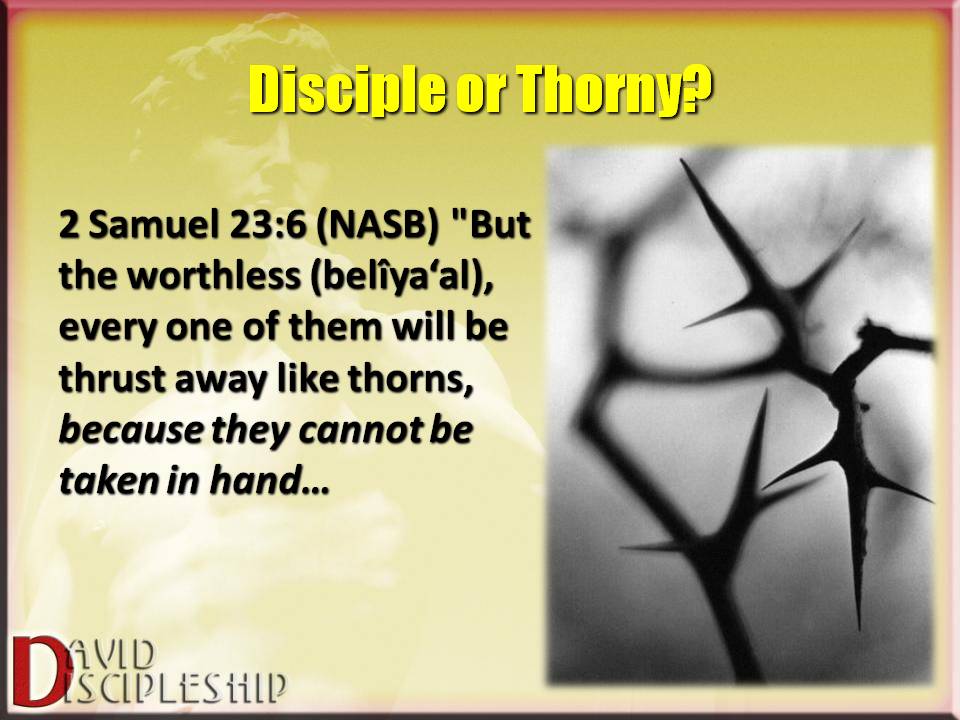
2 Samuel 23:6 (NASB) “But the worthless (belîya‘al), every one of them will be thrust away like thorns, because they cannot be taken in hand;

Belîya‘al. Worthlessness. Belial from belî and yaʿal: “not, without” and “to be of use, worth, or profit”. This concept of Belial became a proper name for the prince of evil, Satan, in the pseudepigraphal literature, the Zadokite Document, and the War Scroll of the Dead Sea Scrolls. See also 2 Cor. 6:15 and 2 Thes. 2:3[3].

What Does God Delight in?

  • Lovingkindness – Hesed
  • Justice – Mishpat
  • Righteousness – Tsedaqah

‏These are God’s Covenant Virtues

חֶסֶד‎ HESED

Hesed is the active force of God whereby he actively seeks to come to the aid of those with whom He has established a relationship. He displays His strength in showing mercy and loving kindness in a steadfast way. His love and mercy never fail because it is impossible for God to be weakened to the point of failure. (Unfailing Love)  

This word is used 240 times in the Old Testament, and is especially frequent in the Psalms. Is that any surprise since the Psalms were written by a man after God’s Heart.

Hesed has three components working together: “strength”, “steadfastness”, and “love”. Take one away and His hesed is not complete. Any understanding of the word that fails to suggest all three inevitably loses some of its richness.

Ḥesed implies personal involvement and commitment in a relationship beyond the rule of law.

Marital love is often related to hesed. The prophet Hosea applies the analogy to Yahweh’s hesed to Israel within the covenant (e.g., Hosea 2:21). Hence, “devotion” is sometimes the single English word best capable of capturing the nuance of the original. The RSV attempts to bring this out by its translation, “steadfast love”.[4]

However, ḥesed is not only a matter of obligation; it is also of generosity. It is not only a matter of loyalty, but also of mercy. Hesed describes God’s devotion to those He has a relationship with. It is an active, seeking love that is based upon strength and resolve. It is devotion of the heart. Hesed comes from the very heart of God! It is His desire for His people!

Hesed is the Active force of God whereby he actively seeks to come to the aid of those whom He has established a relationship. He displays His strength in showing mercy and loving-kindness in a steadfast way. His love and mercy never fail because it is impossible for God to be weakened to the point of failure. (Jim Tompkins)

Hesed is the Heart & Desire of God

Jesus Christ on the Cross is the visible expression of the Heart and Desire of God! Discipleship begins with our Heart and our Desires committed to following God’s Heart and God’s Desires!

The Spirit of Babylon (Satan) seeks to steal your devotion away from God by corrupting your heart by the foolish wisdom of man and the corrupted splendor of the world. He wants you to desire what this world has to offer! He wants you to think your desires are OK and actually wise!

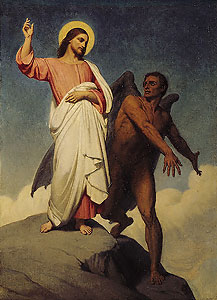
When Satan tempted Christ to turn the stones into bread so He could eat, Satan was using the most simple, basic splendor of this world to cause our Savior to sin. However, Jesus demonstrated the hesed of God when He refused, Matthew 4:4 (ESV) But he answered, “It is written, “‘Man shall not live by bread alone, but by every word that comes from the mouth of God.’ ”  Our Life is not in the Splendor of the things that this world has, even basic splendor like Bread.

Our Life is in the Splendor of God and His Word, for it expresses the Hesed of His heart! So when your Heart and your desires desire God’s hesed above all, you will begin your discipleship journey!

‏מִשְׁפָּט‎ mishpāṭ

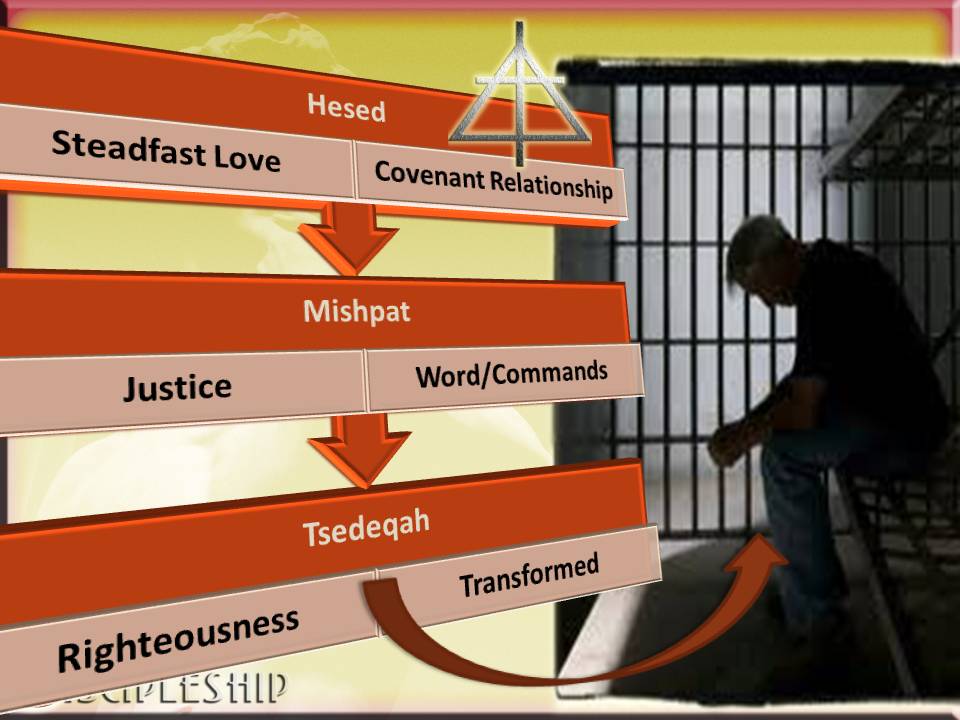
Mishpat is God’s Kingdom design in place within man through the reign of Christ in our hearts. His Kingdom design must grow to encompass our life, our family, our church –  our ‘House’. (Justice)

Mishpat begins in the external and transforms the internal (Describes the design and function of the Tabernacle)

God has a Kingdom in His heart, a kingdom of justice, of order, a kingdom that is at work in heaven and his desire is for it to be so on earth.

The Tabernacle was an earthly type of the Justice that God seeks on the earth. (Exodus 26:30; 1 Kings 6:38; and Ezekiel 42:11 this word is used in reference to the design of the tabernacle, the temple of Solomon, and the future temple prophesied by Ezekiel, respectively. Significantly, in all these passages it refers to the design or arrangement of God’s dwelling place.)

When His Son came to earth, He did what was necessary to empower this justice on earth. One day He will claim this inheritance and establish God’s Justice on earth. Until that day, we as His children, have an earthly tabernacle in which the Holy Spirit dwells. God can establish His justice in our lives. His Son can reign in our hearts and everywhere our foot trods. Mishpāṭ, as justice, i.e. rightness rooted in God’s character, ought to be an attribute of man in general and of judicial process among them (Psalm 106:37).

Mishpat expresses the nature of God and the demands of God. He desires His mishpat to reign on earth, and to reign in the hearts of mankind. His mishpat is what condemns us; His mishpat is what Jesus Christ satisfied upon the Cross. When God’s mishpat reigns in your heart through faith in Jesus Christ, you stand before God uncondemned. You have standing before God. You have the very ear of God because you delight in the mishpat of Jesus Christ!

Your standing in mishpat is for the benefit of your House, for your dependants. Jesus died to bring many sons to salvation. Jesus desired to bring mishpat to His House, this earth, and right now is building mansions for us to bring to the New Earth where He will rule over His House in mishpat!

mishpāṭ. This justice is primarily an attribute of God all true mishpāṭ finding its source in God himself and therefore carrying with it his demand. “When therefore the Scripture speaks of the mishpāṭ of God, as it frequently does, the word has a particular shade of meaning and that is not so much just statutes of God as the just claims of God. God, who is the Lord, can demand and He does demand” (Koehler, OT Theology, pp. 205-206). All the right (justice, authority, etc.) there is his, “because Jehovah is the God of justice” (Isaiah 30:18, cf. Genesis 18:2

Satan tempted Christ to throw himself from the tower overlooking Jerusalem. Certainly, God would honor His word and protect His own son, as Psalms said. Satan was saying, OK, if you live by the Word of God, let me see if you really believe. However, Jesus responded by quoting Deut 6:16, “You shall not put the Lord your God to the test”.

Jesus realized something that we need to embrace. God’s mishpat reigns! God desires to order this world according to His mishpat. It begins in our heart and our life. It is not to be scoffed at, questioned, and argued with. God is not someone you can trifle with and presume upon His mercy (hesed). God’s Justice is certain.

Even Jesus, the only son of God was not about to presume upon God’s mercy if He fell from the tower. Jesus knew that His Father was Just, and His Mishpat would reign.

You must understand that God delights in Justice. He delights in proper standing with Him. We have no proper standing with God. We have no special status with God. God’s justice is totally blind, even when it came to his son. So for you to seek after status and hope it will put you in better standing with God is ridiculous. You are tempting the Lord God. You have no concept of what He is about. You are doomed, and your house will be in shambles!

When the mishpat of God is the standing and status you seek for yourself and your house; your dependents will be established along with you in the House of God! When you desire Right Standing before God, this is the beginning of discipleship!

Tṣedāqâh

Because of our right relationship with God, we are free to embrace His righteousness. His righteousness transforms our lives and our environment. The righteousness of Christ within prevails and causes us to outwardly triumph!

Right Behavior and Attitudes that grow from a Right Relationship.

Conquering Righteousness In Action

Tsedaqa begins in the internal and transforms the external.(JT)

The difference between mishpat and tsedaqa is that mishpat begins in the external and transforms the internal. God’s justice becomes ingrained in our character. Tsedaqa begins in the internal and transforms the external. The justice of God in our heart becomes righteousness that transforms our lives and our environment. Inner righteousness prevails and causes us to outwardly triumph!

Tṣedāqâh implies relationship. A man is righteous when he meets certain claims which another has on him in virtue of relationship”. It is that which “triumphs and prospers” deliverance, salvation or triumph — tṣedāqâh (reaches, relates, rewards– delivers, saves and causes to triumph) The word describes the attitude and actions God had and expected His people to maintain. He is unequivocally righteous;

Satan’s third temptation was to show Jesus all the Kingdoms of the World and their glory. Satan would give all these to Jesus if He would fall down and worship him. Jesus. Matthew 4:8-10 (ESV) 8 Again, the devil took him to a very high mountain and showed him all the kingdoms of the world and their glory. 9 And he said to him, “All these I will give you, if you will fall down and worship me.” 10 Then Jesus said to him, “Be gone, Satan! For it is written, “You shall worship the Lord your God and him only shall you serve”.

Satan was offering Christ “SUCCESS” without the sacrifice of the Cross. God was going to give Jesus all the Nations, so why not go ahead with what Satan wanted.

Christ had a purpose, to worship His Father God with His life. Christ came to serve His Father in fulfilling His will. That was SUCCESS to Christ, serving His Father, whatever it cost, even his life. Success is in Development into what God desires for our life. Success is based upon being conformed to the Hope of Jesus Christ!

So let us build the Foundational Wall of David Discipleship.

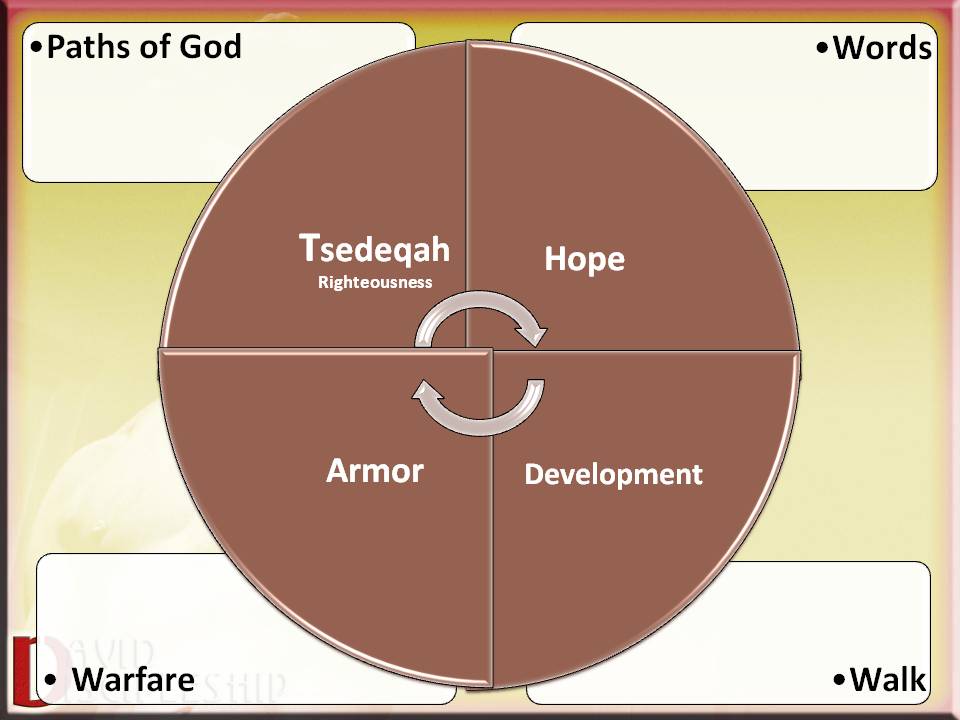
A Disciple is one whose Heart is given to God, whose Status is in Christ, whose Life is Developing into Jesus Christ, and every aspect of his life is based upon the Hope of Jesus Christ.

The World says Seek Splendor, all the beauty and bling the world can offer. The world says to promote yourself, seek status even if it means the sacrifice of your family. The world says seek success and display it to the world, the more you have the more successful you are. You can be a Christian without being a disciple.

We find Jeremiah 9:24 in the New Testament as well.

Jer 9:24 is in SALVATION: Ephesians 2:8-10

Ephesians 2:8-10 (ESV) 8 For by grace you have been saved through faith. And this is not your own doing; it is the gift of God, 9 not a result of works, so that no one may boast. 10 For we are his workmanship, created in Christ Jesus for good works, which God prepared beforehand, that we should walk in them.  

‘By grace you have been saved’ is God’s hesed, ‘we are His workmanship’ is his mishpat, ‘good works…walk in them’ is His tsedaqah! These are the foundational virtues of His Covenant of Salvation through the Blood and Body of Jesus Christ!

Jesus Puts Discipleship in perspective:

Discipleship is a Feast that you must sacrifice to attend

Luke 14:12-33 (ESV) 12 He said also to the man who had invited him, “When you give a dinner or a banquet, do not invite your friends or your brothers or your relatives or rich neighbors, lest they also invite you in return and you be repaid. 13 But when you give a feast, invite the poor, the crippled, the lame, the blind, 14 and you will be blessed, because they cannot repay you. For you will be repaid at the resurrection of the just.” 15 When one of those who reclined at table with him heard these things, he said to him, “Blessed is everyone who will eat bread in the kingdom of God!” 16 But he said to him, “A man once gave a great banquet and invited many. 17 And at the time for the banquet he sent his servant to say to those who had been invited, ‘Come, for everything is now ready.’ 18 But they all alike began to make excuses. The first said to him,(Status) ‘I have bought a field, and I must go out and see it. Please have me excused.’ 19 And another said, (Success) ‘I have bought five yoke of oxen, and I go to examine them. Please have me excused.’ 20 And another said, (Splendor) ‘I have married a wife, and therefore I cannot come.’ 21 So the servant came and reported these things to his master. Then the master of the house became angry and said to his servant, ‘Go out quickly to the streets and lanes of the city, and bring in the poor (success/righteous) and crippled (standing/justice) and blind (splendor/singleness of desire) and lame.’ 22 And the servant said, ‘Sir, what you commanded has been done, and still there is room.’ 23 And the master said to the servant, ‘Go out to the highways and hedges and compel people to come in, that my house may be filled. 24 For I tell you, none of those men who were invited shall taste my banquet.’ ” 25 Now great crowds accompanied him, and he turned and said to them, 26 If anyone comes to me and does not hate his own father and mother and wife and children and brothers and sisters, yes, and even his own life, he cannot be my disciple. 27 Whoever does not bear his own cross and come after me cannot be my disciple. 28 For which of you, desiring to build a tower, does not first sit down and count the cost, whether he has enough to complete it? 29 Otherwise, when he has laid a foundation and is not able to finish, all who see it begin to mock him, 30 saying, ‘This man began to build and was not able to finish.’ 31 Or what king, going out to encounter another king in war, will not sit down first and deliberate whether he is able with ten thousand to meet him who comes against him with twenty thousand? 32 And if not, while the other is yet a great way off, he sends a delegation and asks for terms of peace. 33 So therefore, any one of you who does not renounce all that he has cannot be my disciple.

The ones that were initially invited to the feast gave excuses which corresponded to the three ‘Spirit of Babylon’ components. The three temptations of Christ focused on those very same things. In response to the declined invitations, the servants were told to go and seek poor people, for they are open to the success of God through His righteousness. They realize they have no righteousness of their own. They invited the crippled and lame, for they realize their need for God’s status, for they have no standing of their own. Then they invited the blind, for they would be most open to seeing the Splendor of God. They are not distracted by the splendor of man.

Many ask to be excused because they have been infected with the ‘spirit of Babylon’. Discipleship begins with a heart given totally to God and His desires. There can be no ‘hold backs’! There can be no hesitation. Discipleship begins with a need for Jesus Christ to be our life!

Discipleship begins with a Decision to Yoke and Learn

Matthew 11:25-30 (ESV) 25 At that time Jesus declared, “I thank you, Father, Lord of heaven and earth, that you have hidden these things from the wise and understanding and revealed them to little children; 26 yes, Father, for such was your gracious will. 27 All things have been handed over to me by my Father, and no one knows the Son except the Father, and no one knows the Father except the Son and anyone to whom the Son chooses to reveal him. 28 Come to me, all who labor and are heavy laden, and I will give you rest. 29 Take my yoke upon you, and learn from me, for I am gentle and lowly in heart, and you will find rest for your souls. 30 For my yoke is easy, and my burden is light.”

Rest which is given –  Rest which must be found

Discipleship is never given. It is granted only as you let go of those thorns of Babylon and take His yoke, and learn of Him!

If you try to put the yoke on and still have some thorns, that yoke will hurt. It will be so uncomfortable. You will not last. However, if those thorns are cast down, you will discover his burden is light, his yoke is easy.

Discipleship – “the intentional process of making the virtue of Christ my own, through submitting to His Lordship and Direction, and the daily Hope of Gaining Christ”

Discipleship is simply gaining by trading (diapragmateúomai)[5];

Do you want to trade your life, your comfort for Jesus?


[1] Warren Baker and Eugene Carpenter, The Complete Word Study Dictionary – Old Testament, (Chattanooga, TN: AMG Publishers, 2003), WORDsearch CROSS e-book, 337.

[3] R. Laird Harris, Gleason L. Archer, Bruce K. Waltke, ed., “246: ‏בָּלָה‎,” in Theological Wordbook of the Old Testament, (Chicago: Moody Press, 1980), WORDsearch CROSS e-book, 111.

[4] William E. Vine, Vine’s Expository Dictionary of Old Testament and New Testament Words, (Nashville, TN: Thomas Nelson, 1940), WORDsearch CROSS e-book, Under: “Loving-kindness”.

[5] Spiros Zodhiates, The Complete Word Study Dictionary – New Testament, (Chattanooga, TN: AMG Publishers, 1993), WORDsearch CROSS e-book, Under: “megauploaddiapragmateúomai”.


When I owned an Asphalt Paving company we decided to get into concrete, and so we did in a big way. We even did footings, slabs and walls for new construction. I learned a great deal about foundations for commercial buildings. You don’t just dig a trench and pour concrete. You must consider where the main support beams are placed, what the weight load of the walls will be, what type of soil the foundation is on, and many other factors. The foundation is a really big deal that I had taken for granted. Good concrete alone is not enough for a solid foundation. You must use steel re-bar, and the amount and configuration of the re-bar depends upon the load at that point. Even concrete slabs have to consider the weight of the objects they will support. As part of our foundation work we did some banks which had bank vaults. Most vaults nowadays are actually pre-fab concrete units that are shipped in and moved in place. The vault door is added later. But the slab of the vault is poured 12″ to 24″ thick, with 2 to 3 layers of 3/4″ re-bar tied on 12″ centers. (We did one with 6″ centers). They do not want the vault going anywhere! It also indicates the weight (and importance) of the bank vault. Before concrete, I never thought about foundations. Now I consider them wherever I go. I even took this picture of some awesome re-bar for a building going up in Addis Ababa, Ethiopia. Judging by the re-bar pile, they still had a lot of tying to do!

The church of today is so often about programs. We need programs to keep drawing crowds and making people ‘feel’ like they are Christians. So often ministry programs for children, seniors, life groups, special events, and whatever must pass the “feel good” test. Will it “minister to a felt need” and make everyone “feel good”. Modern ministry must have an emotional draw or it usually dies.

The church that Jesus began and the Apostles modeled was centered around discipleship, making disciples. Emotional feelings quickly fade in the face of persecution. There must be something more about being a church than “feel good” programs. That more is true discipleship. We tried to get a “discipleship program” going within a year after coming to my present church, Pleasant Prairie. But we were only 3 years removed from a tragic ‘split’ that nearly destroyed a church that had been there for 36 years at the time. The people were not ready for a discipleship program that did not meet the need to rebuild their emotional being. There were emotional scars of bitterness and unforgiveness that needed attention before discipleship could begin. Inward hurts hinder the ability to look upward and outward!

God has recently burdened me that it is time to more clearly define the mission of our church. God has been sending some great men and families our way, but we need to have a clearly defined discipleship path. Our church is ready to stand and embrace discipleship as our core value, but I do not want it to be a “program”. Discipleship does not automatically have a “feel good” component that builds excitement. Most Christians seem to view discipleship as something for Paul’s and Timothy’s, people who serve in a major capacity. Even leaders in the church seem to shy away from intentional discipleship. Too often Christians are ‘comfortable’ where they are at. Convenience and comfort are often core values of most American Christians.

The Holy Spirit was leading me to preach on the Life of King David. He is a great example of a man of God. There is no more transparent life in the Bible than King David. But the Holy Spirit was also burdening me with the need for a clearly defined discipleship path in our church. For some reason He led me to the ‘last saying’ of King David in 2 Samuel 23:5. I won’t get it to it in this writing, but through this, the Holy Spirit is revealing some awesome revelations about discipleship and how the church can embrace it, accomplish it and even have a “feel good”  component at the same time. 

So the next few posts will be the “Laying of the Foundation” of what I am calling “David Discipleship”. We don’t often associate King David with discipleship, but I believe his life is the very definition of discipleship, beginning with the revelation of His last words.

Now to bend and tie the “re-bar” of David Discipleship:

If the church is not to be about “programs” but about making disciples, what is a disciple? 

Disciple: One who embraces and assists in spreading the teachings of another. In the New Testament, the word is Mathētés. Here it means more than a mere pupil or learner. It is an adherent who accepts the instruction given to him and makes it his rule of conduct[1]. The general designation of mathētés was given to those who believed on Christ. Jesus clearly defines disciple in John 8:31: (ESV) So Jesus said to the Jews who had believed in him, “If you abide in my word, you are truly my disciples”.

What is Discipleship?

If a disciple is an adherent of another person’s teachings, what is discipleship?

A consensus of definitions produces this: Discipleship is the process of learning about the teachings of another, internalizing them and then acting upon them. Most discipleship programs focus on the learning process, with the emphasis on knowledge.

Peters Perspective on the Discipleship Process

Peter turned out to be the most dynamic of the early disciples of Christ. He had learned a great deal after spending three years at the feet of the Master Teacher. Yet when it was time for the rubber to meet the road, Mighty Peter failed, and denied his Master in a dramatic fire. Where was that knowledge then? What good did his earlier confession do at the moment when it mattered most? Peter sheds a glaring light upon what a discipleship program should be about.

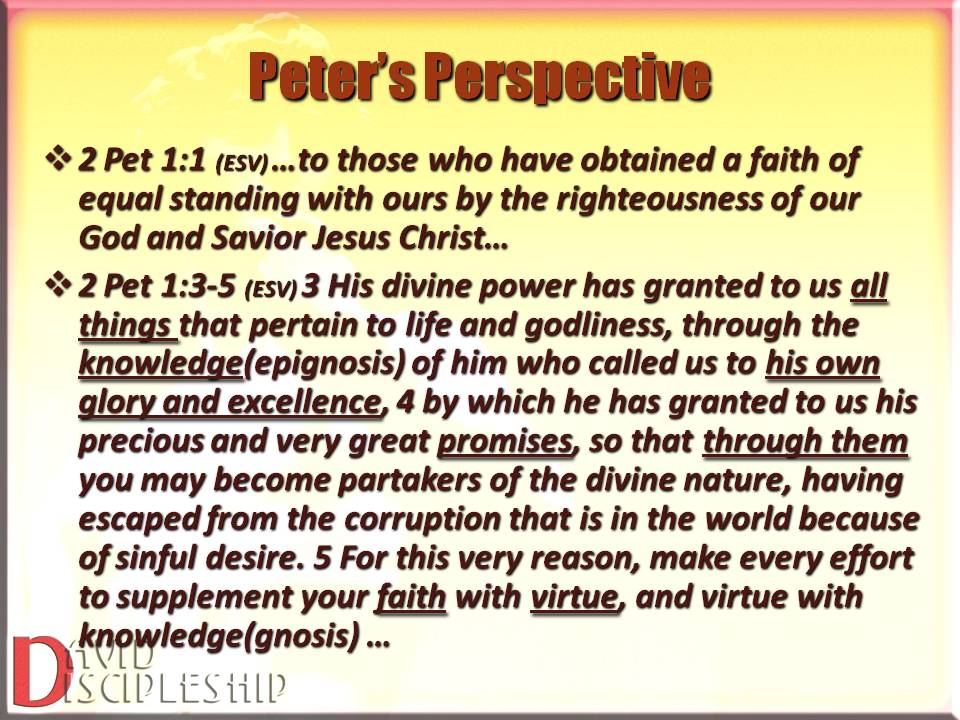
2 Peter 1:1 (ESV) Simeon Peter, a servant and apostle of Jesus Christ, To those who have obtained a faith of equal standing with ours by the righteousness of our God and Savior Jesus Christ…

2 Peter 1:3-5 (ESV) 3 His divine power has granted to us all things that pertain to life and godliness, through the knowledge (epignosis)[2] of him who called us to his own glory and excellence, 4 by which he has granted to us his precious and very great promises, so that through them you may become partakers of the divine nature, having escaped from the corruption that is in the world because of sinful desire. 5 For this very reason, make every effort to supplement your faith with virtue, and virtue with knowledge(gnosis) …

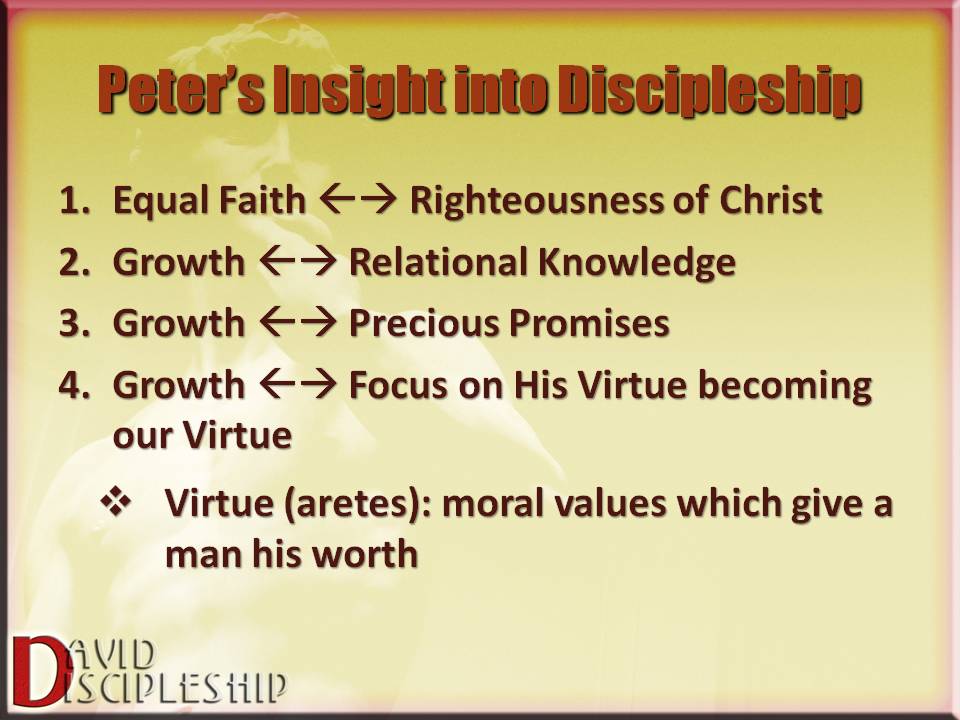
Peter’s Insights into Discipleship:

1. Equal Faith <–> Righteousness of Christ

  • Discipleship grows from Faith that is provided by the righteousness of our Savior Jesus Christ. That faith makes each believer equal in the sight of God. That equality is not based upon knowledge, but upon the righteousness provided us by our God and Savior Jesus Christ!

2. Growth <–> Relational Knowledge

  • Our growth in life and godliness is by His divine power and only through knowing Him in His glory and excellence.

3. Growth <–> Precious Promises

  • Our growth is only by His divine nature becoming our nature through the power of the Word and His precious promises.

4. Growth <–> Focus on His Virtue becoming our Virtue

  • Discipleship must focus on His Virtue becoming our Virtue. We first add virtue to our faith, and knowledge to virtue.

VIRTUE is the Greek “areté” which denotes in a moral sense what gives man his worth[3]

Why is Virtue Important to Discipleship?

There are four synonyms to Areté in the Greek according to Zodhiates…

  • dóxa – glory;
  • dúnamis – power;
  • chárisma – gift;
  • ōphéleia – usefulness[4]

Virtue is a quality that is difficult to define, but definite in its impact. From the synonyms we glimpse the power of this little word. Here is my humble attempt at a definition.

Virtue is the strength of the character of Christ internalized into my life as I follow Him. Virtue brings worth and value to my life. Without His virtue I am weak and ineffective.

Virtue grows from an obedient relationship!

Discipleship programs are not effective if their focus is primarily upon knowledge (ginosis). It must be knowledge that grows from a personal on-going relationship with Jesus Christ Himself! (epiginosko). I know far too many graduates of Christian Schools and Colleges that display little if any of the life of Jesus Christ. A surprising number no longer go to church. Knowledge is not enough to become a disciple of Jesus Christ. Look at Judas. He had three years of instruction from Jesus Christ, and yet there was no changed life!

Discipleship is Life-Changing only if it is Life-Giving!

Discipleship must lead believers into a life that is above the natural, a life that is empowered by the Righteous Life of Jesus Christ. His virtue of LIFE becomes our virtue by our dying.

We Have No Virtue worth Propping up

Discipleship is not a self-improvement course. It is not a way of “improving” your Christian walk! We are ugly before we are saved, we are ugly after we are saved. The only beauty we can ever have is the beauty of Jesus Christ.

COULD YOUR HEART PASS THE HOLE IN THE WALL TEST?

God told Ezekiel to dig a hole in the King’s wall. He was startled by the abominations being committed by the ‘supposed’ righteous leaders of Israel.

Ezekiel 8:8-13 (ESV) 8 Then he said to me, “Son of man, dig in the wall.” So I dug in the wall, and behold, there was an entrance. 9 And he said to me, “Go in, and see the vile abominations that they are committing here.” 10 So I went in and saw. And there, engraved on the wall all around, was every form of creeping things and loathsome beasts, and all the idols of the house of Israel. 11 And before them stood seventy men of the elders of the house of Israel, with Jaazaniah the son of Shaphan standing among them. Each had his censer in his hand, and the smoke of the cloud of incense went up. 12 Then he said to me, “Son of man, have you seen what the elders of the house of Israel are doing in the dark, each in his room of pictures? For they say, ‘The Lord does not see us, the Lord has forsaken the land.’ ” 13 He said also to me, “You will see still greater abominations that they commit.”

No matter how ‘spiritual’ we pretend to be, or how much ‘Bible knowledge’ we possess, no one can pass the “Hole in the Wall” test. Our hearts are full of abominations through sin. The harder we try to be a good disciple, the further we alienate ourselves from the heart of God! The heart of God is centered around the virtue of His Son, Jesus Christ! The only virtue worth having is not man-centered but Christ-centered!

Discipleship finds all that we need in Jesus Christ

1 Corinthians 1:30-31 (NIV) 30 It is because of him that you are in Christ Jesus, who has become for us wisdom from God–that is, our righteousness, holiness and redemption. 31 Therefore, as it is written: “Let him who boasts boast in the Lord.”

Discipleship which focuses on knowledge will always lead to pride and self-effort. Discipleship which focuses on virtue will always lead to humility and dependence.

Therefore I define Discipleship as:

Discipleship – “the intentional process of making the virtue of Christ my own, through submitting to His Lordship and Direction, and the daily Hope of Gaining Christ”

Discipleship is simply gaining by trading (diapragmateúomai)[5];

The King will demand an accounting of what you have GAINED by trading

Luke 19:15 (ESV) When he returned, having received the kingdom, he ordered these servants to whom he had given the money to be called to him, that he might know what they had gained by doing business.

I believe we will be judged at the ‘bema seat’ and our judgment will simply be an accounting of what we traded to gain for the sake of becoming like Jesus Christ! We will be judged for how we ‘gained’ Jesus Christ! Christians are to be about the business of trading their lives to gain Jesus Christ!

Paul said it best in Philippians 3:8: Philippians 3:8 (ESV) Indeed, I count everything as loss because of the surpassing worth of knowing Christ Jesus my Lord. For his sake I have suffered the loss of all things and count them as rubbish, in order that I may gain Christ

So the ‘re-bar’ of discipleship is the Virtue of Jesus Christ! Any substitution or absence of His virtue will result in a foundation that is weak and doomed to fail.

Our Hope of Glory is Christ IN me

Colossians 1:27 (ESV) To them God chose to make known how great among the Gentiles are the riches of the glory of this mystery, which is Christ in you, the hope of glory.


[1] Spiros Zodhiates, The Complete Word Study Dictionary – New Testament, (Chattanooga, TN: AMG Publishers, 1993), WORDsearch CROSS e-book, 936.

[2] Epígnōsis: In the NT, it often refers to knowledge which very powerfully influences the form of religious life, a knowledge laying claim to personal involvement. When used as an obj. (Eph. 1:17; 4:13; Col. 1:9, 10; 2:2; 1 Tim. 2:4; 2 Tim. 2:25; 3:7; Titus 1:1; Heb. 10:26; 2 Pet. 1:2, 3), it shows the relationship of the learner to the object of his knowledge (2 Pet. 1:8). Spiros Zodhiates, The Complete Word Study Dictionary – New Testament, (Chattanooga, TN: AMG Publishers, 1993), WORDsearch CROSS e-book, 624.

[3] Spiros Zodhiates, The Complete Word Study Dictionary – New Testament, (Chattanooga, TN: AMG Publishers, 1993), WORDsearch CROSS e-book, 252-251.

[4] Spiros Zodhiates, The Complete Word Study Dictionary – New Testament, (Chattanooga, TN: AMG Publishers, 1993), WORDsearch CROSS e-book, 252.

[5] Spiros Zodhiates, The Complete Word Study Dictionary – New Testament, (Chattanooga, TN: AMG Publishers, 1993), WORDsearch CROSS e-book, Under: “megauploaddiapragmateúomai”.


I want to focus on the golden sash across Jesus chest. It is the sash that covers His heart. It is a Kingly sash, wore by one in authority. It is a symbol of strength for action. The material is real gold and gold is only achieved when refined by fire, indicating that He was tested, yet came forth as gold. The purity of gold over His heart represents the purity of His love.

His heart of love is the basis of His authority, His strength and His actions. His love is the foundation for everything He is and does. This is Divine Love, which we understand when we see the Real Jesus. It is a Love this world does not understand.

We need an extreme makeover of our concept of love.

We need to see the Real Jesus to understand the Love that He expects us to have in our Christian Life.

Most of us really only know phileo, brotherly love. It is love (actually friendship) based on common interests and concerns. It is usually based on our interests and concerns.

Jesus expects Christians to have agape love. He expressed what it means in Matthew 5:44 when He told us to “love your enemies”

To love (agapáō) others means to see what their need is and to meet that need, not according to that person’s concept of need, but that of the one who loves. For a believer, we are to see the needs of even our enemies and we must do everything in our power to meet that need. Believers are never told to love their enemies with the word philéō because that would mean to have the same interests as they have[1].

To See This we need to understand God calling us ‘friends’

God calls us his friend (phílos), as He did Abraham (James 2:23), when we adopt His interests as our own, just as Abraham was willing to sacrifice his son even as God did His own.[2]

The Son of Man, the Real Jesus Christ has a message for each of seven churches in Revelation. Each message indicates a facet or characteristic of His Divine Love, and how the church is falling short of His love. The very first church, Ephesus, thinks they love Jesus, but Jesus wants them to understand what Divine Love is really all about.

Revelation 2:1-3

“To the angel of the church in Ephesus write: ‘The words of him who holds the seven stars in his right hand, who walks among the seven golden lampstands. “ ‘I know your works, your toil and your patient endurance, and how you cannot bear with those who are evil, but have tested those who call themselves apostles and are not, and found them to be false. I know you are enduring patiently and bearing up for my name’s sake, and you have not grown weary.

Some clarifications of the words Jesus uses:

Jesus knows (eido). He knows these people intimately, and watches them constantly.

  • “emphasizes better the absolute clearness of mental vision which photographs all the facts of life as they pass” (Swete)[3].

Works (ergon)

  • erga; The whole life and conduct as in John 6:29[4]. “Jesus answered them, “This is the work of God, that you believe in him whom he has sent.” John 6:29
  • deed, act, action, something done[5]

Toil (kopos)

  • kópos; gen. kópou, from kóptō <G2875>, to strike. Beating, wailing, grief with beating the breast, equal to kopetós <G2870>, lamentation, wailing (Sept.: Jer. 51:3). In the NT, toil, labor, i.e., wearisome effort, generally[6]
  • Originally suffering, weariness; hence exhausting labor[7]

Patient endurance (hupomone)

  • Hupomoné is associated with hope (1 Thess. 1:3) and refers to that quality of character which does not allow one to surrender to circumstances or succumb under trial.[8]

Cannot tolerate evil men (Not able (ou dunēi).bear (bastasai)

  • No power to bear them. They are such a burden, you dismiss them as being a burden and drag to the congregation.
  1. Test and deny false (pseudo) apostles
  2. Patiently endured and born up for the sake of Jesus (bastazo)
  • bastázō; from básis, basis, foot. To bear, carry in the hands or on the shoulders (picturing the duty of a servant, to bear a pitcher of water). Also pictures carrying the cross.
  • Figuratively it means to bear, support, endure, i.e., labors, sufferings[9]

Not fainted or turned back. (kopiáō)

  • kopiáō; contracted kopió, from kópos, labor, fatigue. To be worn out, weary, faint[10]

Ephesus sounds like a great church. They are doing all the right things. Any Pastor would be proud of this church! But they should be a church rich in ‘agape’ Love, for Paul taught them all about it…

Paul Emphasized Love to the Ephesians

Remember Paul’s letter to the Ephesians: It was all about needing, knowing, living a life of Love, God’s Divine Love.

  • 1:5 –  “In love he predestined us for adoption as sons through Jesus Christ
  • 2:4 –   “For his great love wherewith he loved us”
  • 3:17 – “that you, being rooted and grounded in love,
  • 3:19 – ” the breadth and length and height and depth, and to know the love of Christ”
  • 4:2 –   “bearing with one another in love”
  • 4:15 – “speaking the truth in love”
  • 4:16 –  “the body…builds itself up in love”
  • 5:2 –   “Walk in love as Christ also loved us”
  • 5:25 – “As Christ loved the church and gave himself for it”
  • 5:25, 28, 33 “Husbands love your wives” – because you picture the love of Jesus Christ.

How could the Church at Ephesus fail the Test of the ‘Golden Sash’?

But I hold this against you, that you do not love as you did at first. Remember then how far you have fallen. Repent and live as you lived at first. Otherwise, if your heart remains unchanged, I shall come to you and remove your lampstand from its place. Revelation 2:4-5(Phillips)

~’But I have this against you, that you have left your first love. ~’Therefore remember from where you have fallen, and repent and do the deeds you did at first; or else I am coming to you and will remove your lampstand out of its place—unless you repent. Revelation 2:4-5(NASB)

But I have this against you: You have abandoned the love you had at first. Remember then how far you have fallen; repent, and do the works you did at first. Otherwise, I will come to you and remove your lampstand from its place—unless you repent. Revelation 2:4-5(HCSB)

Jesus sees and knows intimately how hard they labor and toil and try to live a life pleasing to Him. They live good and moral lives for His name’s sake. They endure persecution for His sake.

  • However, Jesus sees that something is missing in their hearts.
  • Something about their service bothers Him.
  • Outwardly, everything is great, but inwardly, something is not right.

He sees that their duty is correct, but their devotion is missing love. They are laboring and enduring from obedience rather than love.

They have moved away, they have forgotten what made them new creations. They have forgotten the love of Jesus Christ. Instead of it being about Him, and their love for Him, it has become about the service, the duty, and the religious observances. They are serving Him simply because they should.

Jesus holds this against them.

Remember their deeds at the first? Acts 19 recounts their sacrificial love for Jesus Christ. They sacrificed everything for the sake of following Jesus!

And a number of those who had practiced magic arts brought their books together and burned them in the sight of all. And they counted the value of them and found it came to fifty thousand pieces of silver. So the word of the Lord continued to increase and prevail mightily. Acts 19:19-20

They have Fallen

They have (aphēkes), at a particular moment, made a sad but definite departure from their fist love.

  • your first love (tēn agapēn sou tēn prōtēn). The Love you had at the first!

Aphekes pictures a definite moment in time when they left, deserted, or quit loving Jesus with all their heart mind, soul and strength. It is the same word used in Romans 1:27 that describes a man’s decision to leave the natural love of a woman and start loving a man. O yes, homosexuality is a decision, just as leaving your first love is a decision.

Remember Your First Works

The first works define your life, define your heart. The first works move you to crazy love, where you risk everything for the one you love.

  • The work of God resulted in something utterly crazy, giving His only Son to take all the sins of the world. [“This is the work of God, that you believe in him whom he has sent.” John 6:29]
  • The work of Jesus led Him to become rejected by His Father, so that He might redeem you and me.

Jesus saw their service, but He also saw their hearts, and saw that they were falling into ritual service, ritual devotion, ritual duties. They were faithfully doing their duty. They were being good people doing what good people should. But the basis for their service was no longer their agape love. They had fallen into a phileo love. Their love for Jesus was now based on their own interests and concerns. Gone was that willingness to risk it all for Jesus Christ.

Jesus never meant His followers to religious or good. He meant them to love, the same way He loved. That love was not comfortable, not good, but it risked everything.

The Ephesians needed to repent. You need to ask yourself, do I need to repent?

  1. They had made a definite decision, which weakened their love.
  2. Their decision resulted in a fall from Divine Love, the only Love, which pleases the Lord.
  3. Their decision resulted in duty not devotion.
  4. Their decision resulted in the Lord’s demand for repentance and return.
  • Decision: to love something other than Jesus Christ, or to disobey his commands
  • Fall: Change of focus meant that the throne of God lost its power

Leaving their first love meant that sacrifice and devotion gave way to duty and observances.

The impact of this letter to the Ephesians is seen in answering the following questions from what Jesus said in the Gospels.

How Does Jesus Define Divine Love?

Divine Love is Crazy, with no concern for yourself, your safety, your possessions or even your reputation:

Matthew 5:43-48 “You have heard that it was said, ‘You shall love your neighbor and hate your enemy.’ But I say to you, Love your enemies and pray for those who persecute you, so that you may be sons of your Father who is in heaven. For he makes his sun rise on the evil and on the good, and sends rain on the just and on the unjust. For if you love those who love you, what reward do you have? Do not even the tax collectors do the same? And if you greet only your brothers, what more are you doing than others? Do not even the Gentiles do the same? You therefore must be perfect (COMPLETE, FULL), as your heavenly Father is perfect.

Luke 6:27-31 “But I say to you who hear, Love your enemies, do good to those who hate you, bless those who curse you, pray for those who abuse you. To one who strikes you on the cheek, offer the other also, and from one who takes away your cloak do not withhold your tunic either. Give to everyone who begs from you, and from one who takes away your goods do not demand them back. And as you wish that others would do to you, do so to them.

What is the Source of Divine Love?

As the Father has loved me, so have I loved you. Abide in my love. If you keep my commandments, you will abide in my love, just as I have kept my Father’s commandments and abide in his love. These things I have spoken to you, that my joy may be in you, and that your joy may be full. John 15:9-11

I made known to them your name, and I will continue to make it known, that the love with which you have loved me may be in them, and I in them.” John 17:26

You must know and be convinced of the Power of God’s Name if you are to risk everything for the sake of Jesus Christ.

What Causes us to lose our Divine Love?

A. NEGLECT OF THE WORD: Jesus answered him, “If anyone loves me, he will keep my word, and my Father will love him, and we will come to him and make our home with him. Whoever does not love me does not keep my words. And the word that you hear is not mine but the Father’s who sent me. John 14:23-24

B. Other or Divided Interests: “No one can serve two masters, for either he will hate the one and love the other, or he will be devoted to the one and despise the other. You cannot serve God and money. Matthew 6:24

C. FRIENDSHIP WITH THE WORLD: You adulterous people! Do you not know that friendship with the world is enmity with God? Therefore whoever wishes to be a friend of the world makes himself an enemy of God. James 4:4

D. CHOSE COMFORT vs. SACRIFICE: READ MATT 19:17-21 And he said to him, “Why do you ask me about what is good? There is only one who is good. If you would enter life, keep the commandments.” He said to him, “Which ones?” And Jesus said, “You shall not murder, You shall not commit adultery, You shall not steal, You shall not bear false witness, Honor your father and mother, and, You shall love your neighbor as yourself.” The young man said to him, “All these I have kept. What do I still lack?” Jesus said to him, “If you would be perfect (complete, full), go, sell what you possess and give to the poor, and you will have treasure in heaven; and come, follow me”.

How important is it that we have Divine Love?

John 5:40-44 “yet you refuse to come to me that you may have life. I do not receive glory from people. But I know that you do not have the love of God within you. I have come in my Father’s name, and you do not receive me. If another comes in his own name, you will receive him. How can you believe, when you receive glory from one another and do not seek the glory that comes from the only God?

Divine Love is Fullness of life!

Be Full and Complete as the Father is Full! Only when you risk it all do you know true love and fullness! Which would you rather eat-the fruit of the forbidden tree or the fruit of the tree of life! Those that keep their first love will eat of the Tree of Life. The Tree of Life was in the Garden of Eden, where life was complete, full, until sin entered the world. The Tree of Life will be in the New Heavens, when God’s plan is fulfilled, and life on earth is full!

The world teaches that fullness of life is in possessions and money, a prestigious career, the number of friends you have, or even your family.

But Jesus said “whoever would save his life will lose it, but whoever loses his life for my sake and the gospel’s will save it. For what does it profit a man to gain the whole world and forfeit his soul?” Mark 8:35-36

Divine Love is Fullness of Life…Fullness of Life comes to those willing to risk it all for His sake!

What are the consequences of fallen love?

In His letter to the church, the danger was the removal of the candlestick, which signifies the removal of the fire of the Holy Spirit. Today Ephesus lies in ruins, and the church is long gone.

  • Worship Devoid of the Spirit

Across the world there are churches that look like churches, act like churches, but the Divine Love of God is not in them. The Holy Spirit is not there. They are functioning out of a mistaken sense of duty. There may be a supposed love for Jesus, but they have fallen from His standards. They are down, serving in their fleshly strength. They are not living in the fullness of Christ of His love, of His word. They are like the Pharisees, content in their religious observances, yet on their way to Hell.

  • Children, teens Abandon the Church

The other consequence is that our children grow up with a concept of religion, but no concept of loving a real Jesus. Therefore, they rebel against religion for the sake of religion, and seek after something else that fills the void in their heart.

  • A Nation that is Outwardly Moral but inwardly Corrupt

How do we return to our first love?

Jesus said we are to do three things:

A.Remember

  1. Remember what He has done for you
  2. Remember what you were willing to do at first.

B.Repent

  1. Change your heart focus,
  2. Get rid of those things that have captured your affections, that have taken the place of Jesus Christ.

C.Return

  1. Do what you did when you first came to Jesus
  2. Live for Him totally.
  3. Risk it all for Him

David Left His First Love

PSALMS 51:7-15 Purge me with hyssop, and I shall be clean; wash me, and I shall be whiter than snow. Let me hear joy and gladness; let the bones that you have broken rejoice. Hide your face from my sins, and blot out all my iniquities. Create in me a clean heart, O God, and renew a right spirit within me. Cast me not away from your presence, and take not your Holy Spirit from me. Restore to me the joy of your salvation, and uphold me with a willing spirit. Then I will teach transgressors your ways, and sinners will return to you. Deliver me from bloodguiltiness, O God, O God of my salvation, and my tongue will sing aloud of your righteousness. O Lord, open my lips, and my mouth will declare your praise.

David returned to his first love, singing and writing the Psalms, teaching others of the ways of God!

Peter Left His First Love

John 21:15-18 “When they had finished breakfast, Jesus said to Simon Peter, “Simon, son of John, do you love me more than these?” He said to him, “Yes, Lord; you know that I love you.” He said to him, “Feed my lambs.” He said to him a second time, “Simon, son of John, do you love me?” He said to him, “Yes, Lord; you know that I love you.” He said to him, “Tend my sheep”. He said to him the third time, “Simon, son of John, do you love me?” Peter was grieved because he said to him the third time, “Do you love me?” and he said to him, “Lord, you know everything; you know that I love you.” Jesus said to him “Feed my sheep. Truly, truly, I say to you, when you were young, you used to dress yourself and walk wherever you wanted, but when you are old, you will stretch out your hands, and another will dress you and carry you where you do not want to go.”

Peter had left his first love, even denying Christ, and returning to the thing he loved most-fishing. Yet, when confronted by Jesus, he could only confess deep emotions for Jesus. He was not quite ready to confess agape love, that love that risks everything, sacrifices everything. Still, Jesus said, feed and care for my sheep. You will one day know that agape love.

Return to the works you did at the first. Return to the time you depended upon me for everything. The agape will return. You will regain your first love. You will sacrifice, you will risk it all!

Peter returned to His agape love, and He teaches us the importance of it in his last letter. Look at what Peter wrote in 2 Peter 1:3-11:

2 Peter 1:3-11 – His divine power has granted to us all things that pertain to life and godliness, through the knowledge of him who called us to his own glory and excellence, by which he has granted to us his precious and very great promises, so that through them you may become partakers of the divine nature, having escaped from the corruption that is in the world because of sinful desire. For this very reason, make every effort to supplement your faith with virtue, and virtue with knowledge, and knowledge with self-control, and self-control with steadfastness, and steadfastness with godliness, and godliness with (phileo) brotherly affection, and brotherly affection with (agape) love. For if these qualities are yours and are increasing, they keep you from being ineffective or unfruitful in the knowledge of our Lord Jesus Christ. For whoever lacks these qualities is so nearsighted that he is blind, having forgotten that he was cleansed from his former sins. Therefore, brothers, be all the more diligent to make your calling and election sure, for if you practice these qualities you will never fall. For in this way there will be richly provided for you an entrance into the eternal kingdom of our Lord and Savior Jesus Christ. 2 Peter 1:3-11

  • You will never fall as I did. You will keep your first love!

Do You See the Real Jesus? Do you see His Golden Sash? Do You Pass the Gold Sash Test.? Do You Love Him with Divine Love?

Have you fallen into comfort and complacency? Are you still doing the first works? Are you still risking everything for Jesus Christ? Perhaps you never did, perhaps you are not a genuine follower of Jesus Christ. Perhaps you never loved Him with agape love. You need to make sure you are a Christian. You need to repent and love Jesus with agape, sacrificing, risking it all kind of love!

Do you really want to Know Divine Love?
Do you want to see the Real Jesus?

Turn with me to Hebrews 13:12

So Jesus also suffered outside the gate in order to sanctify the people through his own blood. Therefore let us go to him outside the camp and bear the reproach he endured. Hebrews 13:12-13

Outside the Camp is Where we Find Agape Love

Jesus Christ died to set apart a people unto God. If we truly love Him, we must go to where He was willing to go – outside the camp.

  • ‘Outside the camp’ is where the lepers were kept.
  • ‘Outside the camp’ is where murderers were sent.
  • ‘Outside the camp’ is where the beggar begged as the apostles walked through the gate.
  • ‘Outside the camp’ was where all who were to be separated from society at large were to be kept.

‘Outside the camp’ is where we were called to ‘go to him’ and ‘bear the reproach he endured’ – death. Death to our comfort, death to our desires, death to our reputation.

Going Outside the Camp is where we discover the Love of the Golden Sash.

By this we know love, that he laid down his life for us, and we ought to lay down our lives for the brothers. But if anyone has the world’s goods and sees his brother in need, yet closes his heart against him, how does God’s love abide in him? Little children, let us not love in word or talk but in deed and in truth. By this we shall know that we are of the truth and reassure our heart before him;1 John 3:16-19

  • Divine Love risks it all for the city that is to come.
  • Whatever you lose in this life will be made up 1000 fold in the life to come.
  • We can either retreat and perish in the wilderness
  • We can risk it all for the love of Jesus Christ, who risked it all for us.

In the 1600’s there was a man named Joseph Aline and he wrote a book entitled An Alarm to Unconverted Sinners.Let me close our time with what he said.

“All of Christ is accented by the sincere convert. He loves not only the wages, but the work of Christ. Not only the benefits but the burden of Christ. He’s willing not only to tread out the corn but to draw under the yoke. He takes up the command of Christ, yea, even the cross of Christ. The unsound man closes by halves with Christ. He’s all for the salvation of Christ but he’s not for sanctification. He is for the privileges but appropriates not the person of Christ. He divides the offices and benefits of Christ. This is an error in the foundation. Who so loveth life let him beware here. It is an undoing mistake of which you have beenoften warned and yet none is more common. Jesus is a sweet name but men love not the Lord Jesus in sincerity. They divide what God has joined, the King and the Priest, yea they will not accept the salvation of Christ as He intends it. They divide it, every man’s vote is for salvation from suffering but they desire not to be saved from sinning. They would have their lives saved but with all would have their lusts. Yea, many divide here again, they would be content to have some of their sins destroyed but they cannot leave the lap of Delilah or divorce the beloved Herodias. They cannot be cruel to the right eye or right hand. The Lord must pardon then in this thing. 0 be careful here, your soul depends on it. The sound convert takes a whole Christ, takes Him for all intents and purposes, without exceptions, without limitations, without reserve. He’s willing to have Christ upon any terms. He’s willing to have the dominion of Christ as well as deliverance by Christ and he says with Paul, “Lord, what wilt Thou have me to do?”


[1] Spiros Zodhiates, The Complete Word Study Dictionary – New Testament, (Chattanooga, TN: AMG Publishers, 1993), WORDsearch CROSS e-book, Under: “phileo”.

[2] Ibid.

[3] Archibald Thomas Robertson, A.M., D.D., LL.D., Litt. D., Word Pictures in the New Testament, (Nashville, TN: Broadman Press, 1930), WORDsearch CROSS e-book, Under: “Revelation 2:2”.

[4] ibid.

[5] Spiros Zodhiates, The Complete Word Study Dictionary – New Testament, (Chattanooga, TN: AMG Publishers, 1993), WORDsearch CROSS e-book, 650.

[6] ibid, 877.

[7] Marvin R. Vincent, Word Studies in the New Testament, (New York: Scribners, 1887), WORDsearch CROSS e-book, Under: “Revelation 2:2”.

[8] Spiros Zodhiates, The Complete Word Study Dictionary – New Testament, (Chattanooga, TN: AMG Publishers, 1993), WORDsearch CROSS e-book, Under: “hupomone”.

[9] Spiros Zodhiates, The Complete Word Study Dictionary – New Testament, (Chattanooga, TN: AMG Publishers, 1993), WORDsearch CROSS e-book, 328.

[10] Ibid, under kopiáō.