Posts Tagged ‘god’


I would like 2012 to be a significant year in the life of our church. I want us to get serious about Discipleship. I want discipleship to be discussed in every class room, every committee meeting, every get together. I want the question that is asked most of each other, “How are you developing as a Disciple of Jesus Christ?” I want each of us to have a clear picture of how we are to develop as disciples of Christ. It will not happen right away, but over the next 18 months, as we look at every aspect of our church in light of Discipleship, we can make the proper adjustments in how we do ministry, and develop a clear-cut road to discipleship, Biblical Discipleship.

This will not come without some difficulties. Discipleship is difficult, for the way is blocked with Goliath’s. Saul’s and Doegs. But if we continue to kneel before the Cross, and desire to follow the Holy Spirit, Christ will do an amazing work in this church and in your lives.

Many (if not most) Christians Live in a Cave

We need to ask ourselves “Are we walking in the Light?” (If you are not daily in the Word of God how can you think you are walking in the Light?) I believe many Christians are living in a cave, but they may or may not realize it. Their profession of faith in Christ may have been real, but they have stopped walking by FAITH. They walk by sight. And sadly, when you walk by sight, you are blind. You are living in a Cave. The danger is that living in a cave will produce eyes that no longer see the light. They can no longer walk by faith. They can no longer see Him who is invisible. When you become used to the darkness of the cave, you don’t realize how much ‘light’ you are missing. Isaiah wrote about the Lord:

Isaiah 42:5-7 Thus says God, the LORD, who created the heavens and stretched them out, who spread out the earth and what comes from it, who gives breath to the people on it and spirit to those who walk in it: “I am the LORD; I have called you in righteousness; I will take you by the hand and keep you; I will give you as a covenant for the people, a light for the nations, to open the eyes that are blind, to bring out the prisoners from the dungeon, from the prison those who sit in darkness.

When Jesus began His public ministry, he proclaimed:

Luke 4:18 “The Spirit of the Lord is upon me, because he has anointed me to proclaim good news to the poor. He has sent me to proclaim liberty to the captives and recovering of sight to the blind, to set at liberty those who are oppressed,

The Jewish people thought they were walking in the light. But in actuality they were held in prison by the perversions of the Law perpetrated by the Pharisees. Jesus opened many eyes to the true Light of the Gospel, but the religious Leaders remained blind, because “we just don’t do it that way”. Jesus did not fit into the mold formed in the cave of their minds and they rejected Him. In fact, they crucified Him, for they refused to follow His light.
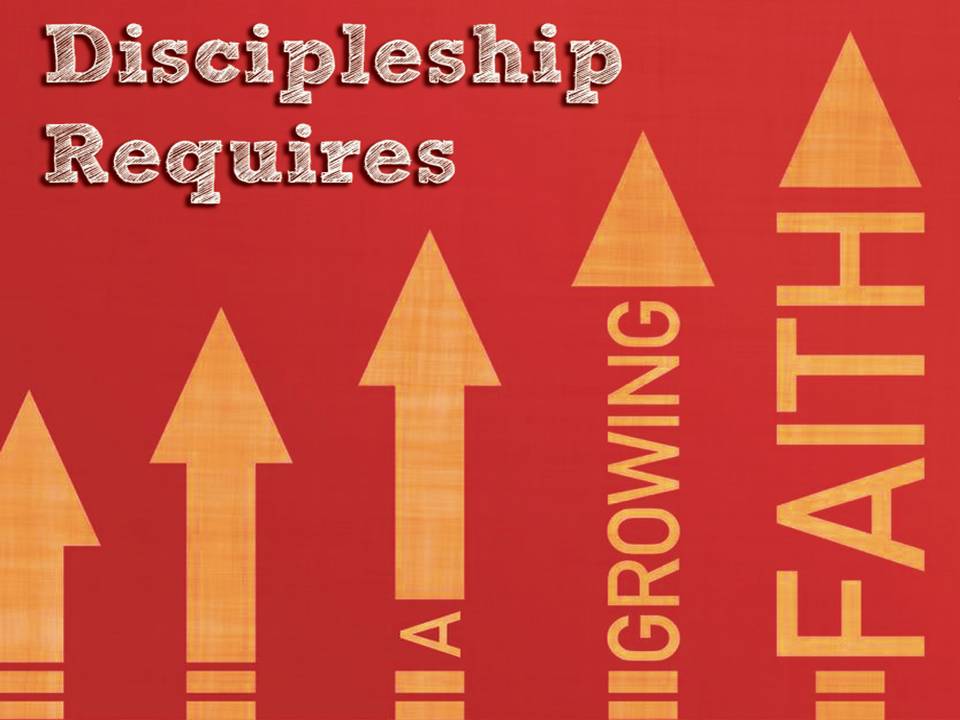
Discipleship is difficult, for you follow Christ, not a religion, not a list of man-made rules or traditions. Discipleship requires an ongoing growth and development of a relationship with an invisible Savior. Discipleship requires Faith, for only Faith imparts the ability to see Him who is Invisible.

Jesus proclaimed that He was coming to give sight to the blind. But in order to receive sight, we must be willing to submit to His leadership and commands. Any resistance on our part places us right back in the darkness that Jesus came to free us from.

I.   David Discipleship Involves:

A. Involves Growing Faith, Or It Is Not Discipleship.

1 Samuel 23:29 And David went up from there and lived in the strongholds of Engedi.
David leaves the Rock of Escape and goes down to the Dead Sea, to find refuge in the Strongholds of EnGedi. EnGedi is a great hideout. Plenty of hide-outs, fresh water, a veritable oasis. EnGedi is the largest oasis along the western shore of the Dead Sea.  The springs here have allowed nearly continuous inhabitation of the site for 4000 years. The abundant springs and year-round temperate climate provided the perfect conditions for agriculture in ancient times. Solomon compared his lover to “a cluster of henna blossoms from the vineyards of EnGedi,” an indication of the beauty and fertility of the site (Song 1:14).

Even though there are many springs around the Dead Sea, most of them have a high salt content. EnGedi is one of only two fresh water springs located on the western shore of the Dead Sea and, because of the greater availability of land for agriculture at EnGedi, it is the best spring by which to settle.

EnGedi means literally “the spring of the kid (goat).” Evidence exists that young ibex have always lived near the springs of EnGedi. One time when David was fleeing from King Saul, the pursuers searched the “Crags of the Ibex” in the vicinity of EnGedi.

David could have settled here and hoped in the natural strongholds that were there in EnGedi. He may not have become content, but he and his men could have resumed more normal lives. They could have still worshipped God, do an occasional good deed, and been safe. That is what a stronghold is, a place of safety due to its position or protection.

But this would not produce the Discipleship that God required of David, nor would it serve to transform David’s crew into Mighty Men. God wanted them to grow in their faith.

So God allowed King Saul to find David. God lead Saul into David’s Stronghold.

 1 Samuel 24:1-3 When Saul returned from following the Philistines, he was told, “Behold, David is in the wilderness of Engedi.” Then Saul took three thousand chosen men out of all Israel and went to seek David and his men in front of the Wildgoats’ Rocks. And he came to the sheepfolds by the way, where there was a cave, and Saul went in to relieve himself. Now David and his men were sitting in the innermost parts of the cave.

 His Men are urging David to Kill Saul

1 Samuel 24:4 And the men of David said to him, “Here is the day of which the LORD said to you, ‘Behold, I will give your enemy into your hand, and you shall do to him as it shall seem good to you.’ ”

Perhaps David had told his men of a promise God had given him, a promise of deliverance similar to Abraham. His men believed in David, and when Saul came to them, excitedly they exclaimed that “Deliverance is Here”! Perhaps David identified with Abram, when God delivered his enemies into his hand:

 Genesis 14:17-20 After his return from the defeat of Chedorlaomer and the kings who were with him, the king of Sodom went out to meet him at the Valley of Shaveh (that is, the King’s Valley). And Melchizedek king of Salem brought out bread and wine. (He was priest of God Most High.) And he blessed him and said, “Blessed be Abram by God Most High, Possessor of heaven and earth; and blessed be God Most High, who has delivered your enemies into your hand!” And Abram gave him a tenth of everything.

Encouraged by his men, the Scriptures record what happened next: “Then David arose and stealthily cut off a corner of Saul’s robe.” His men must have been shocked. Why didn;t he kill him. Their troubles would be over. They could go home. David could be King. But God wanted each of them to learn a valuable lesson. 

1.  Disciples that desire safety and comfort usually end up in the dark as far as God is concerned.
2.  In the cave of safety, our self-centeredness prevents us from seeing the light of Jesus Christ
3.  In the cave of safety we often resort to solving our problems with our own short-sighted vision.

God wanted David and his men to look to Him in the darkness of the cave, not to their own resources. Here was a struggle of conscience pre-ordained of God that would lead these men into the very presence of God!

As John Piper told his church:

But if we do what David did, and follow the call of God—hazards and all—then we will come to this place week in and week out with a sense of deepening reality and power.

That’s essential number one: if God’s blessing is going to be on this place, as a place of real worship, then those of us who gather here must gather as a kind of haven between hazards. Not as a haven instead of hazards but a haven between hazards. True worship will come from the impulse to hazard things for the name of God.[1]

B. Involves Growing Worship, Or It Is Not Discipleship.
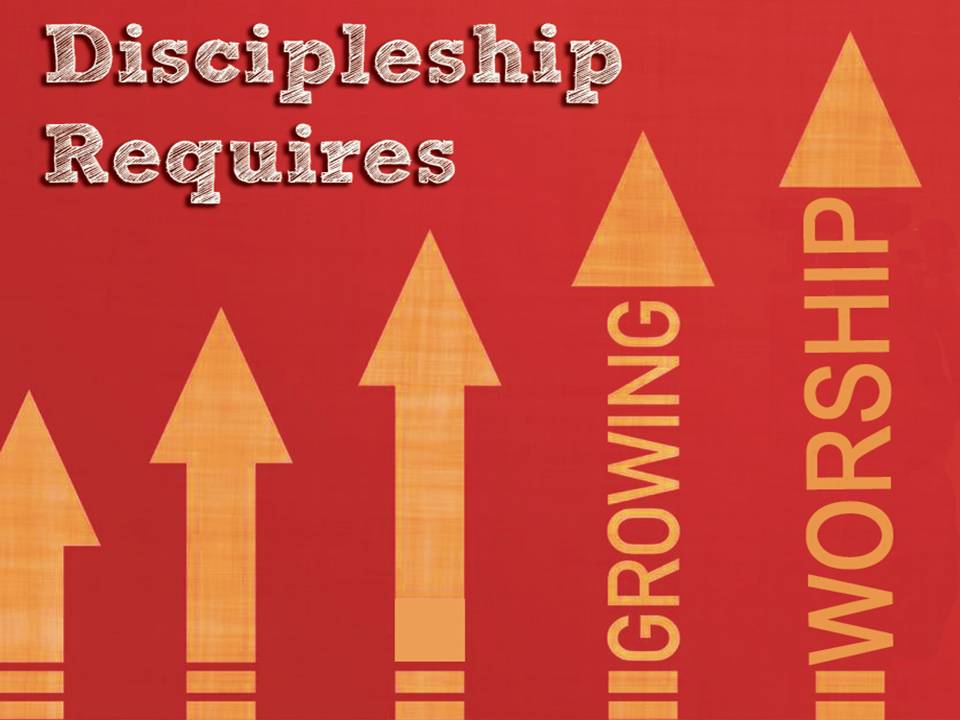
Most people associate worship with something you do when things are going OK. We associate church with worship. We go to church when things are normal. I have discovered that when things get “abnormal” that folks don’t really feel like worshipping at church. When we are overwhelmed with house guests. When we experience the loss of a loved one. When we have a tragedy strike us. When we are stricken with a deadly disease.

One thing very obvious about David is His worship of God, especially when things were “abnormal” And David’s worship wasn’t confined to the Tabernacle of the Temple. David worshipped God anywhere and everywhere. But David especially worshipped God when things were “abnormal”, because Worship was what David lived for.

When David found himself in the cave, with Saul but a breath away, followed by his 3000 trained killers, David was justifiably afraid. It was dark, he was trapped, here was Saul, his men outside. David’s men wanted to kill Saul, but David feared God much more than he feared King Saul. Since he was the anointed King of Israel, only God could remove him. It was not within David’s power. Even if Saul was dead, what would the 3000 armed men do when they discovered he was dead?

No, this was problem too great for David. His men needed to learn what David already knew, that God had great power to deal with dangerous or perilous situations in our life. We can see David’s heart response and message to his men in Psalm 57:

For the director of music. To the tune of “Do Not Destroy.” Of David. A miktam (instruction). When he had fled from Saul into the cave. 

Psalm 57:1-11 Be merciful to me, O God, be merciful to me, for in you my soul takes refuge; in the shadow of your wings I will take refuge, till the storms of destruction pass by. I cry out to God Most High, to God who fulfills his purpose for me. He will send from heaven and save me; he will put to shame him who tramples on me. Selah God will send out his steadfast love and his faithfulness! My soul is in the midst of lions; I lie down amid fiery beasts— the children of man, whose teeth are spears and arrows, whose tongues are sharp swords. Be exalted, O God, above the heavens! Let your glory be over all the earth! They set a net for my steps; my soul was bowed down. They dug a pit in my way, but they have fallen into it themselves. Selah My heart is steadfast, O God, my heart is steadfast! I will sing and make melody! Awake, my glory! Awake, O harp and lyre! I will awake the dawn! I will give thanks to you, O Lord, among the peoples; I will sing praises to you among the nations. For your steadfast love is great to the heavens, your faithfulness to the clouds. Be exalted, O God, above the heavens! Let your glory be over all the earth!


David cried out to God to fulfill His purpose in his life. If God’s purpose was to be accomplished by David’s death, then so be it. But David had a promise from God that he would be King, so David cried out for that purpose to be accomplished.

  • David asked God to send out His “hesed” (unfailing love) and his faithfulness
  • David asked that God be exalted regardless of what happened.
  • David affirmed that his heart was fixed upon God.
  • David promised to give thanks to all the people, regardless of the outcome.
  • David worshiped one more time and exalted God.

Because David’s heart was fixed upon God, David always worshipped God in the midst of his problems, and in fact exalted God in the face of his problems. No matter what David faced, he always said “God, this is for you to handle. You be exalted, and however you work this out, I will praise you before all the people”.

We will see this over and over in David’s life. Because his heart was given to God, David sought to see God’s justice in every situation he faced, even in the unjust ones.

Application:

Are you overwhelmed with a certain situation? Do you struggle with what God is doing in your life?

  • Confess to God your sinfulness for not giving Him your heart, and for not fixing your heart upon Him.
  • Confess your lack of worship and then bow humbly before Him, and ask Him to fulfill His purpose for your life. Ask Him to be exalted in the situation you are facing. Then bow before Him and say, whatever you want for my life, I accept it and I want it. I want you to be exalted in this situation.

II.  David Discipleship Requires:

A. Requires Humble Submission to God’s Ways, or there will be no Discipleship

There was a mom with a young pre-teen who was neglecting his chores to play his new video game, Call of Duty: Modern Warfare 3. His room was a disaster, and Mom had enough. She marched into his room and holding her preferred form of politically incorrect discipline, exclaimed “Get up and clean this room or you will know the wrath of Vladimir Makarov!” He knew what that meant, so he jumped up and started cleaning his room. You could tell his heart was not in it, however, and soon he said, “I may be cleaning my room on the outside, but inside I’m playing Modern Warfare 3 and I’m blasting away! He was submitting to a greater force, but only because he had to. But that is not David’s heart in the Cave.

Three things in Psalm 57:1 show a disciple’s (David) submission before God.

  • He cries for mercy. He sees his need from God for mercy and grace. 
  • He cries out for a refuge. He is vulnerable before his enemies, he sees his need for God’s provision. 
  • He calls his refuge the “shadow of God’s wings.” David, the mighty warrior, the anointed of God, says, “In the shadow of thy wings I will take refuge.” In other words, “I am a little chick. And I need the covering of my God.” Submission to God requires humility.

Psalm 57:2 “I cry out to God Most High, to God who fulfills his purpose for me”.

Discipleship requires you to submit your will to God’s purpose for you. That took humility for David, especially in front of 600 manly vagabums. But it also requires something else, something that most American Christians stumble at:

B. Requires the Desire for God’s Glory above Our Own Concerns, or there will be no Discipleship

  • Psalm 57:5 Be exalted, O God, above the heavens! Let your glory be over all the earth!
  • Psalm 57:11 Be exalted, O God, above the heavens! Let your glory be over all the earth!
  • Psalm 57:7 My heart is steadfast, O God, my heart is steadfast! I will sing and make melody!

No matter what happens, I want you to be exalted. If it means my death, or my imprisonment, that will be your purpose, and You will be Exalted.

You must be willing to accept poverty, homelessness, sickness, disease, rejection, betrayal, injustice, abuse, anything, as long as it exalts God. A Disciple never says I don’t have to put up with this. A Disciple exalts God to where His glory is between you and any problem you may be having.

Jesus did just that:

1 Peter 2:20-24 For what credit is it if, when you sin and are beaten for it, you endure? But if when you do good and suffer for it you endure, this is a gracious thing in the sight of God. For to this you have been called, because Christ also suffered for you, leaving you an example, so that you might follow in his steps. He committed no sin, neither was deceit found in his mouth. When he was reviled, he did not revile in return; when he suffered, he did not threaten, but continued entrusting himself to him who judges justly. He himself bore our sins in his body on the tree, that we might die to sin and live to righteousness. By his wounds you have been healed.

We have become a Nation that focuses so  much on our Individual Rights, that we place our supposed rights before our responsibilities. That philosophy has infected our church to the point that we put our rights before our responsibilities as a Disciple of Christ.

  • We want our discipleship to be comfortable, but Jesus says I don’t even promise you a bed to sleep on.
  • We want our discipleship to fit our schedule, but Jesus says let the dead bury their dead.
  • We want our discipleship to be convenient, but Jesus says if you put your hand to the plow and then look back at those conveniences, you are not fit for the Kingdom of God.
  • We don’t want our discipleship to make us so different that we’ll be embarrassed, or laughed at,  , or be embarrassing, but Jesus said “whoever is ashamed of me and of my words, of him will the Son of Man be ashamed when he comes in his glory”.
  • We want our discipleship to not be too costly, but Jesus says if you are going to follow Him, you must give up everything by dying to self and taking up His cross for you!

We always say that our primary purpose as Christians is to give Glory to God, but what we mean is that we want a nice comfortable life that portrays the good side of God. How dare Him make us suffer! How can our suffering bring glory to Him? I can do so much more for God when I am affluent and generous! Right?

I was reading about the injustices going on in Eritrea. Evangelical Christians are imprisoned, some for life, for simply bowing their heads in prayer over a meal. They are imprisoned in stifling hot shipping containers or underground bunkers. They are never given baths or showers. There are so many forced into a small place that to lay down and sleep they must sleep on their side. The stench is intolerable. They are given one glass of water a day. They get bread if they are lucky. The prison officials do not care if they live or die. Some are executed. Most are tortured. When a new prisoner come, the first thing anyone says to him, “Did you smuggle any razor blades” because they want to kill themselves. Some are given the opportunity to leave if they recant their faith. Most do not. They cannot, for they are Disciples of Jesus Christ. They knew what it would cost them when they gave their lives to Him!

One young woman who was caught with a Bible was arrested and tied with her hands and feet tied to opposite limbs behind the back. Her captors told her, “Jesus will save you now.”[2]

Jesus did not save her. She eventually died. Did she march up to Jesus in Heaven and say “How could you forget about me? How could you let me endure such suffering that I died of dehydration?” No, she wakes up in the arms of Jesus, and when she looks into His eyes, she says, Jesus, I would do it all over again, for your wonderful glory!
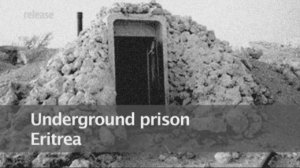
Watch Videos Describing the Torture of Christians going on in Eritrea TODAY!
That is what Discipleship is all about. We develop as Disciples as everything in our life, our good, our bad, our successes, our failures, our joys, our sadness’s are laid at the Cross and our only cry is “Be exalted, O God, above the heavens! Let your glory be over all the earth!” My life is inconsequential to your Glory, but I dedicate it to you, for your use in whatever will bring you Glory!

Psalm 112:1-7 Praise the LORD! Blessed is the man who fears the LORD, who greatly delights in his commandments! His offspring will be mighty in the land; the generation of the upright will be blessed. Wealth and riches are in his house, and his righteousness endures forever. Light dawns in the darkness for the upright; he is gracious, merciful, and righteous. It is well with the man who deals generously and lends; who conducts his affairs with justice. For the righteous will never be moved; he will be remembered forever. He is not afraid of bad news; his heart is firm, trusting in the LORD.

A Disciple is never afraid of bad news. He is not afraid of a diagnosis of cancer. He is not afraid of hearing of a loved one’s tragic death. His heart is firm, always trusting God, no matter what the news.

David wrote another Psalm while he was in the Dark Cave:

Psalm 142 -A maskil (instruction) of David. When he was in the cave. A prayer.

Psalm 142:1-7 With my voice I cry out to the LORD; with my voice I plead for mercy to the LORD. I pour out my complaint before him; I tell my trouble before him. When my spirit faints within me, you know my way! In the path where I walk they have hidden a trap for me. Look to the right and see: there is none who takes notice of me; no refuge remains to me; no one cares for my soul. I cry to you, O LORD; I say, “You are my refuge, my portion in the land of the living.” Attend to my cry, for I am brought very low! Deliver me from my persecutors, for they are too strong for me! Bring me out of prison, that I may give thanks to your name! The righteous will surround me, for you will deal bountifully with me.


When Surrounded by Darkness, in whom do you trust?

  • Do you trust in yourself, doing what you think is best?
  • Do you trust your friends, to get their help?

If David had done either of those, we wouldn’t be studying his life.

David cried out to God, knowing, that

  • “When my spirit faints within me, you know my way!”
  • “You are my refuge, my portion!”
  • “Bring me out of the darkness of this cave, and I will give thanks to your name!”
  • “You deal bountifully with me!”

David turned to God when he was backed into a corner, deep in the darkness of the cave!

What lessons of Hesed, Mishpat and Tsedaqah are in this experience of David’s?

Hesed, Unfailing Love-was in his heart as he refused to kill King Saul. His love for God and trust in Him was stronger than any feeling of hate that might have welled up and led him to take vengeance into his own hands.

  • As a result those men with Him saw the Mercy of God in David’s actions.

Mishpat, justice, was brought into David’s House as both he and his men realized that God must be trusted even in perilous situations where you are tempted to do things your own way. God’s Justice must reign in your response to every situation, good or bad.

  • His men saw that, and the House of David grew strong in the ways of God that day.

Tsedeqah, righteousness, was David’s Hope as He agreed to wait upon God. Even though that meant years of struggle and hardship, it was worth it because David’s Hope was to be in God and His strength, and not in himself. Temporary relief would have brought eternal damnation.

  • His men saw David’s Hope, and would learn to trust God!

Then ask God to grow your Faith to see Him in the Darkness.Do you want to Grow to be a Mighty Man or Woman of God in 2012? Do you want to draw closer to Christ than ever before? Do you His love to be sweeter than ever before?

  • Worship God more faithfully and He will give you more reasons to worship Him.
  • Humble yourself to being a little chickie, needing the protection of His wings.
  • Desire God to be exalted in whatever you face this next year.

Isaiah 9:2 The people who walked in darkness have seen a great light; those who dwelt in a land of deep darkness, on them has light shined.

2 Samuel 22:29-30 For you are my lamp, O LORD, and my God lightens my darkness. For by you I can run against a troop, and by my God I can leap over a wall.

Psalm 18:28-29 For it is you who light my lamp; the LORD my God lightens my darkness. For by you I can run against a troop, and by my God I can leap over a wall.

Isaiah 50:10 Who among you fears the LORD and obeys the voice of his servant? Let him who walks in darkness and has no light trust in the name of the LORD and rely on his God.

When surrounded by Darkness in Whom Do You TRUST?

Isaiah 50:10 … Let him who walks in darkness and has no light trust in the name of the LORD and rely on his God.

How are YOU developing as a Disciple of Jesus Christ?

Overflow through Me!

In days of barren darkness,
I need a light to encourage, refresh,
bring life – God’s word, and grace, and peace.

In a dark and barren world,
God’s Spirit lives within me to be a Light,
abundantly stretching forth, bringing life for all.

Lord, fill me with your light – allow it to shine through me!


I am not against dogs. I love dogs. My only use of ‘dog’ when it comes to “Doeg” is for ease of remembering and to gain an understanding of how David felt as he realized he was now a wanted man, being pursued by “Doeg’s”. Everyone who desires to be a Disciple of Jesus Christ, must realize there are “Doeg’s” that will work to cause us to stumble from the “way of a disciple”. David encountered Doeg in 1 Samuel 21. Let’s see what lessons on Discipleship can we learn.

The very first lesson God taught fleeing David took place at Nob. He had an encounter with a ‘Dog’ (Doeg). (This is not to condemn “Dog the Bounty Hunter“). He is a just a scary looking “Dog” and he pursues relentlessly.

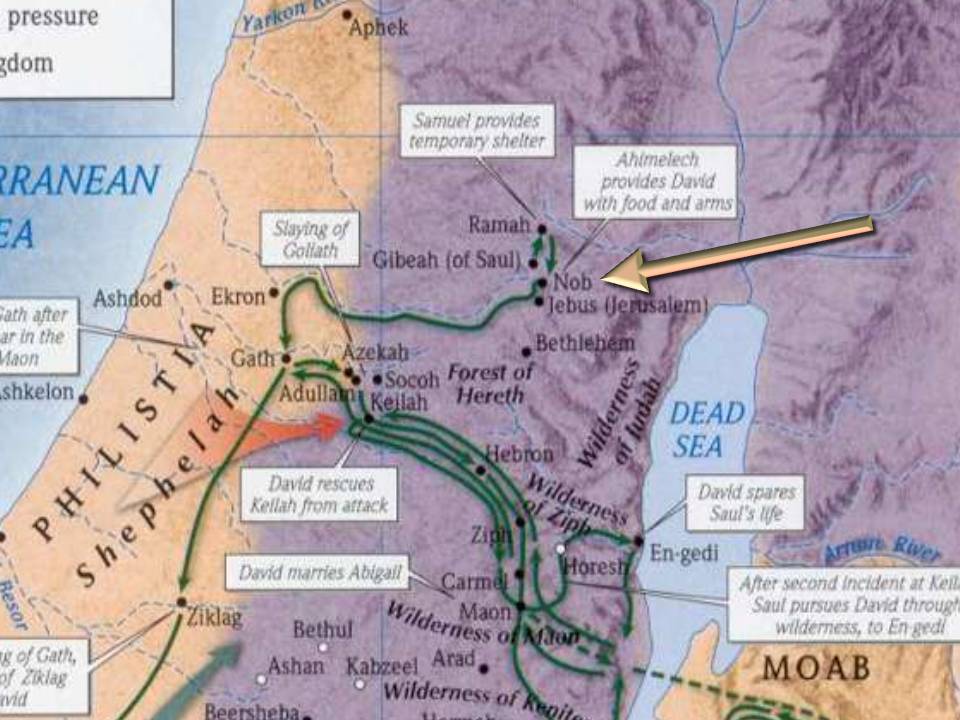
After David left Jonathan at Gibeah, he fled to Nob, the place of the Tabernacle, the city of Priests. Thus began his ‘life as a fugitive’ from Saul, a period of ten years during which he was ‘public enemy number one’ in all of Israel! (1 Sam 21:1-29:11).

God used this time of forced exile to develop David into the Disciple worthy of the Kingdom, in fact, a Disciple worthy of leading the Kingdom. God wanted David to face various tests of his faith, trust and hope. God wanted David to lay the foundation of a Kingdom that one day His very Son would rule over. So that foundation must not be in anything of man, or man’s working. The Foundation of the Kingdom of Christ must be in His Justice and His Righteousness. Therefore David had lessons that God wanted him to learn, lessons that would develop David into the Disciple worthy of establishing the Kingdom of His Son!

The Psalms that David wrote during these 10 years offer insight into David’s Discipleship. While it’s difficult to determine the background of every psalm, it’s likely that David’s fugitive years are reflected in Psalms 7, 11-13, 16-17, 22, 25, 31, 34-35, 52-54, 56-59, 63-64, 142-143[1].

God Wanted David to Rely Solely on Him

Psalm 18 is the Psalm he wrote when the LORD delivered him from the hand of all his enemies and from the hand of Saul. It reveals the Diploma David earned after 10 years of extreme Graduate School!

He began his Psalm of praise with a strange statement coming from a “mighty warrior” who had eluded Saul’s vast army for 10 years. This is not the kind of thing you would hear today from a WWE champion like ” Triple H” aka “The King of Kings”.

 “I love you, O LORD, my strength. The LORD is my rock and my fortress and my deliverer, my God, my rock, in whom I take refuge, my shield, and the horn of my salvation, my stronghold. I call upon the LORD, who is worthy to be praised, and I am saved from my enemies”. Psalm 18:1-3 (ESV)

Becoming a Disciple is about learning not to rely on your own strength, but to rely on the one who is greater than everything!

David’s Experience with Doeg

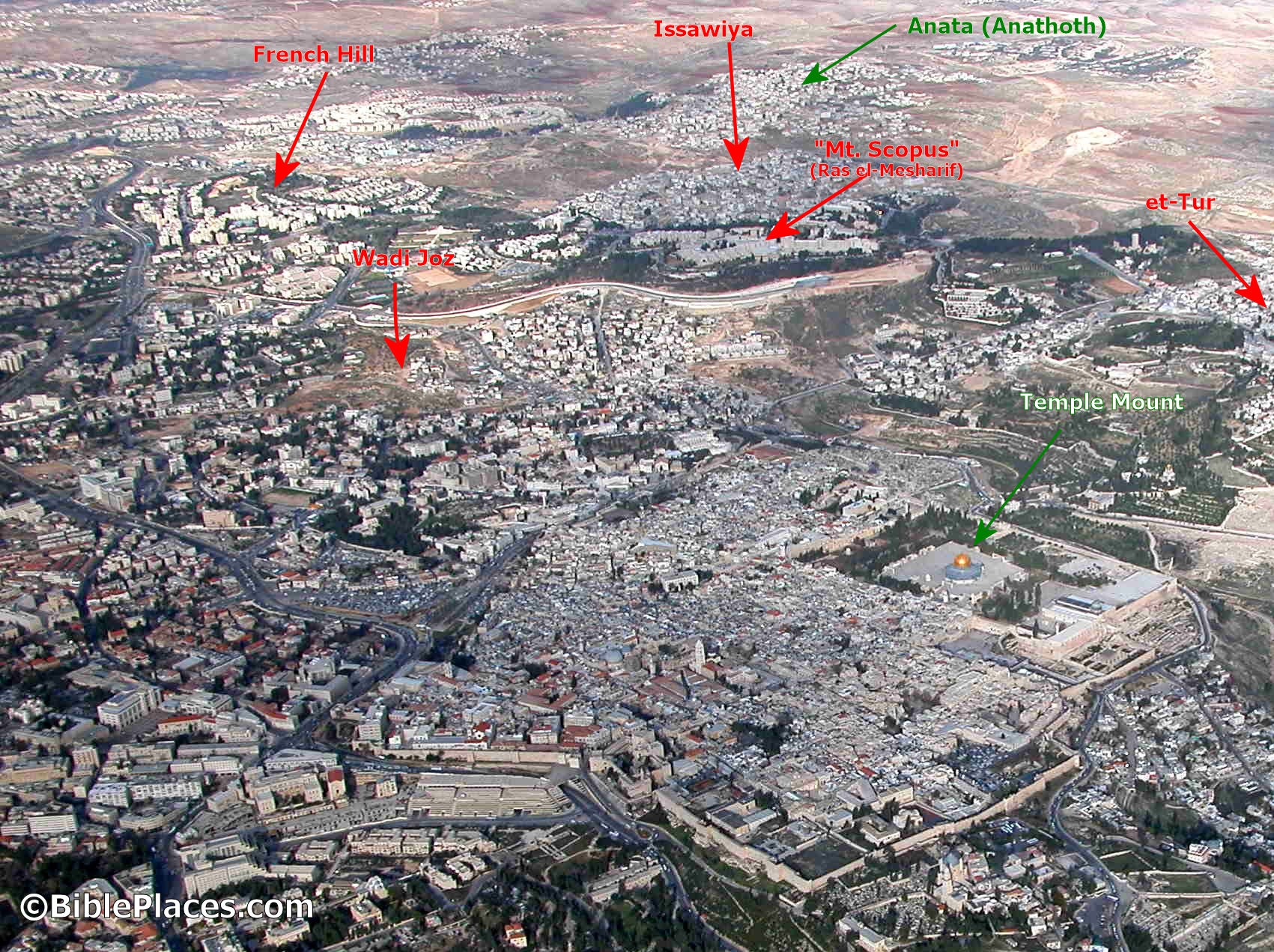
 Then David came to Nob <means fruit[2]; Nob was in the neighborhood of Jerusalem, near the Mount of Olives >[3]. to Ahimelech <means ‘my brother is King’ [4]>, the priest. And Ahimelech came to meet David trembling and said to him, “Why are you alone, and no one with you?”

Nob was known as the town of Priests. The Tabernacle was here and because of David’s relationship with Samuel, he thought he would be welcome here. It was also the responsibility of the Priests to keep provisions on hand for those in need. It was an hour and half walk from Gibeah. It probably took David longer for he had to travel at night, without light, to escape those seeking him. It was the morning of a Sabbath when he suddenly presented himself, alone, unarmed, weary, and faint with hunger before the high-priest.

Ahimelech was frightened to see David looking so, without his usual delegation.

And David said to Ahimelech the priest, “The king has charged me with a matter and said to me, ‘Let no one know anything of the matter about which I send you, and with which I have charged you.’ I have made an appointment with the young men for such and such a place.

He may or may not have been aware of the conflict between David and Saul. But certainly he thought something was up. However, David had reasonable answer’s for all of his questions. The King’s business had been so pressing and secretive that David was forced to leave without adequate provisions and weapons.

David Needed Mercy in the Form of Provisions

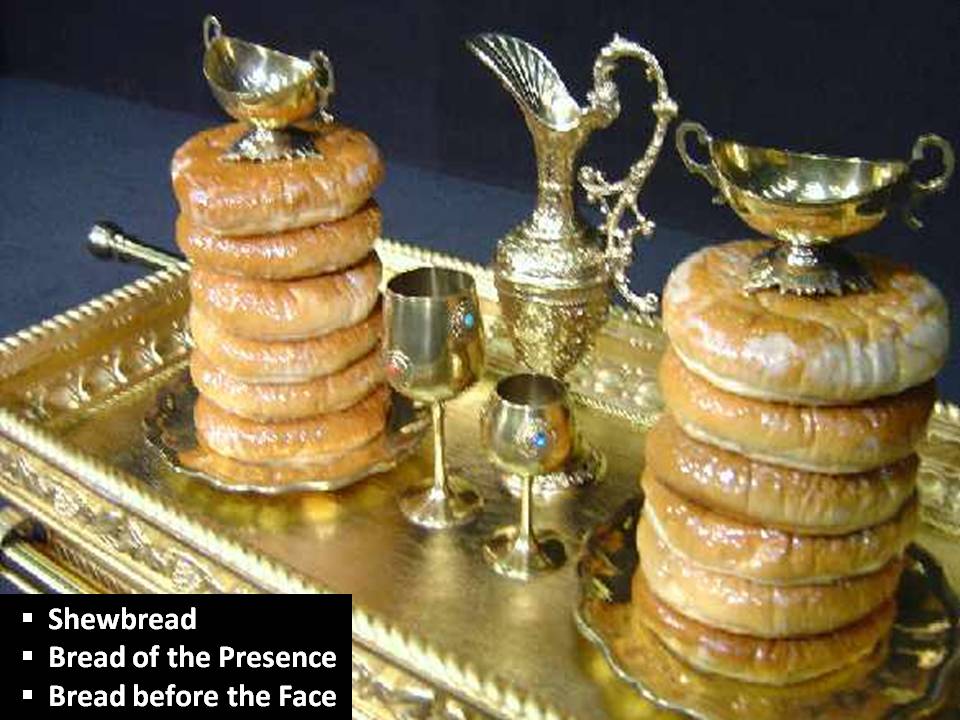
Now then, what do you have on hand? Give me five loaves of bread, or whatever is here.” And the priest answered David, “I have no common bread on hand, but there is Holy bread— if the young men have kept themselves from women.” And David answered the priest, “Truly women have been kept from us as always when I go on an expedition. The vessels of the young men are holy even when it is an ordinary journey. How much more today will their vessels be holy?” So the priest gave him the holy bread, for there was no bread there but the bread of the Presence, which is removed from before the LORD, to be replaced by hot bread on the day it is taken away.

David was on the run, homeless, penniless, and had likely been three days without food. He came to the place where he had prayed to so many times. He needed mercy from God. He didn’t need a lecture or a sermon. He needed God’s mercy!

This little incident allows us to evidence the decay into which the priesthood and offerings of the people had fallen. The fact that there was nothing to offer David except the shewbread reveals the poverty of the priesthood, and the neglect of such by the people. If people would have been offering sacrifices, there would be plenty of food.

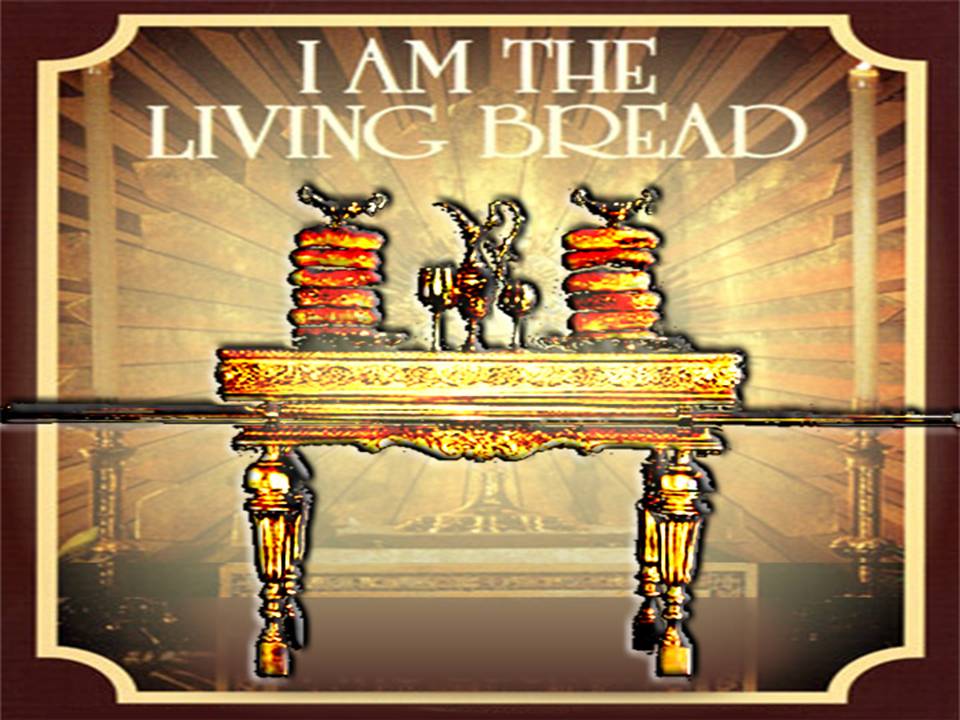
The Table of Shewbread

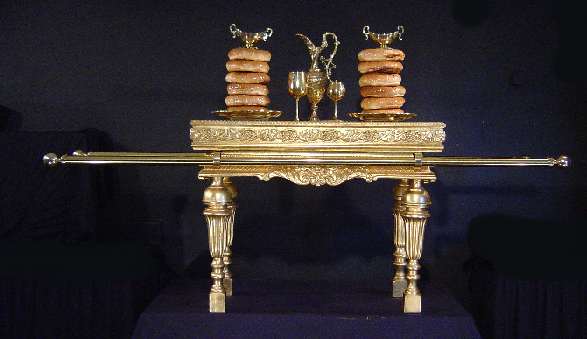
When you walk into the tabernacle you enter a door that leads to the holy place. The priest had at his right hand the table of shewbread or also referred to as the table of the presence. It was made of acacia wood overlaid with pure gold. Its size was 2 cubits (3 feet) in length by one cubit (1 1/2 feet) in breadth and a height of 1 1/2 cubits (2 1/4 feet). Around the table was a border of gold and then a little further in, on the table top, an additional border which would hold the contents in place. The table had four legs, and two gold-plated poles were inserted through golden rings attached to the legs for transporting.

  • “And you shall set the showbread on the table before Me always.”

The purpose of the golden table was to hold 12 cakes of bread made of fine flour. They were placed there in two stacks (or rows) of six, each loaf representing one of the tribes of Israel (Lev. 24:8).

  • Lev 24:5-9 And you shall put pure frankincense on each row, that it may be on the bread for a memorial, an offering made by fire to the LORD. Every Sabbath he shall set it in order before the LORD continually, being taken from the children of Israel by an everlasting covenant. And it shall be for Aaron and his sons, and they shall eat it in a holy place; for it is most holy to him from the offerings of the LORD made by fire, by a perpetual statute.”

Significance of the Bread of Presence

  • Fine Flour (from the earth)
  • Baked (agony and suffering)
  • Unleavened (nothing artificial)
  • Sprinkled with pure frankincense[5]

Bread Sprinkled with Pure Frankincense

Frankincense was given to Baby Jesus, and symbolizes His office as High Priest, offering prayers of intercession before the Father for us. Here, sprinkled upon the bread that is to be always before the face of God, it illustrates the truth of what Jesus declared in John 6.

I AM the Living Bread

John 6:51-58 “I am the living bread which came down from heaven. If anyone eats of this bread, he will live forever; and the bread that I shall give is My flesh, which I shall give for the life of the world. As the living Father sent Me, and I live because of the Father, so he who feeds on Me will live because of Me. This is the bread which came down from heaven– not as your fathers ate the manna, and are dead. He who eats this bread will live forever.”

When David ate the Shewbread, he was prophetically eating a symbol of the Savior that he hoped in, and who offered his body a broken sacrifice for him. That broken body is ever before the face of God, offering prayers on our behalf! This is a picture of how our Hope is not in our own strength, but the strength that comes from the Bread of Life!

Recent studies by an international team of scientists, including researchers from Johns Hopkins University and the Hebrew University in Jerusalem, have indicated that burning frankincense resin helps to alleviate anxiety and depression. The University of Munich found the anti-inflammatory properties of frankincense very effective as a treatment for joint pain and arthritis[6]

 2000 Years Later, Jesus faced a similar situation:

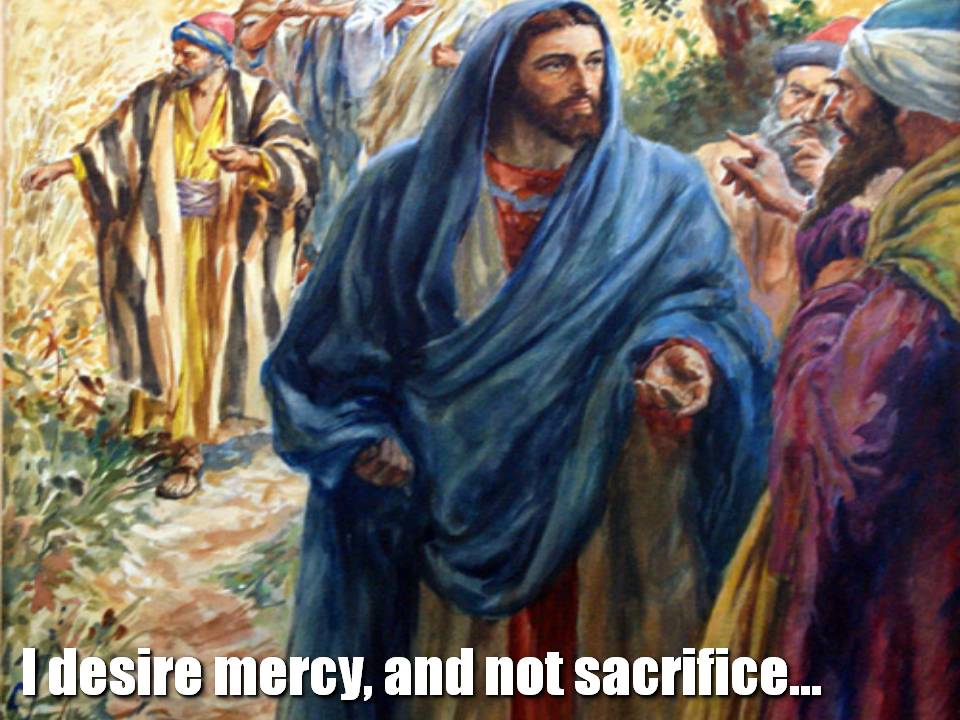
Jesus is walking with his disciples through a corn/wheat field. It was on a Sabbath, and they were very hungry. So they plucked the grain and ate it. (I’ve eaten freshly plucked wheat, so I know they must have been very hungry to eat it). Some Pharisees watched and immediately cried “law breakers’!

According to the Pharisees, the disciples reaped a crop. They threshed it by rubbing the berries in their hands and breaking the hulls off. Then they winnowed it by blowing the hulls away. By doing so, they were guilty of preparing a meal.

Jesus said to them, “Have you not read what David did when he was hungry, and those who were with him: (4) how he entered the house of God and ate the bread of the Presence, which it was not lawful for him to eat nor for those who were with him, but only for the priests? (5) Or have you not read in the Law how on the Sabbath the priests in the temple profane the Sabbath and are guiltless? (6) I tell you, something greater than the temple is here. (7) And if you had known what this means, ‘I desire mercy, and not sacrifice,’ you would not have condemned the guiltless. (8) For the Son of Man is lord of the Sabbath.” Matthew 12:1-8 (ESV)

Jesus deliberately drew attention to one of the Sabbath’s main purposes: It is a day of mercy and not a day of sacrifice.

Christ’s referred to 1 Samuel 21-when David ate the showbread. He wanted the Pharisees to understand that the Sabbath is to benefit a mercy needing man. David benefited from the Mercy of Ahimelech in giving him the showbread at a time when he was starving and weak. Mercy for the weak and hurting trumped the Law. Christ is always about Life, not Death.

The Pharisees didn’t understand Jesus. They did not see the Life He offered.

The Sabbath is a Day of Mercy for it is a Day of Hope!

David was about to learn the need for Hope!

The Doeg

Now a certain man of the servants of Saul was there that day, detained before the LORD. His name was Doeg the Edomite, the chief of Saul’s herdsmen.

It so happened in the Providence of God, that on this special Sabbath, one of Saul’s principal officials, the “chief over the herdsmen,” was in Nob, “detained before Jehovah.” The expression implies that Doeg was obliged to remain in the sanctuary in consequence of some religious ceremony—whether connected with his admission as a proselyte, for he was by birth an Edomite, or with a vow, or with some legal purification. (22:22)[7].

Doeg’s presence at the tabernacle is a mystery. He was an Edomite and whose presence would not normally be welcomed. He was “detained before the Lord” at the sanctuary (1 Sam. 21:7). Perhaps he had become a Jewish proselyte and was following the Hebrew faith in order to hold his job. As Saul’s chief shepherd, Doeg could easily have become defiled so that he had to bring a sacrifice to the Lord.

David knew that Doeg would report to Saul what he had seen at Nob and that this would mean trouble.Perhaps that is why he was not being honest with Ahimelech, so as to insulate him from the wrath of Saul.

Doeg Tells Saul

1 Samuel 22:6-19 reveals the Destructiveness of Doeg

(6) Now Saul heard that David was discovered, and the men who were with him. Saul was sitting at Gibeah under the tamarisk tree on the height with his spear in his hand, and all his servants were standing about him. (7) And Saul said to his servants who stood about him, “Hear now, people of Benjamin; will the son of Jesse give every one of you fields and vineyards, will he make you all commanders of thousands and commanders of hundreds, (8) that all of you have conspired against me? No one discloses to me when my son makes a covenant with the son of Jesse. None of you is sorry for me or discloses to me that my son has stirred up my servant against me, to lie in wait, as at this day.” (9) Then answered Doeg the Edomite, who stood by the servants of Saul, “I saw the son of Jesse coming to Nob, to Ahimelech the son of Ahitub, (10) and he inquired of the LORD for him and gave him provisions and gave him the sword of Goliath the Philistine.” (11) Then the king sent to summon Ahimelech the priest, the son of Ahitub, and all his father’s house, the priests who were at Nob, and all of them came to the king. (12) And Saul said, “Hear now, son of Ahitub.” And he answered, “Here I am, my lord.” (13) And Saul said to him, “Why have you conspired against me, you and the son of Jesse, in that you have given him bread and a sword and have inquired of God for him, so that he has risen against me, to lie in wait, as at this day?” (14) Then Ahimelech answered the king, “And who among all your servants is so faithful as David, who is the king’s son-in-law, and captain over your bodyguard, and honored in your house? (15) Is today the first time that I have inquired of God for him? No! Let not the king impute anything to his servant or to all the house of my father, for your servant has known nothing of all this, much or little.” (16) And the king said, “You shall surely die, Ahimelech, you and all your father’s house.” (17) And the king said to the guard who stood about him, “Turn and kill the priests of the LORD, because their hand also is with David, and they knew that he fled and did not disclose it to me.” But the servants of the king would not put out their hand to strike the priests of the LORD. (18) Then the king said to Doeg, “You turn and strike the priests.” And Doeg the Edomite turned and struck down the priests, and he killed on that day eighty-five persons who wore the linen ephod. (19) And Nob, the city of the priests, he put to the sword; both man and woman, child and infant, ox, donkey and sheep, he put to the sword. 1 Samuel 22:6-19 (ESV)

Doeg, wanting to gain from Saul, (Saul had just mentioned what he could give people), told about David being offered help by the Priests in Nob. He did not reveal that David had gained the help by misleading Ahimelech. He knew his information would better him at the expense of the Priests.

When all of Saul’s servants refused to go against the Priests, Saul turned to Doeg, and he not only killed all the priests, but he went to Nob and killed everyone there, boys, girls, mothers, even infants. He totally wiped the city of Nob from the face of the earth. Doeg was not only a Doeg, but he was a Destroyer.

Doeg is a Disciple killer

David had faced Goliath, and defeated him with a single stone. David’s heart was so united with God’s that there was nothing of this world that could defeat him. Now David was on the run from his authority, the anointed King of Israel. David had the love of Jonathan, and a few servants, but no one else to aid him, except God. So he came to the Tabernacle for food, provisions, and to inquire of the Lord for guidance. There he encountered Doeg, and David knew he was evil, but he had no idea what would happen. Perhaps he had an inkling, and that is why he did not tell Ahimelech the truth.

As a David Disciple you will encounter Goliath’s, you will encounter Saul’s, and you will encounter Doegs.

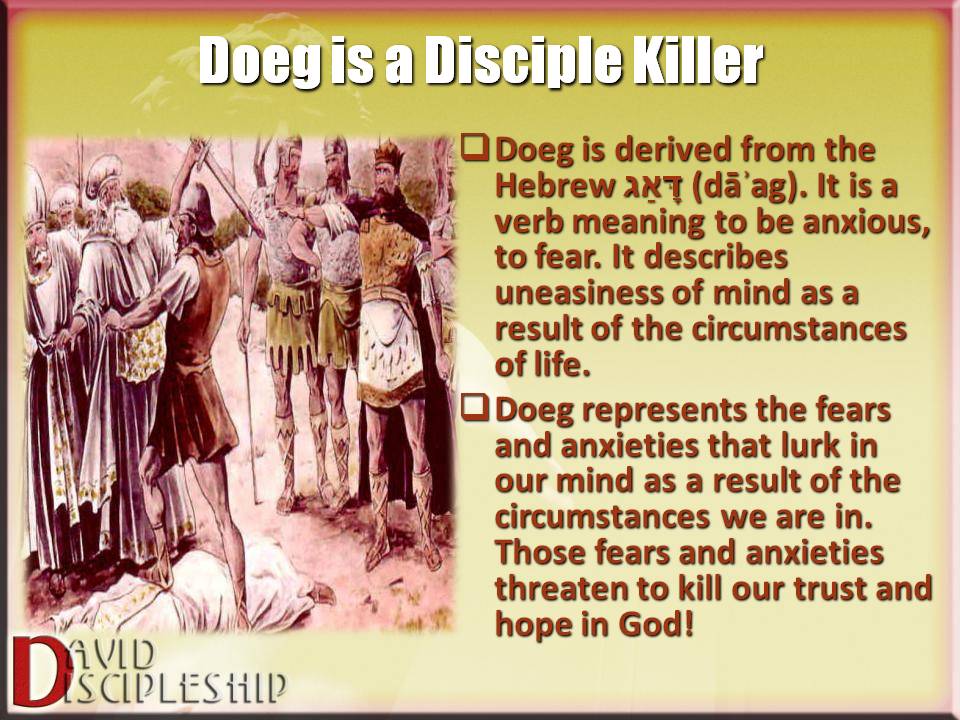
Doegs are very dangerous to Disciples, for they lurk in the shadows. They don’t come directly at you. Often they are an unseen enemy. But Doegs are very deadly. Doeg is derived from the Hebrew ‏דָּאַג‎ (dāʾag). It is a verb meaning to be anxious, to fear. This word describes uneasiness of mind as a result of the circumstances of life[8].

Doeg represents the fears and anxieties that lurk in our mind as a result of the circumstances we are in. Those fears and anxieties threaten to kill our trust and hope in God!

David described how his sin made him ‘dāʾag

I confess my iniquity; I am troubled (dāʾag) by my sin. Psalm 38:18 (NIV)

 Jeremiah used the word ‘dāʾag’ to illustrate how Disciples are to be:

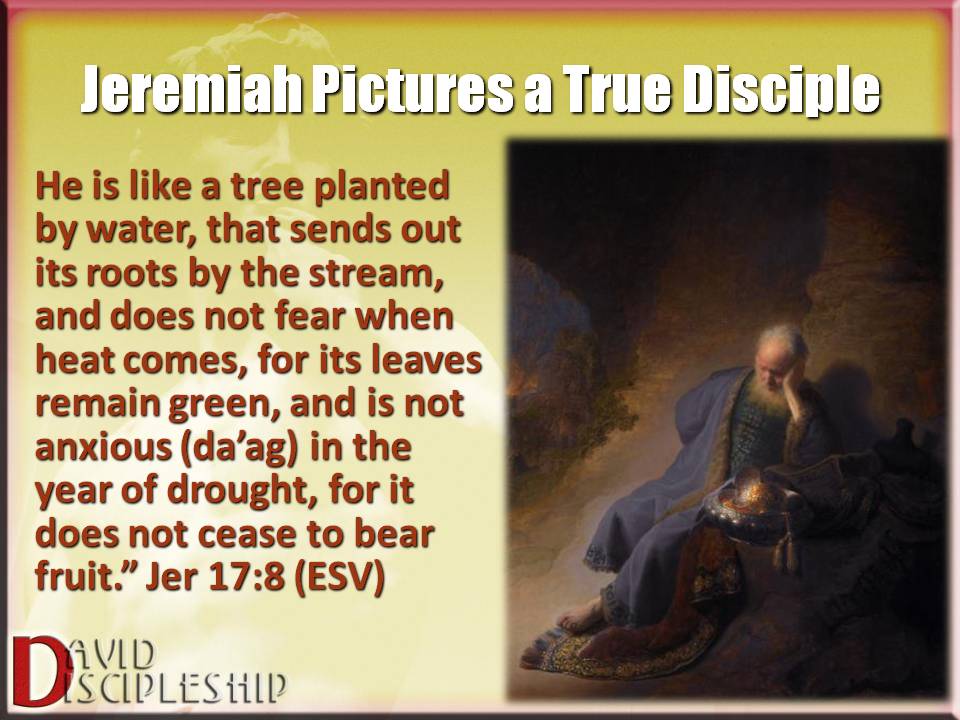
He is like a tree planted by water, that sends out its roots by the stream, and does not fear when heat comes, for its leaves remain green, and is not anxious (dāʾag) in the year of drought, for it does not cease to bear fruit.” Jeremiah 17:8 (ESV)

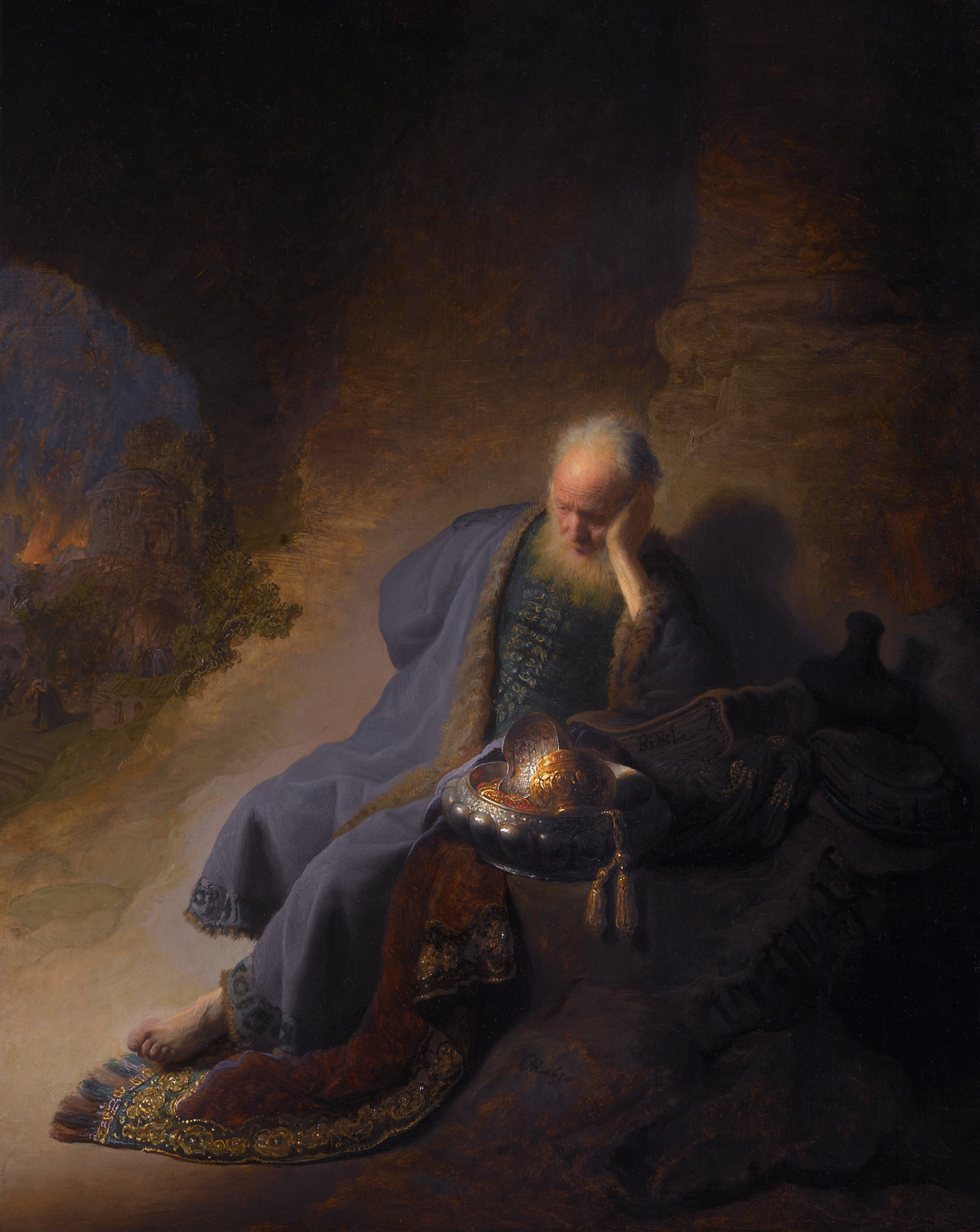
Jeremiah was called the weeping prophet. One poignant moment immortalized by Rembrandt depicts Jeremiah grieving over the destruction of Jerusalem and the First Temple by Nebuchadnezzar. Tradition has him in a grotto just outside the North Wall of Jerusalem. It is under the hill called Golgotha. He wrote the five poems of Lamentations near the  place where our Savior was crucified.

Jeremiah’s sermons and prophecies were ignored and scoffed at by the leaders of Jerusalem. Jeremiah (in a message from God) encouraged the soldiers to surrender to Nebuchadnezzar to save the city. They threw him into an empty cistern in the King’s palace prison and he sank in mud up to his armpits. They left him there to starve to death, hoping to silence him. Still he kept on preaching the Word of the Lord. Fortunately an Ethiopian man, a court official, persuaded the King to release Jeremiah. It took thirty men with ropes to pull Jeremiah out of that mud.

As much as Jeremiah was despised. As grief-stricken as he was when he wrote this:

How lonely sits the city that was full of people! How like a widow has she become, she who was great among the nations! She who was a princess among the provinces has become a slave. Lamentations 1:1 (ESV)

Jeremiah did something totally crazy:

While he was imprisoned, Jeremiah received a visit from his cousin Hanamel. Hanamel wanted to sell Jeremiah a piece of land in their hometown of Anathoth. It was a foolish request, for the land was already in control of the Chaldeans and Nebuchadnezzar. Furthermore, Jeremiah was in prison for treason, and unable to use the land. Jeremiah bought the land in front of many witnesses, saying:

‘Thus says the LORD of hosts, the God of Israel: Take these deeds, both this sealed deed of purchase and this open deed, and put them in an earthenware vessel, that they may last for a long time. For thus says the LORD of hosts, the God of Israel: Houses and fields and vineyards shall again be bought in this land.’ Jeremiah 32:14-15 (ESV)

In spite of his grief and despair over the circumstances he was in, Jeremiah never lost his Hope in God.

Jeremiah discovered a Hope that is greater than all our fears:

  •  The steadfast love of the LORD never ceases; his mercies never come to an end; they are new every morning; great is your faithfulness. “The LORD is my portion,” says my soul, “therefore I will hope in him.”  The LORD is good to those who wait for him, to the soul who seeks him. Lamentations 3:22-25 (ESV)
  • There is hope for your future,” says the LORD. “Your children will come again to their own land. Jeremiah 31:17 (NLT)

Jer 14:8 Calls out to the Hope of Israel – its Savior. Then He reveals the coming Hope:

Jeremiah’s Hope – The Lord our Righteousness

“For the time is coming,” says the LORD, “when I will raise up a righteous descendant from King David’s line. He will be a King who rules with wisdom. He will do what is just and right throughout the land. And this will be his name: ‘The LORD Our Righteousness.’ yehōwāh tṣid̠qēnû (from tsedaqah) Jeremiah 23:5-6 (NLT)

 Fear versus Hope (Doeg vs the Lord)

Discipleship is all about knowing the ways of God, embracing and understanding all that He delights in. He delights in hesed, mishpat and tsedaqah. (Jer 9:24)

The hesed of God strengthens our heart to defeat Goliath. The mishpat of God enables us to endure the injustice of Saul, as we focus on our responsibility to build our house by reaching out to the lame and lost.

The Tsedaqah of God allows us to conquer the Doegs of life by focusing on the Hope we have in Christ, and His righteousness.

The Psalms that David wrote after these encounters reveal that David learned this exact lesson:

David wrote Psalm 52 when he learned of Doeg’s murderous actions

The Steadfast Love (hesed) of God Endures: To the choirmaster. A Maskil of David, when Doeg, the Edomite, came and told Saul, “David has come to the house of Ahimelech.”

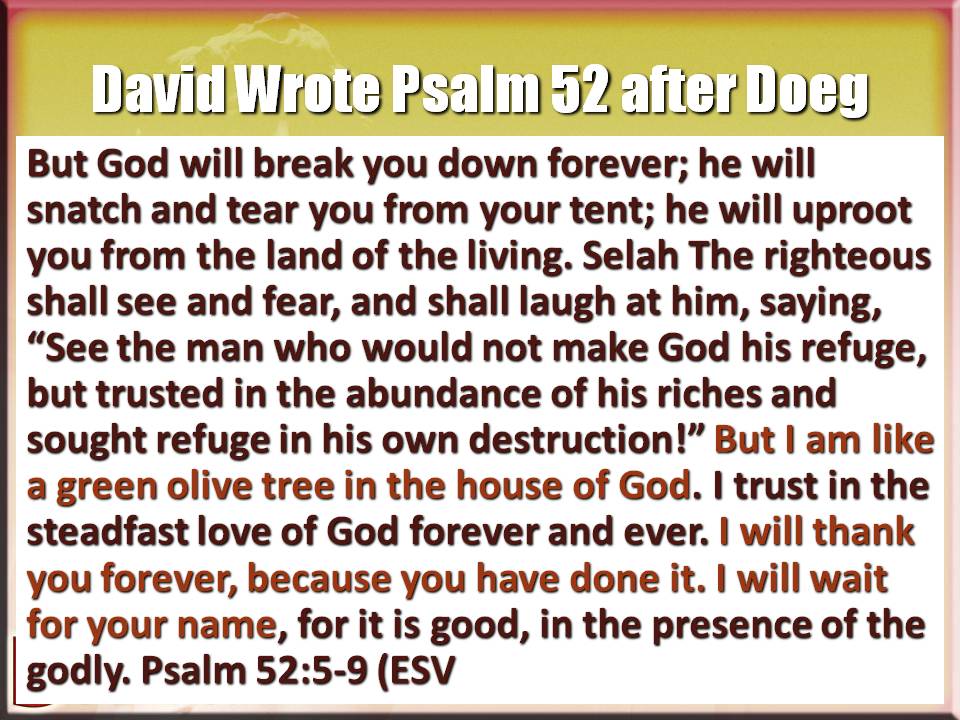
(5) But God will break you down forever; he will snatch and tear you from your tent; he will uproot you from the land of the living. Selah (6) The righteous shall see and fear, and shall laugh at him, saying, (7) “See the man who would not make God his refuge, but trusted in the abundance of his riches and sought refuge in his own destruction!” (8) But I am like a green olive tree in the house of God. I trust in the steadfast love of God forever and ever. (9) I will thank you forever, because you have done it. I will wait for your name, for it is good, in the presence of the godly. Psalm 52:5-9 (ESV)

God told David to go to Gath (when he inquired of Ahimelech), for God wanted David doubly learn this lesson. God wanted David to never forget!

After Being Seized in Gath

Psalm 34: “Of David, when he pretended to be insane in front of Abimelech, who sent him away”.

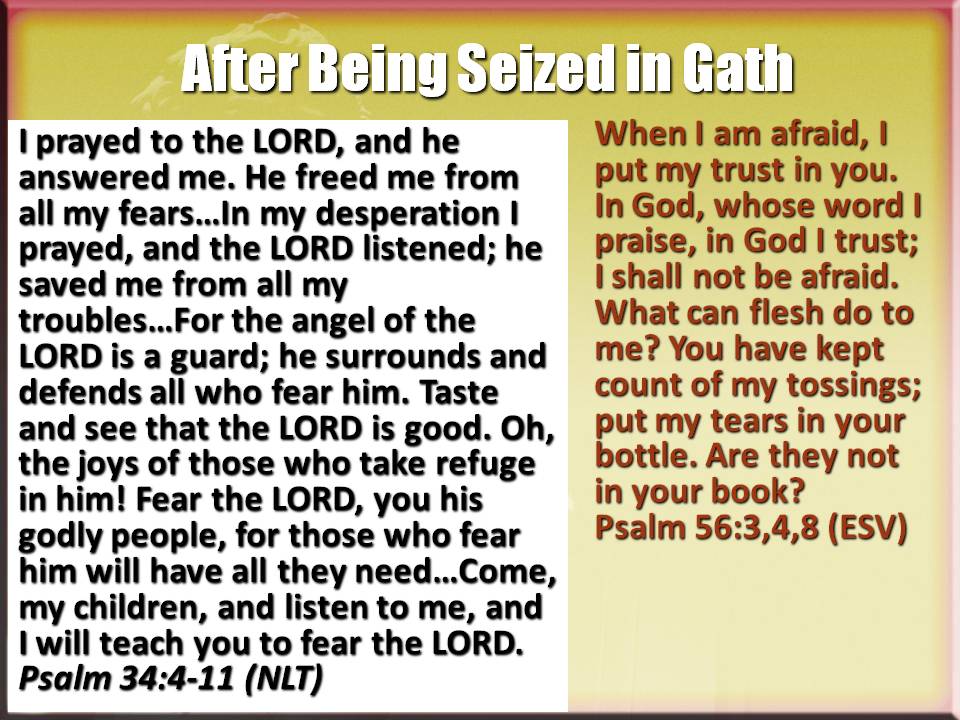
I prayed to the LORD, and he answered me. He freed me from all my fears…In my desperation I prayed, and the LORD listened; he saved me from all my troubles…For the angel of the LORD is a guard; he surrounds and defends all who fear him. Taste and see that the LORD is good. Oh, the joys of those who take refuge in him! Fear the LORD, you his godly people, for those who fear him will have all they need…Come, my children, and listen to me, and I will teach you to fear the LORD. Psalm 34:4-11 (NLT)

Psalm 56: In God I Trust “To the choirmaster:. A Miktam of David, when the Philistines seized him in Gath”.

When I am afraid, I put my trust in you. In God, whose word I praise, in God I trust; I shall not be afraid. What can flesh do to me? Psalm 56:3-4 (ESV)

David learned that the fear of the Lord conquers every other fear (vv. 9-16). When you walk in fear of the Lord, you walk in His Righteousness. When you walk in His righteousness, you are no longer walking in fear or anxiety. Doeg can never push you from the discipleship path!

How are you handling the Doegs of Life? Are circumstances getting to you? Is fear lurking in the corners of your mind? Have you been hoping in something that has let you down? Perhaps it is time to follow David, and learn the fear of the Lord, learn that Jesus is your Righteousness! Life is never meant to be up to us. There are too many “Doeg’s” that lurk in the shadows. Fear is a discipleship killer. There is no fear of man when we walk in fear of the Lord, when we walk in the Righteousness of Christ!


[1] Warren W. Wiersbe, The Bible Exposition Commentary – History, (Colorado Springs, CO: Victor, 2003), WORDsearch CROSS e-book, 264.

[2] James Strong, Strong’s Talking Greek & Hebrew Dictionary, (Austin, TX: WORDsearch Corp., 2007), WORDsearch CROSS e-book, Under: “5011”.

[3] Robert Jamieson, A.R. Fausset, David Brown, A Commentary: Critical, Experimental, and Practical on the Old and New Testaments, (Toledo, OH: Jerome B. Names & Co., 1884), WORDsearch CROSS e-book, Under: “1 SAMUEL”.

[4]Warren Baker and Eugene Carpenter, The Complete Word Study Dictionary – Old Testament, (Chattanooga, TN: AMG Publishers, 2003), WORDsearch CROSS e-book, Under:  “אֲחִימֶלֶךְ ’aḥiymelek̠”.

[7] Alfred Edersheim, Bible History Old Testament, (London: Religious Tract Society, 1890), WORDsearch CROSS e-book, Under: “CHAPTER 12”.

[8] R. Laird Harris, Gleason L. Archer, Bruce K. Waltke, ed., “393: ‏דָּאַג‎,” in Theological Wordbook of the Old Testament, (Chicago: Moody Press, 1980), WORDsearch CROSS e-book, Under: “‏דָּאַג‎”.


When I owned an Asphalt Paving company we decided to get into concrete, and so we did in a big way. We even did footings, slabs and walls for new construction. I learned a great deal about foundations for commercial buildings. You don’t just dig a trench and pour concrete. You must consider where the main support beams are placed, what the weight load of the walls will be, what type of soil the foundation is on, and many other factors. The foundation is a really big deal that I had taken for granted. Good concrete alone is not enough for a solid foundation. You must use steel re-bar, and the amount and configuration of the re-bar depends upon the load at that point. Even concrete slabs have to consider the weight of the objects they will support. As part of our foundation work we did some banks which had bank vaults. Most vaults nowadays are actually pre-fab concrete units that are shipped in and moved in place. The vault door is added later. But the slab of the vault is poured 12″ to 24″ thick, with 2 to 3 layers of 3/4″ re-bar tied on 12″ centers. (We did one with 6″ centers). They do not want the vault going anywhere! It also indicates the weight (and importance) of the bank vault. Before concrete, I never thought about foundations. Now I consider them wherever I go. I even took this picture of some awesome re-bar for a building going up in Addis Ababa, Ethiopia. Judging by the re-bar pile, they still had a lot of tying to do!

The church of today is so often about programs. We need programs to keep drawing crowds and making people ‘feel’ like they are Christians. So often ministry programs for children, seniors, life groups, special events, and whatever must pass the “feel good” test. Will it “minister to a felt need” and make everyone “feel good”. Modern ministry must have an emotional draw or it usually dies.

The church that Jesus began and the Apostles modeled was centered around discipleship, making disciples. Emotional feelings quickly fade in the face of persecution. There must be something more about being a church than “feel good” programs. That more is true discipleship. We tried to get a “discipleship program” going within a year after coming to my present church, Pleasant Prairie. But we were only 3 years removed from a tragic ‘split’ that nearly destroyed a church that had been there for 36 years at the time. The people were not ready for a discipleship program that did not meet the need to rebuild their emotional being. There were emotional scars of bitterness and unforgiveness that needed attention before discipleship could begin. Inward hurts hinder the ability to look upward and outward!

God has recently burdened me that it is time to more clearly define the mission of our church. God has been sending some great men and families our way, but we need to have a clearly defined discipleship path. Our church is ready to stand and embrace discipleship as our core value, but I do not want it to be a “program”. Discipleship does not automatically have a “feel good” component that builds excitement. Most Christians seem to view discipleship as something for Paul’s and Timothy’s, people who serve in a major capacity. Even leaders in the church seem to shy away from intentional discipleship. Too often Christians are ‘comfortable’ where they are at. Convenience and comfort are often core values of most American Christians.

The Holy Spirit was leading me to preach on the Life of King David. He is a great example of a man of God. There is no more transparent life in the Bible than King David. But the Holy Spirit was also burdening me with the need for a clearly defined discipleship path in our church. For some reason He led me to the ‘last saying’ of King David in 2 Samuel 23:5. I won’t get it to it in this writing, but through this, the Holy Spirit is revealing some awesome revelations about discipleship and how the church can embrace it, accomplish it and even have a “feel good”  component at the same time. 

So the next few posts will be the “Laying of the Foundation” of what I am calling “David Discipleship”. We don’t often associate King David with discipleship, but I believe his life is the very definition of discipleship, beginning with the revelation of His last words.

Now to bend and tie the “re-bar” of David Discipleship:

If the church is not to be about “programs” but about making disciples, what is a disciple? 

Disciple: One who embraces and assists in spreading the teachings of another. In the New Testament, the word is Mathētés. Here it means more than a mere pupil or learner. It is an adherent who accepts the instruction given to him and makes it his rule of conduct[1]. The general designation of mathētés was given to those who believed on Christ. Jesus clearly defines disciple in John 8:31: (ESV) So Jesus said to the Jews who had believed in him, “If you abide in my word, you are truly my disciples”.

What is Discipleship?

If a disciple is an adherent of another person’s teachings, what is discipleship?

A consensus of definitions produces this: Discipleship is the process of learning about the teachings of another, internalizing them and then acting upon them. Most discipleship programs focus on the learning process, with the emphasis on knowledge.

Peters Perspective on the Discipleship Process

Peter turned out to be the most dynamic of the early disciples of Christ. He had learned a great deal after spending three years at the feet of the Master Teacher. Yet when it was time for the rubber to meet the road, Mighty Peter failed, and denied his Master in a dramatic fire. Where was that knowledge then? What good did his earlier confession do at the moment when it mattered most? Peter sheds a glaring light upon what a discipleship program should be about.

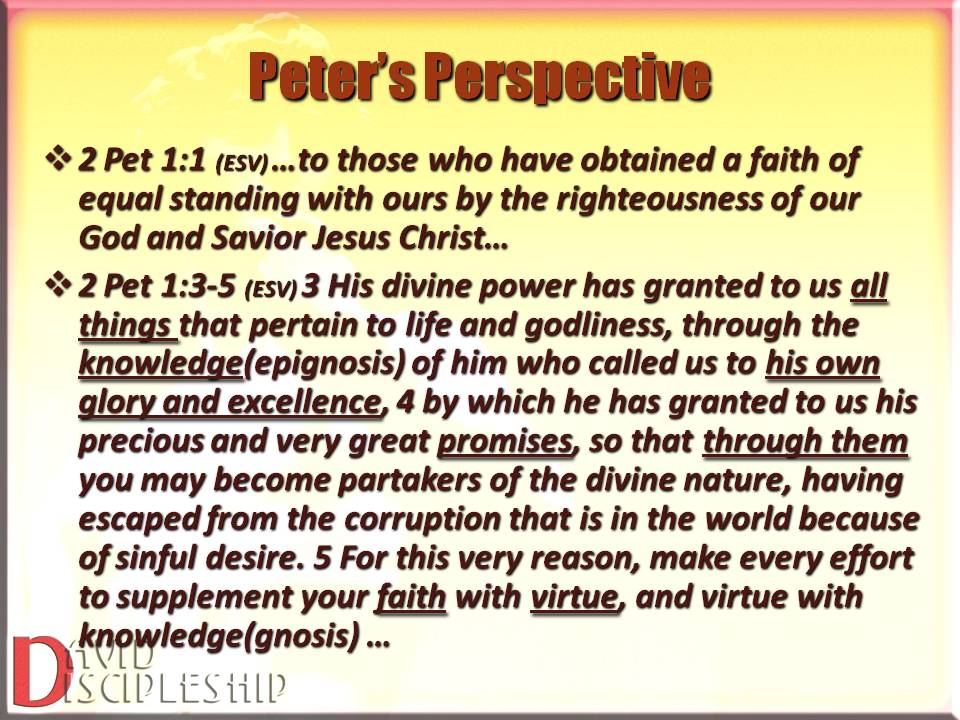
2 Peter 1:1 (ESV) Simeon Peter, a servant and apostle of Jesus Christ, To those who have obtained a faith of equal standing with ours by the righteousness of our God and Savior Jesus Christ…

2 Peter 1:3-5 (ESV) 3 His divine power has granted to us all things that pertain to life and godliness, through the knowledge (epignosis)[2] of him who called us to his own glory and excellence, 4 by which he has granted to us his precious and very great promises, so that through them you may become partakers of the divine nature, having escaped from the corruption that is in the world because of sinful desire. 5 For this very reason, make every effort to supplement your faith with virtue, and virtue with knowledge(gnosis) …

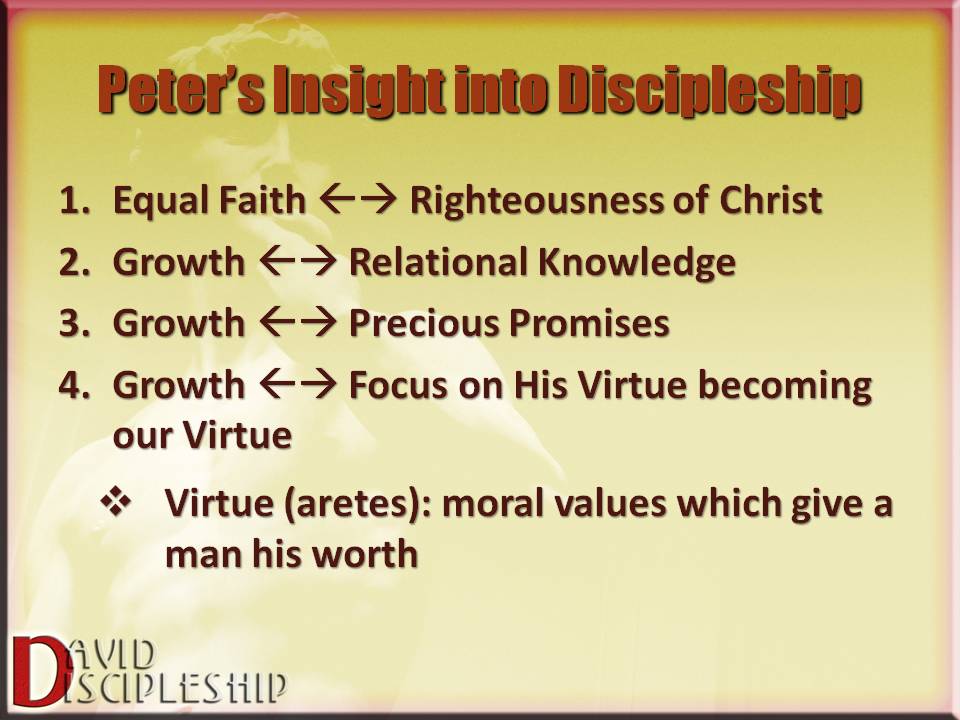
Peter’s Insights into Discipleship:

1. Equal Faith <–> Righteousness of Christ

  • Discipleship grows from Faith that is provided by the righteousness of our Savior Jesus Christ. That faith makes each believer equal in the sight of God. That equality is not based upon knowledge, but upon the righteousness provided us by our God and Savior Jesus Christ!

2. Growth <–> Relational Knowledge

  • Our growth in life and godliness is by His divine power and only through knowing Him in His glory and excellence.

3. Growth <–> Precious Promises

  • Our growth is only by His divine nature becoming our nature through the power of the Word and His precious promises.

4. Growth <–> Focus on His Virtue becoming our Virtue

  • Discipleship must focus on His Virtue becoming our Virtue. We first add virtue to our faith, and knowledge to virtue.

VIRTUE is the Greek “areté” which denotes in a moral sense what gives man his worth[3]

Why is Virtue Important to Discipleship?

There are four synonyms to Areté in the Greek according to Zodhiates…

  • dóxa – glory;
  • dúnamis – power;
  • chárisma – gift;
  • ōphéleia – usefulness[4]

Virtue is a quality that is difficult to define, but definite in its impact. From the synonyms we glimpse the power of this little word. Here is my humble attempt at a definition.

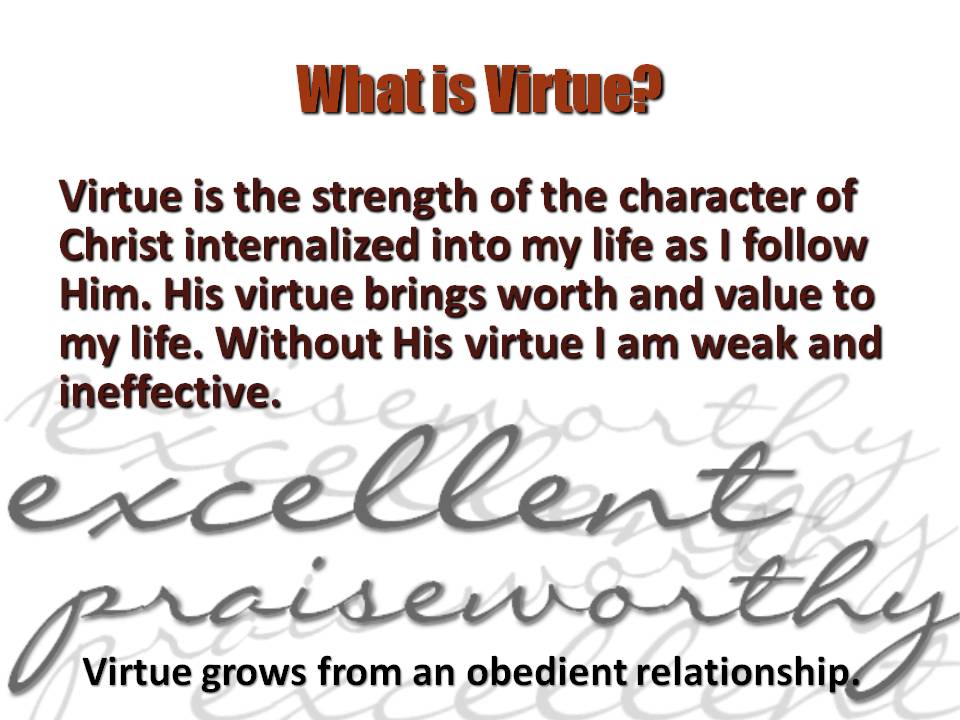
Virtue is the strength of the character of Christ internalized into my life as I follow Him. Virtue brings worth and value to my life. Without His virtue I am weak and ineffective.

Virtue grows from an obedient relationship!

Discipleship programs are not effective if their focus is primarily upon knowledge (ginosis). It must be knowledge that grows from a personal on-going relationship with Jesus Christ Himself! (epiginosko). I know far too many graduates of Christian Schools and Colleges that display little if any of the life of Jesus Christ. A surprising number no longer go to church. Knowledge is not enough to become a disciple of Jesus Christ. Look at Judas. He had three years of instruction from Jesus Christ, and yet there was no changed life!

Discipleship is Life-Changing only if it is Life-Giving!

Discipleship must lead believers into a life that is above the natural, a life that is empowered by the Righteous Life of Jesus Christ. His virtue of LIFE becomes our virtue by our dying.

We Have No Virtue worth Propping up

Discipleship is not a self-improvement course. It is not a way of “improving” your Christian walk! We are ugly before we are saved, we are ugly after we are saved. The only beauty we can ever have is the beauty of Jesus Christ.

COULD YOUR HEART PASS THE HOLE IN THE WALL TEST?

God told Ezekiel to dig a hole in the King’s wall. He was startled by the abominations being committed by the ‘supposed’ righteous leaders of Israel.

Ezekiel 8:8-13 (ESV) 8 Then he said to me, “Son of man, dig in the wall.” So I dug in the wall, and behold, there was an entrance. 9 And he said to me, “Go in, and see the vile abominations that they are committing here.” 10 So I went in and saw. And there, engraved on the wall all around, was every form of creeping things and loathsome beasts, and all the idols of the house of Israel. 11 And before them stood seventy men of the elders of the house of Israel, with Jaazaniah the son of Shaphan standing among them. Each had his censer in his hand, and the smoke of the cloud of incense went up. 12 Then he said to me, “Son of man, have you seen what the elders of the house of Israel are doing in the dark, each in his room of pictures? For they say, ‘The Lord does not see us, the Lord has forsaken the land.’ ” 13 He said also to me, “You will see still greater abominations that they commit.”

No matter how ‘spiritual’ we pretend to be, or how much ‘Bible knowledge’ we possess, no one can pass the “Hole in the Wall” test. Our hearts are full of abominations through sin. The harder we try to be a good disciple, the further we alienate ourselves from the heart of God! The heart of God is centered around the virtue of His Son, Jesus Christ! The only virtue worth having is not man-centered but Christ-centered!

Discipleship finds all that we need in Jesus Christ

1 Corinthians 1:30-31 (NIV) 30 It is because of him that you are in Christ Jesus, who has become for us wisdom from God–that is, our righteousness, holiness and redemption. 31 Therefore, as it is written: “Let him who boasts boast in the Lord.”

Discipleship which focuses on knowledge will always lead to pride and self-effort. Discipleship which focuses on virtue will always lead to humility and dependence.

Therefore I define Discipleship as:

Discipleship – “the intentional process of making the virtue of Christ my own, through submitting to His Lordship and Direction, and the daily Hope of Gaining Christ”

Discipleship is simply gaining by trading (diapragmateúomai)[5];

The King will demand an accounting of what you have GAINED by trading

Luke 19:15 (ESV) When he returned, having received the kingdom, he ordered these servants to whom he had given the money to be called to him, that he might know what they had gained by doing business.

I believe we will be judged at the ‘bema seat’ and our judgment will simply be an accounting of what we traded to gain for the sake of becoming like Jesus Christ! We will be judged for how we ‘gained’ Jesus Christ! Christians are to be about the business of trading their lives to gain Jesus Christ!

Paul said it best in Philippians 3:8: Philippians 3:8 (ESV) Indeed, I count everything as loss because of the surpassing worth of knowing Christ Jesus my Lord. For his sake I have suffered the loss of all things and count them as rubbish, in order that I may gain Christ

So the ‘re-bar’ of discipleship is the Virtue of Jesus Christ! Any substitution or absence of His virtue will result in a foundation that is weak and doomed to fail.

Our Hope of Glory is Christ IN me

Colossians 1:27 (ESV) To them God chose to make known how great among the Gentiles are the riches of the glory of this mystery, which is Christ in you, the hope of glory.


[1] Spiros Zodhiates, The Complete Word Study Dictionary – New Testament, (Chattanooga, TN: AMG Publishers, 1993), WORDsearch CROSS e-book, 936.

[2] Epígnōsis: In the NT, it often refers to knowledge which very powerfully influences the form of religious life, a knowledge laying claim to personal involvement. When used as an obj. (Eph. 1:17; 4:13; Col. 1:9, 10; 2:2; 1 Tim. 2:4; 2 Tim. 2:25; 3:7; Titus 1:1; Heb. 10:26; 2 Pet. 1:2, 3), it shows the relationship of the learner to the object of his knowledge (2 Pet. 1:8). Spiros Zodhiates, The Complete Word Study Dictionary – New Testament, (Chattanooga, TN: AMG Publishers, 1993), WORDsearch CROSS e-book, 624.

[3] Spiros Zodhiates, The Complete Word Study Dictionary – New Testament, (Chattanooga, TN: AMG Publishers, 1993), WORDsearch CROSS e-book, 252-251.

[4] Spiros Zodhiates, The Complete Word Study Dictionary – New Testament, (Chattanooga, TN: AMG Publishers, 1993), WORDsearch CROSS e-book, 252.

[5] Spiros Zodhiates, The Complete Word Study Dictionary – New Testament, (Chattanooga, TN: AMG Publishers, 1993), WORDsearch CROSS e-book, Under: “megauploaddiapragmateúomai”.


VATICAN CITY, Oct 24 (Reuters) – – Pope Benedict called on Monday for sweeping reforms of the world economy and the creation of a ethical, global authority to regulate financial markets as demonstrations against corporate greed continued to spring up in major cities across the globe.

Caritas in Veritate,” or “Charity in Truth,” is Benedict’s third encyclical since he became pope in 2005. He said the financial downturn had revealed behaviours like “selfishness, collective greed and hoarding of goods on a great scale,” adding that world economics needed an “ethic of solidarity” among rich and poor nations.

Pope Benedict XVI on Tuesday Oct 26th 2011 called for a radical rethinking of the global economy, criticizing a growing divide between rich and poor and urging the establishment of a “true world political authority” to oversee the economy and work for the “common good.”

The Vatican called for the establishment of “a supranational authority” and a “true world political authority” with worldwide scope and “universal jurisdiction” to guide economic policies and decisions and work for the common good.

Such an authority should start with the United Nations as its reference point but later become independent and be endowed with the power to see to it that developed countries were not allowed to wield “excessive power over the weaker countries”.

This startling announcement brought back to my mind teaching I heard in the late 60’s that the Pope was the Antichrist. Then I started thinking “ What if this idea gets traction, and the Pope succeeds in getting the world leaders together to put this plan into action. Then some of what is written in the Book of Revelations would make perfect sense.

Revelation 13:17 (ESV) so that no one can buy or sell unless he has the mark, that is, the name of the beast or the number of its name.

How easy would this be if we have only one world bank and money?

Then what happens in Revelations 18 would make sense as well:

Revelation 18:1-3 (ESV) After this I saw another angel coming down from heaven, having great authority, and the earth was made bright with his glory. And he called out with a mighty voice, “Fallen, fallen is Babylon the great! She has become a dwelling place for demons, a haunt for every unclean spirit, a haunt for every unclean bird, a haunt for every unclean and detestable beast. For all nations have drunk the wine of the passion of her sexual immorality, and the kings of the earth have committed immorality with her, and the merchants of the earth have grown rich from the power of her luxurious living.”

Many teach that the Antichrist will come from ‘Babylon’. Revelation 17 says he will carry Babylon, but then he will carry out its destruction.

I can see the world’s financial collapse leading to such a plan as the Pope is proposing. One of the great supporters of it will be the Antichrist. But after the plan is in place and he comes to power, he will turn on the religious power of Babylon, destroying it (Rev 17) and then turn on the political power of Babylon (Rev 18). This is because all power will belong to him!

So much for conjecture…

Regardless of who or what Babylon is, it plays a prominent role in the events of the Revelation of the end times.  This brings me to the deeper issue…

I.   What Does Babylon Represent in Scripture?

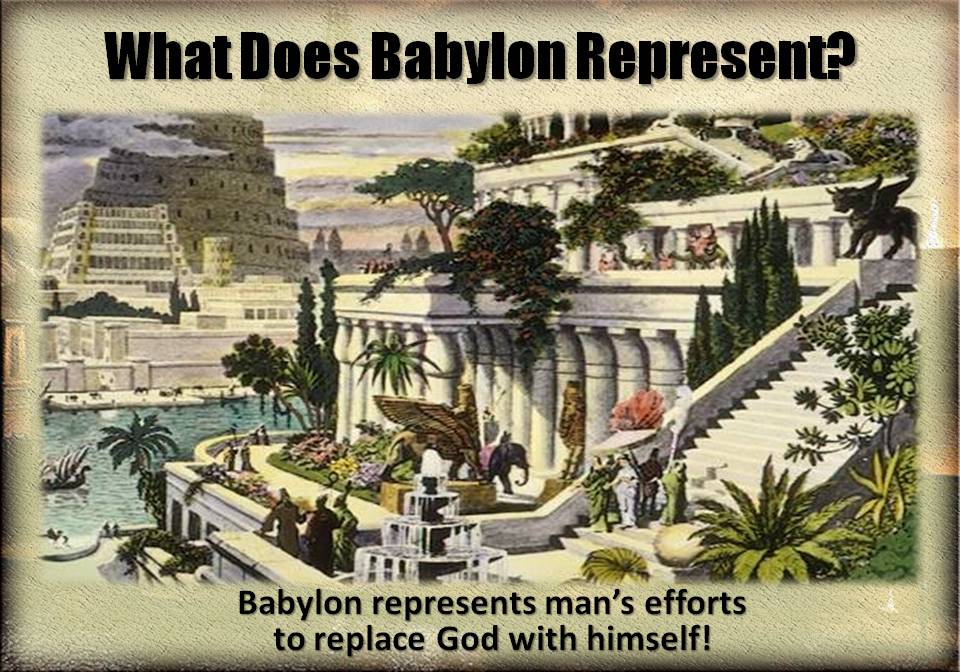
To understand Babylon, we need to go way back, to the time just after the Great Flood. As we examine Babylon’s place in history, we will find that it represents the Best that Man can do and be. Babylon is man exalting himself to God, and even above God.

Babylon represents man’s efforts to replace God with himself!

A. The First Sin of Babylon

The First Corporate Sin that Manifested itself after the Flood took place on the planes of Shinar, the sight of Babylon. Here a mighty ruler named Nimrod built a tower that reached to the heavens.

Genesis 10:8-10 (NIV) Cush was the father of Nimrod, who grew to be a mighty warrior on the earth. He was a mighty hunter before the Lord; that is why it is said, “Like Nimrod, a mighty hunter before the Lord.” The first centers of his kingdom were Babylon, Erech, Akkad and Calneh, in Shinar.

The Sin of Nimrod and his subjects was seeking to Minimize God’s place in their lives.

  • They were seeking to exalt themselves above God.
  • They were seeking to take God out of their lives. They were also seeking a guarantee that God could never destroy them by a flood again. They would simply go into their ‘tower’ of escape!

Genesis 11:4 (ESV) Then they said, “Come, let us build ourselves a city and a tower with its top in the heavens, and let us make a name for ourselves, lest we be dispersed over the face of the whole earth.”

Babylon represents Man’s efforts to MINIMIZE God. They wanted a God whom they could control. The attitudes revealed in their actions indicate how they sought to accomplish this.

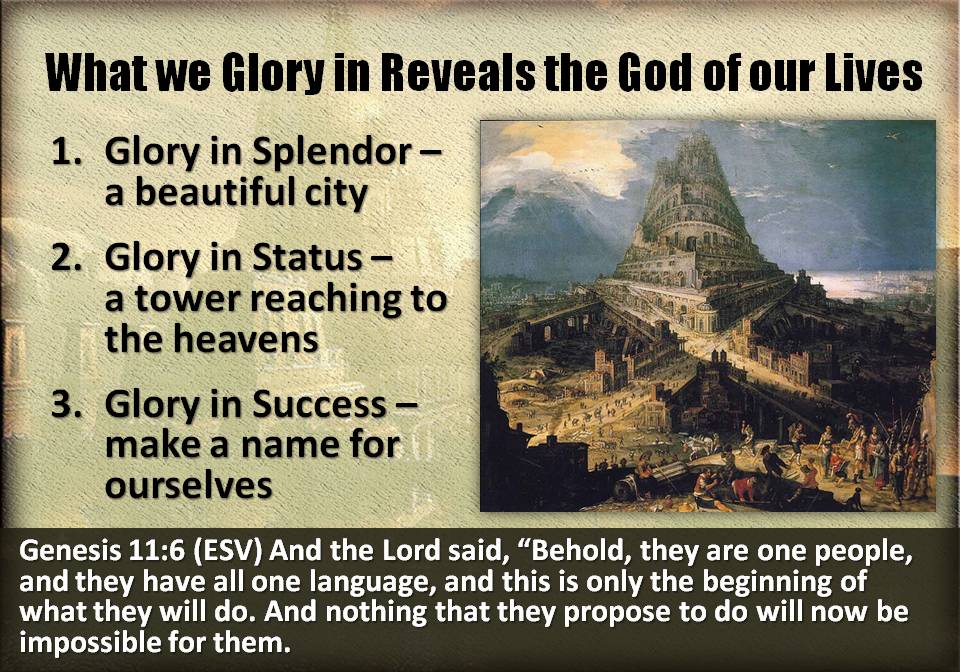
What we glory in reveals the god(s) of our lives.

  1. Glory in Splendor – a beautiful city
  2. Glory in Status – the tower that reached to the heavens
  3. Glory in Success – make a name for ourselves

Man wanted to make a name for himself, through the work of his hands. He wanted recognition for what he could accomplish. So man built a tower on the plains of Shinar, at Babylon. The very first place in the post-flood world that man exalted himself above God was at Babylon. Indeed Babylon became a symbol for the greatness of man!

In his book, Structures or why things don’t fall down (Pelican 1978–1984), Professor J.E. Gordon considers the height of the Tower of Babel. He wrote, ‘brick and stone weigh about 120 lb per cubic foot (2,000 kg per cubic metre) and the crushing strength of these materials is generally rather better than 6,000 lbs per square inch or 40 megapascals. Elementary arithmetic shows that a tower with parallel walls could have been built to a height of 2.1 km (1.3 mi) before the bricks at the bottom were crushed. However by making the walls taper towards the top they … could well have been built to a height where the men of Shinar would run short of oxygen and had difficulty in breathing before the brick walls crushed beneath their own dead weight.”[1]

This desire to rob God of His glory is so entrenched in mankind, that no matter what God does to mankind in the tribulation, mankind will curse God and refuse to repent and give Him glory!

Revelation 16:8-9 (ESV) The fourth angel poured out his bowl on the sun, and it was allowed to scorch people with fire. They were scorched by the fierce heat, and they cursed the name of God who had power over these plagues. They did not repent and give him glory.

Indeed, Psalms 2 reveals this intrinsic attitude toward God in the heart of man:

Psalms 2:1-4 (NIV) Why do the nations conspire and the peoples plot in vain? The kings of the earth take their stand and the rulers gather together against the Lord and against his Anointed One. “Let us break their chains,” they say, “and throw off their fetters.” The One enthroned in heaven laughs; the Lord scoffs at them.

God had the last laugh:

Genesis 11:6 (ESV) And the Lord said, “Behold, they are one people, and they have all one language, and this is only the beginning of what they will do. And nothing that they propose to do will now be impossible for them.

Where Does Man Get this desire to rob glory from God?

SATAN

What man was saying was eerily similar to something Satan (Lucifer) had said centuries before:

Isaiah 14:13-14 (ESV) You said in your heart,

  • ‘I will ascend to heaven;
  • above the stars of God I will set my throne on high;
  • I will sit on the mount of assembly in the far reaches of the north;
  • I will ascend above the heights of the clouds;
  • I will make myself like the Most High.’

We all know what happened to Lucifer: Luke 10:18 (ESV) And he said to them, “I saw Satan fall like lightning from heaven”.

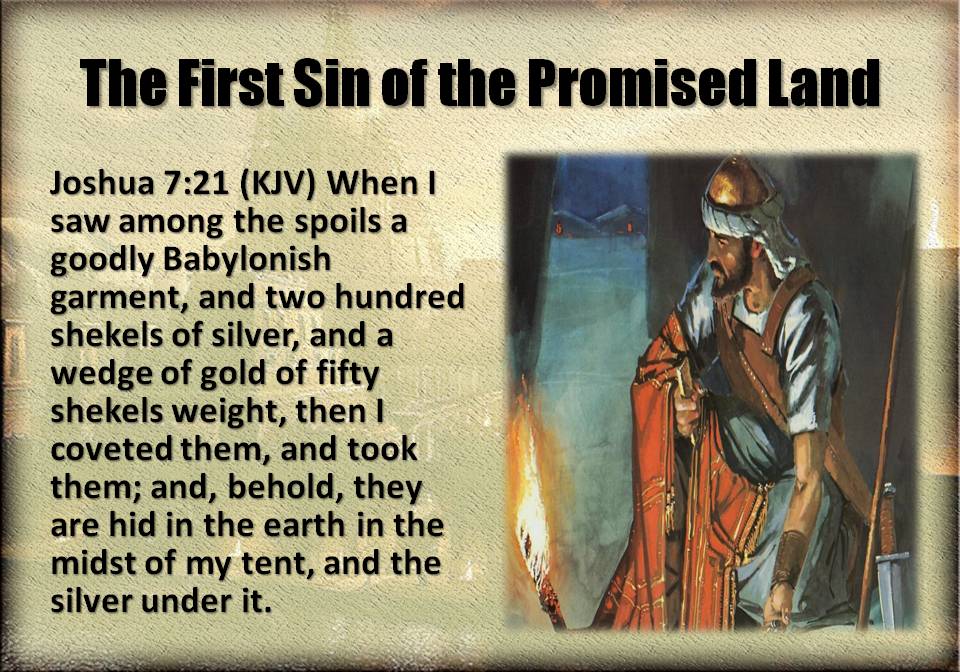
B. The First Sin of the Promised Land

The first Sin that spoiled the Promised Land for the Jews was the pride of wearing a Babylonian Garment.

Joshua 7:21 (KJV) When I saw among the spoils a goodly Babylonish garment, and two hundred shekels of silver, and a wedge of gold of fifty shekels weight, then I coveted them, and took them; and, behold, they are hid in the earth in the midst of my tent, and the silver under it.

Achan just had to have that babylonian garment…

Joshua had warned the people

Joshua 6:17-19 (ESV) And the city and all that is within it shall be devoted to the Lord for destruction. Only Rahab the prostitute and all who are with her in her house shall live, because she hid the messengers whom we sent. But you, keep yourselves from the things devoted to destruction, lest when you have devoted them you take any of the devoted things and make the camp of Israel a thing for destruction and bring trouble upon it. But all silver and gold, and every vessel of bronze and iron, are holy to the Lord; they shall go into the treasury of the Lord.”

Jericho, an evil city, full of evil inhabitants, so evil that Lindey Lohan could have been a priestess, was dedicated to God for destruction. It was so evil that everyone in it was to be destroyed like Sodom and Gomorrah. The silver and gold, and every vessel of bronze and iron was to be given to the treasury of God.

Achan cheered at Joshua’s decree. Yeah! Everything is wicked! We’ll destroy it all!

But there he was, checking out the spoil of one of his victims, and his eye was attracted to this snazzy Babylonian garment. The material was so soft, the design was so intricate. The beading and jewels adorning the garment took your breath away. This garment took a year to sew.  He had seen something almost as nice in the latest issue of Babylonia Today! If his friends would see him wearing such a garment, they would be so jealous! He could go anywhere in the Kingdom wearing such a garment. It was fit for a King!

Actually, that garment was fit for destruction. It represented Man’s Pride in his accomplishments, accomplishments made apart from God!

Achan was seduced and brought trouble upon Israel:  “then I coveted them and took them”.

The life of Achan ended in a heap of stones.

Joshua 7:25-26 (ESV) And Joshua said, “Why did you bring trouble on us? The Lord brings trouble on you today.” And all Israel stoned him with stones. They burned them with fire and stoned them with stones. And they raised over him a great heap of stones that remains to this day. Then the Lord turned from his burning anger. Therefore, to this day the name of that place is called the Valley of Achor.

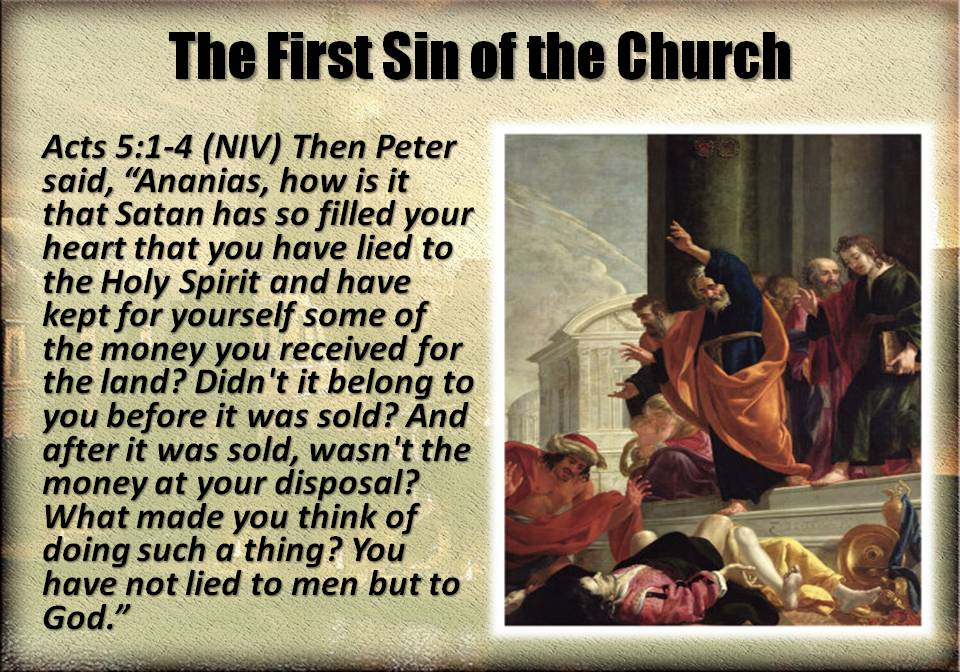
C. The First Sin of the Church

Acts 5:1-4 (NIV) Now a man named Ananias, together with his wife Sapphira, also sold a piece of property. With his wife’s full knowledge he kept back part of the money for himself, but brought the rest and put it at the apostles’ feet. Then Peter said, “Ananias, how is it that Satan has so filled your heart that you have lied to the Holy Spirit and have kept for yourself some of the money you received for the land? Didn’t it belong to you before it was sold? And after it was sold, wasn’t the money at your disposal? What made you think of doing such a thing? You have not lied to men but to God.”

Ananias, in lying to the church, embraced all the sins of Babylon. He wanted the splendor that the money could by him. He wanted to status of appearing to be such a giving saint. He wanted to appear successful in the eyes of the church and his friends. Satan filled his heart with the spirit of Babylon. Ananias tried to minimize God, and exalt himself. God had the last laugh once again.

D. What is the Danger of Babylon?

  • Nimrod built one tall building
  • Achan took one fancy robe
  • Ananias told one little lie

Yet their small act of sin represented a danger to what God wanted to accomplish.

  • Nimrod looked at the Tower of Babel reaching to the sky and said, wow, look what we did!
    • God saw the Tower and changed the course of Mankind!
  • Achan looked at the Shiny Robe and said, Wow wouldn’t I look like somebody in the Robe?
    • God saw the robe hidden in his tent and changed the course of Achan’s life! (In a dramatic fiery heap of stones!)
  • Ananias told a partial truth but still gave the church a lot of money
    • God saw his heart and startled the church

What is so dangerous about Babylon? What dangers was God wanting to protect His people from?

The Best Way to understand the danger of Babylon is to understand what the Babylonian Garment represented. This garment pictures Babylon far better than the silver or gold that Achan also took. That is why it was mentioned.

This Babylonian Garment represents Three Things that are a Danger to our love for God. They are seemingly innocent things, things that we all need and appreciate and even desire. But the Seduction of these three things will work their way into our lives until they minimize our need for God.

The Babylonian Garment Represents:

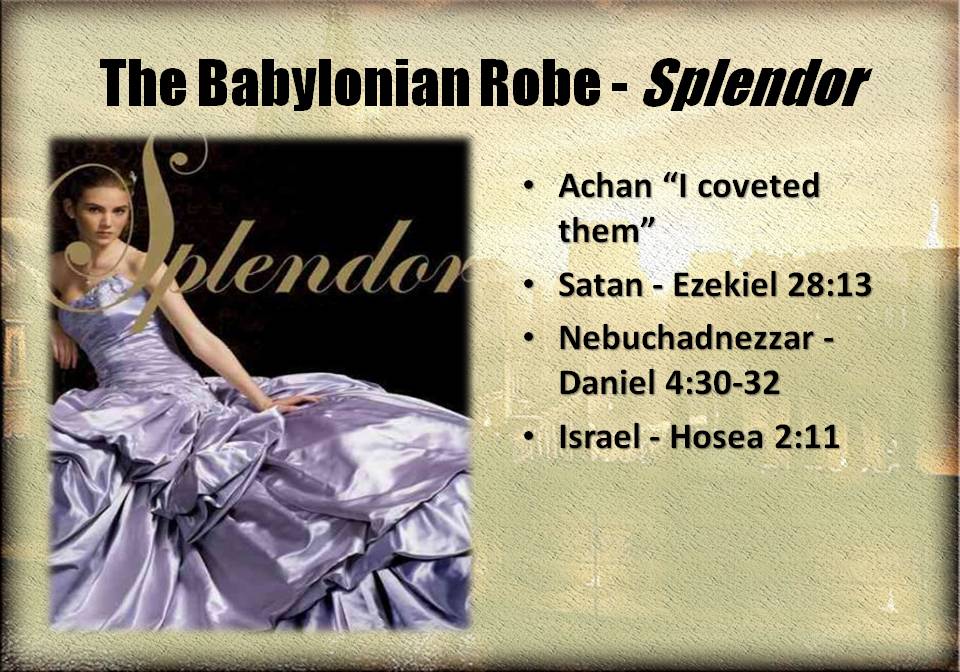
1. Splendor

We all appreciate beauty. We are drawn to it. Whether it is a car, a woman, even a horse, we love beautiful things. Advertisements shout this loud and clear. Television shows, even reality TV shows, shout this. Women (and men) spend billions of dollars to make themselves beautiful. Architects design buildings, even stadiums, to display the splendor and beauty of their imagination.

King Ahasuerus, reigned from India to Ethiopia, and in the third year of his reign, he gave a feast for all of his officials and servants and nobles and governors that lasted 180 days. All the days of the feast he displayed the riches of his royal glory and the splendor and pomp of his greatness.

We love to display our splendor and glory-whether in our clothes, our car, our home, our possessions.

America is a land of BLING! We even do it with teeth fillings, piercings and tattoos! We trick out our trucks, our cars, our motorcycles, we wear our jewelry and accessorize!

a) Even Satan was all about BLING!

According to Ezekiel 28:13, a probable reference to Lucifer, we learn that he is an amazing being to behold: “You were the seal of perfection, full of wisdom and perfect in beauty. You were in Eden, the garden of God; every precious stone was your covering: the sardius, topaz, and diamond, beryl, onyx, and jasper, sapphire, turquoise, and emerald with gold. The workmanship of your timbrels and pipes was prepared for you on the day you were created”.

Splendor is seductive. It lured Lucifer into rebellion. It lured David into deep sin. It lured the wisest man on the earth into committing unspeakable acts against his God, whose very wisdom he possessed.

b) Nebuchadnezzar:

Daniel 4:29-30 (NIV) … as the king was walking on the roof of the royal palace of Babylon, he said, “Is not this the great Babylon I have built as the royal residence, by my mighty power and for the glory of my majesty?”

God Had the Last Word. Immediately a voice came from heaven:

Daniel 4:31-32 (NIV) “This is what is decreed for you, King Nebuchadnezzar: Your royal authority has been taken from you. You will be driven away from people and will live with the wild animals; you will eat grass like cattle. Seven times will pass by for you until you acknowledge that the Most High is sovereign over the kingdoms of men and gives them to anyone he wishes.”

c) Israel:

Hosea 2:11-13 I will stop all her celebrations: her yearly festivals, her New Moons, her Sabbath days –all her appointed feasts. I will ruin her vines and her fig trees, which she said were her pay from her lovers; I will make them a thicket, and wild animals will devour them. I will punish her for the days she burned incense to the Baals; she decked herself with rings and jewelry, and went after her lovers, but me she forgot,” declares the LORD.

God and Splendor

1. Inner beauty and splendor matters to God

    • 1Pet. 3:1 Wives, in the same way be submissive to your husbands so that, if any of them do not believe the word, they may be won over without words by the behavior of their wives, 2when they see the purity and reverence of your lives. 3Your beauty should not come from outward adornment, such as braided hair and the wearing of gold jewelry and fine clothes. 4Instead, it should be that of your inner self, the unfading beauty of a gentle and quiet spirit, which is of great worth in God’s sight. 5For this is the way the holy women of the past who put their hope in God used to make themselves beautiful.

2. God Looks on the Heart

    • 1 Samuel 16:7 (ESV) But the Lord said to Samuel, “Do not look on his appearance or on the height of his stature, because I have rejected him. For the Lord sees not as man sees: man looks on the outward appearance, but the Lord looks on the heart.”

3. God Must be our Splendor

    • Psalms 96:9 (ESV) Worship the Lord in the splendor of holiness; tremble before him, all the earth!
    • Psalms 104:1 (ESV) Bless the Lord, O my soul! O Lord my God, you are very great! You are clothed with splendor and majesty,
    • Psalms 111:3 (ESV) Full of splendor and majesty is his work, and his righteousness endures forever.

4. We are to make Known His Splendor to our Children

    • Psalms 145:12 (ESV) to make known to the children of man your mighty deeds, and the glorious splendor of your kingdom.

5. In the End Times, Men will seek to hide from the splendor of God!

    • Isaiah 2:19 (ESV) And people shall enter the caves of the rocks and the holes of the ground, from before the terror of the Lord, and from the splendor of his majesty, when he rises to terrify the earth.

6. The Splendor of Babylon will be no more

    • Isaiah 13:19 (ESV) And Babylon, the glory of kingdoms, the splendor and pomp of the Chaldeans, will be like Sodom and Gomorrah when God overthrew them.

7. The Church will be presented to Christ in Splendor

    • Ephesians 5:25-27 (ESV) Husbands, love your wives, as Christ loved the church and gave himself up for her, that he might sanctify her, having cleansed her by the washing of water with the word, so that he might present the church to himself in splendor, without spot or wrinkle or any such thing, that she might be holy and without blemish.

2. Status

Tradition has it that this robe was a priestly robe, used in worship to the Canaanite gods. This robe not only was beautiful, it represented power. It represented standing. It represented status.

Whoever wore this robe was always on the “A-List” party invitations. This robe granted its wearer access to the power people of Jericho and Canaan. The wearer was somebody. Nobody messed with whoever wore this robe. If they did, they found themselves being sacrificed to Baal!

Status is very important in our world.

  • Satan began it all by saying “I will be as the most high”. He wanted the status of God himself.
  • Adam and Eve ate the forbidden fruit because they wanted to be like gods.
  • Lot chose the well watered plains of Sodom and Gomorrah, and instead of hating the sin, he became enmeshed in it, even becoming a man of ‘status’ a judge at the gate.
  • Judas followed Jesus for the status he thought it would bring him. When it became apparent that Jesus was not going to become King, he set out to betray the Son of God!
  • Aaron and the Levites set out to worship God in the Tabernacle. But by the time of Christ, the High Priest had become a perverted, corrupt institution motivated by power and status.
  • Ministry today is often corrupted by a pursuit of ratings and donations and status. Pastors focus their efforts on the Four “B’s” – Building Size, Budget Size, Number of Baptisms, and Number of Bodies. Spiritual growth and Character growth are not emphasized, because they do not build the churches ‘status’ as far as the world is concerned.

Focus upon STATUS is PRIDE!

There is no room for Pride in God’s Kingdom: Mark 9:35 (ESV) And he sat down and called the twelve. And he said to them, “If anyone would be first, he must be last of all and servant of all.”

3. Success

Nothing says success like Excess. Or a Rolex, Cadillac, or ___________.  You name it, we’ll wear it or drive it as long as it makes us look successful!

I can just see Achan trying on that shiny robe. Oooh he felt so good. He couldn’t wait to be seen wearing it. Everyone would be jealous of his apparent success!

Daniel 4:4 (ESV) I, Nebuchadnezzar, was at ease in my house and prospering in my palace.

Look at America. We are swimming in debt, but we still consume and charge and buy our way into success. Just a few months ago the politicians were encouraging us to consume more to get this economy going.

We trade our souls for stuff. Stuff to show our success. Stuff to make us feel secure at night. Possessions, Money, those are things we can rely on. Our future is secure if we have money. We don’t have to worry about growing old, or caring for our loved ones, if we have money in the bank.

Man’s Success is Failure before God

Mark 8:34-36 (ESV) And calling the crowd to him with his disciples, he said to them, “If anyone would come after me, let him deny himself and take up his cross and follow me. For whoever would save his life will lose it, but whoever loses his life for my sake and the gospel’s will save it. For what does it profit a man to gain the whole world and forfeit his soul?

Revelation 3:17 (ESV) For you say, I am rich, I have prospered, and I need nothing, not realizing that you are wretched, pitiable, poor, blind, and naked.

 This is God’s Plan for Success:

Joshua 1:8 (ESV) This Book of the Law shall not depart from your mouth, but you shall meditate on it day and night, so that you may be careful to do according to all that is written in it. For then you will make your way prosperous, and then you will have good success.

E.The Splendor of Babylon Will Vanish

  • Revelation 18:10 (KJV) Standing afar off for the fear of her torment, saying, Alas, alas, that great city Babylon, that mighty city! for in one hour is thy judgment come.
  • Revelation 18:14 (NLT) “The fancy things you loved so much are gone,” they cry. “All your luxuries and splendor are gone forever, never to be yours again.”

When Babylon Falls, there will be the greatest Hallelujah ever!

Revelation 19:1-3 (ESV) After this I heard what seemed to be the loud voice of a great multitude in heaven, crying out, “Hallelujah! Salvation and glory and power belong to our God, for his judgments are true and just; for he has judged the great prostitute who corrupted the earth with her immorality, and has avenged on her the blood of his servants.” Once more they cried out, “Hallelujah! The smoke from her goes up forever and ever.”

F. The Solution for A Heart Infected with Babylon

Joshua 7:19 (ESV) Then Joshua said to Achan, “My son, give glory to the Lord God of Israel and give praise to him. And tell me now what you have done; do not hide it from me.”

To counter the effects of the Babylonian Garment, Joshua told Achan to give glory to the Lord God!

When we do what we want, when we go our own way, when we place our confidence in splendor, status and success, we are robbing God of His Glory. God wants His people to give all praise and glory to Him. Everything in our live depends upon God!

We are Losing a Generation of Young People because we are wearing Babylonian Garments

The Millennial Generation or Generation Y consists of young adults born after 1980. The latest research from Barna indicates that this generation is growing up without a Biblical Foundation of Jesus Christ. Only 15% of Millennials profess faith in Jesus Christ. Yet their parents, the Baby Boomers, profess a 65% Christianity.

What happened?

The Garment of Babylon is what happened. We have put on our Sunday Faces and Clothes at Church, but throughout the week we wear our Babylonian Garment. We pursue our splendor, our status and our success.

We embrace the spirit of Babylon in our homes and work. We display a MINIMAL DEPENDENCE upon God in our homes, our work and our lives.

Jude 1:11 (ESV) Woe to them! For they walked in the way of Cain and abandoned themselves for the sake of gain to Balaam’s error and perished in Korah’s rebellion.

We have danced with Cain, we have partied with Balaam and we have colluded with Korah. And so Babylon has infected the hearts of our families and children.

  • Cain wanted to seek the God in his own way. He thought his splendor was good enough.
  • Balaam was divided between pleasing God and having the status of the King’s Prophet. So he corrupted the message of God, and gained the status of the King, but lost his soul to the ways of Babylon.
  • Korah wanted to make his own success, apart from Noah and God. He had enough of Moses, and told him, everyone is holy enough. He wanted to go his own way and be successful apart from Moses and God.

We have two choices…

Allow Babylon to Steal our Love for God or

Give Glory to God in everything,  Seek His Glory through Everything and most importantly, allow our lives to display His Glory to those around us!

We Can Live Hallelujah Lives or Crying Lives!

  • The World cried at the downfall of Babylon. It had become their life!
  • Those Saints in Heaven Shouted Hallelujah!

Revelation 19:1 (ESV) After this I heard what seemed to be the loud voice of a great multitude in heaven, crying out, “Hallelujah! Salvation and glory and power belong to our God,

When we seek satisfaction in the Splendor, Status and Success of this world, we will end up miserable, dissatisfied, on medication for depression.

Or you will come to the Salvation that only Jesus Christ offers, accept the misery of sin, and fall into the Love and Hope that Jesus Christ alone offers.

When Jesus Christ becomes your Savior, then God can say to you:

Jim, you are the most wretched and hopeless man, and in yourself you will never be anything else. But I have looked upon you through your faith in My Son as though you never sinned at all. I chose to see you in my Son by your faith!

Glory! God alone is worthy of Glory! My Joy, my happiness, my accomplishments are all in Him!

What Does that Babylonian Garment offer me that could even compare? It is temporary, it is fading, it will be soon eaten or destroyed or lost!

We need to embrace Christ with our children. We need to quit putting emphasis on the Babylonian Lifestyle of self effort and success, and focus on the splendor, the standing and the success that come from putting on the Lord Jesus Christ!

Isaiah 43:7 says we are created for God’s Glory! Isaiah 48:9 says God will not give His glory to another.

So God did not create us so that He would become more glorious, for His beauty and perfection are complete. He is already Glory defined. God cannot become more God by making something that is not God.

No, God created us to display His Glory! This world is to KNOW God’s Glory by our lives! We are not to seek our own glory through splendor, status or success. No, in all our lives we are to display God’s glory to the world, not our own glory!

Babylon is man-centeredness. It can be in our churches, our worship, our work, our families, our lives.

God will give His glory to no one. We cannot make God more glorious by accumulating stuff and bringing it to Him. But we can bring our lives and all we have to HIM and ask Him to use it to bring glory to Him.

Never hold on to stuff if it starts to become more important than God or worshipping Him! We are to display God’s Glory to the world with all our lives, with all our being, with all our STUFF!


Total Health

is “the dynamic and harmonious interaction of spirit, soul and body in the absence of mental, emotional or physical sickness or disease”.

“Now may the God of peace himself sanctify you completely, and may your whole spirit and soul and body be kept blameless at the coming of our Lord Jesus Christ. He who calls you is faithful; he will surely do it”. 1 Thessalonians 5:23-24

To be sanctified is to withdraw your spirit, soul and body from the unhealthy entanglements of our corrupt culture and experience true fellowship with the God of peace.

We are made of three distinct parts: spirit, soul and body. Total Health involves an understanding of how these interact with each other.

We are made in God’s image, and that means we are like God who “is a Spirit, and they that worship Him must worship in spirit and truth”.

There are three different laws operating within us-law of the spirit, law of the mind (soul), and the law of sin in the body (Romans 7:22-8:1)

When these three laws are in conflict with one another, we will experience stress, disease and even premature death. When they are in harmony with one another, we will experience health, peace and life.

“For to set the mind on the flesh is death, but to set the mind on the Spirit is life and peace”. Romans 8:6

“Beloved, I pray that all may go well with you and that you may be in good health, as it goes well with your soul”. 3 John 1:2

The Goal of Total Health

Total Health is not perfect health. Perfect health is not possible for we are all in the process of dying physically.

Though our outer self is wasting away, our inner self is being renewed day by day. 2 Corinthians 4:16

Total Health is the ability to fulfill the purposes for which God created you. Before we were even born, God designed us to carry out great works.

For we are his workmanship, created in Christ Jesus for good works, which God prepared beforehand, that we should walk in them. Ephesians 2:10

Our identity and fulfillment in life is to carry out these great works. We do not want any sickness or disease to hinder us from carrying out our life purpose. We have a limited number of days in which to accomplish the great works for which God brought us into this world. Our focus should not be on having better health but on completing our life purpose.

We were designed before conception

“Before I formed you in the womb I knew you, and before you were born I consecrated you; I appointed you a prophet to the nations.” Jeremiah 1:5

For you formed my inward parts; you knitted me together in my mother’s womb. I praise you, for I am fearfully and wonderfully made. Wonderful are your works; my soul knows it very well. Psalms 139:13-14

God promised His people that if they would love Him and keep His commandments, He would bless them more than all the other peoples of the earth:

And the Lord commanded us to do all these statutes, to fear the Lord our God, for our good always, that he might preserve us alive, as we are this day. And it will be righteousness for us, if we are careful to do all this commandment before the Lord our God, as he has commanded us.’ Deuteronomy 6:24-25

You shall be blessed above all peoples. There shall not be male or female barren among you or among your livestock. And the Lord will take away from you all sickness, and none of the evil diseases of Egypt, which you knew, will he inflict on you, but he will lay them on all who hate you. Deuteronomy 7:14-15

“And if you faithfully obey the voice of the Lord your God, being careful to do all his commandments that I command you today, the Lord your God will set you high above all the nations of the earth. And all these blessings shall come upon you and overtake you, if you obey the voice of the Lord your God. Blessed shall you be in the city, and blessed shall you be in the field. Blessed shall be the fruit of your womb and the fruit of your ground and the fruit of your cattle, the increase of your herds and the young of your flock. Blessed shall be your basket and your kneading bowl. Blessed shall you be when you come in, and blessed shall you be when you go out. Deuteronomy 28:1-6

Total Health: Being Made “Whole”

On the way to Jerusalem, he was passing along between Samaria and Galilee. And as he entered a village, he was met by ten lepers, who stood at a distance and lifted up their voices, saying, “Jesus, Master, have mercy on us.” When he saw them, he said to them, “Go and show yourselves to the priests”. And as they went, they were cleansed (katharizo). Then one of them, when he saw that he was healed, turned back, praising God with a loud voice; and he fell on his face at Jesus’ feet, giving him thanks. Now he was a Samaritan. Then Jesus answered, “Were not ten cleansed? Where are the nine? Was no one found to return and give praise to God except this foreigner?” And he said to him, “Rise and go your way; your faith has made you well.” Luke 17:11-19

1. Cleansing the Blood

As they went, they were cleansed.

katharízō; from katharós , pure. To cleanse, free from filth[1]; “to cleanse, make clean”,[2]

In a physical sense, this would refer primarily to the circulatory system, because the “life of the flesh is in the blood” (Lev. 17:11)

In a spiritual sense, to purify from the pollution and guilt of sin (Acts 15:9; 2 Cor. 7:1; Eph. 5:26; Titus 2:14; Heb. 9:14; James 4:8; 1 John 1:7, 9;[3]

In a spiritual sense, ‘katharizo’ refers to the removal of the pollution and guilt of sin.

2. Healing the Flesh

One of the lepers looked at his flesh and saw that he was healed which is “iáomai”; to heal, cure, restore to bodily health.[4] The physical symptoms of the disease had disappeared.

When our blood is cleansed of its impurities, the flesh can be restored to health.

3. Achieving Wholeness

Simply removing the distressing condition of the disease is not total health. Total health involves a restored relationship with God and the accompanying signs of joy, freedom, and inward peace.

The leper who returned to give thanks was the only one that Jesus told, “Rise and go your way; your faith has made you well”. Well or whole is the word ‘sózō’.

Sózō; to save, deliver, make whole, preserve safe from danger, loss, destruction. Sózō occurs fifty-four times in the Gospels. Fourteen relate to deliverance from disease or demon possession. Twenty instances, the inference is to the rescue of physical life from some impending peril or instant death. The remaining twenty times, the reference is to spiritual salvation[5]

Three Aspects of Salvation

1. Salvation of the Spirit

Eternal Salvation of our spirit. This is the New Birth spoken of in John 3. This is what Paul described in Romans 10:

Because, if you confess with your mouth that Jesus is Lord and believe in your heart that God raised him from the dead, you will be saved (sózō). For with the heart one believes and is justified, and with the mouth one confesses and is saved. For the Scripture says, “Everyone who believes in him will not be put to shame.” For there is no distinction between Jew and Greek; for the same Lord is Lord of all, bestowing his riches on all who call on him. For “everyone who calls on the name of the Lord will be saved (sózō)”. Romans 10:9-13

2. Salvation of the Soul

The regeneration and salvation of our spirit is instantaneous. The salvation of our soul (mind, will and emotions) is a continual process. It is accomplished through the control of the Holy Spirit in conjunction with the washing of the Word of God. As we read and meditate on God’s Word, we build a Biblical belief system. This is what James was writing about:

Therefore put away all filthiness and rampant wickedness and receive with meekness the implanted word, which is able to save (sózō) your souls. James 1:21

The wholeness, soundness and health of our soul has a direct effect upon our physical health. This is the meaning of John’s greeting:

“Beloved, I pray that all may go well with you and that you may be in good health, as it goes well with your soul”. 3 John 1:2

3. Salvation of the Body

The “wholeness” or “wellness” of our physical body is contingent upon obedience to God’s moral standards.

Do not be deceived: God is not mocked, for whatever one sows, that will he also reap. For the one who sows to his own flesh will from the flesh reap corruption, but the one who sows to the Spirit will from the Spirit reap eternal life. Galatians 6:7-8

When a member of the Corinthian church committed gross immorality, Paul commanded

When you are assembled in the name of the Lord Jesus and my spirit is present, with the power of our Lord Jesus, you are to deliver this man to Satan for the destruction of the flesh, so that his spirit may be saved in the day of the Lord. 1 Corinthians 5:4-5

Three Primary Factors that Contribute to Health

1. Genetic Tendencies

We all inherit tendencies toward certain diseases based on weaknesses in our genetic makeup. They do not have to become diseases if we follow God’s way of life.

The challenge of finding hereditary disease genes:

Our expectation is that the characterization of a disease- instigating gene will greatly assist our understanding of how and why it causes a malfunction in the body. It makes good sense to go to the root of the problem. But to learn a gene’s secret, first you must find it. And finding it is not so simple. It is much easier to locate the neighborhood in the genome where a gene resides than it is to determine its exact address.

Lilliput and Brobdingnag: Beyond Gulliver’s Travels. The magnitude of the challenge arises from the vast amount of DNA contained in the diploid human genome, which includes all of a person’s genetic material. If strung out, the DNA in a single human genome would stretch to about two meters, but the diameter of the strand would amount to only about two billionths of a meter, 20 angstroms, a span a hundred times smaller than a wavelength of light. If the DNA from a single cell from every human being on the planet — 6 billion people — were stitched end to end, the resulting string would girdle the earth about 300 times. If the genomes from every cell of the 6 billion people were laid out end to end, they would extend 700 billion, billion miles — enough to wrap around our galaxy more than 700 times.

To understand the enormous problem of finding a gene somewhere on an individual’s strand of DNA, imagine that a single human genome is long enough to circle the globe. On this scale, the amount of DNA in a chromosome would extend for a thousand miles. A gene would span just one twentieth of a mile, and a disease-causing defect — a point mutation, a change in only one DNA base pair — could run as short as one twentieth of an inch. What we are thus searching for is comparable to a fraction of an inch on the circumference of the globe! In this immense morass of DNA, finding the exact address of a gene and pinpointing its fault makes for extremely tough going, and it requires all of the creativity and ingenuity of everyone engaged in the quest.[6]

An example of genetic tendencies in one family:

We were looking for a large extended multigenerational family in which we could observe many instances of the Huntington’s disease gene or its normal counterpart being passed on — and we knew of just such a family. Members of the kindred live in Venezuela in three rural villages — San Luis, Barranquitas, and Laguneta — on the shores of Lake Maracaibo. Because it is situated in the northern region of Latin America and Lake Maracaibo is actually a huge ocean gulf, Venezuela has long communicated directly with Europe, and many European genes have appeared in the local population. Story has it that some sailor with Huntington’s disease came over to trade and left his legacy, but we do not know if this is apocryphal.

We have been able to trace the disease as far back as the early 1800s, to a woman appropriately named Maria ConcepciÛn. We know that Maria lived in the “pueblos de agua,” villages built on stilts in the water next to shores too marshy, jungly, and inhospitable to accommodate human life. Laguneta, where many of Maria’s descendants live, remains such a stilt village.

Maria was the founder of a kindred now numbering close to 11,000 people, living and deceased. In the pedigree, there are 371 persons with Huntington’s disease, 1,266 at 50 percent risk and 2,395 at 25 percent risk for the disease. Of the 11,000, 9,000 are living and the majority are under the age of forty. In these small and impoverished towns, we estimate that there are over 660 asymptomatic gene carriers who are too young to show symptoms, but as years pass — if no treatment is found — they will surely die. It is crushing to look at these exuberant children full of hope and expectation, despite poverty, despite illiteracy, despite dangerous and exhausting work for the boys fishing in small boats in the turbulent lake, or for even the tiny girls tending house and caring for ill parents, despite a brutalizing disease robbing them of parents, grandparents, aunts, uncles, and cousins — they are joyous and wild with life, until the disease attacks.[7]

2. Physical Constitution

We can inherit a strong physical constitution from our parents, yet through immoral or wild living pass along a weaker constitution to our children and grand children.

In the 1940’s Francis M. Pottenger (not Pottinger) M.D. began a ten year study using 900 cats to determine what effects processed foods have on the body, and to examine the genetic propensity of passing degenerative disease traits from generation to generation. The cats were divided into five groups with two of the groups fed raw whole foods and the other three groups cooked enzyme less foods. The cats were observed over a four generation period and the following results were documented by Doctor Pottenger:[8]

POTTENGER CAT EXPERIMENT SUMMARY

GROUP A B C D E
FOOD FED Raw meat Raw milk Pasteurized milk Evaporated milk Condensed milk
1st Generation Remained healthy Remained healthy Developed diseases and illnesses near end of life
2nd Generation Remained healthy Remained healthy Developed diseases and illnesses in middle of life
3rd Generation Remained healthy Remained healthy Developed diseases and illnesses in beginning of life; many died before six months of age;
4th Generation Remained healthy Remained healthy No fourth generation was produced: either third generation parents were sterile, or fourth generation cats were aborted before birth

Source: Pottenger’s Cats, a Study in Nutrition

3. Various Stresses

Whether our genetic tendencies and weak constitution will result in diseases will be determined primarily by stresses in our lives (because of what we say, think and do).

There can be many causes of stress, such as time constraints, having too much to do, and having too many bills and not enough funds.

However, the greatest stresses come from inward attitudes such as anger, guilt, lust, bitterness, greed, fear and envy. These destroy the immune system.

Is Total Health Healing?

Total healing is not possible on earth, because the sentence of death and the curse of sin have been placed on the physical body of every person.

Total Health refers to fulfilling the number of years for which God designed us to serve Him and the quality of life we need to carry out the work He has created us to accomplish.

There are three types of illnesses given in Scripture. When you develop an illness, discern which of these types you are experiencing. Then, carry out the appropriate Biblical responses.

1. Sickness unto Death

As a believer in the Lord, you are indestructible until your work on earth is done. As one preacher said: “you are bulletproof!” Once you finish your work, there is no point in staying around here. It is far more glorious to be in the presence of the Lord!

If a believer has what the doctors describe as a terminal illness, but he believes that his work is not yet done, he can appeal to God for healing-not just to extend his life but to accomplish the work that God has called him to do.

This was the basis for David’s prayer in his old age:

O God, from my youth you have taught me, and I still proclaim your wondrous deeds. So even to old age and gray hairs, O God, do not forsake me, until I proclaim your might to another generation, your power to all those to come. Psalms 71:17-18

In order to have this outlook on life and death, we must be good stewards of the time God has entrusted to us. We should be continually looking for better ways to redeem every hour by keeping it from going to waste and choosing the most profitable activities to advance God’s Kingdom.

If you were told today that you have a terminal disease, what reason would you give God for keeping you alive?

2. Sickness unto Chastisement

There are physical, emotional and spiritual consequences for violating God’s Laws. The most severe come to those who chose to violate His laws dealing with morality. If we cater to our fleshly wants, we shall reap the corruption of the flesh as Galatians 6:7 states.

The Bible also mentions specific consequences to those who dishonor their parents (Prov 30:17), violate God’s dietary restrictions (I Peter 1:15-16, Leviticus 11:44ff)

There are cause and effect health consequences when we violate God’s commands. In His mercy, God has established the communion table a place for thorough self-examination. Carry it out with the utmost care.

Careless Communion results in what Paul described:

“For anyone who eats and drinks without discerning the body eats and drinks judgment on himself. That is why many of you are weak and ill, and some have died. 1 Corinthians 11:29-30

If you are sick, ask yourself, is this God’s way of chastening me for not following His way of life? Consider the state of your soul as well:

  • Am I withholding forgiveness from someone who has hurt me deeply?
  • Am I resentful or regretful over something in my past, either because of someone else or my own actions?
  • Is there anything in my past for which I cannot bring myself to thank God for?
  • Are there any private sins that I cherish without confessing and repenting before Holy God?
  • Is there anything in my past that I have not found forgiveness for, and when reminded, I immediately jump on the Ferris wheel of regret?
  • Am I quick to get frustrated and even angry when certain situations arise?
  • Are there areas of my life I refuse to submit to God’s control?

3. Sickness unto the Glory of God.

God uses infirmities, sickness and disease to bring glory to Himself.

a) He Provides Supernatural Healing

As he passed by, he saw a man blind from birth. And his disciples asked him, “Rabbi, who sinned, this man or his parents, that he was born blind?” Jesus answered, “It was not that this man sinned, or his parents, but that the works of God might be displayed in him. John 9:1-3

This infirmity was designed years before Christ healed him. Therefore, we must never attribute sickness, disease or impairment as sin on his part or his parents fault.

b) God’s Glory is Manifested in our Weakness.

So to keep me from becoming conceited because of the surpassing greatness of the revelations, a thorn was given me in the flesh, a messenger of Satan to harass me, to keep me from becoming conceited. Three times I pleaded with the Lord about this, that it should leave me. But he said to me, “My grace is sufficient for you, for my power is made perfect in weakness.” Therefore I will boast all the more gladly of my weaknesses, so that the power of Christ may rest upon me. For the sake of Christ, then, I am content with weaknesses, insults, hardships, persecutions, and calamities. For when I am weak, then I am strong. 2 Corinthians 12:7-10

God often gives us physical and even mental weaknesses to prevent us from depending on our own strength or ability rather than the supernatural working of His power.

The Five Factors Which Determine our Total Health

Sickness and disease can be associated with one or more of the following five factors. When proper care is given regarding these factors, you have the optimal potential to avoid or clear up the related diseases. The first three are the most important, according to Scripture.

1. What We Think

Intellectual thoughts travel through the limbic system of the brain, directly effecting many bodily functions. Research has proven a connection between the limbic system and emotional memory, which includes positive thoughts such as love, joy and peace; and negative thoughts such as anger, guilt, lust, bitterness, greed, fear and envy.

But what comes out of the mouth proceeds from the heart, and this defiles a person. For out of the heart come evil thoughts, murder, adultery, sexual immorality, theft, false witness, slander. These are what defile a person. But to eat with unwashed hands does not defile anyone.” Matthew 15:18-20

There are two parts of the nervous system that are especially significant: The limbic system and the autonomic nervous system. The Limbic System The limbic system is a complex set of structures that lies on both sides and underneath the thalamus, just under the cerebrum. It includes the hypothalamus, the hippocampus, the amygdala, and several other nearby areas. It appears to be primarily responsible for our emotional life, and has a lot to do with the formation of memories.[9]

All emotional memories are stored and can be consciously or subconsciously stimulated by the senses. The brain, the heart and the intestinal tract release neuro-transmitters that result in physiological changes. The thoughts of the heart prompt the greatest changes in the body, as it is stated in Scripture:

For as he thinketh in his heart, so is he: Eat and drink, saith he to thee; but his heart is not with thee. Proverbs 23:7

Neurotransmitters Receptors

Neurotransmitters exert their effect by binding to specific receptors on the neuronal postsynaptic membrane. A neurotransmitter can either ‘excite’ its neighbouring neuron so increasing its activity, or ‘inhibit’ its neighbouring neuron, suppressing its activity. In general, the activity of a neuron depends on the balance between the number of excitatory and inhibitory processes affecting it, and these can occur simultaneously. Most neurotransmitter receptors can be divided into two types – ligand-gated receptors and G-protein linked receptors.

Stimulation of a ligand-gated receptor  enables a channel in the receptor to open and permits the influx of chloride and potassium ions into the cell. The positive or negative charges that enter the cell either excite or inhibit the neuron. Ligands for these receptors include excitatory neurotransmitters, such as glutamate and, to a lesser extent, aspartate. Binding of these ligands to the receptor produces an excitatory postsynaptic potential (EPSP). Alternatively, binding of inhibitory neurotransmitter ligands, such as GABA and glycine, produces an inhibitory postsynaptic potential (IPSP). These ligand-gated receptors are also known as ionotropic or fast receptors.

G-protein linked receptors are indirectly linked to ion channels, via a second messenger system involving G-proteins and adenylate cyclase. These receptors are neither precisely excitatory nor inhibitory and modulate the actions of the classic excitatory and inhibitory neurotransmitters such as glutamate and glycine. These receptors tend to have an inhibitory effect if they are linked to the Gi protein in the cell membrane, and a more excitatory effect if linked to the Gs protein. G-protein linked receptors are known as metabotropic or slow receptors and examples include GABA-B, glutamate, dopamine (D1 and D2), 5-HT1A, 5-HT1B, 5-HT1D, 5-HT2A,5-HT2C receptors.

Serotoning receptors

Type Distribution Postulated Roles
5-HT1 Brain, instetinal nerves Neuronal inhibition, behavioural effects, cerebral vasoconstriction
5-HT2 Brain, heart, lungs, smooth muscle control, GI system, blood vessels, platelets Neuronal excitation, vasoconstriction, behavioural effects,depression, anxiety
5-HT3 Limbic system, ANS Nausea, anxiety
5-HT4 CNS, smooth muscle Neuronal excitation, GI
5-HT5, 6, 7 Brain Not known

Noradrenaline receptors

Type Distribution Postulated Roles
Alpha1 Brain, heart, smooth muscle Vasoconstriction, smooth muscle control
Alpha2 Brain, pancreas, smooth muscle Vasoconstriction, presynaptic effect in GI (relaxant)
Beta1 Heart, brain Heart rate (increase)
Beta2 Lungs, brain, skeletal muscle Bronchial relaxation, vasodilatation
Beta3 Postsynaptic effector cells Stimulation of effector cells

Dopamine receptors

Type Distribution Postulated Roles
D1, 5-like Brain, smooth muscle Stimulatory, role in schizophrenia?
D2, 3, 4-like Brain, cardiovascular system, presynaptic nerve terminals Inhibitory, role in schizphrenia?

Acetylcholine receptors

Type Distribution Postulated Roles
M1 Nerves CNS excitation, gastric acid secretion
M2 Heart, nerves, smooth muscle Cardiac inhibition, neural inhibition
M3 Glands, smooth muscle, endothelium Smooth, muscle contraction, vasodilation
M4 ?CNS? Not known
M5 ?CNS? Not known
NM Skeletal muscles neuromuscular junction Neuromuscular transmission
NN Postganglionic cell body dendrites Ganglionic transmission[10]

[11]

The heart and brain

However, following several years of  research, it was observed that, the heart communicates with the brain in ways that significantly affect how we perceive and react to the world. It was found that, the heart seemed to have its own peculiar logic that frequently diverged from the direction of the autonomic nervous system. The heart appeared to be sending meaningful messages to the brain that it not  only understood, but also obeyed (Lacey and Lacey, 1978).

Later, neurophysiologists discovered a neural pathway and mechanism whereby input from the heart to the brain could inhibit or facilitate the brain’s electrical activity (McCraty, 2002)

The brain in the heart:

After extensive research, Armour (1994) introduced the concept of functional ‘heart brain’. His work revealed that the heart has a complex intrinsic nervous system that is sufficiently sophisticated to qualify as a ‘little brain’ in its own right. The heart’s brain is an intricate network of several types of neurons, neurotransmitters, proteins and support cells similar to those found in the brain proper. Its elaborate circuitry enables it to act independently of the cranial brain – to learn, remember, and even feel  and sense. The heart’s nervous system contains around 40,000 neurons, called sensory neurites (Armour, 1991).

Information from the heart – including feeling sensations – is sent to the brain through several afferents. These afferent nerve pathways enter the brain at the area of the medulla, and cascade up into the higher centres of the brain, where they may influence perception, decision making and other cognitive processes (Armour, 2004).

Thus, it was revealed that the heart has its own intrinsic nervous system that operates and processes information  independently of the brain or nervous system. This is what allows a heart transplant to work. Normally, the heart communicates with the brain via nerve fibres running through the vagus nerve and the spinal column. In a heart transplant, these nerve connections do not reconnect for an extended period of time; in the meantime, the transplanted heart is able to function in its new host only through the capacity of its intact, intrinsic nervous system (Murphy, et al, 2000)

The heart’s magnetic field:

Research has also revealed that the heart communicates information to the brain and throughout the body via electromagnetic field interactions. The heart generates the body’s  most powerful and most extensive rhythmic electromagnetic field. The heart’s magnetic component is about 500 times stronger than the brain’s magnetic field and can be detected several feet away from the body. It was proposed that, this  heart field acts as a carrier wave for information that provides a global synchronizing signal for the entire body (McCraty, Bradley & Tomasino, 2004)

Heart field interactions between individuals

There is now evidence that a subtle yet influential electromagnetic or ‘energetic’ communication system operates just below our conscious awareness. Energetic interactions possibly contribute to the ‘magnetic’ attractions or repulsions that occur between individuals, and also affect social relationships. It was also found that one person’s brain waves can synchronize to another person’s heart (McCraty, 2004).

Communication via hormones: the heart as a hormonal gland

Another component of the heart-brain communication system was provided by researchers studying  the hormonal system. The heart was reclassified as an endocrine gland when, in 1983, a hormone produced and released by the heart called atrial natriuretic factor (ANF) was isolated. This hormone exerts its effect on the blood vessels, on the kidneys, the adrenal glands, and on a large number of regulatory regions in the brain. It was also found that the heart contains a cell type known as ‘intrinsic cardiac adrenergic’’ (ICA) cells. Theses cells release noradrenaline and dopamine neurotransmitters,  once thought to be produced only by neurons in the CNS. More recently, it was discovered that the heart also secretes  oxytocin, commonly referred to as the ‘love’ or bonding hormone. In addition to its functions in childbirth and lactation, recent evidence indicates that this hormone is also involved in cognition, tolerance, adaptation, complex sexual and maternal behaviours, learning social cues and the establishment of enduring pair bonds. Concentrations of oxytocin in the heart were found to be as high as those found in the brain (Cantin & Genest, 1986).[12]

2. What We Say

God states, “Death and Life are in the power of the tongue”[13]. Positive words produce energy for health and peace, whereas negative words result in confusion and disease.

Positive words can be expressed in praise, verbal blessings, audible prayers and cries to God. The Words of God are alive and powerful:

For the word of God is living and active, sharper than any two-edged sword, piercing to the division of soul and of spirit, of joints and of marrow, and discerning the thoughts and intentions of the heart. Hebrews 4:12

We are also instructed:

My son, be attentive to my words; incline your ear to my sayings. Let them not escape from your sight; keep them within your heart. For they are life to those who find them, and healing to all their flesh. Keep your heart with all vigilance, for from it flow the springs of life. Proverbs 4:20-23

Negative words are expressed by such things as curses, ridicule, mocking, gossip and false accusations. God compares such words to poison, fire , venom and arrows because of the effect they have on the physical body.

A man who bears false witness against his neighbor is like a war club, or a sword, or a sharp arrow. Proverbs 25:18

So also the tongue is a small member, yet it boasts of great things. How great a forest is set ablaze by such a small fire! And the tongue is a fire, a world of unrighteousness. The tongue is set among our members, staining the whole body, setting on fire the entire course of life, and set on fire by hell. For every kind of beast and bird, of reptile and sea creature, can be tamed and has been tamed by mankind, but no human being can tame the tongue. It is a restless evil, full of deadly poison. James 3:5-8

who whet their tongues like swords, who aim bitter words like arrows, Psalms 64:3

“Their throat is an open grave; they use their tongues to deceive.” “The venom of asps is under their lips.” Romans 3:13

Negative words must be neutralized with verbal blessings, or they will do greater damage to our health. We are told by Christ and Paul:

“But I say to you who hear, Love your enemies, do good to those who hate you, bless those who curse you, pray for those who abuse you”. Luke 6:27-28

“Bless those who persecute you; bless and do not curse them”. Romans 12:14

3. What We Do

God designed man to function in intricate cause and effect sequences. He prescribed a way of life that is consistent with His holy standards. If these standards are violated by our lifestyle or behavior, we will experience corresponding consequences in our health and length of life.

Many times a lifestyle of promiscuity destroys the immune system and introduces destructive viruses to the body with the result of fatal diseases.

4. What We Eat

Our body needs proper nutrition. Note: your ability to digest food and assimilate its nutritional value is determined by what you think, say and do.

5. What We Inherit

Each of us inherits a genetic predisposition to death through Adam’s transgression. We each have genetic tendencies toward certain diseases. We also have in our body opportunistic agents that are ready to spring into action just as soon as our immune systems are too weak to stop them. These disease factors include Bacteria, Viruses, Parasites and Fungi.

When the stresses of anger, guilt, lust, bitterness, greed, fear and envy are resolved by obeying the commands of Christ, the sickness or disease they caused often clears up.

Then shall your light break forth like the dawn, and your healing shall spring up speedily; your righteousness shall go before you; the glory of the Lord shall be your rear guard. Isaiah 58:8


[1] Spiros Zodhiates, The Complete Word Study Dictionary – New Testament, (Chattanooga, TN: AMG Publishers, 1993), WORDsearch CROSS e-book, 793.

[2] William E. Vine, Vine’s Expository Dictionary of Old Testament and New Testament Words, (Nashville, TN: Thomas Nelson, 1940), WORDsearch CROSS e-book, Under: “Purge”. See Hebrews 9:14 & 9:22

[3] Spiros Zodhiates, The Complete Word Study Dictionary – New Testament, (Chattanooga, TN: AMG Publishers, 1993), WORDsearch CROSS e-book, 793.

[4] Ibid, under “iáomai”.

[5] Ibid, p. 1353.

[6] Nancy S. Wexler, Clairvoyance and Caution: Repercussions from the Human Genome Project. The Code of Codes: Scientific and Social Issues in the Human Genome Project. D.J. Kevles and L. Hood (Eds) Harvard University Press, 1992, 211-243 at http://www.hdfoundation.org/html/clair.php

[7] Ibid.

[9] Boeree, C. George, Ph.D. “General Psychology”. Epublication, 4/21/2008 found at: http://www.scribd.com/doc/6004602/general-psychology-etext

[13] Proverbs 18:21a

For more information get “How to Resolve 7 Deadly Stresses” published by the Institute in Basic Life Principles, Inc, 2008. www.iblp.org