Posts Tagged ‘god’


The Crucifixion in Excruciating Detail

1 Corinthians 1:18-25 For the word of the cross is folly to those who are perishing, but to us who are being saved it is the power of God. For it is written, “I will destroy the wisdom of the wise, and the discernment of the discerning I will thwart.” Where is the one who is wise? Where is the scribe? Where is the debater of this age? Has not God made foolish the wisdom of the world? For since, in the wisdom of God, the world did not know God through wisdom, it pleased God through the folly of what we preach to save those who believe. For Jews demand signs and Greeks seek wisdom, but we preach Christ crucified, a stumbling block to Jews and folly to Gentiles, but to those who are called, both Jews and Greeks, Christ the power of God and the wisdom of God. For the foolishness of God is wiser than men, and the weakness of God is stronger than men.

To ask a Gentile to believe in a Savior who had been crucified was absolute foolishness at the time of Paul. Crucifixion was considered so obscene that no one spoke of it. If a relative had been crucified for his crimes, you would be too ashamed to mention it. A Crucified Savior was unheard of! It was foolishness to the “wisdom” of the Gentiles. It was a stumbling block to the Jews, who looked for a Kingly Messiah, not a Crucified commoner.
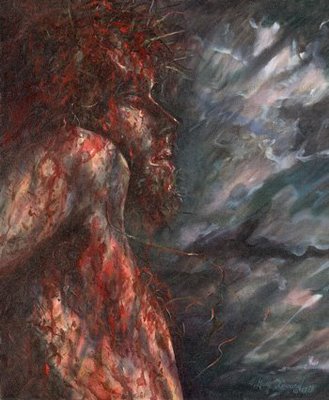
Death was designed for maximum pain with minimal blood loss, thereby extending the pain and suffering by days. Crucifixion was, in every sense of the word, excruciating (Latin, excruciatus, or “out of the cross”). In order to understand the obscenity and shame of the crucifixion, and to know the depths of the Love of our Savior,  we need to understand the horrors to which our Savior willingly submitted Himself.

The Scourging
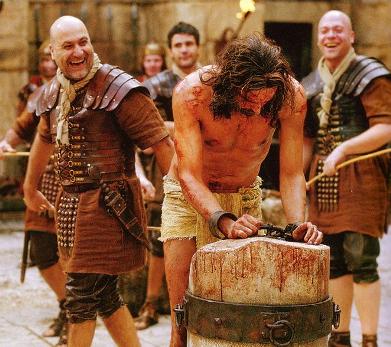
Preparations for Jesus’ scourging were carried out at Caesar’s orders. The prisoner was stripped of His clothing and His hands tied to a post above His head. The Roman legionnaire stepped forward with the flagrum, or flagellum, in his hand. This was a short whip consisting of several heavy, leather thongs with two small balls of lead attached near the ends of each. The heavy whip was brought down with full force again and again across Jesus’ shoulders, back, and legs. At first the weighted thongs cut through the skin only. Then, as the blows continued, they cut deeper into the subcutaneous tissues, producing first an oozing of blood from the capillaries and veins of the skin and finally spurting arterial bleeding from vessels in the underlying muscles.

The small balls of lead first produced large deep bruises that were broken open by subsequent blows. Finally, the skin of the back was hanging in long ribbons, and the entire area was an unrecognizable mass of torn, bleeding tissue. When it was determined by the centurion in charge that the prisoner was near death, the beating was finally stopped.

The Humiliation
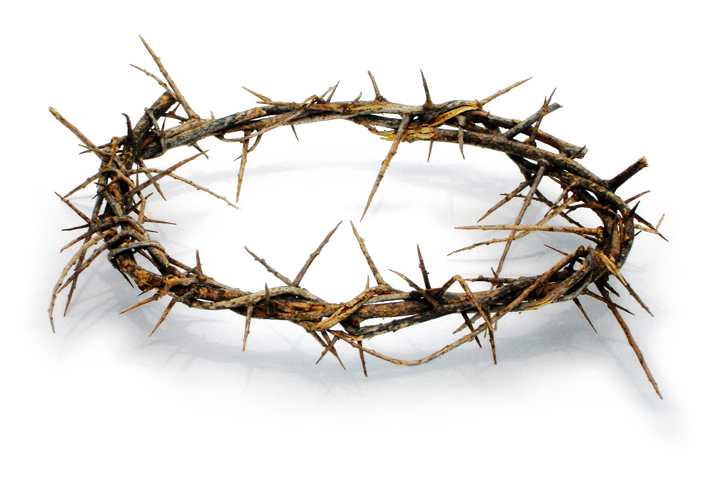
The half-fainting Jesus was then untied and allowed to slump to the stone pavement, wet with his own blood. The Roman soldiers saw a great joke in this provincial Jew claiming to be a king. They threw a robe across His shoulders and placed a stick in His hand for a scepter. They still needed a crown to make their travesty complete. Small flexible branches covered with long thorns, commonly used for kindling fires in the charcoal braziers in the courtyard, were plaited into the shape of a crude crown. The crown was pressed into his scalp and again there was copious bleeding as the thorns pierced the very vascular tissue. After mocking Him and striking Him across the face, the soldiers took the stick from His hand and struck Him across the head, driving the thorns deeper into His scalp. Finally, they tired of their sadistic sport and tore the robe from His back. The robe had already become adherent to the clots of blood and serum in the wounds, and its removal, just as in the careless removal of a surgical bandage, caused excruciating pain. The wounds again began to bleed.
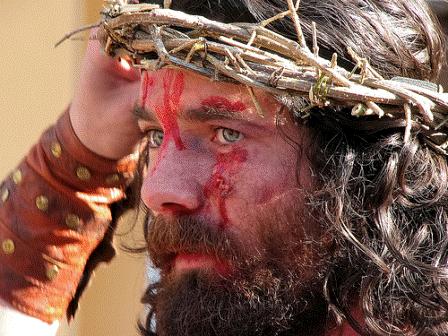
Jesus had not drank since the night before, so the combination of the beatings, the crown of thorns, and the scourging would have set into motion an irreversible process of severe dehydration and cardio respiratory failure. All of this was done so that the prophecies would be fulfilled:

  • I can count all my bones: they look and stare upon me. Psalm 22:17
  • I gave my back to those who strike, and my cheeks to those who pull out the beard; I hid not my face from disgrace and spitting. Isaiah 50:6
  • As many were astonished at you— his appearance was so marred, beyond human semblance, and his form beyond that of the children of mankind. Isaiah 52:14
  • Surely he has borne our griefs and carried our sorrows; yet we esteemed him stricken, smitten by God, and afflicted. But he was wounded for our transgressions; he was crushed for our iniquities; upon him was the chastisement that brought us peace, and with his stripes we are healed. Isaiah 53:4-5

Behold the Man!

The Crown of Thorns and the Robe

The significance of the scarlet robe and crown of thorns is to emphasize Jesus’ taking the sins of the world upon His body. The Bible describes sin by the color of scarlet and that thorns first appeared after the fall, as a sign of the curse. Thus, the articles that He wore are symbols to show that Jesus took on the sins (and the curse) of the world upon Himself.

  • Genesis 3:17-18: “Cursed is the ground because of you; through painful toil you will eat of it all the days of your life. It will produce thorns and thistles for you, and you will eat the plants of the field.
  • “Isaiah 1:18 “Come now, let us reason together,” says the LORD.”Though your sins are like scarlet, they shall be as white as snow; though they are red as crimson, they shall be like wool.”  

Crucifixion

Crucifixion was invented by the Persians approximately 300-400 B.C. It was “perfected” by the Romans in the first century B.C. It is arguably the most painful death ever invented by man and is where we get our term “excruciating.” It was reserved primarily for the most vicious of criminals, as well as conquered foes.

Victims of crucifixion were typically stripped naked and their clothing divided by the Roman guards. In Jesus’ case this was done in fulfillment of Psalm 22:18, “They divide My garments among them, and for My clothing they cast lots.”

It was customary for the condemned man to carry his own cross from the flogging post to the site of crucifixion outside the city walls. He was usually naked, unless this was prohibited by local customs. Since the weight of the entire cross was probably well over 300 lb., only the crossbar was carried. The heavy patibulum of the cross, (weighing 75 to 125 lb.) was placed across the nape of the victim’s neck and balanced along both shoulders. Usually, the outstretched arms were tied to the crossbar. The procession of the condemned Christ, two thieves, and the execution detail of Roman soldiers headed by a centurion began its slow journey along the route which we know today as the Via Dolorosa.

In spite of Jesus’ efforts to walk erect, the weight of the heavy wooden beam, together with the shock produced by copious loss of blood, was too much. He stumbled and fell. The rough wood of the beam gouged into the lacerated skin and muscles of the shoulders. He tried to rise, but human muscles had been pushed beyond their endurance. The centurion, anxious to proceed with the crucifixion, selected a stalwart North African onlooker, Simon of Cyrene, to carry the cross. Jesus followed, still bleeding and sweating the cold, clammy sweat of shock. The 650-yard journey from the Fortress Antonia to Golgotha was finally completed.

Outside the city walls were permanently located the heavy upright wooden stipes, on which the patibulum would be secured. At the site of execution, by law, the victim was given a bitter drink of wine mixed with myrrh (gall) as a mild analgesic. Even though Jesus was severely dehydrated through blood and fluid loss, He refused this drink. He chose to face death in full control of His senses. Edersheim writes:

“It was a merciful Jewish practice to give to those led to execution a draught of strong wine mixed with myrrh so as to deaden consciousness” (Mass Sem 2.9; Bemid. R. 10). The draught was offered to Jesus when He reached Golgotha. But having tasted it….He would not drink it. ….He would meet Death, even in his sternest and fiercest mood, and conquer by submitting to the full…. (p.880).

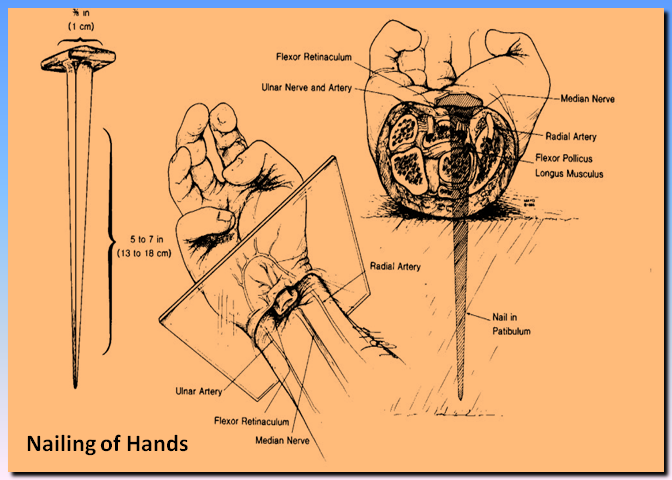
Jesus refused this drink. The criminal was then thrown to the ground on his back, with his arms outstretched along the patibulum. The hands could be nailed or tied to the crossbar, but nailing apparently was preferred by the Romans. The archaeological remains of a crucified body, found in an ossuary near Jerusalem and dating from the time of Christ, indicate that the nails were tapered iron spikes approximately 5 to 7 in (13 to 18 cm) long with a square shaft 3/8 in (1 cm) across. Furthermore, ossuary findings and the Shroud of Turin have documented that the nails commonly were driven through the wrists rather than the palms.

After both arms were fixed to the crossbar, the patibulum and the victim, together, were lifted onto the stipes. On the low cross, four soldiers could accomplish this relatively easily. However, on the tall cross, the soldiers used either wooden forks or ladders.

Next, the feet were fixed to the cross, either by nails or ropes. Ossuary findings and the Shroud of Turin suggest that nailing was the preferred Roman practice. Although the feet could be fixed to the sides of the stipes or to a wooden footrest, they usually were nailed directly to the front of the stipes. To accomplish this, flexion of the knees may have been quite prominent, and the bent legs may have been rotated laterally. The left foot was pressed backward against the right foot. With both feet extended, toes down, a nail was driven through the arch of each, leaving the knees moderately flexed. The victim was now crucified.

When the nailing was completed, the titulus was attached to the cross, by nails or cords, just above the victim’s head. The soldiers and the civilian crowd often taunted and jeered the condemned man, and the soldiers customarily divided up his clothes among themselves.

To add to the horror, insects would light upon or burrow into the open wounds or the eyes, ears, and nose of the dying and helpless victim, and birds of prey would tear at these sites. Moreover, it was customary to leave the corpse on the cross to be devoured by predatory animals. However, by Roman law, the family of the condemned could take the body for burial, after obtaining permission from the Roman judge.
Since no one was intended to survive crucifixions the body was not released to the family until the soldiers were sure that the victim was dead. By custom, one of the Roman guards would pierce the body with a sword or lance. Traditionally, this was a spear wound to the heart through the right side of the chest — a fatal wound probably taught to most Roman soldiers. The Shroud of Turin documents this form of injury. Moreover, the standard infantry spear, which was 5 to 6 ft long, could easily have reached the chest of a man crucified on the customary low cross.”

On the Cross

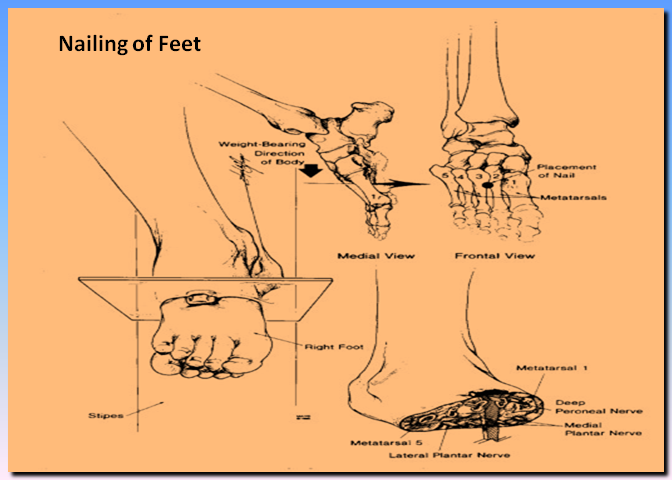
As Jesus slowly sagged down with more weight on the nails in the wrists, excruciating, fiery pain shot along the fingers and up the arms to explode in the brain. The nails in the wrists were putting pressure on the median nerve, large nerve trunks which traverse the mid-wrist and hand. As He pushed himself upward to avoid this stretching torment, He placed His full weight on the nail through His feet. Again there was searing agony as the nail tore through the nerves between the metatarsal bones of His feet.
At this point, another phenomenon occurred. As the arms fatigued, great waves of cramps swept over the muscles, knotting them in deep relentless, throbbing pain. With these cramps came the inability to push Himself upward. Hanging by the arm, the pectoral muscles, the large muscles of the chest, were paralyzed and the intercostal muscles, the small muscles between the ribs, were unable to act. Air could be drawn into the lungs, but could not be exhaled. Jesus fought to raise Himself in order to get even one short breath. Finally, the carbon dioxide level increased in the lungs and in the blood stream, and the cramps partially subsided.

Forces of Darkness

While He was on the cross, darkness covered the land (noon to three p.m.). Jesus, in Luke 22:53, associates those who arrested Him with the power of darkness. Where were the evil forces while Jesus was on the cross? The verses below from Psalm 22 seem out of place when first read. There seems to be no mention of “bulls” and “lions” around the cross. The verses, however, have a deeper meaning. Bashan was an area to the east of the Jordan River which was famous for its fertility. There cattle were raised which grew to enormous sizes. The people there worshipped demon spirits (associated with Baal) within the cattle.1 Pet 5:8 describes Satan as “a roaring lion…seeking those who he may devour” These verses are thus suggestive of the spiritual activity of Satan and his demons, celebrating as Jesus was suffering on the cross.

Psalm 22:12-13: “Many bulls surround me; strong bulls of Bashan encircle me. Roaring lions tearing their prey open their mouths wide against me.”

Medical Aspects of Crucifixion

After forced to carry his cross to the site, the victim was then placed on his back, arms stretched out and nailed to the cross bar. The nails, which were generally about 7-9 inches long, were placed between the bones of the forearm (the radius and ulna) and the small bones of the hands (the carpal bones).

The placement of the nail at this point had several effects. First it ensured that the victim would indeed hang there until dead. Secondly, a nail placed at this point would sever the largest nerve in the hand called the median nerve.

The severing of this nerve is a medical catastrophe. In addition to severe burning pain the destruction of this nerve causes permanent paralysis of the hand. Furthermore, by nailing the victim at this point in the wrist, there would be minimal bleeding and there would be no bones broken! Thus scriptures were fulfilled:

  • He keepeth all his bones: not one of them is broken. Psalm 34:20

The positioning of the feet is probably the most critical part of the mechanics of crucifixion. First the knees were flexed about 45 degrees and the feet were flexed (bent downward) an additional 45 degrees until they were parallel the vertical pole. An iron nail about 7-9 inches long was driven through the feet between the 2nd and 3rd metatarsal bones. In this position the nail would sever the dorsal pedal artery of the foot, but the resultant bleeding would be insufficient to cause death.

The scourging prior to crucifixion served to weaken the condemned man and, if blood loss was considerable, to produce orthostatic hypotension[1] and even hypovolemic[2] shock. When the victim was thrown to the ground on his back, in preparation for transfixion of the hands, his scourging wounds most likely would become torn open again and contaminated with dirt. Furthermore, with each respiration, the painful scourging wounds would be scraped against the rough wood of the stipes. As a result, blood loss from the back probably would continue throughout the crucifixion ordeal.

With arms outstretched but not taut, the wrists were nailed to the patibulum. It has been shown that the ligaments and bones of the wrist can support the weight of a body hanging from them, but the palms cannot. Accordingly, the iron spikes probably were driven between the radius and the carpals or between the two rows of carpal bones, either proximal to or through the strong band like flexor retinaculum and the various intercarpal ligaments. Although a nail in either location in the wrist might pass between the bony elements and thereby produce no fractures, the likelihood of painful periosteal injury would seem great. Furthermore, the driven nail would crush or sever the rather large median nerve. The stimulated nerve would produce excruciating bolts of fiery pain in both arms. Although the severed median nerve would result in paralysis of a portion of the hand, ischemic contracture and impalement of various ligaments by the iron spike might produce a claw like grasp.

Most commonly, the feet were fixed to the front of the stipes by means of an iron spike driven through the first or second inter metatarsal space, just distal to the tarsometatarsal joint. It is likely that the deep peroneal nerve and branches of the medial and lateral plantar nerves would have been injured by the nails. Although scourging may have resulted in considerable blood loss, crucifixion per se was a relatively bloodless procedure, since no major arteries, other than perhaps the deep plantar arch, pass through the favored anatomic sites of transfixion.

Tetanic Spasm

The major effect of crucifixion, beyond the excruciating pain, was a marked interference with normal respiration, particularly exhalation. The weight of the body, pulling down on the outstretched arms and shoulders, would tend to fix the intercostal[3] muscles in an inhalation state and thereby hinder passive exhalation.  Accordingly, exhalation was primarily diaphragmatic, and breathing was shallow. It is likely that this form of respiration would not suffice and that hypercapnia[4] would soon result. The onset of muscle cramps or tetanic spasms[5], due to fatigue and hypercapnia, would hinder respiration even further.

The resulting position on the cross sets up a horrific sequence of events which results in a slow, painful death. Having been pinned to the cross, the victim now has an impossible position to maintain.

With the knees flexed at about 45 degrees, the victim must bear his weight with the muscles of the thigh. However, this is an almost impossible task-try to stand with your knees flexed at 45 degrees for 5 minutes. As the strength of the legs gives out, the weight of the body must now be borne by the arms and shoulders. The result is that within a few minutes of being placed on the cross, the shoulders will become dislocated. Minutes later the elbows and wrists become dislocated. The result of these dislocations is that the arms are as much as 6-9 inches longer than normal.
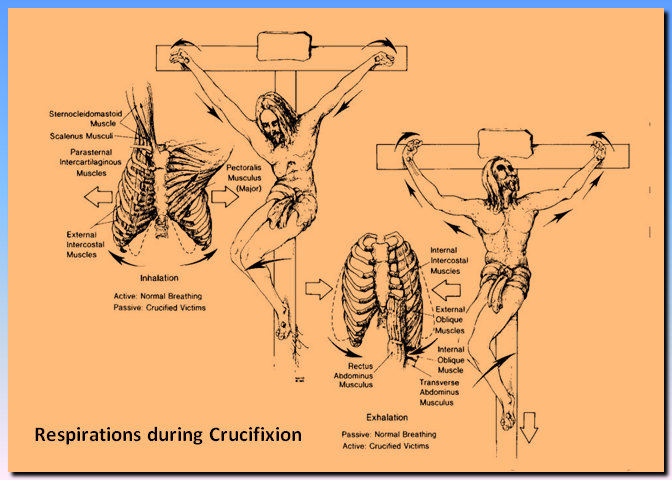
With the arms dislocated, considerable body weight is transferred to the chest, causing the rib cage to be elevated in a state of perpetual inhalation. Consequently, in order to exhale the victim must push down on his feet to allow the rib muscles to relax. The problem is that the victim cannot push very long because the legs are extremely fatigued. As time goes on, the victim is less and less able to bear weight on the legs, causing further dislocation of the arms and further rising of the chest wall, making breathing more and more difficult.

  • …all my bones are out of joint; my heart is like wax; it is melted within my breast; Psalm 22:14
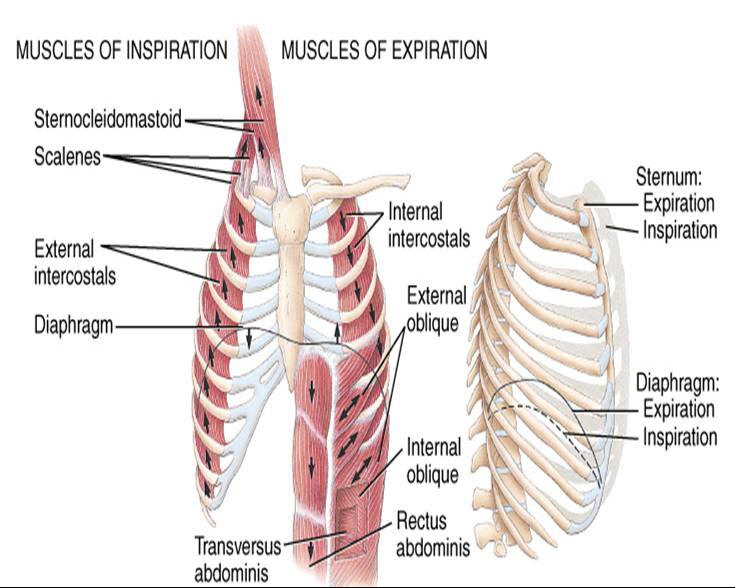
The result of this process is a series of catastrophic physiological effects. Because the victim cannot maintain adequate ventilation of the lungs, the blood oxygen level begins to diminish and the blood carbon dioxide (CO2) level begins to rise. This process sets up a vicious cycle of increasing oxygen demand-which cannot be met-followed by an ever increasing heart rate. The rising CO2 level stimulates the heart to beat faster in order to increase the delivery of oxygen and the removal of CO2. Due to the shallow breathing, the victim’s lungs begin to collapse in small areas, causing hypoxia and hypercapnia. A respiratory acidosis[6], with lack of compensation by the kidneys due to the loss of blood from the numerous beatings, resulted in an increased strain on the heart, which beats faster to compensate. After several hours the heart begins to fail, the lungs collapse and fill up with fluid, which further decreases oxygen delivery to the tissues. The blood loss and hyperventilation combines to cause severe dehydration. Over a period of several hours the combination of collapsing lungs, a failing heart, dehydration, and the inability to get adequate oxygen supplies to the tissues cause the eventual death of the victim. The victim, in effect, cannot breath properly and slowly suffocates to death. In cases of severe cardiac stress, such as crucifixion, a victim’s heart can even burst. This process is called “Cardiac Rupture.”

The actual cause of death by crucifixion was multifactorial and varied somewhat with each case, but the two most prominent causes probably were hypovolemic shock and exhaustion asphyxia. Other possible contributing factors included dehydration, stress-induced arrhythmias, and congestive heart failure with the rapid accumulation of pericardial and perhaps pleural effusions. Crucifracture (breaking the legs below the knees), if performed, led to death from asphyxia within minutes.

His Last Words

Spasmodically, Jesus was able to push Himself upward to exhale and bring in life-giving oxygen. It was undoubtedly during these periods that He uttered the seven short sentences that are recorded.

He suffered hours of limitless pain, cycles of twisting, joint-rending cramps, intermittent partial asphyxiation, and searing pain as tissue was torn from His lacerated back from His movement up and down against the rough timbers of the cross. Then another agony began: a deep crushing pain in the chest as the pericardium, the sac surrounding the heart, slowly filled with serum and began to compress the heart.

The prophecy in Psalm 22:14 was being fulfilled: “I am poured out like water, and all my bones are out of joint, my heart is like wax; it is melted in the midst of my bowels.”

The end was rapidly approaching. The loss of tissue fluids had reached a critical level; the compressed heart was struggling to pump heavy, thick, sluggish blood to the tissues, and the tortured lungs were making a frantic effort to inhale small gulps of air. The markedly dehydrated tissues sent their flood of stimuli to the brain. Jesus gasped His fifth cry: “I thirst.” Again we read in the prophetic psalm: “My strength is dried up like a potsherd; my tongue cleaveth to my jaws; and thou has brought me into the dust of death” (Psalm 22:15 KJV).
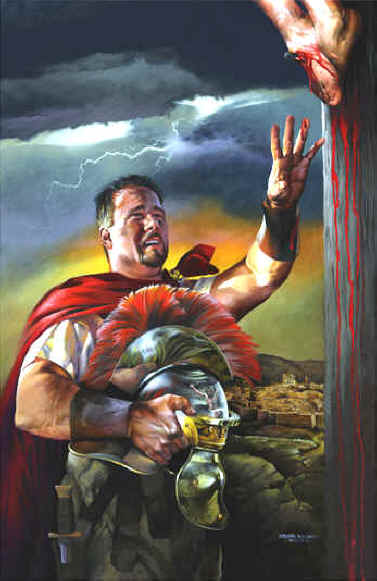
Jesus was offered a second drink, which He accepted. It is ‘pocsa’, a sour wine popular at that time. Jesus accepted this drink because of two important images. The drink was given on the “stalk of a hyssop plant”. Remember that these events occurred at the Feast of the Passover. During this feast, hyssop was used to apply the blood of the Passover lamb to the wooden doorposts of the Jews. It is interesting the end of this hyssop stalk pointed to the blood of the Perfect Lamb which was applied to the wooden cross for the salvation of all mankind.

In addition, the wine vinegar is a product of fermentation, which is made from grape juice and yeast. The word literally means “that which is soured” and is related to the Hebrew term for “that which is leavened”. (Holmans) Yeast or leaven, is a Biblical symbol of sin. When Jesus took this drink, (i.e. a drink which was “leavened”) it is thus symbolic of His taking the sins of the world into His body.

After this last drink, His body was now in extremis, and He could feel the chill of death creeping through His tissues. This realization brought forth His sixth word, possibly little more than a tortured whisper: “It is finished.” His mission of atonement had been completed. Finally, He could allow His body to die. With one last surge of strength, He once again pressed His torn feet against the nail, straightened His legs, took a deeper breath, and uttered His seventh and last cry: “Father, into Your hands I commit My spirit.”
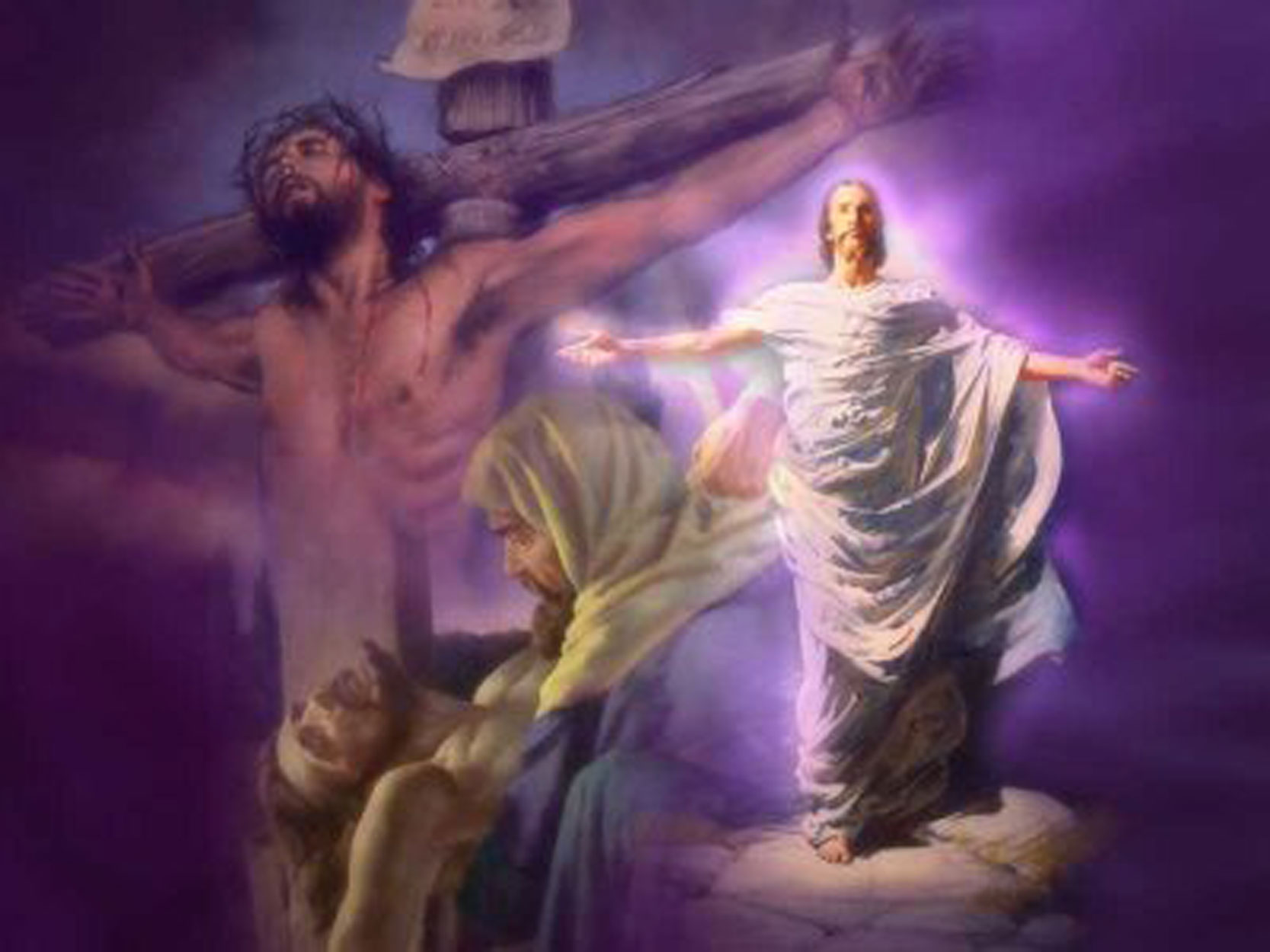
While the crucifixion is horrible to our physical senses, we will never understand the spiritual agony of Hell that Jesus experienced for us upon the cross. There is no graphic display that can impress upon our senses the wrath of God upon Jesus Christ. He drank of God’s Wrath against our sin! Wrath that was meant for us, to be experienced in an eternity of Hell, Jesus experienced in a moment. God experienced Hell for you and me! That is love that cannot be defined, only experienced! Do you know His Love? Has He changed your life?

This is a Compilation from the following Sources:

Dr. C Truman David, “The Crucifixion”,, New Wine Magazine, April 1982. Originally published in Arizona Medicine, March 1965, Arizona Medical Association.

The Agony of Love by Dr. Mark Eastman

http://www.frugalsites.net/jesus/crucifixion.htm

Medical Aspects of the Crucifixion of Jesus Christ, Compiled by David Terasaka, M.D. ©1996.


[1] Orthostatic hypotension is a form of hypotension in which a person’s blood pressure suddenly falls when standing up or stretching. The symptom is caused by blood pooling in the lower extremities upon a change in body position. It is quite common and can occur briefly in anyone, although it is particularly prevalent among the elderly, and those with low blood pressure.

[2] Hypovolemic shock refers to a medical or surgical condition in which rapid fluid loss results in multiple organ failure due to inadequate circulating volume and subsequent inadequate perfusion.

[3] Intercostal muscles are several groups of muscles that run between the ribs, and help form and move the chest wall. The intercostal muscles are mainly involved in the mechanical aspect of breathing. These muscles help expand and shrink the size of the chest cavity when you breathe.

[4] Hypercapnia (or hypercarbia) is generally defined as an abnormally high level of carbon dioxide (e.g., more than 45 mm Hg) in the arterial blood.

[5] a state of sustained muscular contraction without periods of relaxation caused by repetitive stimulation of the motor nerve trunk at frequencies so high that individual muscle twitches are fused and cannot be distinguished from one another

[6] Respiratory acidosis develops when there is too much carbon dioxide (an acid) in the body. This type of acidosis is usually caused when the body is unable to remove enough carbon dioxide through breathing.

My Daddy taught me not to waste. He would yell at us to close the door, turn out the lights, clean my plate. He so impressed that quality upon me that I echoed his words to my children. Something about waste bothers us. We would never volunteer to pay $100 for a McDonald’s Happy Meal. No, that would be a waste!

To understand the radical work of the Gospel, we must understand that the Gospel runs counter to everything that man is taught. The Gospel is opposed to every rational thing that we teach our children. The core concept that is most repulsive to us is seen in John 12. But before we dwell upon the Gospel and “waste”, I want us to see what other things can block the power of the Gospel from our lives. This will lead us into a deeper understanding of the power of the Gospel for our everyday lives. This will open the Gospel to us and it will drive our discipleship.

The Gospel is “Death with a view to increase”. Discipleship is “gaining by trading”. Fruitfulness is the result of living the Gospel. We are not talking of your own fruitfulness, like looking at your garden and admiring your green thumb. We are speaking of fruit that comes from gaining the life of Jesus Christ. Fruit comes from Him and our willingness to give everything to Him.

John 12:24 Truly, truly, I say to you, unless a grain of wheat falls into the earth and dies, it remains alone; but if it dies, it bears much fruit.

A grain of wheat has life in it, but it abides alone. It has the power to impart life to others, but to do so it must be buried in death.

2 Corinthians 4:11-12 For we who live are always being given over to death for Jesus’ sake, so that the life of Jesus also may be manifested in our mortal flesh. So death is at work in us, but life in you.

Is Life at work in You? Are you experiencing the Life that is in Jesus Christ? Do you ache when you spend a day without a word from Him? Do you miss not spending time in prayer and fellowship with Him? If His life is at work in you, you know it. If it is not, perhaps you have become hardened to the Gospel. Perhaps you will see yourself in John 12, and God will speak to you this morning, calling you to repent, calling you to waste your life for the sake of Jesus Christ.

John 12 is a chapter about Life and Death, Light and Darkness, Man’s Wisdom vs. God’s Wisdom. At the beginning we see Lazarus who came back to life from the dead. He is the testimony of what a Christian is to be. In the middle we see people who want to see Jesus, but they are blind, their hearts are darkened. At the end we see a lonely Jesus talking to a group of people who just don’t get Him:

John 12:44-50 And Jesus cried out and said, “Whoever believes in me, believes not in me but in him who sent me. And whoever sees me sees him who sent me. I have come into the world as light, so that whoever believes in me may not remain in darkness. If anyone hears my words and does not keep them, I do not judge him; for I did not come to judge the world but to save the world. The one who rejects me and does not receive my words has a judge; the word that I have spoken will judge him on the last day. For I have not spoken on my own authority, but the Father who sent me has himself given me a commandment—what to say and what to speak. And I know that his commandment is eternal life. What I say, therefore, I say as the Father has told me.”

There is light in the words of Christ. There is Life in the Words of Christ. But our hearts are easily hardened to the power of Christ and His Gospel. Our eyes are easily dulled to witness the power of the Gospel.

Let’s see how our hearts can become hard, and our eyes become dull:

There are three people seen in John 12. There are the Disciples, who supposedly follow Jesus. There are the Greeks who want to see Jesus. There are the Pharisees who despise Jesus. Finally, there is a solitary woman named Mary, and our attention will be drawn to her in a moment.

1. The Greeks

Now among those who went up to worship at the feast were some Greeks. So these came to Philip, who was from Bethsaida in Galilee, and asked him, “Sir, we wish to see Jesus.” Philip went and told Andrew; Andrew and Philip went and told Jesus. And Jesus answered them, “The hour has come for the Son of Man to be glorified. Truly, truly, I say to you, unless a grain of wheat falls into the earth and dies, it remains alone; but if it dies, it bears much fruit. Whoever loves his life loses it, and whoever hates his life in this world will keep it for eternal life. If anyone serves me, he must follow me; and where I am, there will my servant be also. If anyone serves me, the Father will honor him. (Joh 12:20-26)

The Greeks wanted to see Jesus. They made a big deal about seeing him. As if they were important and were worth an audience with Him. The fact that they used intermediaries to see Jesus indicates they were men of station and means. In the oriental world important people would always use intermediary agents. As important men they would never go directly to Jesus. They required an introduction.

  • Man’s Status is not an element of the Gospel.
  • Only Dying Slaves have Status with God

Jesus answered Philip and Andrew’s request by referring to His approaching Glory.

John 12:23 And Jesus answered them, “The hour has come for the Son of Man to be glorified.”

His glory is not based upon His status or rank, but simply upon His death. Jesus answered their request with a grain of wheat, and how it must die to bear fruit. If anyone wants to see Jesus, they must hate their life and their status, and follow Him as a slave, a person with no status.

God will honor all those who hate this life and follow Jesus as a slave.

2. The Pharisees & the Crowd

One more time Jesus speaks of glory.

“Now is my soul troubled. And what shall I say? ‘Father, save me from this hour’? But for this purpose I have come to this hour. Father, glorify your name.” Then a voice came from heaven: “I have glorified it, and I will glorify it again.” (Joh 12:27-28)

And the crowd heard the voice of God. Jesus said further, When I am lifted up from the earth, I will draw all people to myself.”

But the people didn’t understand. They said the Law teaches that Christ will abide forever. How could the Son of Man die? Their eyes were blind to Jesus. Their hearts were hardened to Jesus being the Messiah. The Pharisees and the crowd could not see Jesus as Lord because they were too focused on their standing, and what they thought should be the standing of the Messiah.

The word spoken by the prophet Isaiah might be fulfilled: “Lord, who has believed what he heard from us, and to whom has the arm of the Lord been revealed?” Therefore they could not believe. For again Isaiah said, “He has blinded their eyes and hardened their heart, lest they see with their eyes, and understand with their heart, and turn, and I would heal them.” Isaiah said these things because he saw his glory and spoke of him. Nevertheless, many even of the authorities believed in him, but for fear of the Pharisees they did not confess it, so that they would not be put out of the synagogue; for they loved the glory that comes from man more than the glory that comes from God. (Joh 12:38-50)

The Pharisees could not see the Glory of God because they loved the glory of man. They put their own concepts of standing and status before God’s. They could not see the glory of God hanging on the cross. It was a foreign concept to them. It kept their eyes blind and their hearts hard.

Do you seek man’s glory? Do you like the admiration of men? Does it bother you when men think bad of you, or look down on you?

Is standing important to you? Do position, influence and power matter to you? If you answered even a tiny ‘yes’ to any of those things, you might not understand the Gospel. Your eyes might be blind to the power of the Gospel. Your heart might be hardened to the power of the Gospel.

But the real test of whether the Gospel is impacting your life is in the third group, the Disciples.

3.  The Disciples

Money and things can harden our heart to the message of the Gospel.

Mark 14:4-9 There were some who said to themselves indignantly, “Why was the ointment wasted like that? For this ointment could have been sold for more than three hundred denarii and given to the poor.” And they scolded her. But Jesus said, “Leave her alone. Why do you trouble her? She has done a beautiful thing to me. For you always have the poor with you, and whenever you want, you can do good for them. But you will not always have me. She has done what she could; she has anointed my body beforehand for burial. And truly, I say to you, wherever the gospel is proclaimed in the whole world, what she has done will be told in memory of her.”

To show you how hard hearts can get over money, look what Mark records as happening next:

Mark 14:10-11 Then Judas Iscariot, who was one of the twelve, went to the chief priests in order to betray him to them. And when they heard it, they were glad and promised to give him money. And he sought an opportunity to betray him.

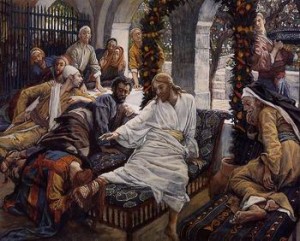
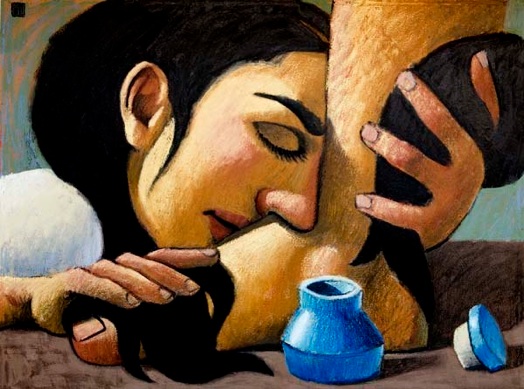
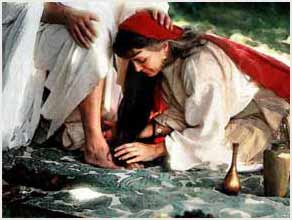
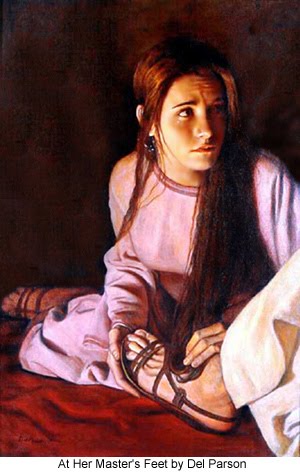
Jesus is being honored because He brought Life to a dead man. He raised a dead man to life. Not a sick man, not a comatose man, but a dead rotting in the ground, stinking to high heaven man. Jesus had brought life to a dead man, and all the disciples could worry about was how wasteful this woman was. A woman (Mary) took an alabaster flask of spikenard and used it to anoint the head and feet of Jesus. She even used her hair to wipe his feet. The disciples reacted indignantly, especially Judas. They said this is such a waste, it should have been sold for a year’s worth of wages and given to the poor.

The Gospel is Never “Rational”

What she did was so unusual, that most ‘normal, rational Christians’ would find it a waste. They shake their heads and turn the judgmental faucet on. Jesus reacted with some stern comments. His comments will shed some insight into the Gospel that you and I believe in. I want to unwrap His comments so we can learn the power of the Gospel in our everyday lives.

Why was the ointment wasted like that? Why this Waste?

Waste-apóleia; gen. apōleías, fem. noun from apóllumi , to destroy fully. Used trans. the losing or loss (Matt. 26:8), intrans. perdition, ruin. In the NT, apóleia refers to the state after death wherein exclusion from salvation is a realized fact, wherein  .[1]

In 1 Tim. 6:9 the words ólethros and apóleia occur together referring to those who determine to be rich. In this instance, ólethros refers to the actual physical death of those who desire to be rich by any means such as Judas, Ananias and Sapphira. Apóleia, on the other hand, refers to separation from God Himself in fulfillment of our Savior’s warnings that the rich enter the kingdom of heaven with difficulty (Matt. 19:23, 24; Mark 10:25). [2]

Jesus responds to His blind and hardened disciples:

1. Leave her alone

Jesus issued a stern rebuke to His disciples. Give it up guys! Stop it! You are so wrong Guys. You just don’t get it! Jesus wanted his men to see something amazing about the Gospel. It is a foundational principle of God’s character revealed in the Gospel. It is a principle which must be applied to our life if we are to experience the power of Jesus Christ.

Sometimes we are quick to judge someone, especially because of something they do that seems to be stupid or dumb. God often has a lesson for us to see and understand. God’s ways are not our ways, and we must learn to see God in those moments that seem such a waste.

Have you ever said something or thought something about what someone has done and you say, I know I should say this, or I don’t mean any disrespect… Jesus is telling you to “Leave Her Alone”

2. Why do you trouble her. (Cause her pain)

The disciples probably thought they were something else. They had already argued about who was going to sit at the right hand of Christ. So they thought they were entitled to look down their noses at this poor unfortunate woman.

Jesus said stop causing her pain. Spiritual pride gets in the way of the work of the Spirit. It can cause pain in the body. The idea of this Greek word for cause  is ‘minister’.

  • The disciples were ministering pain to the body.

The Gospel is about Honoring Jesus Christ through your life. You can touch and encourage people and other disciples. You can strengthen others with your words and your actions. But when you allow things to darken your eyes, you can say and do things that bring pain to the body, to other believers. You cause pain to Jesus Christ. He says, why do you trouble her.

3. She has done a beautiful thing to me

Mark 14:6 καλὸν kalon ἔργον ergon  ἠργάσατο ērgasato ἐν en ἐμοί. emoi –A GOOD WORK SHE HAS PERFORMED ON ME

expresses beauty as a harmonious completeness, balance, proportion. Good as to effect or influence, useful, profitable, equivalent to hálas, salt[3]

We are to be salt to this world and to each other. And if we do it to honor Christ, the world will say that is so wasteful.

Here was a woman who wasted her beauty on the beauty of Jesus Christ. Her future as a wife and mother was bound up in that alabaster jar. It was her dowry given for marriage. She considered honoring Jesus so important that she poured out her beauty, her future, her everything upon his dirty feet, his dirty hair.

To give your life to Jesus Christ as a living sacrifice. To give Him your future, your reputation, your desires, and your dreams is a beautiful thing to God. It is considered your obligation as a follower of Jesus Christ. But if you want to do something really beautiful to Jesus, you must waste something. You must do something so ‘irrational’ that even disciples will say, “what a waste.”

4. She did what she could.

This single woman, who a few days before had been scolding Jesus for not coming sooner to heal sick Lazarus. She even blamed Jesus for his death. Now she was so touched by His compassion and love, that she was willing to give Him her future. Here was her dowry, reserved for the day of her betrothal, and now she was willingly pouring it upon her Savior.

She did it willingly, sacrificially, but most importantly, she did it! There was no delay, no hesitation, no doubt. If she had waited but a week, Jesus would have been dead.

Parents, Grandparents, are you doing anything wasteful for your family. Are you doing anything wasteful for God? What you can do should always be a waste. We do not limit our discipleship by what is rational or even prudent. We do what we can. We waste our lives, our possessions for the sake of the gospel.

5. She demonstrated the Gospel.

How did a foolish, wasteful act by an obviously desperate single woman display the Gospel? Why was this seemingly foolish act so important that Jesus said it would be told alongside the Gospel for the rest of time? The Gospel will be proclaimed throughout eternity.

  • She died to her future.
  • She broke the bottle of her substance
  • She poured out her life to be united with Jesus
  • A sweet fragrance covered the Savior and filled the room.

What is waste?

Waste means giving more than necessary. If something costs a dollar and you pay $5, it is a waste. If a pint will be enough to paint, a gallon would be a waste. Waste means you give something too much for something too little. If someone is receiving more than he is worth, that is a waste.

But the action of Mary would go wherever the Gospel is preached. Why? Christ wants all those who respond to the Gospel to waste themselves on Him.

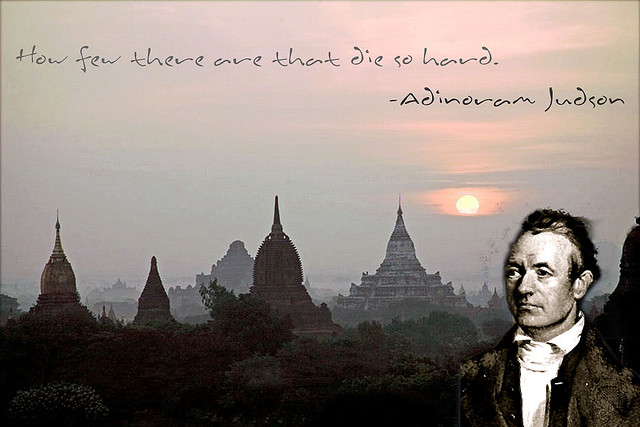
Adoniram Judson

Adoniram Judson labored in Burma in the early 1800’s. He was bright, ambitious, and could have been very successful in his life. Instead, he chose to be a missionary for Jesus Christ.

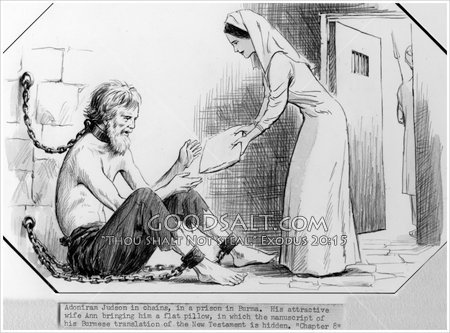
Life in Burma was beyond hard. This was a ‘hard’ mission field. It was six years before his first convert. The hardships he and his family experienced were deadly.

Adoniram buried two young wives and six young children, victims of the diseases and rigors of Burma. He was imprisoned to the point of starvation and death. He was tortured mercilessly. He labored long hours suffering from fever, headaches, poor eyesight, all due to the conditions he lived in. He had only one furlough in 38 years. After being imprisoned for 17 months, and upon being released experiencing the death of his wife and infant, and hearing of the death of his father, he even suffered a crisis of despair and lost faith.

“God is to me the Great Unknown. I believe in him, but I find him not.[4]

He even dug a grave in the tiger infested jungle and for 30 days would retreat there and contemplate his wasted life. He despaired to the point of desiring death. As God and some Burmese worked to pull him out of his despair, his faith slowly returned. The next year (1831) saw a miraculous outpouring of God’s Holy Spirit as hundred turned to Christ.

  • It took Judson 12 years to make 18 converts.

When Judson began his mission in Burma, he set a goal of translating the Bible and founding a church of 100 members before his death. When he died, he left the Bible, 100 churches, and over 8,000 believers.

Adoniram Judson “hated his life in this world” and was a “seed that fell into the ground and died.” In his sufferings “he filled up what was lacking in Christ’s afflictions” in unreached Burma. Therefore his life bore much fruit and he lives to enjoy it today and forever. He would, no doubt, say: It was worth it.

In the world’s view, giving yourself to Christ and serving as a Pastor or a Missionary is a waste of ability. If someone of great natural ability surrenders that to serve the Lord, his friends will say “such a waste”.

Are you experiencing the power of the Gospel? Are you more in love with Jesus today than last year, or even 20 years ago? Would He say you have done a beautiful thing for Him? Would He say you have done what you could?

What are you willing to waste for the sake of Jesus Christ?

Don’t let your love of money harden you. Don’t let your love of status or reputation blind you. Don’t let men influence you as to what is proper. Do you want to see the glory of Jesus Christ? Do you want to hear Him say, “You did what you could”? Then ask Him what you can waste for Him.

John 12:36 While you have the light, believe in the light, that you may become sons of light.” 


[1] Spiros Zodhiates, The Complete Word Study Dictionary – New Testament, (Chattanooga, TN: AMG Publishers, 1993), WORDsearch CROSS e-book, 246.
[2] Spiros Zodhiates, The Complete Word Study Dictionary – New Testament, (Chattanooga, TN: AMG Publishers, 1993), WORDsearch CROSS e-book, 246.
[3] Spiros Zodhiates, The Complete Word Study Dictionary – New Testament, (Chattanooga, TN: AMG Publishers, 1993), WORDsearch CROSS e-book, 814.
[4] Anderson, To the Golden Shore, 398-399.

God desires for you to have daily evidence of your Salvation. He desires us to know it in our heart, our soul and our strength. His desire is that you live each day as a devoted follower of Jesus Christ. We can see how this is possible at church, even though church can become a distraction to following Jesus Christ. After all, we sing songs about Jesus and we pretend to listen to sermons about Jesus.But what about in the parking lot, on Monday morning, when the pressures and stresses of life start to bombard us? How does Jesus relate to real life? This is where discipline comes into our Christian walk. We must discipline ourselves to bring Jesus Christ into every situation we face. In fact, we must discipline ourselves to view every situation from the Gospel perspective.

Paul said: I decided to know nothing among you except Jesus Christ and him crucified. 1 Corinthians 2:2

Do You Have Stress in Your Life?

Why? Jesus promised us rest…

Matthew 11:28 Come to me, all who labor and are heavy laden, and I will give you rest.

The writer of Hebrews says there is a promise of entering God’s rest, but bemoaned the fact that not every Christian enters…

Hebrews 4:1-2 Therefore, while the promise of entering his rest still stands, let us fear lest any of you should seem to have failed to reach it. For good news came to us just as to them, but the message they heard did not benefit them, because they were not united by faith with those who listened.

These were not heathen Gentiles. These were faithful Jews, God’s chosen. They had seen His Salvation at the Red Sea. They had covenanted with Moses to follow the Lord. But something happened, and they were overthrown in the wilderness by their stresses.

I believe the Gospel has the Power of Rest for Stressed Christians.

In Paul’s day, being a Christian meant being a disciple. It meant giving everything up. It meant losing family, friends, and possessions. It meant the threat of losing your life. We have lost that perspective in Culturally Christian Bible Belt America.

The Gospel has power for our lives, but it is conditional.

1 Corinthians 15:1-2 Now I would remind you, brothers, of the gospel I preached to you, which you received, in which you stand, and by which you are being saved, if you hold fast to the word I preached to you— unless you believed in vain.

“You are being saved” pictures an ongoing process whereby you are the recipient of God’s salvation. You are the one being acted upon. However, you can block the power of the Gospel by failing to take hold of the Word. Κατέχω (Katecho) does not mean to take hold of something in a casual way. It means to take hold of something as if you were making it your own, (to hold fast, keep secure, keep firm possession of). Like holding on to a bar of gold. You clutch it close to you, you make it yours, and no one is going to pry it from your hands.

Jesus explain the importance of “holding fast” in the parable of the soils and the seeds:

Luke 8:15 As for that in the good soil, they are those who, hearing the word, hold it fast in an honest and good heart, and bear fruit with patience.

When you give your life to Jesus knowing that you could lose your life, you take hold of His Word as though your life depends upon it!

If you are not holding fast to the Gospel, the chances are that your belief in Christ had a selfish motivation, and was for your personal benefit, and not because you needed Jesus, and needed His life to be yours. If you have not been holding fast to the Gospel of Christ, if you have failed to make it your life, perhaps you should “examine yourselves, to see whether you are in the faith.”

2 Corinthians 13:5 Examine yourselves, to see whether you are in the faith. Test yourselves. Or do you not realize this about yourselves, that Jesus Christ is in you?—unless indeed you fail to meet the test!

Stress – What is it?

Dr. Nick Hall (expert in psychobiology) conducts a seminar called “Stress and Disease” He gives a humorous example of one coping skill for dealing with job stress.

When you have had one of those TAKE THIS JOB AND SHOVE IT days, try this. On your way home after work, stop at your pharmacy and go to the section where they have thermometers. You will need to purchase a rectal thermometer made by *Q-Tip. Be very sure that you get this brand. When you get home, lock your doors, draw the drapes, and disconnect the phone so you will not be disturbed during your therapy. Change to very comfortable clothing, such as a sweat suit and lie down on your bed. Open the package containing the thermometer and remove the thermometer and carefully place it on the bedside table so that it will not become chipped or broken.Take the written material that accompanies the thermometer and as you read it you will notice in small print the statement that “every rectal thermometer made by Q-Tip is PERSONALLY tested.” Now close your eyes and say out loud five times, ‘I am so glad that I do not work in quality control at the Q-Tip Company.’

Practical Definition of Stress.

The basic definition of “stress” is any opposing reaction or force to your own intention that causes strain or tension. Similarly (but not the same), the definition of a problem is an opposing intention or force of some kind. Problems can be solved. A problem does not necessarily cause stress or tension. The main characteristic of a problem that becomes stressful is feeling like we cannot do anything about it. Not all problems are stressful when we feel that we can do something about them, no matter how much or how little.

The full definition of stress is “a problem (or set of problems) that we do not feel that we can solve or do something effective to handle.”

In other words, you could say “I don’t feel like I can do anything about this problem” or “I feel stressed” and it would mean the same thing. Take anything in your life that feels stressful to you. Apply this definition to it and see if it fits. Is it something you do not have a real solution for? Let’s look at it another way. Do you feel stressed by situations or problems that you have a good solution for? Probably not!
Stress and Children – Causes
  • being away from home (ages 5 to 7)
  • fear of wetting themselves (ages 5 to 7)
  • worry about getting along with peers
  • worry about school work
  • fear of being chosen last on any team
  • fear of being different from others
  • worry about changing bodies (ages 10 to 12)

Other major sources of stress:

  • divorce of parents
  • move to new town or city
  • being held back in school
  • serious illness
  • parent being called to war
Signs and Symptoms of Child Stress
  • Physical—headaches, stomach aches, vomiting, wetting
  • Emotional—fear, irritability, sadness
  • Behavioral—crying, nervous tics, losing temper
  • Interactions with others—withdrawing, teasing or bullying, extreme
Stress and Teens
  • The pressure of expectations from self and from others
  • The pressure at school from teachers, coaches,
  • The pressures due to grades and homework
  • Strained relationship with classmates
  • Strained relationship with parents/siblings
  • Physical and biological changes in the body during adolescence
  • Negative feelings about oneself/low self-esteem
  • Heated arguments with or between parents
  • Financial problems in the family
  • Tragedy in the family (e.g. death, divorce, cancer, AIDS)
  • Break up with boyfriend/girlfriend
  • Separation or divorce of parents
  • High crime rate in the living environment/neighborhood
  • Moving to a new surroundings
  • Changing to a new school
  • Horrifying societal events like 9/11 terrorist attacks or communal war
  • Failing to achieve something desired
Signs and Symptoms of Teen Stress

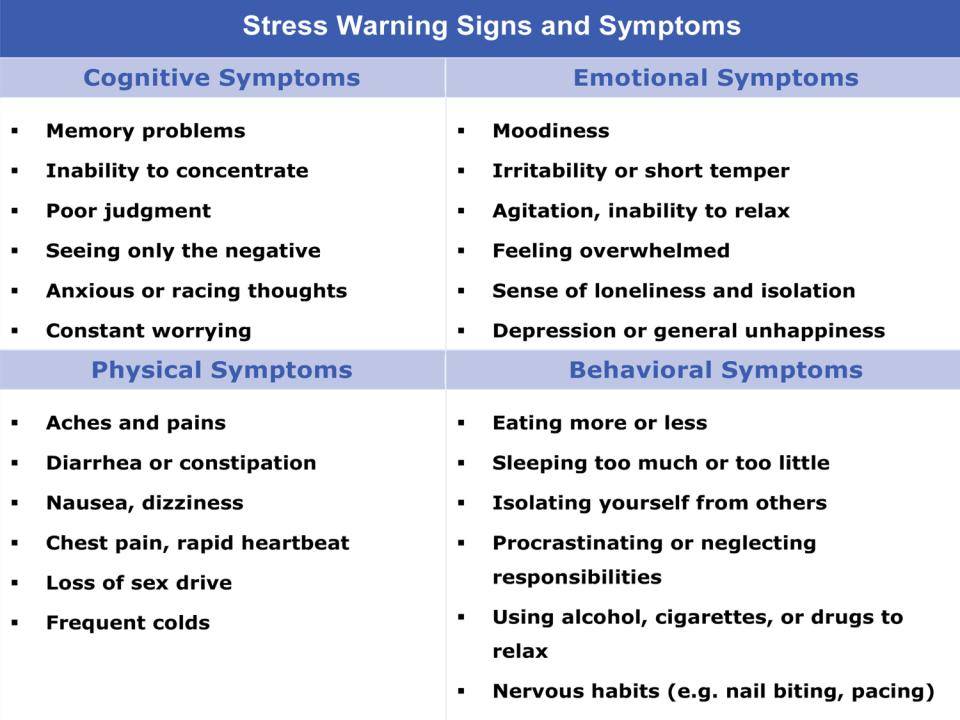
Signs of teen stress include withdrawal; crying; picking fights; loss of focus and diminishing accomplishment; change in eating or sleeping patterns, particularly loss of appetite and disturbed sleep; moodiness or anger. Extreme stress can lead to thoughts of suicide.

Stress and Adults
Latest Results from the American Psychological Association:
  • 32% report extreme stress
  • Nearly one in five (17%) reach their highest stress level 15 or more days per month.
  • Almost half (48%) say their stress level has risen over the last five years.
  • Stress didn’t come as a surprise. Most participants indicated that stress is a natural part of life.
  • But the survey shows that participants are suffering physically, emotionally, professionally, and personally as a result of stress.
  • Most participants — 82% — say they manage their stress well. But they also admit that stress causes problems with their physical and mental health, relationships, and work.
  • More than three out of four participants — 77% — said that within the previous month, they had had physical problems due to stress.
  • Those problems included fatigue, headache, upset stomach, muscle tension, change in appetite, teeth grinding, change in sex drive, and feeling dizzy.
  • Almost as many participants — 73% — reported stress-related psychological symptoms in the previous month, including irritability, anger, nervousness, lack of energy, and feeling on the verge of tears.
  • Stress kept nearly half of participants — 48% — awake at night during the previous month. They reported losing 21 hours of sleep during that month.
  • Almost half of participants — 43% — said they had overeaten or eaten unhealthy foods because of stress in the previous month. Candy and chocolate were their most popular comfort foods.
  • Two-thirds of smokers said they smoked more when they were stressed, and 17% of drinkers said they drank too much within the previous week because of stress.
  • Work: 74%
  • Money: 73%
  • Workload: 66%
  • Children: 64%
  • Family responsibilities: 60%
  • Health concerns: 55%
  • Health problems affecting spouse, partner, or children: 55%
  • Health problems affecting parents or other family members: 53%
  • Housing costs (e.g. rent or mortgage): 51%
  • Intimate relationships: 47%
Stress and Health
  • Most participants — 82% — say they manage their stress well. But they also admit that stress causes problems with their physical and mental health, relationships, and work.
  • More than three out of four participants — 77% — said that within the previous month, they had had physical problems due to stress.
  • Those problems included fatigue, headache, upset stomach, muscle tension, change in appetite, teeth grinding, change in sex drive, and feeling dizzy.
  • Almost as many participants — 73% — reported stress-related psychological symptoms in the previous month, including irritability, anger, nervousness, lack of energy, and feeling on the verge of tears.
Losing Sleep, Eating Badly
  • Stress kept nearly half of participants — 48% — awake at night during the previous month. They reported losing 21 hours of sleep during that month.
  • Almost half of participants — 43% — said they had overeaten or eaten unhealthy foods because of stress in the previous month. Candy and chocolate were their most popular comfort foods.
  • Two-thirds of smokers said they smoked more when they were stressed, and 17% of drinkers said they drank too much within the previous week because of stress.
Sources of Stress
  • Work: 74%
  • Money: 73%
  • Workload: 66%
  • Children: 64%
  • Family responsibilities: 60%
  • Health concerns: 55%
  • Health problems affecting spouse, partner, or children: 55%
  • Health problems affecting parents or other family members: 53%
  • Housing costs (e.g. rent or mortgage): 51%
  • Intimate relationships: 47%

Biblical Lessons for Dealing With Stress

1. How Did Jesus Handle Stress?

Jesus in Matthew 11 was facing what some would consider “Stressful Problems”

  1. He went preaching in the cities where his disciples lived.
  2. John the Baptist sent his disciples to ask if Jesus was the one. Jesus did not give a straight answer, but said, tell John what I have done, and tell him “Blessed are the ones who are not offended in me.”
  3. The crowd around Jesus did not understand what he said, Jesus said something else harsh, “from the days of John the Baptist until now the Kingdom of heaven has suffered violence, and the violent take it by force.”
  4. Jesus gets on the crowd for not understanding His message.
  5. Then he lambasts the cities where he had been preaching and doing miracles, because they had refused to understand His message. He said it would be more tolerable for Sodom on the Day of Judgment than it would be for them.

So at the height of these stresses – of John doubting Him, his followers doubting Him, and the cities where He did miracles doubting Him, Jesus said an amazing thing.
MATT 11:25 – “I thank you Father, Lord of Heaven and Earth, that you have hidden these things for the wise and understanding and revealed them to children; yes, Father, for such was your gracious will. All things have been handed over to me by my Father…

Come unto me, all who labor and are heavy laden, and I will give you rest. Take my yoke upon you, and learn from me, for I am gentle and lowly in heart, and you will find rest for your souls. For my yoke is easy, and my burden is light.”

Jesus was facing some stressful situations that would appear beyond His control. He reacted by calling God Lord of heaven and earth, and then thanking God for giving Him babies instead of wise adults to start His church. Then He said, by the way, God has turned over everything to me. I am the boss, and if you doubt me, I lay down this challenge. Lay down your burdens and I promise you rest. But if you want more, you need to study and learn from me, and if you really follow me, your soul will find rest!

Jesus said there are two rests, one promised upon receiving Him, and one discovered as you live your life yoked to Him. The second rest is deeper and more satisfying, effecting your mind, will and emotions. In other words, no matter the problems you are facing, if you face them with the one who handles everything, you will not feel stressed!

2. How Did Paul Handle Stress?

1 Corinthians 2:5 that your faith might not rest in the wisdom of men but in the power of God.

2 Corinthians 12:8-10 Three times I pleaded with the Lord about this, that it should leave me. But he said to me, “My grace is sufficient for you, for my power is made perfect in weakness.” Therefore I will boast all the more gladly of my weaknesses, so that the power of Christ may rest upon me. For the sake of Christ, then, I am content with weaknesses, insults, hardships, persecutions, and calamities. For when I am weak, then I am strong.
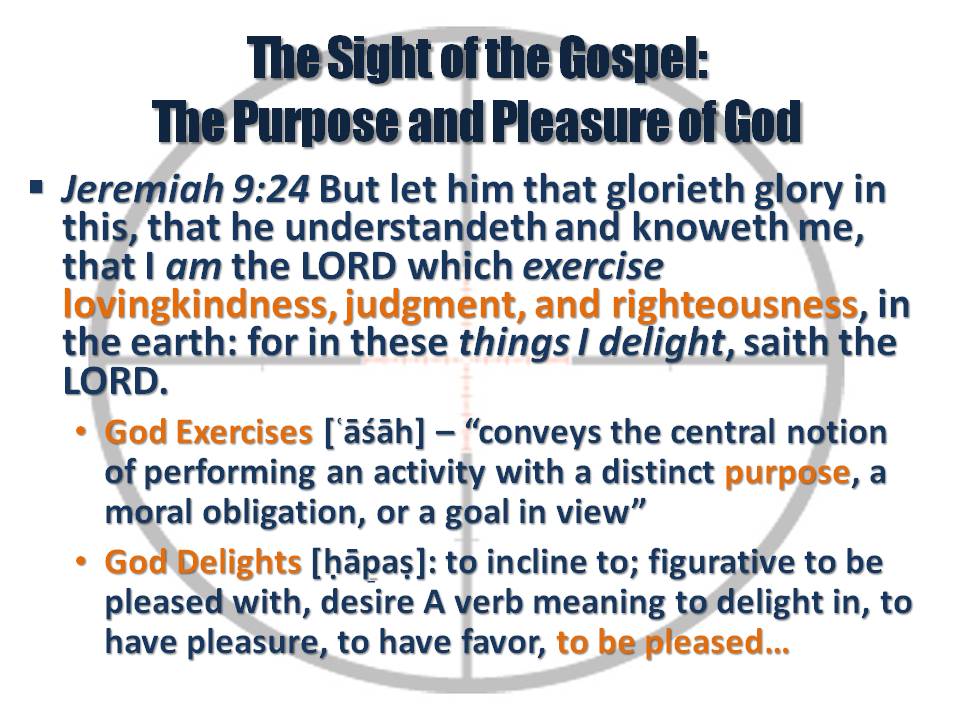
Paul  could see the importance of the Power of God. He desired it so much, that he welcomed stresses, persecutions, hardships, because they gave him the opportunity to know the power of God in the midst of his weaknesses and stresses.

3. How Did God Try to Teach the Wilderness Jews to Deal with Stress?

Early on in their Journey, the Hebrews faced several stressful problems. They came into the wilderness of Shur, which means a foe lying in wait.

שׁוּר shûr (From H7889); a foe (as lying in wait). This set the stage for what was to come in the early months of their travels in the Sinai. Problems were lying in wait for them, and God wanted to teach them how to respond to stressful situations.

Problems always lie in wait. You can go to work like any other day, and discover that you are out of a job. You can go for a routine check up and be told you need some tests. A simple conversation with a friend or family member can end up in a fight and a wall. There may be a call from the police about your child, or worse, your spouse. Problems happen, and depending upon whether we think we can handle it or not, we feel stressed.

This problem was serious. They needed water. Three days had passed, some were suffering dehydration. Livestock was at the point of death. Suddenly a cry goes up, “look there’s water!” Everyone rushes to it, starts to drink, but something is wrong. This is like the water pools in Egypt that develop after the Nile floods. That water brought disease. This was the same ‘bitter’ water. The people grumbled and Moses cried out. He was thirsty too. He was beginning to stress!
Exodus 15:22-26 Then Moses made Israel set out from the Red Sea, and they went into the wilderness of Shur. They went three days in the wilderness and found no water. When they came to Marah, they could not drink the water of Marah because it was bitter; therefore it was named Marah. And the people grumbled against Moses, saying, “What shall we drink?” And he cried to the LORD, and the LORD showed him a log, and he threw it into the water, and the water became sweet. There the LORD made for them a statute and a rule, and there he tested them, saying, “If you will diligently listen to the voice of the LORD your God, and do that which is right in his eyes, and give ear to his commandments and keep all his statutes, I will put none of the diseases on you that I put on the Egyptians, for I am the LORD, your healer.”

A. God Revealed the Power of His Word.

    • The Word of Life

He gave them a statute and rule, that if they diligently listened to the voice of the Lord, and obeyed His commandments, they would never have any disease that the Egyptians had. God revealed a new name-Jehovah Rophe, Our God who heals. He then led them to Elim, where there were 12 springs and 70 palm trees. A veritable oasis in the wilderness.

You can drink bitter water, and it will not make you sick. All you have to do is believe to the point of obeying. Paul said you will be saved (healed), but all you have to do is hold fast to the Word! God always does our problems one better. His power is simply amazing, and He wants us to enjoy it.

The cure for the bitterness of Life is the Healing power of faith in God and His Word. His Word Is The Tree Of Life!

B. God Revealed the Importance of Rest.

    • The Bread of Life

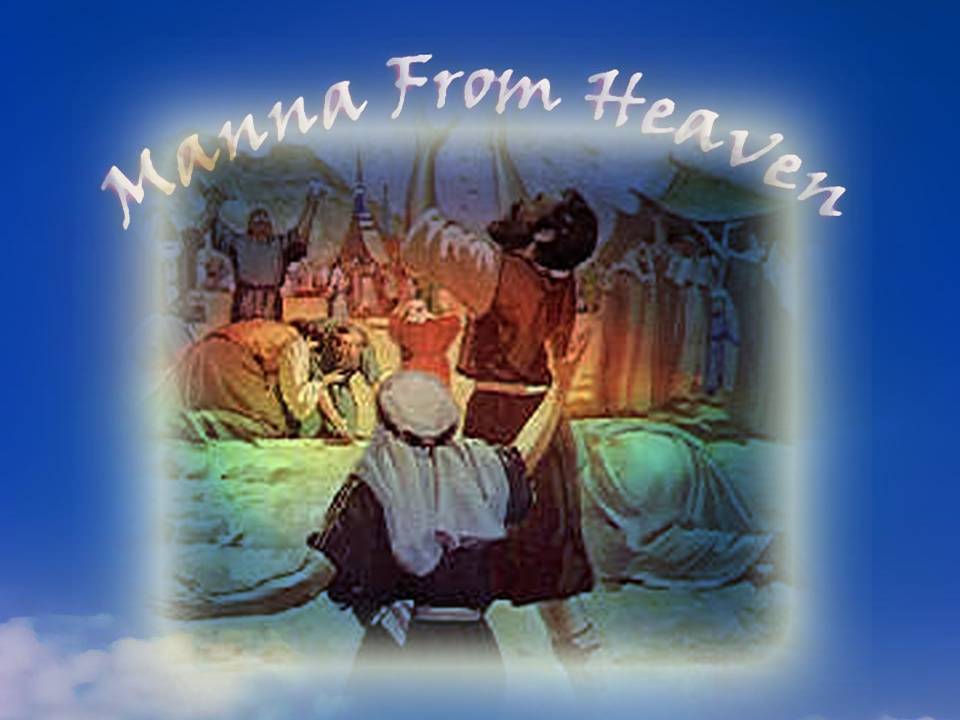
In the wilderness of Sin, the people grumbled again because they were hungry.

Exodus 16:4 Then the LORD said to Moses, “Behold, I am about to rain bread from heaven for you, and the people shall go out and gather a day’s portion every day, that I may test them, whether they will walk in my law or not.

God told Moses that He was going to rain manna from heaven and that it was going to be a test of whether the Hebrews would walk in God’s Law. How you say? He only gave them six days of food. They were to rest…the seventh day.

The cure for temporal problems is to look to Heaven and learn to rest in the power of God!

C. God Reveals the Rock of Living Water (He is Always with Us)

    • The Water of Life

Ex 17:1-7 the people grumbled again, and this time took up stones to heave at Moses. God revealed the Rock of Living Water.

The cure for doubts about God’s presence and power in the midst of your problems is to come to the Rock and quench your thirst on His Living Water.

The Samaritan woman lived with the daily stress of being hated by the townspeople. She was a sinful woman, the object of abuse and contempt. Then one afternoon, she met the Rock, the Rock who could give her Living Water. Nothing else mattered. The contempt, her scandalous past, her poor reputation. Here was the Rock greater than all that, who could give her Living Water that would never run dry. She gained her life back. She discovered the Savior for all her mistakes, all her failures and all her hopes.

D. God reveals the Altar of Jehovah Nissi

    • The Altar of Victory in Life

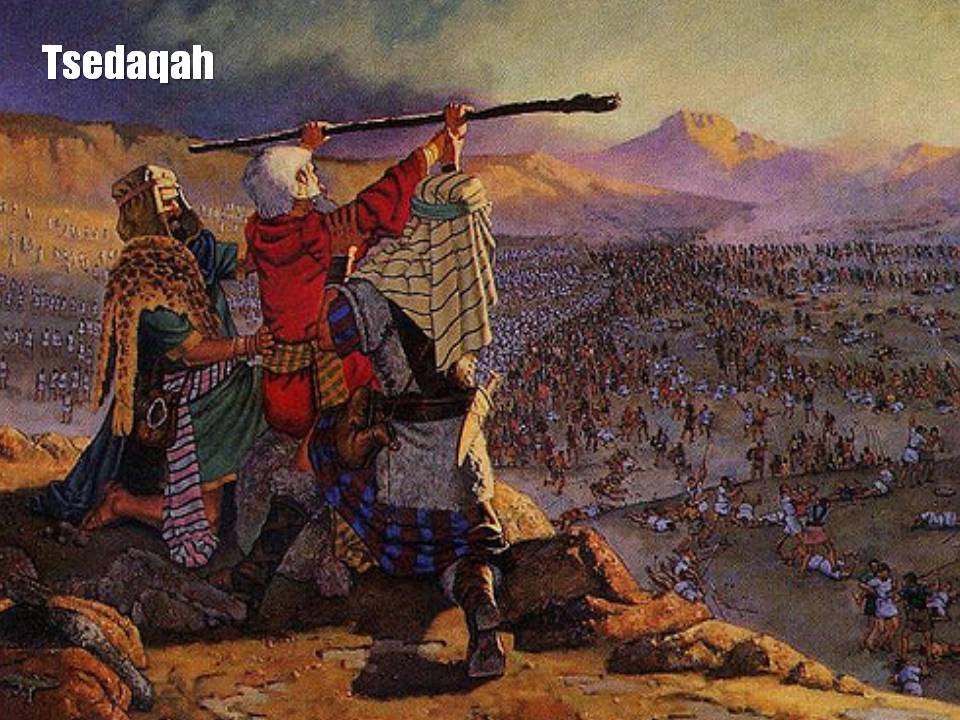
Exodus 17:8-9 Then Amalek came and fought with Israel at Rephidim. So Moses said to Joshua, “Choose for us men, and go out and fight with Amalek. Tomorrow I will stand on the top of the hill with the staff of God in my hand.”

Amalek always represents the flesh. And the flesh is constantly at war with God and His children. The chosen men still had to fight, had to bleed, had to die, but the victory was dependent upon God.

One aspect of Victory over the flesh is the need of the Altar. The Altar of Life.

Romans 12:1-2 I beseech you therefore, brethren, by the mercies of God, that ye present your bodies a living sacrifice, holy, acceptable unto God, which is your reasonable service. And be not conformed to this world: but be ye transformed by the renewing of your mind, that ye may prove what is that good, and acceptable, and perfect, will of God.

The cure for battling the flesh is to die on the altar of the Cross of Christ!

  • The Cross is our Banner-Jehovah Nissi. The Cross is our Victory!

Does God Want us to Stress or Rest?

Can a Disciple truly enjoy Rest, even in the midst of stressful situation? God Promises that we can enter into His Rest:

Hebrews 4:1 Therefore, while the promise of entering his rest still stands, let us fear lest any of you should seem to have failed to reach it.

So there is a Rest, but it is not guaranteed. It is something to be desired and attained. The consequence is being overthrown in the wilderness.

Hebrews 4:6-7 Since therefore it remains for some to enter it, and those who formerly received the good news failed to enter because of disobedience, again he appoints a certain day, “Today,” saying through David so long afterward, in the words already quoted, “Today, if you hear his voice, do not harden your hearts.”

Hebrews 4:9-11 So then, there remains a Sabbath rest for the people of God, for whoever has entered God’s rest has also rested from his works as God did from his. Let us therefore strive to enter that rest, so that no one may fall by the same sort of disobedience.

  1. Obey God
  2. Do not harden your heart
  3. Strive to enter
  • The striving is in regards to this flesh. It has a hard time with the idea of FAITH.

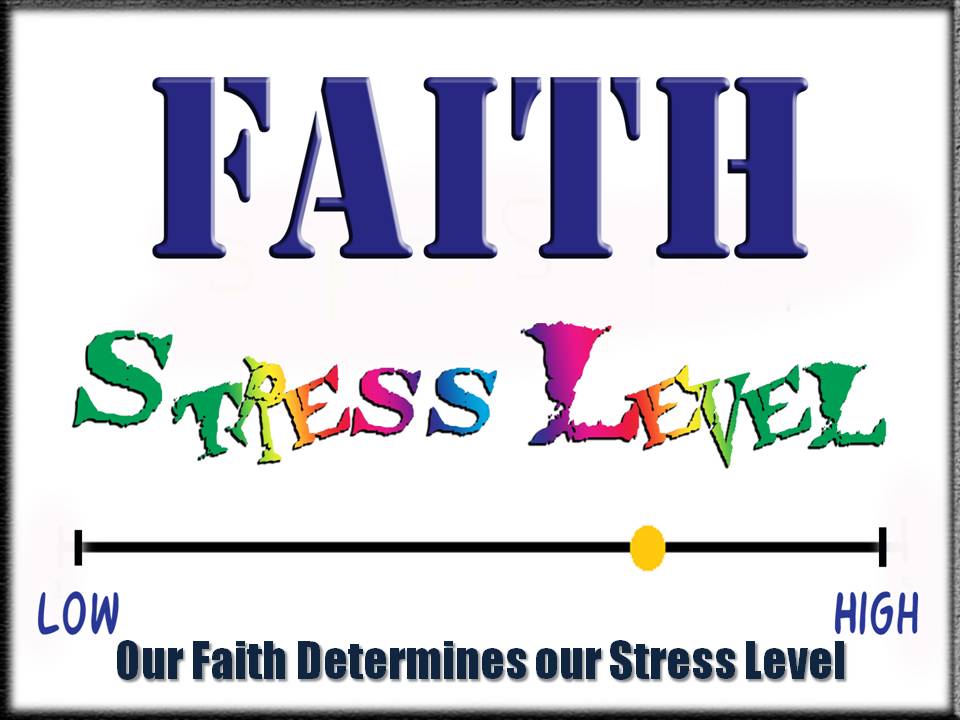
Faith Determines our Stress Level

1 Corinthians 15:2 You are also saved by it, if you hold to the message I proclaimed to you—unless you believed for no purpose. HCSB

Paul says it is a fact that you are being saved (Indicative, Passive). You are the recipient of the action; however, this salvation is conditioned upon you actively holding fast to the Gospel message that Paul preached (Indicative, Present). You must do the holding. Otherwise, your belief was in vain, (without purpose, or cause).

It is a circle of FAITH. You are being saved by the power of the Gospel, but you must keep holding on to the message of the Gospel in order for that salvation to stay in effect. This world is corrupt, the enemy is too strong. If you try to find salvation in your own strength, or grow apathetic through the hardness of your heart, you will be overcome; you will not know the power of the Gospel.

As Christians, we must keep the message of the Gospel ever before us, in all we encounter. As soon as we turn away, or forget, or act in our flesh, we will be overcome. The Gospel has power for our lives, but we must desire it, we must embrace it, we must hold fast! Salvation is more than a belief. Salvation is life, life that is transformed by the eternal power of the Gospel of Jesus.

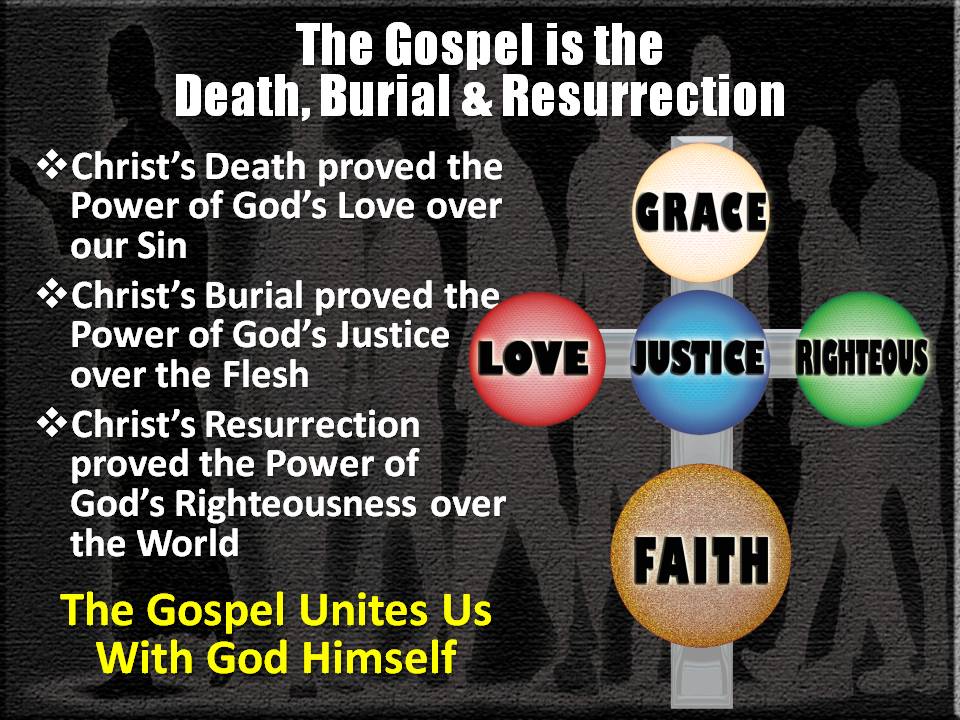
What that means is that you will not know the power of this Gospel until you identify with the Death, burial and resurrection of Jesus Christ.

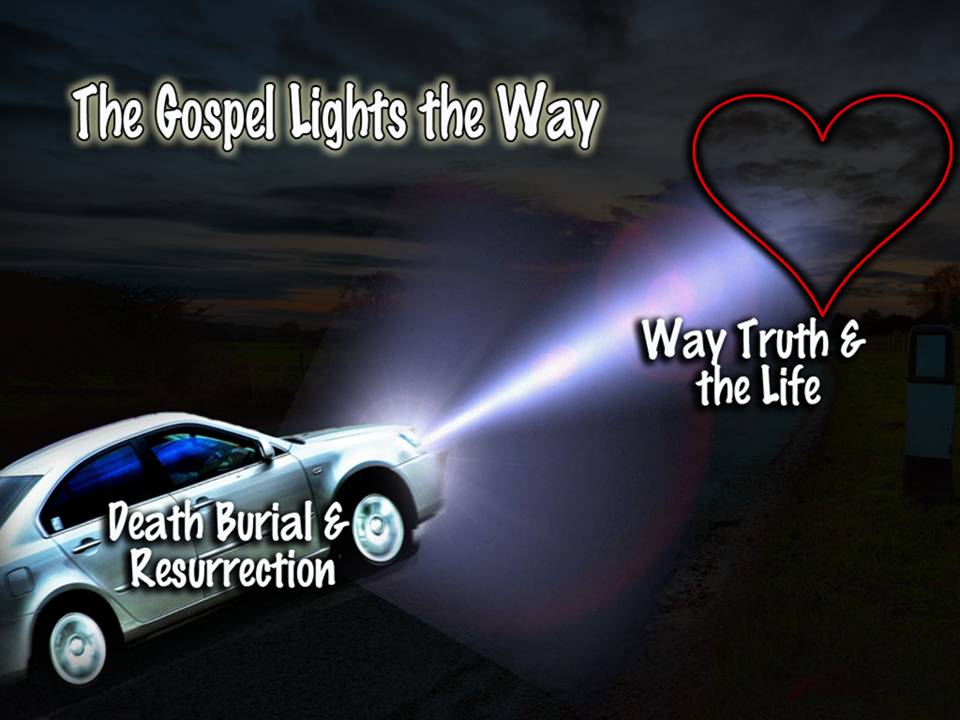
The Death, Burial and Resurrection Conquers Stress

You must daily die to what you want, submit your body to God’s design, and then lean entirely upon Christ for victory.

If Salvation is to be continuous and healing, the Gospel is to be applied to our lives every day.

1. His Dead Body opens God’s Reservoir of Love upon our Life

We face a stressful problem, an impossible situation and we cry out: God, how could you let this happen? This is not fair, this is not right! Bitterness enters, distrust becomes rooted, and we begin to doubt God’s Love for us. We start to see Him as vindictive, judgmental. We see the church that way. We see pastors that way.

How does the Death apply to stress?

Stress is when a problem we face seems larger than what we can handle. The Death is something we embrace every day, in every problem. Through Faith, we believe that God’s Love is upon us, because we are in His Son. We die to what we want and say, “God, your plans are my plans. I lay such and such on the altar. You have your will and way.”

  • I am the LORD your God. (Jehovah Elohim)

2. His Buried Body applies God’s Justice upon our life.

Sometimes stress is because things are not right in our life. There may be addictions that we cannot overcome. There may be situations at work that are not right. Our spouse may be causing problems. Our priorities may be wrong. Life is out of balance, and things are stressful.

Jesus dealt with this world. He dealt with Satan. He dealt with the flesh. He enabled God to declare we are justified even when clothed with the flesh. The peace of Jesus Christ is upon us. He overcame Satan through the power of the Word.

We need to embrace what His buried body represents. God is free to apply His justice to your life. No matter the addiction or the backslidden condition of your heart. When you desire God’s justice upon your body, your life, God will start to work that, because He can. His Kingdom Will can be upon your life, because Jesus dealt with the flesh. Your soul is free to pursue the Spirit of God.

When stress is so bad that your health is affected, give your body to God. Realize the need to be a living sacrifice. Your body is buried, but you still live. However, you do not live for yourself, you live to fulfill God’s pleasure and will. If God wants to use your health to further His pleasure, so be it. You body is a living sacrifice. But perhaps God wants you to deal with things that are not right in your life.

Perhaps a broken relationship is causing stress. Perhaps you are dishonoring a spouse or an authority in your life. Perhaps you are dishonoring your body in some way. Set it right, ask God to bring His justice into your life. Then live as a living sacrifice, ever consumed, but ever living.

  • God is Jehovah Rophe-our healer!

3. His Resurrected Body applies God’s Righteousness to our Life.

What happens when you experience God’s steadfast love, have His justice applied to your life, but there is still this war going on, there is still stress? You feel weak, you feel powerless. You want to give up, stop believing that God can do anything.

This is the hardest test of all. This is the time when you try to hold up the Word, you try to cling to God, but your arms fail, you grow weak, and the stress is overwhelming.

You need to realize that God is strongest when we are weakest. Instead of despair, we reach out; we embrace the Victory that is in Christ. Too often, that victory comes only when we lock arms with other Christians. Hoist the Banner of Christ’s Victory at the altar! We look to the banner, but we must join others at the altar. Some stress is so great that you must humble yourself and reach out to the strength of others.

The Victory of Christ is always joined to the Altar. We die, we are buried, and we share in His Victory with others.

During the early stressful days of their wilderness journey, God revealed three names to His people.

  • God is Jehovah-Nissi!

At the Very, least we should have Sunday set aside where we rest in the Lord. We give all our problems and stresses to Him. We come to the altar and we lift up the name of Jehovah Nissi

Philippians 4:4-7 Rejoice in the Lord always; again I will say, Rejoice. Let your reasonableness be known to everyone. The Lord is at hand; do not be anxious about anything, but in everything by prayer and supplication with thanksgiving let your requests be made known to God. And the peace of God, which surpasses all understanding, will guard your hearts and your minds in Christ Jesus.

For we who have believed do enter into that rest.


Quit hanging on to the handrails . . . Let go. Surrender. Go for the ride of your life. Do it every day. (Melody Beattie, “Finding Your Way Home”)

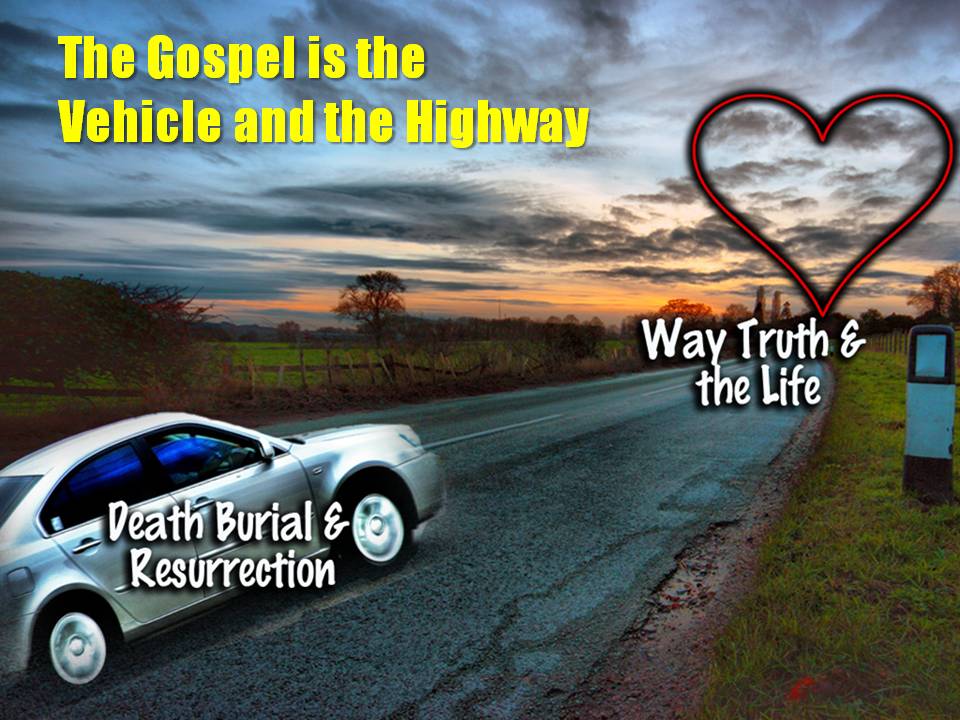
Sometimes it is great fun to go for the ride of your life, such as skydiving, bungee-jumping or zip-lining. The thrill is exhilarating. There is a ride that is much more important, much more exhilarating, but much too frightening for most. It is the RIDE FOR YOUR LIFE! Your very life depends upon it. It is the Gospel ride, the ride that depends entirely on an invisible Savior. Let’s discover the Gospel and see that it truly is the “RIDE FOR YOUR LIFE.”

WHAT IS THE GOSPEL?

Matthew – the Gospel of the Kingdom. (Matthew 4:23 And he went throughout all Galilee, teaching in their synagogues and proclaiming the gospel of the kingdom and healing every disease and every affliction among the people.)

 Mark – the Gospel of God. (Mark 1:14-15 Now after John was arrested, Jesus came into Galilee, proclaiming the gospel of God, and saying, “The time is fulfilled, and the kingdom of God is at hand; repent and believe in the gospel.”)

 Luke – the Good News of the Kingdom of God. Luke 8:1 Soon afterward he went on through cities and villages, proclaiming and bringing the good news of the kingdom of God. And the twelve were with him,

 Philip – the Good News of the Kingdom of God and the Name of Jesus. Acts 8:12 But when they believed Philip as he preached good news about the kingdom of God and the name of Jesus Christ, they were baptized, both men and women.

 Peter – the Good News of Peace through Jesus Christ.  Acts 10:36 As for the word that he sent to Israel, preaching good news of peace through Jesus Christ (He is Lord of all)

 Paul – the Gospel of the Grace of God.  Acts 20:24 But I do not account my life of any value nor as precious to myself, if only I may finish my course and the ministry that I received from the Lord Jesus, to testify to the gospel of the grace of God.

The Gospel – Good News that Brings a Reward

Gospel: εὐαγγέλιον, (euangelion) originally denoted a reward for good tidings; later, the idea of reward dropped, and the word stood for “the good news” itself.(1)

2 Samuel 18:19-22 Then Ahimaaz the son of Zadok said, “Let me run and carry news to the king that the LORD has delivered him from the hand of his enemies.” And Joab said to him, “You are not to carry news today. You may carry news another day, but today you shall carry no news, because the king’s son is dead.” Then Joab said to the Cushite, “Go, tell the king what you have seen.” The Cushite bowed before Joab, and ran. Then Ahimaaz the son of Zadok said again to Joab, “Come what may, let me also run after the Cushite.” And Joab said, “Why will you run, my son, seeing that you will have no reward for the news?

The Gospel is the good news (+ )!The Plus is the Reward of Life with God!
God promises this reward. In fact, we must believe in His reward if we are to please God!

  • Heb 11:6 – You must believe that God is a rewarder of those that earnestly seek Him
  • Heb 12:1 – Jesus endured the shame and suffering of the cross for the reward (joy) that was set before Him

PAUL EXPLAINS THE GOSPEL

1 Corinthians 15:1-6 Now I would remind you, brothers, of the gospel I preached to you, which you received, in which you stand, and by which you are being saved, if you hold fast to the word I preached to you— unless you believed in vain. For I delivered to you as of first importance what I also received: that Christ died for our sins in accordance with the Scriptures, that he was buried, that he was raised on the third day in accordance with the Scriptures, and that he appeared to Cephas, then to the twelve. Then he appeared to more than five hundred brothers at one time, most of whom are still alive, though some have fallen asleep. Then he appeared to James, then to all the apostles. Last of all, as to one untimely born, he appeared also to me.

A. The SCOPE of the Gospel

1. The Plan 1 Corinthians 15:3 … that Christ died for our sins according to the Scriptures (mentioned twice).

2. Event in History 1 Corinthians 15:4-6 that he was buried, that he was raised on the third day according to the Scriptures, and that he appeared to Peter, and then to the Twelve. After that, he appeared to more than five hundred of the brothers at the same time…

3. Achievement (between the Father and the Son) Philippians 2:8-11 And being found in human form, he humbled himself by becoming obedient to the point of death, even death on a cross. Therefore God has highly exalted him and bestowed on him the name that is above every name, so that at the name of Jesus every knee should bow, in heaven and on earth and under the earth, and every tongue confess that Jesus Christ is Lord, to the glory of God the Father.

4. Free Offer Romans 3:21-26 But now the righteousness of God has been manifested apart from the law, although the Law and the Prophets bear witness to it— the righteousness of God through faith in Jesus Christ for all who believe. For there is no distinction: for all have sinned and fall short of the glory of God, and are justified by his grace as a gift, through the redemption that is in Christ Jesus, whom God put forward as a propitiation by his blood, to be received by faith. This was to show God’s righteousness, because in his divine forbearance he had passed over former sins. It was to show his righteousness at the present time, so that he might be just and the justifier of the one who has faith in Jesus. Romans 6:23 For the wages of sin is death, but the free gift of God is eternal life in Christ Jesus our Lord.

5. Application of the Achievement by Faith (forgiveness, justification, life). Ephesians 2:8-9 For by grace you have been saved through faith. And this is not your own doing; it is the gift of God, not a result of works, so that no one may boast. Romans 5:17 For if, because of one man’s trespass, death reigned through that one man, much more will those who receive the abundance of grace and the free gift of righteousness reign in life through the one man Jesus Christ.

The application is not the end. Forgiveness and freedom from guilt is great, but God’s purpose does not end with our being born again. The Gospel is given simply for us, it is given to accomplish the Purpose and Pleasure of God. THE GOSPEL …

6. Brings us to God 1 Peter 3:18 For Christ also suffered once for sins, the righteous for the unrighteous, that he might bring us to God, being put to death in the flesh but made alive in the spirit, Ephesians 2:12-13 remember that you were at that time separated from Christ, alienated from the commonwealth of Israel and strangers to the covenants of promise, having no hope and without God in the world. But now in Christ Jesus you who once were far off have been brought near by the blood of Christ. Ephesians 2:16 and might reconcile us both to God in one body through the cross, thereby killing the hostility.

Finally, the Gospel accomplishes what God is all about…

7. Accomplishes the Purpose and Pleasure of God Ephesians 1:9-10 Having made known unto us the mystery of his will, according to his good pleasure which he hath purposed in himself: That in the dispensation of the fulness of times he might gather together in one all things in Christ, both which are in heaven, and which are on earth; even in him…

B. The SIGHT of the Gospel

The Gospel Achieves the Purpose and Pleasure of God

Jeremiah 9:24 But let him that glorieth glory in this, that he understandeth and knoweth me, that I am the LORD which exercise lovingkindness, judgment, and righteousness, in the earth: for in these things I delight, saith the LORD.

  1.  God Exercises [ʿāśāh] – “conveys the central notion of performing an activity with a distinct purpose, a moral obligation, or a goal in view”(2)
  2. God Delights [ āp a ]: to incline to; figurative to be pleased with, desire(3); A verb meaning to delight in, to have pleasure, to have favor, to be pleased(4)

The Gospel Accomplishes the Purpose and Pleasure of God.

We see this in 1 COR 15:1: “the gospel I preached to you, which you received, in which you stand, and by which you are being saved…”

  • You receive the unfailing love of God (hesed)
  • You stand in the Justice of God secured on the Cross (mishpat)
  • You are continually being saved through the Righteousness of Christ (tsedaqah)

(For definition of hesed, mishpat and tsedaqah and an understanding of their importance in discipleship…)

David made a decision to seek the Heart of God. In His seeking he discovered the ways of God, that those ways are always working to accomplish hesed, mishpat and tsedaqah. David grew as a man of God when he reacted the right way to what God was trying to accomplish in his life. God worked in David’s life these three things: hesed, mishpat and tsedaqah.

C. The SUCCESS of the Gospel

Provides the Vehicle and the Highway

It is important that we see the Gospel as a driving force in our life. The Gospel is much more than a story that you believe in when you are a child and then forget about when you are older. The Gospel is the driving purpose and pleasure of God that is to be with us at Work, at Rest, at family gatherings, at the movies, at the restaurant, when we are dealing with pressures, dealing with physical problems. The Gospel is to be on our minds and in our hearts! The Gospel is the core belief of a child of God. It is the Vehicle that God has provided for us to bring peace, hope, faith, love, justice, righteousness and grace. It is the vehicle that will bring us to Him!

1.  The Gospel is the Death Burial & Resurrection (Vehicle)

a) Christ’s Death proved the Power of God’s Love over our Sin
b) Christ’s Burial proved the Power of God’s Justice over the Flesh
c) Christ’s Resurrection proved the Power of God’s Righteousness over the World

The Gospel Unites Us With God Himself

Not only is the Gospel the vehicle that we are to ride in, it provides the way, the roadway, the highway for our journey.

2. The Gospel is the Way, the Truth and the Life (Highway)

a) The Way to hesed (God’s Steadfast Love)
b) The Truth of mishpat (God’s Justice)
c) The Life of tsedaqah (God’s Righteousness)

The Gospel Unites Us With the Heart Of God – It is according to His Purpose & Pleasure

THERE IS NO OTHER WAY TO GOD

Jesus said I am the Way, the Truth and the Life. To know the way we have to by faith receive the mercy and unfailing love of Jesus Christ. Then we stand in the Truth of Jesus Words, the mishpat. Then we have Life as we abide in the Righteousness (tsedaqah) of Jesus Christ.

So the Elements of Discipleship which we found operating in David as he sought after the Heart of God are here in the Gospel.

3. The Gospel Lights the Way

a) The Gospel is the Lamp shining in a dark place. It that shines in your heart… 2 Peter 1:19 And we have something more sure, the prophetic word, to which you will do well to pay attention as to a lamp shining in a dark place, until the day dawns and the morning star rises in your hearts,

b) The Gospel is the Light of the Knowledge of the Glory of God in the face of Jesus Christ… 2 Corinthians 4:4-6 In their case the god of this world has blinded the minds of the unbelievers, to keep them from seeing the light of the gospel of the glory of Christ, who is the image of God. For what we proclaim is not ourselves, but Jesus Christ as Lord, with ourselves as your servants for Jesus’ sake. For God, who said, “Let light shine out of darkness,” has shone in our hearts to give the light of the knowledge of the glory of God in the face of Jesus Christ.

4. The Gospel Reaches the Destination – the Heart of God is revealed and made available to us in the Gospel.

The Gospel accomplishes the Purpose and Pleasure of God, and therefore is the means of developing us into Disciples of Jesus Christ. This is the basis for Gospel Driven Discipleship.

Gospel driven discipleship realizes the Power of the Gospel to transform our lives, and propel us to the Heart of God. Gospel Driven Discipleship realizes that Discipleship is not about your own abilities or efforts, but it is about relying on the Power of Jesus Christ! You must be willing to give up everything or the Gospel will have no power in your life! It will cause the car to slow down and lose power, even stall out.

POP THE HOOD – TAKE A LOOK AT THE ENGINE of the GOSPEL!

My brother Mike bought a Mercedes that cost $197,000. He took me for a ride, but I said it didn’t seem that much better than my Mercedes that cost $60,000. But all he had to do was push the accelerator down. That car literally took off like a rocket. Not a hurky jerky rocket, but a smooth take your breath away rocket. The engine was a V12 that could rocket to 60 mph in 4.4 seconds. With his car, the engine was the star! And so it is with the Gospel of Jesus Christ. Lets pop the hood and see what drives the Gospel.

I Corinthians 15: Now I would remind you, brothers, of the gospel I preached to you, which you received, in which you stand, and by which you are being saved, if you hold fast to the word I preached to you— unless you believed in vain. For I delivered to you as of first importance what I also received: that Christ died for our sins in accordance with the Scriptures, that he was buried, that he was raised on the third day in accordance with the Scriptures,

A. The Love of the Gospel is Incomprehensible

Christ died for our Sins…Mercy and Love Incomprehensible. The Gospel is the visible expression of the unfailing love and mercy of Holy God for sinful man. God literally died and experienced the wrath of hell that we deserved because of our sin and disobedience. His love drove Him to pursue us by going to the cross, humbling himself to a horrible death, and drinking the wrath of God against sin.

While Jesus pleased His Father, and satisfied the demands of His justice and righteousness, we must receive this love by faith. We must humble ourselves before God and confess our sin and disobedience. We must need the salvation Jesus has provided. We must accept this gift as the perfect and total sacrifice for our sins. There cannot be one iota of dependence upon self for salvation. It is either all of Christ or it has no power to Bring us to God!

As Paul writes, we receive this loving gift bought with the Holy blood of God’s Son. His love is what we rest upon. There is no looking over your shoulder, no wondering why He is doing this to you, no thinking you have to do something to make Him love you. His love comes from the strength of His Name and His character. It does not depend upon how lovely you are. His love is steadfast, strong, unfailing, based upon His death for you. His love is incomprehensible. His desire is to bring you to Him. His desire is to live in your everyday life.
When the Light of the Gospel applies the Mercy of God to our heart, we are born again. Then the Word of God is applied to our soul and our lives are justified before God. We are made right with God through the application of His justice. Then daily we must lean entirely upon the Word of God for our righteousness, for our victory over this world. It can never be anything of our flesh, or it was belief (eike) without purpose. It was in vain.

Counterfeit Salvation is dependent upon self, upon the strength of your will and your flesh. It is false salvation based upon your interests and concerns. It is a false hope that somehow you can please God enough to allow you into His heaven. It is a belief that sets its eyes on yourself, and not on the Purpose and Pleasure of God alone. That belief is counterfeit, it is vanity and you will spend eternity in Hell. That is the belief that is in vain that Paul talks about.

B. The Truth of the Gospel is Impenetrable

Christ died for our sins in accordance with the Scriptures, that he was buried, that he was raised on the third day in accordance with the Scriptures

  • Jesus acted according to the Truth of God’s Word.
  • Jesus died for our sins-the visible expression of the hesed of God.
  • Jesus body was buried-the justice of God was applied to this world through the broken body of His Son.

His body was anointed before His death… Mark 14:8-9 She has done what she could; she has anointed my body beforehand for burial. And truly, I say to you, wherever the gospel is proclaimed in the whole world, what she has done will be told in memory of her.”

We often ignore the burial, and jump to the resurrection. But the burial was dealing with the body, with this flesh. Sin had corrupted this world, our flesh, and Jesus needed to bring Justice to this corrupt world. He had to make it right so that God could once again say “it is good!” The preparation and burial of His body was significant in that it represented the application of mishpat to this world.

God’s Word is triumphant over this flesh-power over sin, over addiction, over disease!

  • The Truth of the Gospel has application for every area of our lives.

Jesus rose again in victory over sin and Satan and the grave. That victory can be experienced by us each and every day of our lives. That victory came because of His righteousness. His righteousness can be ours. His victory can be ours!

C. The Victory of the Gospel is Inexplicable

that he appeared to Cephas, then to the twelve. Then he appeared to more than five hundred brothers at one time, most of whom are still alive, though some have fallen asleep. Then he appeared to James, then to all the apostles. Last of all, as to one untimely born, he appeared also to me.

His righteousness is ours because of the Victory of the Gospel. All it takes is seeing Jesus for who He really is, our Savior, our Lord, our God!

  • The Gospel transformed a cowardly fisherman into a mighty voice for God.
  • The Gospel transformed a cheating tax collector into a mighty witness to those he had cheated.
  • The Gospel transformed a hateful murderer into a witness before Kings.

The Gospel of Jesus Christ is so powerful, that to know and experience the Gospel, all you must do is see and recognize Jesus as the Christ for who He truly is.

You can know all the verses we talked about today. You can go to church, you can give money. You may have been raised in a Christian home. You may have done tremendous things on His behalf. The question is this: Has Jesus appeared to you? Has the Light of the Gospel shone in your heart? Has the light of the Gospel shone you your sin, your disobedience. Has the light of the Gospel shown you the steadfast love of God?

THE LIGHT OF THE GOSPEL HAS POWER TO TRANSFORM

Charles Bradlaugh, a famous Atheist and contemporary with Charles Darwin, once challenged the Rev. H.P. Hughes to a debate. The preacher, who was head of a rescue mission in London, England, accepted the challenge with the condition that he could bring with him 100 men and women who would tell what had happened in their lives since trusting Christ as their Savior. They would be people who once lived in deep sin, some having come from poverty-stricken homes caused by the vices of their parents. Hughes said they would not only tell of their conversion, but would submit to cross-examination by any who doubted their stories. Furthermore, the minister invited his opponent to bring a group of non-believers who could tell how they were helped by their lack of faith. When the appointed day arrived, the preacher came, accompanied by 100 transformed persons. But Bradlaugh never showed up. The result? The meeting turned into a testimony time and many sinners who had gathered to hear the scheduled debate were converted.

I love this Quote about the Gospel:

A.B. Simpson is reported to have said that the gospel “Tells rebellious men that God is reconciled, that justice is satisfied, that sin has been atoned for, that the judgment of the guilty may be revoked, the condemnation of the sinner cancelled, the curse of the Law blotted out, the gates of hell closed, the portals of heaven opened wide, the power of sin subdued, the guilty conscience healed, the broken heart comforted, the sorrow and misery of the Fall undone. (5)

Will you let the Light shine in your life?

A couple who took their son, 11, and daughter, 7, to Carlsbad Caverns. As always, when the tour reached the deepest point in the cavern, the guide turned off all the lights to dramatize how completely dark and silent it is below the earth’s surface. The little girl, suddenly enveloped in utter darkness, was frightened and began to cry. Immediately was heard the voice of her brother: “Don’t cry. Somebody here knows how to turn on the lights.”(6)

In a real sense, that is the message of the gospel: light is available, even when darkness seems overwhelming. Everyday God shines the Light of the Gospel upon your life. The light is on, but you will not see it if your focus is upon yourself. Focus upon Jesus Christ. You can say yes to the light this very day. If you have backslidden away from the light you can get back to God by simply getting in the car and clinging to the wonderful power of the Gospel. What are your sights set upon.

What are you counting on for success in your life? What are you counting on to take you to God?

(1) William E. Vine, Vine’s Expository Dictionary of Old Testament and New Testament Words, (Nashville, TN: Thomas Nelson, 1940), WORDsearch CROSS e-book, Under: “Gospel”.
(2) Warren Baker and Eugene Carpenter, The Complete Word Study Dictionary – Old Testament, (Chattanooga, TN: AMG Publishers, 2003), WORDsearch CROSS e-book, Under: “ʿāśāh“.
(3) James Strong, Strong’s Talking Greek & Hebrew Dictionary, (Austin, TX: WORDsearch Corp., 2007), WORDsearch CROSS e-book, Under: “2654”.
(4) Warren Baker and Eugene Carpenter, The Complete Word Study Dictionary – Old Testament, (Chattanooga, TN: AMG Publishers, 2003), WORDsearch CROSS e-book, 364.
(5) M. Cocoris, Evangelism, A Biblical Approach, Moody, 1984, p. 29
(6) Bob Woods, Pulpit Digest


Are you ready to Give up and Grab Hold? The plow is sitting out in the field. It needs someone to grab hold and help steer. God provides the power, but He needs faithful disciples to grab hold. The decision to become a Disciple of Jesus Christ is not a decision you make lightly. Nor is it a decision you can forget about and go on your merry way. David had made a decision to follow God, follow so closely that God’s Heart would become David’s heart. God never let David forget that decision. God used test after test to reveal those things in David’s heart and life that were getting in the way of his Discipleship decision. If you make such a decision, God will do the same to you.

God seeks to accomplish three things in the life of a Disciple. Those three things are revealed in Jer 9:24. They are “hesed, mishpat and tsedaqah”. He delights in these three things. These three things are His “good pleasure.”  As Paul wrote: “work out your own salvation with fear and trembling, for it is God who works in you, both to will and to work for his good pleasure.(Phil 2:12b-13). If a disciple is to understand anything about God, it is that He will constantly be working in your life to accomplish these three things, for they are His “good pleasure.” If we are to boast in anything, it is only that we know and understand God, that He delights in these three things.

God used every test that David faced to grow and develop these three things in his life. These three things are the very foundation of God’s Kingdom here on Earth, of Jesus’ Kingdom during the millennium, of the Kingdom that the Church has been charged to usher into this world.

You may doubt the significance of these three things. I hope not. Ever since the Holy Spirit revealed this to me, the Word of God has shouted at me with LIFE! 40 years I have been in the Word, and I just last year saw this. I don’t find anyone teaching this on the internet or in writings. I believe it is truth God wants for our age.

David revealed their importance in Psalm 106.

Psalm 106:1-5 “Praise the LORD! Oh give thanks to the LORD, for He is good; For His loving-kindness is everlasting. Who can speak of the mighty deeds of the LORD, Or can show forth all His praise? How blessed are those who keep justice, Who practice righteousness at all times! Remember me, O LORD, in Your favor toward Your people; Visit me with Your salvation, That I may see the prosperity of Your chosen ones, That I may rejoice in the gladness of Your nation, That I may glory with Your inheritance.”

A. They are the Grounds for Praise and Thanksgiving!

1.  Give thanks for His ‘hesed’ (loving-kindness, unfailing love)– it is everlasting
    • His hesed is the basis of His mighty deeds and bountiful praise. We do nothing to earn it or deserve it.
    • Justice is something we must covet, guard, desire, submit to. It is not of us but of God.
    • Requires commitment of heart, soul and strength. 24/7 diligence.
2.  Keep mishpat (Justice) and you will enjoy blessing
3.  Practice (accomplish) tsedaqah (Righteousness) at all times

B. They are the Grounds for Favor and Salvation!

God’s Steadfast Love (hesed), Justice (mishpat) and Righteousness (tsedaqah), when embraced and exercised, will empower disciples to:

1.  See the prosperity (well-being) of the chosen (Result of hesed changing our Heart’s Desire)
2.  Joy in the gladness of Your Nation (Result of mishpat bringing God’s design into our House and Dependants)
3.  Glory with Your Inheritance (Result of the Victory of Righteousness that produces the Hope of a Godly inheritance)

The rest of Psalms 106 is a revelation of what happens when we resist hesed, mishpat and tsedaqah.

Psalm 106:6-48 We have sinned like our fathers, We have committed iniquity, we have behaved wickedly. Our fathers in Egypt did not understand Your wonders; They did not remember Your abundant kindnesses, But rebelled by the sea, at the Red Sea. Nevertheless He saved them for the sake of His name, That He might make His power known.

Psalm 106:8 Nevertheless he saved them for his name’s sake, that he might make his mighty power to be known.

God saved them for the sake of His Name.Yet look at how they resisted Him:

  • They quickly forgot His works; They did not wait for His counsel, But craved intensely in the wilderness, And tempted God in the desert.
  • Thus they exchanged their glory For the image of an ox that eats grass.
  • They forgot God their Savior, Who had done great things in Egypt, Wonders in the land of Ham And awesome things by the Red Sea.
  • Then they despised the pleasant land; They did not believe in His word, But grumbled in their tents; They did not listen to the voice of the LORD.
  • Therefore He swore to them That He would cast them down in the wilderness, And that He would cast their seed among the nations And scatter them in the lands.
  • They joined themselves also to Baal-peor, And ate sacrifices offered to the dead. Thus they provoked Him to anger with their deeds, And the plague broke out among them.
  • They also provoked Him to wrath at the waters of Meribah, So that it went hard with Moses on their account; Because they were rebellious against His Spirit, He spoke rashly with his lips.
  • They did not destroy the peoples, As the LORD commanded them, But they mingled with the nations And learned their practices, And served their idols, Which became a snare to them.
  • They even sacrificed their sons and their daughters to the demons, And shed innocent blood, The blood of their sons and their daughters, Whom they sacrificed to the idols of Canaan; And the land was polluted with the blood.
  • Thus they became unclean in their practices, And played the harlot in their deeds.
  • Many times He would deliver them; They, however, were rebellious in their counsel, And so sank down in their iniquity.

Nevertheless He looked upon their distress When He heard their cry; And He remembered His covenant for their sake, And relented according to the greatness of His loving-kindness.

Even in Judgment He Loved them because of His Name! Discipleship is simply the following of God’s Name with all our heart, soul and strength!

He also made them objects of compassion In the presence of all their captors. Save us, O LORD our God, And gather us from among the nations, To give thanks to Your holy name And glory in Your praise. Blessed be the LORD, the God of Israel, From everlasting even to everlasting. And let all the people say, “Amen.” Praise the LORD!

The Journey through the Wilderness provides us everything we need to learn about what will prevent us from becoming Disciple’s of Jesus Christ. The Hebrew’s being led by Moses constantly resisted God, and so refused to advance in hesed, mishpat and tsedaqah. 

But before we look at their example, we must see what God did when David humbled himself and cried out to God amidst the ashes of Ziklag…

David Hasaq’d himself in Jehovah Elohim

Last week we left David “hasaq(ing)” himself in Yahweh Elohim. Instead of becoming angry at God because of what had happened, David humbled himself, confessed his sins, and reached up to God, counting on His hesed, committing himself to following His justice and claiming His righteousness!

1 Samuel 30:7

David then called for the Priest, Abiathar, to enquire of the Lord with the Ephod. God gae instruction to pursue the raiders, and God assured David he would overtake them and rescue all of their families. God then led them to find an Egyptian slave who had been left behind due to a divinely appointed sickness. He gave David the intel they needed. They pursued and found the Amelikites scattered and revelling in their good fortune. They were easily defeated by David and his men. And as God had promised, nothing was lost, not even one toe nail of their families and possessions. In fact there was great spoil taken over and above what they had lost.

David and his men, their wives and children returned to Ziklag, and even divided things evenly, even with the men who had been too discouraged to pursue. (This represents a principle of Victory-it benefits everyone, especially those disciples who are weak with discouragement, or are simply feeding or working in the nursery, teaching the kids) Following the Lord in victory brings strength and bounty to all.

I want us to realize (as we’ll see), that with God, Victory results in Righteousness. Righteousness results in Victory. When even a few stand in Righteousness, the whole is benefited. When no one stands in Righteousness, the whole suffers terribly. However, only one kind of Righteousness is truly Victory. That is the Righteousness that comes from God alone. Righteousness which is by Faith alone. There is no room for self-righteousness or self-effort.

David also shared the Victory with all those who had strengthened him along the way.

1 Samuel 30:26-31 Now when David came to Ziklag, he sent some of the spoil to the elders of Judah, to his friends, …and to all the places where David himself and his men were accustomed to go… saying, “Behold, a gift for you from the spoil of the enemies of the LORD “

David was back and battling against the enemies of the Lord! He wanted Judah to know it, that they could count on him when it came to battles against the enemies of the Lord. David was also showing his thankfulness to God and the people who had been a source of encouragement all those years.

When we are zealous for the Lord, we will be zealous in our gratitude for those who encourage us.

Unto the elders of Judah—These were the persons among whom he sojourned during his exile, and who had given him shelter and protection. Gratitude required these presents.[1]

1 Samuel 31

Meanwhile, a real battle was raging on Mt Gilboa, between the forces of Saul and the Philistines. The Philistines prevailed. Saul’s sons, including Jonathon, were killed. Saul was mortally wounded, and fearing what the Philistines would do to his body, fell on his own sword after his armor bearer refused. When the Israelites saw their King dead, they knew the battle was lost, and fled. The Philistines took over the area, and

The Philistines, finding Saul and his three sons among the slain, strip them of their armor, which they put in the house of Ashtoreth, cut off their heads, send the news to all the houses of their idols, and fasten the bodies of Saul and his three sons to the walls of Beth-shan, vv. 8-10. Valiant men of Jabesh-gilead go by night, and take away the bodies; burn them at Jabesh; bury their bones under a tamarisk tree; and fast seven days, vv. 11-13.[2]

2 Samuel 1

An Amalekite comes to David, and informs him that the Philistines had routed the Israelites; and that Saul and his sons were slain, vv. 1-4. And pretends that he himself had despatched Saul, finding him ready to fall alive into the hands of the Philistines, and had brought his crown and bracelets to David, vv. 5-10. David and his men mourn for Saul and his sons, vv. 11, 12. He orders the Amalekite, who professed that he had killed Saul, to be slain, vv. 13-16. David’s funeral song for Saul and Jonathan, vv. 17-27.[3] Look how David honored Saul and Jonathan:

2 Samuel 1:23-27 “Saul and Jonathan, beloved and pleasant in their life, And in their death they were not parted; They were swifter than eagles, They were stronger than lions. “O daughters of Israel, weep over Saul, Who clothed you luxuriously in scarlet, Who put ornaments of gold on your apparel. “How have the mighty fallen in the midst of the battle! Jonathan is slain on your high places. “I am distressed for you, my brother Jonathan; You have been very pleasant to me. Your love to me was more wonderful Than the love of women. “How have the mighty fallen, And the weapons of war perished!”

Here is David, expressing a heart that holds no bitterness for the way he had been treated. Here is a grateful heart, a heart that is submissive to God, and so he can praise King Saul with an upright heart. God’s hesed was certainly at work in David’s heart!

2 Samuel 2

David, by the direction of God, goes up to Hebron, and is there anointed king over the house of Judah, vv. 1-4. He congratulates the inhabitants of Jabesh-gilead on their kindness in rescuing the bodies of Saul and his sons from the Philistines, vv. 5-7. Abner anoints Ish-bosheth, Saul’s son, king over Gilead, the Ashurites, Jezreel, Ephraim, Benjamin, and all Israel; over whom he reigned two years, vv. 8-10. David reigns over Judah, in Hebron, seven years and six months, v. 11. Account of a battle between Abner, captain of the Israelites, and Joab, captain of the men of Judah; in which the former are routed with the loss of three hundred and sixty men: but Asahel, the brother of Joab, is killed by Abner, vv. 12-32.[4]

After 10 years of being on the run, going through every test a disciple could imagine, David is ready to reign as King. The Kingdom is still divided. Abner has put one of Saul’s sons as King over the Northern tribes. But for the next 7 years, Saul’s house will decline, while David’s will increase.

Why did David Succeed where Saul Failed?

It began as a young shepherd who fell in love with God and His Law. As he meditated on the Law, God brought all these wonderful insights into his life. He observed and learned the Ways of God.  The Law became the Psalms. The statutes became testimonies of God’s Word in David’s life! David saw the importance of hesed, mishpat and tsedaqah!

Psalm 19:7-11 The law of the LORD is perfect, converting the soul; The testimony of the LORD is sure, making wise the simple; The statutes of the LORD are right, rejoicing the heart; The commandment of the LORD is pure, enlightening the eyes; The fear of the LORD is clean, enduring forever; The judgments of the LORD are true and righteous altogether. More to be desired are they than gold, Yea, than much fine gold; Sweeter also than honey and the honeycomb. Moreover by them Your servant is warned, And in keeping them there is great reward.

David’s very life became a testimony to God Law and the mishpat that it contains. “The mishpat of the Lord is true and righteous, more to be desired than honey, or even fine Gold. In keeping His mishpat there is great reward,” and Victory!

Have you made the decision to follow Jesus Christ as His Disciple?

I am not talking about your decision to ask Him into your heart. I am talking about your decision to abandon everything this world offers, and cling totally to Jesus Christ.

  • NASB Luke 14:33 So then, none of you can be My disciple who does not give up all his own possessions.
  • NLT Luke 14:33 So you cannot become my disciple without giving up everything you own.
  • ESV Luke 14:33 So therefore, any one of you who does not renounce all that he has cannot be my disciple.

You say “I need to hang on to my possessions to use them for the Lord. After all, who is going to provide clothes for the naked, food for the hungry and water for the thirsty?”

  • Luke 9:62 Jesus said to him, “No one who puts his hand to the plow and looks back is fit for the kingdom of God.”

If that is the reason you place such great store on your possessions, you are sadly mistaken. God knows the motives of your heart. He sees the greed, the lack of trust that is revealed by what you cling to. Whatever you do for the Lord, the test will be “did you do it because you are a disciple, or did you do it because you feel guilty?, or you feel it helps you, or it makes you feel good?” If you do anything for the Lord while clinging to your possessions, you have already lost your reward. The only way to keep the reward of Jesus Christ is to be a Disciple, and serve because He is Lord!

  • Matthew 10:42 And whoever gives one of these little ones even a cup of cold water because he is a disciple, truly, I say to you, he will by no means lose his reward.”

That was the reason He told that group of ‘do-gooders’ to “depart, I never knew you!” They were doing good, they were saying “Jesus things”, but they had never given themselves completely to Him.

Are You Ready To Give Up and Grab Hold?

Understand the Lessons of the Tabernacle and the Wilderness Journey:

A. God’s Hesed is in the Centrality of the Ark

1.  Ark of the Covenant.-Law was added as a witness against them.

Deuteronomy 31:26 Take this book of the law, and put it in the side of the ark of the covenant of the LORD your God, that it may be there for a witness against thee.

2.  Covered with the golden lid- kappōret – the mercy-seat.

Exodus 25:21-22 And you shall put the mercy-seat on the top of the ark, and in the ark you shall put the testimony that I shall give you. There I will meet with you, and from above the mercy-seat, from between the two cherubim that are on the ark of the testimony, I will speak with you about all that I will give you in commandment for the people of Israel.

The Ark was the testimony of God’s Covenant with His people, symbolic of His protection, provision, and blessing. Through the mercy-seat God could have a personal relationship with sinful man. It symbolized His unfailing love to a very fallible and failed man.

God made a covenant with His people. He was building a Nation, centered around the theme of REDEMPTION, bringing them into a Promised land, a land of milk and honey, a land where He would be their God, their King, their protector, and provider. It represented a victorious land, a land where the enemies of the Lord would be vanquished. Those enemies represented the flesh, sin and Satan.

B. God’s Mishpat is in the Centrality of the Tabernacle

1.  Wherever the Hebrews would go, God’s Justice was to reign as the Law of the land.
    • His justice would guide everything
    • Tent of Meeting became the Tabernacle located in the very heart of the Hebrews.
2.  Justice was centered around the Word and Worship of God.
    • Justice is not Political but Moral.
    • Morality comes through a change within, not from without. True Morality is not legislated.
3. The Tabernacle represented the mishpat of God. It was in the center of the 12 tribes.

As the Lord lays out in detail his design for the Tabernacle, he says, “Set up this Tabernacle according to the pattern you were shown on the mountain” (26:30). The word translated here as “pattern” is, in Hebrew, mishpat, which ordinarily means “justice” or “ordinance.” The unusual use of mishpat in this verse underscores the authority of God’s design. Moses and the Israelites were to be guided by the divine pattern when they set up the Tabernacle[5].

4.  The Temple was designed and built according to the “mishpat” of God.

1 Kings 6:38 And in the eleventh year, in the month Bul, which is the eighth month, was the house finished throughout all the parts thereof, and according to all the fashion of it. So was he seven years in building it.

 The high priest wore a pouch called the breast piece of justice, containing the Urim and Thummim by which decisions were obtained from the Lord (Ex. 28:30). Doing what was right and just in the Lord’s eyes was far more important than presenting sacrifices to Him (Gen. 18:19; Prov. 21:3, 15).[6]

  • He executes justice [mishpat] for the oppressed and gives food to the hungry. The LORD sets prisoners free, the LORD gives sight to the blind, he lifts up those who are bowed down, the LORD loves those who live justly. The LORD watches over the immigrant and sustains the fatherless and the widow, but he frustrates the ways of the wicked. Psalm 146:7–9
  • The LORD your God . . . defends the cause [mishpat]of the fatherless and the widow, and loves the immigrant, giving him food and clothing. Deuteronomy 10:17–18
  • Speak up for those who cannot speak up for themselves, for the rights of all who are destitute. Proverbs 31:8

C.  God’s Righteousness is Seen in His Victories!

Deuteronomy 6:24-25 And the LORD commanded us to do all these statutes, to fear the LORD our God, for our good always, that he might preserve us alive, as we are this day. And it will be righteousness for us, if we are careful to do all this commandment before the LORD our God, as he has commanded us.’

God promised His people Victory in everything they did, if they followed His mishpat. He termed this victory “Blessing” He assured them that Blessings would pursue them, the image being of a linebacker pursuing the quarterback, only in a good way.

1.  Righteousness is Victory from the Lord, from His Strength

The oldest meaning of tsedaqah, as judged by its use in the Song of Deborah (Judges 5:1-31), appears to be ‘victory’.

Judges 5:11 To the sound of musicians at the watering places, there they repeat the righteous triumphs of the LORD, the righteous triumphs of his villagers in Israel. “Then down to the gates marched the people of the LORD.

1 Samuel 12:7 Now therefore stand still, that I may reason with you before the LORD of all the righteous acts of the LORD, which he did to you and to your fathers.

When God and Israel mutually fulfill their covenant obligations to each other, a state of righteousness can be said to exist – that is, things are saddiq, ‘as they should be’.

2. Israel’s triumphant victories over her enemies were seen as proofs of the sidqot ’adonay (Victories of God)

In other words, God has bound himself by covenant to ‘make things right’ for his people, and to do so by acting unilaterally on their behalf. It’s true, the “range of meaning” of the word tsedaqah incorporates other meanings, but this meaning is particularly stressed in the Old Testament. .[7]

3.  Righteousness was Promised in Jesus Christ.

Jeremiah 23:5 Behold, the days come, saith the LORD, that I will raise unto David a righteous Branch, and a King shall reign and prosper, and shall execute mishpat and tsedaqah in the earth.

The strongly soteriological overtones of the term tsedaqah can be illustrated from a number of passages in which ‘righteousness’ and ‘salvation’ are practically equated, particularly in many passages within Isaiah:

I will bring my tsedaqah near, it is not far away, And my salvation will not be delayed. (Isaiah 46:13)

How Then Should We Pray?

Isaiah 5:7 For the vineyard of the LORD of hosts is the house of Israel, and the men of Judah his pleasant plant: and he looked for judgment (mishpāṭ), but behold oppression (miśpāḥ), for righteousness (ṣedāqâ), but behold a cry (seʾāqâ)[8]

We should be as the widow woman who came everyday to the unjust judge. She cried out for JUSTICE! In Isaiah 5, God looks for justice (mishpat) but sees only mispah or oppression. God looked for righteousness (tsedaqah) but found people crying (tseaqa). It is a play on words, for God sees the opposite of what He desires on earth. The word for “cry” is the same word in Genesis 19:13, which depicts the outcry against the sin of Sodom against the Lord. God is searching our country, hoping to find justice and righteousness, but instead He hears the cry of the oppressed and the sinful.

Genesis 19:13 For we are about to destroy this place, because the outcry against its people has become great before the LORD, and the LORD has sent us to destroy it.”

What Should be our Response to Jesus’ plea for Disciples?

We should literally transfer ownership of everything we own, every dream we have, every hope in our heart, and lay it all at the foot of Jesus Christ. He is Lord, and we should hold nothing back. We should then cry out to Him to see Justice and Righteousness here on earth as it is in heaven! We must confess our fleshly attitudes, our bitterness, our temporal values and our moral impurity. We must get rid of every ‘besetting’ sin or habit or item that will hinder us from pursuing hesed, mishpat and tsedaqah!

Lift up the Name of God in your Life, You House and your World!

Micah 6:8 He has told you, O man, what is good; and what does the LORD require of you but to do justice, and to love kindness, and to walk humbly with your God?

When we resist the Grace of God, we hinder God’s hesed, mishpat and tsedaqah from working in our lives. When we resist the Grace of God, we are being like the Jews in the wilderness, who were overcome in the wilderness, because they failed to believe God’s Word, failed to trust completely in God, and failed to obey God. They failed the Discipleship Test. The following chart illustrates how the Father of Lies works through our stubbornness and sinful resistance of God. Satan even has counterfeit hesed, mishpat & tsedaqah, based upon man’s wisdom and man’s self-effort. Satan does not want us to Honor the Name of God!

Our only decision should be to join the battle of the Name of the Lord! He needs our full and undivided support! He needs us to join Him in fighting the Father of Lies. He needs warrior who are Mighty in Spirit, exercising hesed, mishpat and tsedaqah!


[1] Adam Clarke, A Commentary and Critical Notes, (New York: Abingdon-Cokesbury Press, 1826), WORDsearch CROSS e-book, Under: “1 Samuel 30”.

[2] Adam Clarke, A Commentary and Critical Notes, (New York: Abingdon-Cokesbury Press, 1826), WORDsearch CROSS e-book, Under: “1 Samuel 31”.

[3] Adam Clarke, A Commentary and Critical Notes, (New York: Abingdon-Cokesbury Press, 1826), WORDsearch CROSS e-book, Under: “The Second Book of Samuel”.

[4] Adam Clarke, A Commentary and Critical Notes, (New York: Abingdon-Cokesbury Press, 1826), WORDsearch CROSS e-book, Under: “2 Samuel 2”.

[6] Warren Baker and Eugene Carpenter, The Complete Word Study Dictionary – Old Testament, (Chattanooga, TN: AMG Publishers, 2003), WORDsearch CROSS e-book, 687.

[8] James Strong, Strong’s Talking Greek & Hebrew Dictionary, (Austin, TX: WORDsearch Corp., 2007), WORDsearch CROSS e-book, Under: “6818”.