Posts Tagged ‘Jesus’


Are you ready to Give up and Grab Hold? The plow is sitting out in the field. It needs someone to grab hold and help steer. God provides the power, but He needs faithful disciples to grab hold. The decision to become a Disciple of Jesus Christ is not a decision you make lightly. Nor is it a decision you can forget about and go on your merry way. David had made a decision to follow God, follow so closely that God’s Heart would become David’s heart. God never let David forget that decision. God used test after test to reveal those things in David’s heart and life that were getting in the way of his Discipleship decision. If you make such a decision, God will do the same to you.

God seeks to accomplish three things in the life of a Disciple. Those three things are revealed in Jer 9:24. They are “hesed, mishpat and tsedaqah”. He delights in these three things. These three things are His “good pleasure.”  As Paul wrote: “work out your own salvation with fear and trembling, for it is God who works in you, both to will and to work for his good pleasure.(Phil 2:12b-13). If a disciple is to understand anything about God, it is that He will constantly be working in your life to accomplish these three things, for they are His “good pleasure.” If we are to boast in anything, it is only that we know and understand God, that He delights in these three things.

God used every test that David faced to grow and develop these three things in his life. These three things are the very foundation of God’s Kingdom here on Earth, of Jesus’ Kingdom during the millennium, of the Kingdom that the Church has been charged to usher into this world.

You may doubt the significance of these three things. I hope not. Ever since the Holy Spirit revealed this to me, the Word of God has shouted at me with LIFE! 40 years I have been in the Word, and I just last year saw this. I don’t find anyone teaching this on the internet or in writings. I believe it is truth God wants for our age.
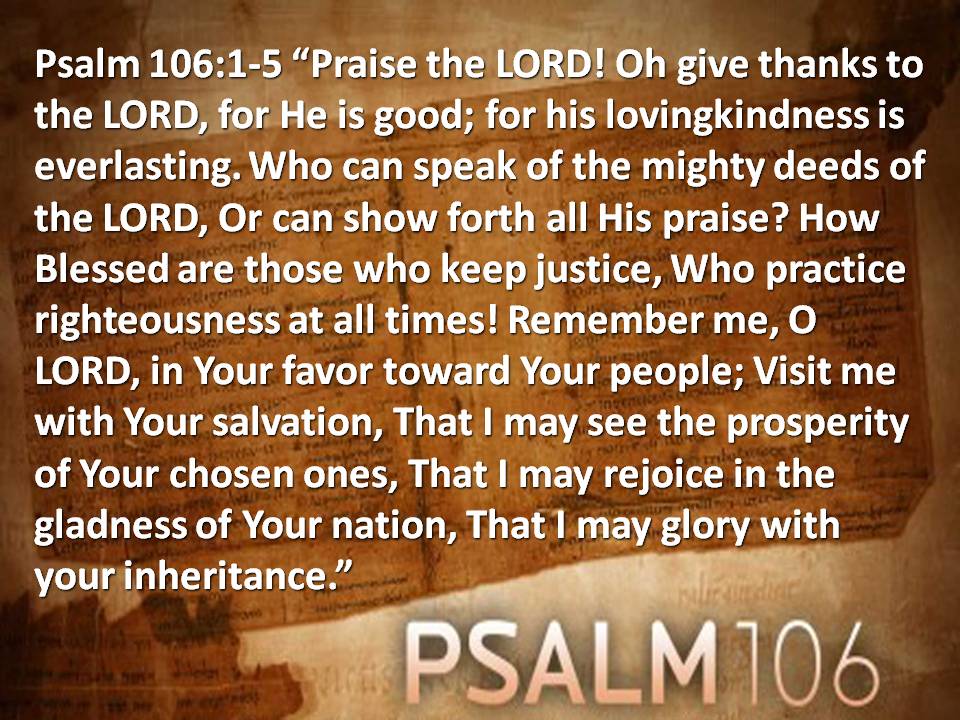
David revealed their importance in Psalm 106.

Psalm 106:1-5 “Praise the LORD! Oh give thanks to the LORD, for He is good; For His loving-kindness is everlasting. Who can speak of the mighty deeds of the LORD, Or can show forth all His praise? How blessed are those who keep justice, Who practice righteousness at all times! Remember me, O LORD, in Your favor toward Your people; Visit me with Your salvation, That I may see the prosperity of Your chosen ones, That I may rejoice in the gladness of Your nation, That I may glory with Your inheritance.”

A. They are the Grounds for Praise and Thanksgiving!

1.  Give thanks for His ‘hesed’ (loving-kindness, unfailing love)– it is everlasting
    • His hesed is the basis of His mighty deeds and bountiful praise. We do nothing to earn it or deserve it.
    • Justice is something we must covet, guard, desire, submit to. It is not of us but of God.
    • Requires commitment of heart, soul and strength. 24/7 diligence.
2.  Keep mishpat (Justice) and you will enjoy blessing
3.  Practice (accomplish) tsedaqah (Righteousness) at all times

B. They are the Grounds for Favor and Salvation!

God’s Steadfast Love (hesed), Justice (mishpat) and Righteousness (tsedaqah), when embraced and exercised, will empower disciples to:

1.  See the prosperity (well-being) of the chosen (Result of hesed changing our Heart’s Desire)
2.  Joy in the gladness of Your Nation (Result of mishpat bringing God’s design into our House and Dependants)
3.  Glory with Your Inheritance (Result of the Victory of Righteousness that produces the Hope of a Godly inheritance)

The rest of Psalms 106 is a revelation of what happens when we resist hesed, mishpat and tsedaqah.

Psalm 106:6-48 We have sinned like our fathers, We have committed iniquity, we have behaved wickedly. Our fathers in Egypt did not understand Your wonders; They did not remember Your abundant kindnesses, But rebelled by the sea, at the Red Sea. Nevertheless He saved them for the sake of His name, That He might make His power known.

Psalm 106:8 Nevertheless he saved them for his name’s sake, that he might make his mighty power to be known.
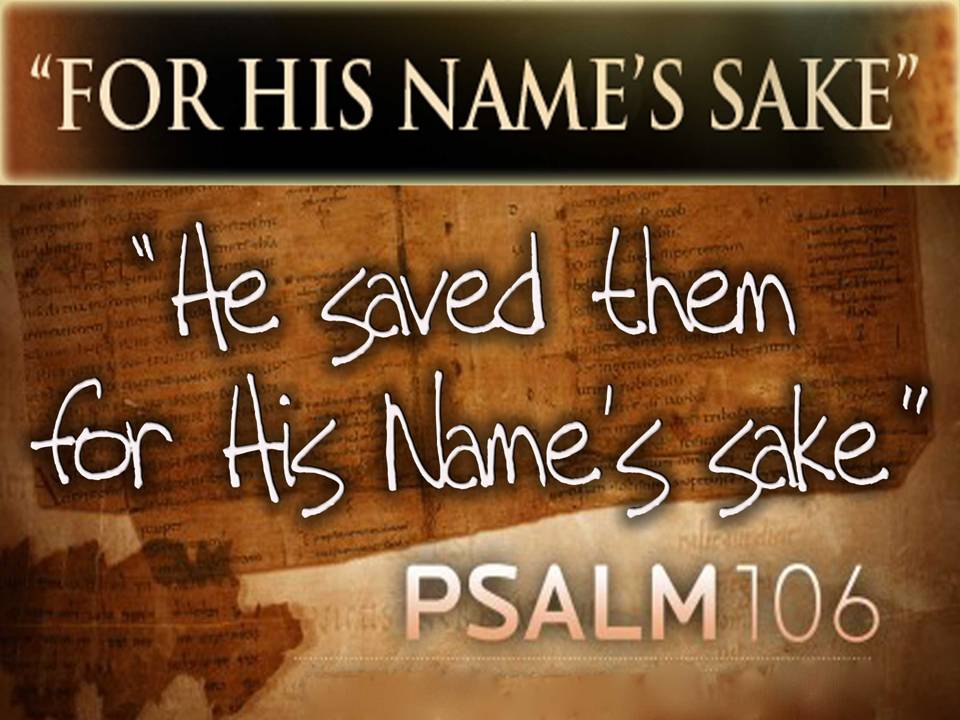
God saved them for the sake of His Name.Yet look at how they resisted Him:

  • They quickly forgot His works; They did not wait for His counsel, But craved intensely in the wilderness, And tempted God in the desert.
  • Thus they exchanged their glory For the image of an ox that eats grass.
  • They forgot God their Savior, Who had done great things in Egypt, Wonders in the land of Ham And awesome things by the Red Sea.
  • Then they despised the pleasant land; They did not believe in His word, But grumbled in their tents; They did not listen to the voice of the LORD.
  • Therefore He swore to them That He would cast them down in the wilderness, And that He would cast their seed among the nations And scatter them in the lands.
  • They joined themselves also to Baal-peor, And ate sacrifices offered to the dead. Thus they provoked Him to anger with their deeds, And the plague broke out among them.
  • They also provoked Him to wrath at the waters of Meribah, So that it went hard with Moses on their account; Because they were rebellious against His Spirit, He spoke rashly with his lips.
  • They did not destroy the peoples, As the LORD commanded them, But they mingled with the nations And learned their practices, And served their idols, Which became a snare to them.
  • They even sacrificed their sons and their daughters to the demons, And shed innocent blood, The blood of their sons and their daughters, Whom they sacrificed to the idols of Canaan; And the land was polluted with the blood.
  • Thus they became unclean in their practices, And played the harlot in their deeds.
  • Many times He would deliver them; They, however, were rebellious in their counsel, And so sank down in their iniquity.

Nevertheless He looked upon their distress When He heard their cry; And He remembered His covenant for their sake, And relented according to the greatness of His loving-kindness.

Even in Judgment He Loved them because of His Name! Discipleship is simply the following of God’s Name with all our heart, soul and strength!

He also made them objects of compassion In the presence of all their captors. Save us, O LORD our God, And gather us from among the nations, To give thanks to Your holy name And glory in Your praise. Blessed be the LORD, the God of Israel, From everlasting even to everlasting. And let all the people say, “Amen.” Praise the LORD!

The Journey through the Wilderness provides us everything we need to learn about what will prevent us from becoming Disciple’s of Jesus Christ. The Hebrew’s being led by Moses constantly resisted God, and so refused to advance in hesed, mishpat and tsedaqah. 

But before we look at their example, we must see what God did when David humbled himself and cried out to God amidst the ashes of Ziklag…

David Hasaq’d himself in Jehovah Elohim
Last week we left David “hasaq(ing)” himself in Yahweh Elohim. Instead of becoming angry at God because of what had happened, David humbled himself, confessed his sins, and reached up to God, counting on His hesed, committing himself to following His justice and claiming His righteousness!

1 Samuel 30:7

David then called for the Priest, Abiathar, to enquire of the Lord with the Ephod. God gae instruction to pursue the raiders, and God assured David he would overtake them and rescue all of their families. God then led them to find an Egyptian slave who had been left behind due to a divinely appointed sickness. He gave David the intel they needed. They pursued and found the Amelikites scattered and revelling in their good fortune. They were easily defeated by David and his men. And as God had promised, nothing was lost, not even one toe nail of their families and possessions. In fact there was great spoil taken over and above what they had lost.

David and his men, their wives and children returned to Ziklag, and even divided things evenly, even with the men who had been too discouraged to pursue. (This represents a principle of Victory-it benefits everyone, especially those disciples who are weak with discouragement, or are simply feeding or working in the nursery, teaching the kids) Following the Lord in victory brings strength and bounty to all.

I want us to realize (as we’ll see), that with God, Victory results in Righteousness. Righteousness results in Victory. When even a few stand in Righteousness, the whole is benefited. When no one stands in Righteousness, the whole suffers terribly. However, only one kind of Righteousness is truly Victory. That is the Righteousness that comes from God alone. Righteousness which is by Faith alone. There is no room for self-righteousness or self-effort.

David also shared the Victory with all those who had strengthened him along the way.

1 Samuel 30:26-31 Now when David came to Ziklag, he sent some of the spoil to the elders of Judah, to his friends, …and to all the places where David himself and his men were accustomed to go… saying, “Behold, a gift for you from the spoil of the enemies of the LORD “

David was back and battling against the enemies of the Lord! He wanted Judah to know it, that they could count on him when it came to battles against the enemies of the Lord. David was also showing his thankfulness to God and the people who had been a source of encouragement all those years.

When we are zealous for the Lord, we will be zealous in our gratitude for those who encourage us.

Unto the elders of Judah—These were the persons among whom he sojourned during his exile, and who had given him shelter and protection. Gratitude required these presents.[1]

1 Samuel 31
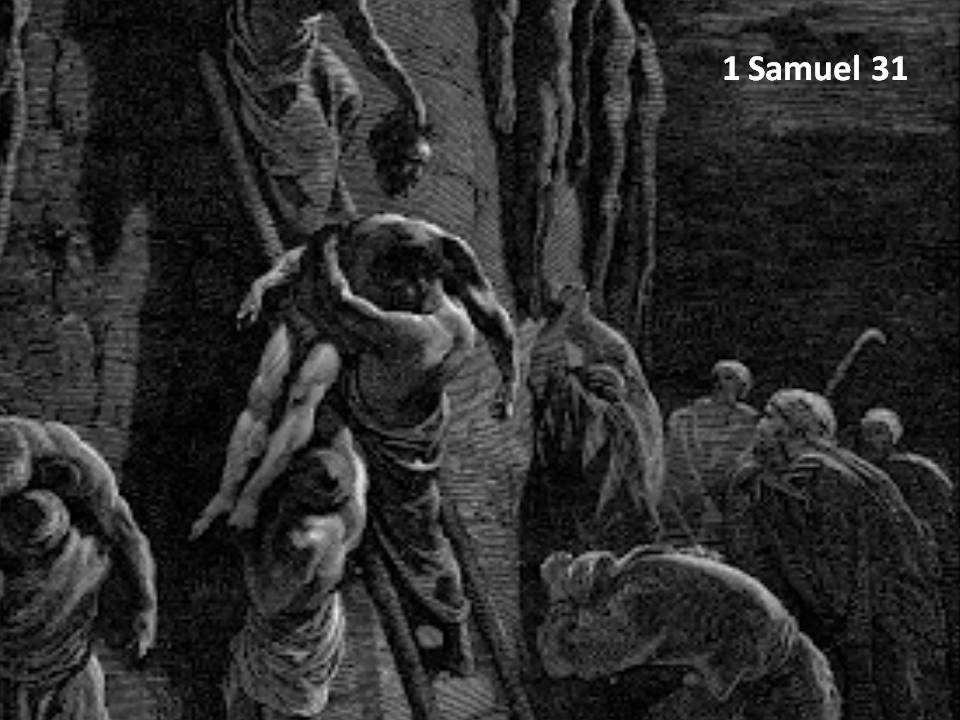
Meanwhile, a real battle was raging on Mt Gilboa, between the forces of Saul and the Philistines. The Philistines prevailed. Saul’s sons, including Jonathon, were killed. Saul was mortally wounded, and fearing what the Philistines would do to his body, fell on his own sword after his armor bearer refused. When the Israelites saw their King dead, they knew the battle was lost, and fled. The Philistines took over the area, and

The Philistines, finding Saul and his three sons among the slain, strip them of their armor, which they put in the house of Ashtoreth, cut off their heads, send the news to all the houses of their idols, and fasten the bodies of Saul and his three sons to the walls of Beth-shan, vv. 8-10. Valiant men of Jabesh-gilead go by night, and take away the bodies; burn them at Jabesh; bury their bones under a tamarisk tree; and fast seven days, vv. 11-13.[2]

2 Samuel 1
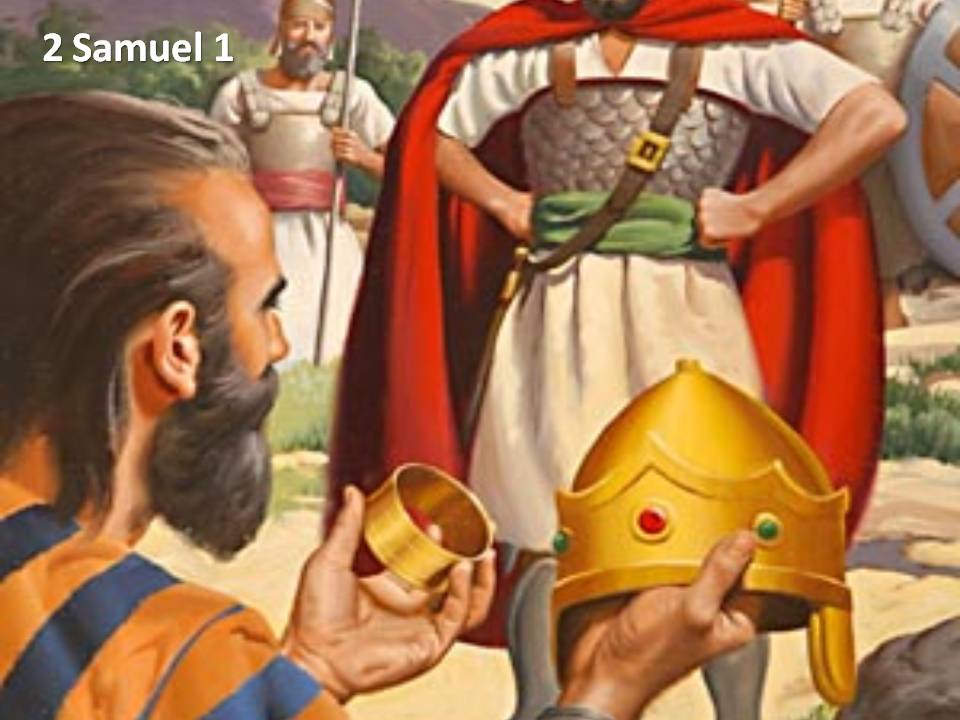
An Amalekite comes to David, and informs him that the Philistines had routed the Israelites; and that Saul and his sons were slain, vv. 1-4. And pretends that he himself had despatched Saul, finding him ready to fall alive into the hands of the Philistines, and had brought his crown and bracelets to David, vv. 5-10. David and his men mourn for Saul and his sons, vv. 11, 12. He orders the Amalekite, who professed that he had killed Saul, to be slain, vv. 13-16. David’s funeral song for Saul and Jonathan, vv. 17-27.[3] Look how David honored Saul and Jonathan:

2 Samuel 1:23-27 “Saul and Jonathan, beloved and pleasant in their life, And in their death they were not parted; They were swifter than eagles, They were stronger than lions. “O daughters of Israel, weep over Saul, Who clothed you luxuriously in scarlet, Who put ornaments of gold on your apparel. “How have the mighty fallen in the midst of the battle! Jonathan is slain on your high places. “I am distressed for you, my brother Jonathan; You have been very pleasant to me. Your love to me was more wonderful Than the love of women. “How have the mighty fallen, And the weapons of war perished!”

Here is David, expressing a heart that holds no bitterness for the way he had been treated. Here is a grateful heart, a heart that is submissive to God, and so he can praise King Saul with an upright heart. God’s hesed was certainly at work in David’s heart!

2 Samuel 2
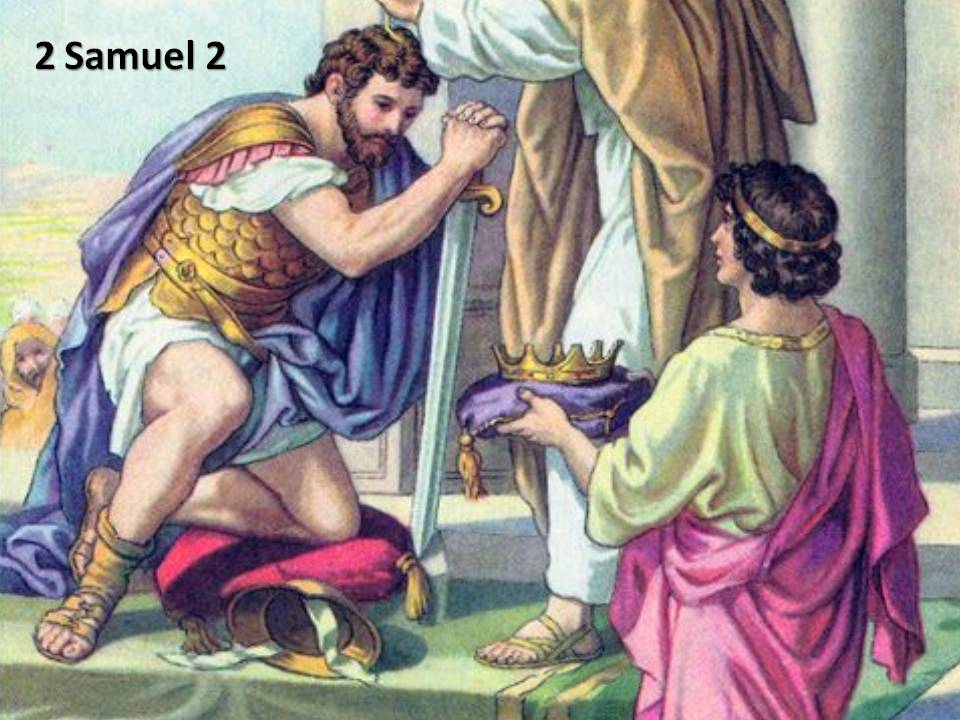
David, by the direction of God, goes up to Hebron, and is there anointed king over the house of Judah, vv. 1-4. He congratulates the inhabitants of Jabesh-gilead on their kindness in rescuing the bodies of Saul and his sons from the Philistines, vv. 5-7. Abner anoints Ish-bosheth, Saul’s son, king over Gilead, the Ashurites, Jezreel, Ephraim, Benjamin, and all Israel; over whom he reigned two years, vv. 8-10. David reigns over Judah, in Hebron, seven years and six months, v. 11. Account of a battle between Abner, captain of the Israelites, and Joab, captain of the men of Judah; in which the former are routed with the loss of three hundred and sixty men: but Asahel, the brother of Joab, is killed by Abner, vv. 12-32.[4]

After 10 years of being on the run, going through every test a disciple could imagine, David is ready to reign as King. The Kingdom is still divided. Abner has put one of Saul’s sons as King over the Northern tribes. But for the next 7 years, Saul’s house will decline, while David’s will increase.

Why did David Succeed where Saul Failed?

It began as a young shepherd who fell in love with God and His Law. As he meditated on the Law, God brought all these wonderful insights into his life. He observed and learned the Ways of God.  The Law became the Psalms. The statutes became testimonies of God’s Word in David’s life! David saw the importance of hesed, mishpat and tsedaqah!

Psalm 19:7-11 The law of the LORD is perfect, converting the soul; The testimony of the LORD is sure, making wise the simple; The statutes of the LORD are right, rejoicing the heart; The commandment of the LORD is pure, enlightening the eyes; The fear of the LORD is clean, enduring forever; The judgments of the LORD are true and righteous altogether. More to be desired are they than gold, Yea, than much fine gold; Sweeter also than honey and the honeycomb. Moreover by them Your servant is warned, And in keeping them there is great reward.

David’s very life became a testimony to God Law and the mishpat that it contains. “The mishpat of the Lord is true and righteous, more to be desired than honey, or even fine Gold. In keeping His mishpat there is great reward,” and Victory!

Have you made the decision to follow Jesus Christ as His Disciple?
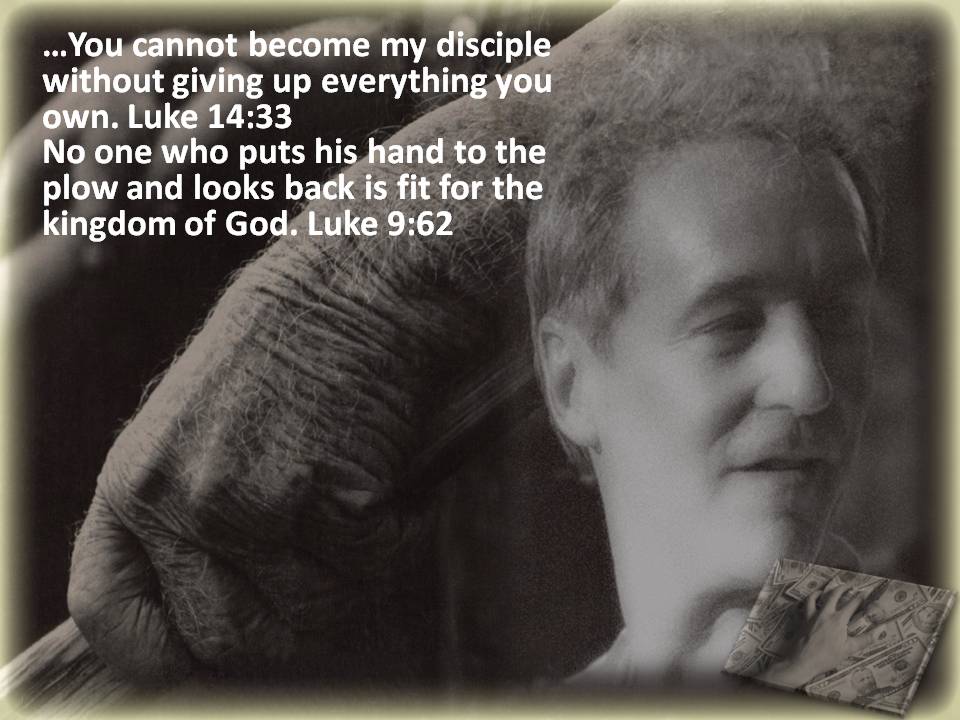
I am not talking about your decision to ask Him into your heart. I am talking about your decision to abandon everything this world offers, and cling totally to Jesus Christ.

  • NASB Luke 14:33 So then, none of you can be My disciple who does not give up all his own possessions.
  • NLT Luke 14:33 So you cannot become my disciple without giving up everything you own.
  • ESV Luke 14:33 So therefore, any one of you who does not renounce all that he has cannot be my disciple.

You say “I need to hang on to my possessions to use them for the Lord. After all, who is going to provide clothes for the naked, food for the hungry and water for the thirsty?”

  • Luke 9:62 Jesus said to him, “No one who puts his hand to the plow and looks back is fit for the kingdom of God.”
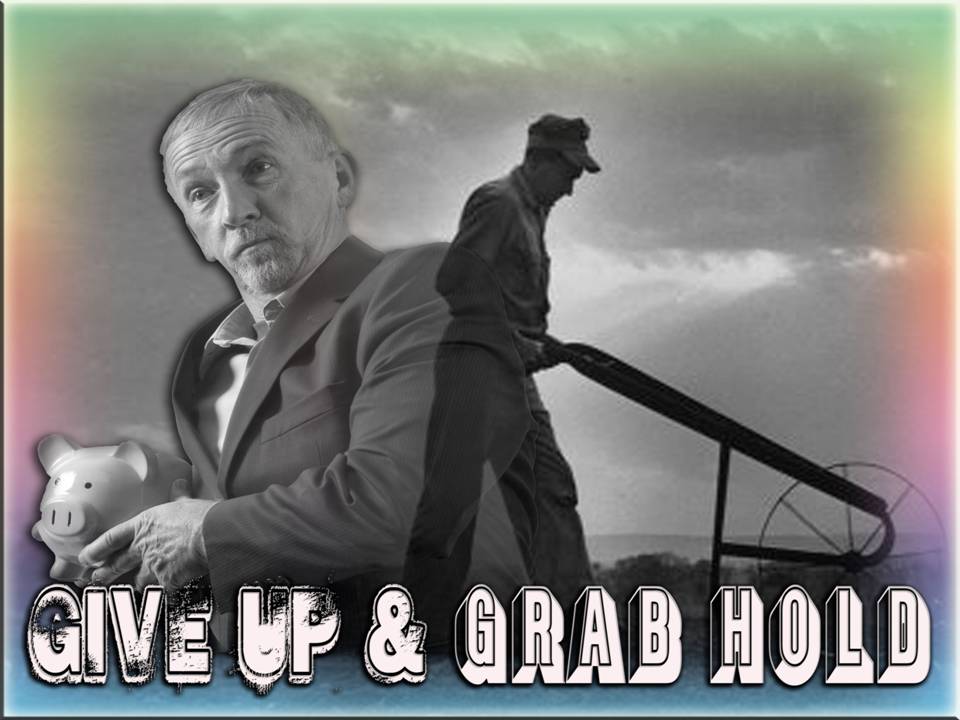
If that is the reason you place such great store on your possessions, you are sadly mistaken. God knows the motives of your heart. He sees the greed, the lack of trust that is revealed by what you cling to. Whatever you do for the Lord, the test will be “did you do it because you are a disciple, or did you do it because you feel guilty?, or you feel it helps you, or it makes you feel good?” If you do anything for the Lord while clinging to your possessions, you have already lost your reward. The only way to keep the reward of Jesus Christ is to be a Disciple, and serve because He is Lord!

  • Matthew 10:42 And whoever gives one of these little ones even a cup of cold water because he is a disciple, truly, I say to you, he will by no means lose his reward.”

That was the reason He told that group of ‘do-gooders’ to “depart, I never knew you!” They were doing good, they were saying “Jesus things”, but they had never given themselves completely to Him.

Are You Ready To Give Up and Grab Hold?

Understand the Lessons of the Tabernacle and the Wilderness Journey:

A. God’s Hesed is in the Centrality of the Ark

1.  Ark of the Covenant.-Law was added as a witness against them.

Deuteronomy 31:26 Take this book of the law, and put it in the side of the ark of the covenant of the LORD your God, that it may be there for a witness against thee.

2.  Covered with the golden lid- kappōret – the mercy-seat.

Exodus 25:21-22 And you shall put the mercy-seat on the top of the ark, and in the ark you shall put the testimony that I shall give you. There I will meet with you, and from above the mercy-seat, from between the two cherubim that are on the ark of the testimony, I will speak with you about all that I will give you in commandment for the people of Israel.
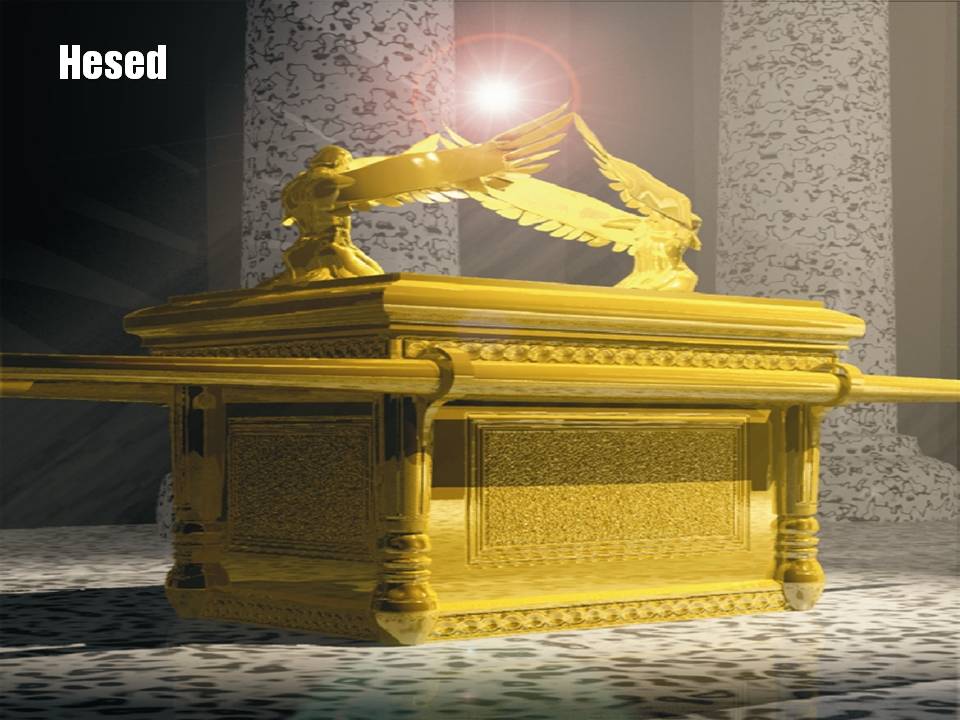
The Ark was the testimony of God’s Covenant with His people, symbolic of His protection, provision, and blessing. Through the mercy-seat God could have a personal relationship with sinful man. It symbolized His unfailing love to a very fallible and failed man.

God made a covenant with His people. He was building a Nation, centered around the theme of REDEMPTION, bringing them into a Promised land, a land of milk and honey, a land where He would be their God, their King, their protector, and provider. It represented a victorious land, a land where the enemies of the Lord would be vanquished. Those enemies represented the flesh, sin and Satan.

B. God’s Mishpat is in the Centrality of the Tabernacle

1.  Wherever the Hebrews would go, God’s Justice was to reign as the Law of the land.
    • His justice would guide everything
    • Tent of Meeting became the Tabernacle located in the very heart of the Hebrews.

2.  Justice was centered around the Word and Worship of God.

    • Justice is not Political but Moral.
    • Morality comes through a change within, not from without. True Morality is not legislated.
3. The Tabernacle represented the mishpat of God. It was in the center of the 12 tribes.

As the Lord lays out in detail his design for the Tabernacle, he says, “Set up this Tabernacle according to the pattern you were shown on the mountain” (26:30). The word translated here as “pattern” is, in Hebrew, mishpat, which ordinarily means “justice” or “ordinance.” The unusual use of mishpat in this verse underscores the authority of God’s design. Moses and the Israelites were to be guided by the divine pattern when they set up the Tabernacle[5].

4.  The Temple was designed and built according to the “mishpat” of God.

1 Kings 6:38 And in the eleventh year, in the month Bul, which is the eighth month, was the house finished throughout all the parts thereof, and according to all the fashion of it. So was he seven years in building it.

 The high priest wore a pouch called the breast piece of justice, containing the Urim and Thummim by which decisions were obtained from the Lord (Ex. 28:30). Doing what was right and just in the Lord’s eyes was far more important than presenting sacrifices to Him (Gen. 18:19; Prov. 21:3, 15).[6]

  • He executes justice [mishpat] for the oppressed and gives food to the hungry. The LORD sets prisoners free, the LORD gives sight to the blind, he lifts up those who are bowed down, the LORD loves those who live justly. The LORD watches over the immigrant and sustains the fatherless and the widow, but he frustrates the ways of the wicked. Psalm 146:7–9
  • The LORD your God . . . defends the cause [mishpat]of the fatherless and the widow, and loves the immigrant, giving him food and clothing. Deuteronomy 10:17–18
  • Speak up for those who cannot speak up for themselves, for the rights of all who are destitute. Proverbs 31:8

C.  God’s Righteousness is Seen in His Victories!

Deuteronomy 6:24-25 And the LORD commanded us to do all these statutes, to fear the LORD our God, for our good always, that he might preserve us alive, as we are this day. And it will be righteousness for us, if we are careful to do all this commandment before the LORD our God, as he has commanded us.’

God promised His people Victory in everything they did, if they followed His mishpat. He termed this victory “Blessing” He assured them that Blessings would pursue them, the image being of a linebacker pursuing the quarterback, only in a good way.

1.  Righteousness is Victory from the Lord, from His Strength
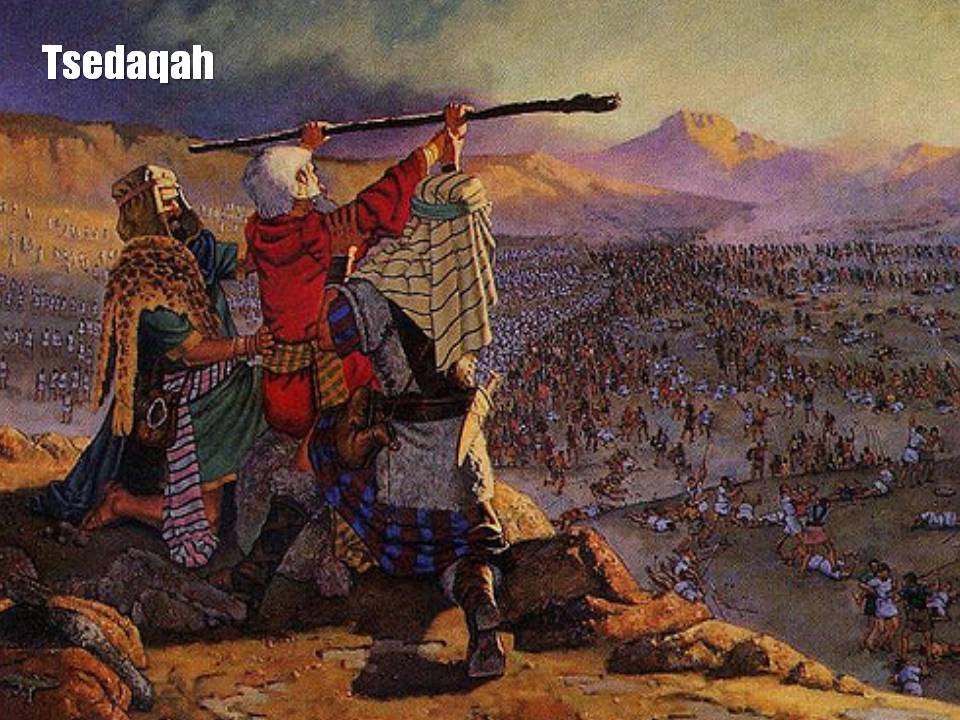
The oldest meaning of tsedaqah, as judged by its use in the Song of Deborah (Judges 5:1-31), appears to be ‘victory’.

Judges 5:11 To the sound of musicians at the watering places, there they repeat the righteous triumphs of the LORD, the righteous triumphs of his villagers in Israel. “Then down to the gates marched the people of the LORD.

1 Samuel 12:7 Now therefore stand still, that I may reason with you before the LORD of all the righteous acts of the LORD, which he did to you and to your fathers.

When God and Israel mutually fulfill their covenant obligations to each other, a state of righteousness can be said to exist – that is, things are saddiq, ‘as they should be’.

2. Israel’s triumphant victories over her enemies were seen as proofs of the sidqot ’adonay (Victories of God)

In other words, God has bound himself by covenant to ‘make things right’ for his people, and to do so by acting unilaterally on their behalf. It’s true, the “range of meaning” of the word tsedaqah incorporates other meanings, but this meaning is particularly stressed in the Old Testament. .[7]

3.  Righteousness was Promised in Jesus Christ.

Jeremiah 23:5 Behold, the days come, saith the LORD, that I will raise unto David a righteous Branch, and a King shall reign and prosper, and shall execute mishpat and tsedaqah in the earth.
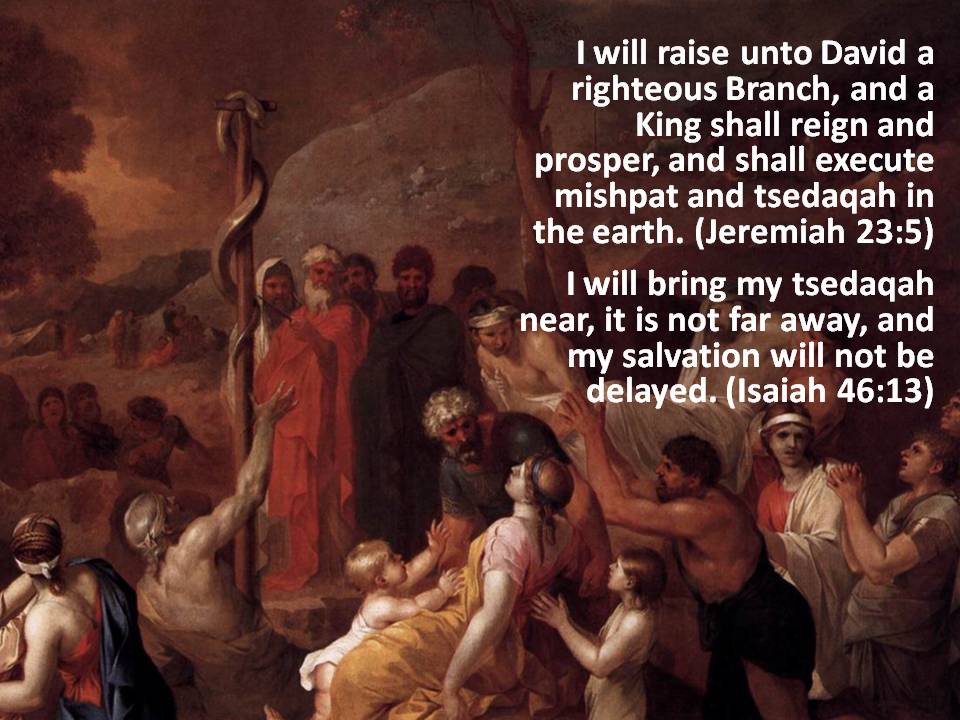
The strongly soteriological overtones of the term tsedaqah can be illustrated from a number of passages in which ‘righteousness’ and ‘salvation’ are practically equated, particularly in many passages within Isaiah:

I will bring my tsedaqah near, it is not far away, And my salvation will not be delayed. (Isaiah 46:13)

How Then Should We Pray?

Isaiah 5:7 For the vineyard of the LORD of hosts is the house of Israel, and the men of Judah his pleasant plant: and he looked for judgment (mishpāṭ), but behold oppression (miśpāḥ), for righteousness (ṣedāqâ), but behold a cry (seʾāqâ)[8]

We should be as the widow woman who came everyday to the unjust judge. She cried out for JUSTICE! In Isaiah 5, God looks for justice (mishpat) but sees only mispah or oppression. God looked for righteousness (tsedaqah) but found people crying (tseaqa). It is a play on words, for God sees the opposite of what He desires on earth. The word for “cry” is the same word in Genesis 19:13, which depicts the outcry against the sin of Sodom against the Lord. God is searching our country, hoping to find justice and righteousness, but instead He hears the cry of the oppressed and the sinful.

Genesis 19:13 For we are about to destroy this place, because the outcry against its people has become great before the LORD, and the LORD has sent us to destroy it.”

What Should be our Response to Jesus’ plea for Disciples?

We should literally transfer ownership of everything we own, every dream we have, every hope in our heart, and lay it all at the foot of Jesus Christ. He is Lord, and we should hold nothing back. We should then cry out to Him to see Justice and Righteousness here on earth as it is in heaven! We must confess our fleshly attitudes, our bitterness, our temporal values and our moral impurity. We must get rid of every ‘besetting’ sin or habit or item that will hinder us from pursuing hesed, mishpat and tsedaqah!

Lift up the Name of God in your Life, You House and your World!

Micah 6:8 He has told you, O man, what is good; and what does the LORD require of you but to do justice, and to love kindness, and to walk humbly with your God?

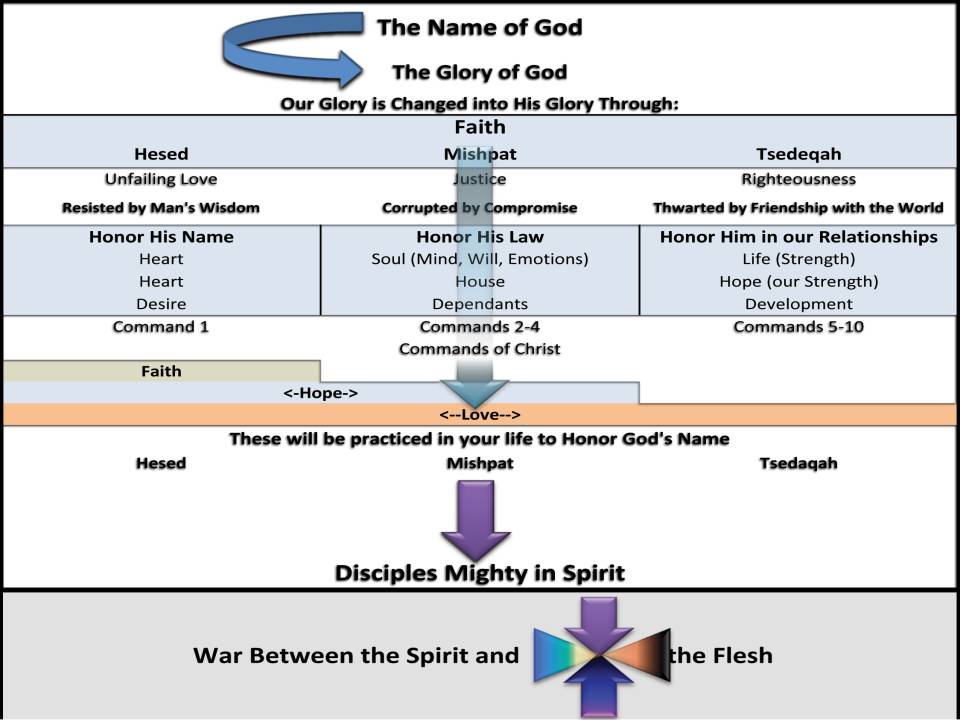
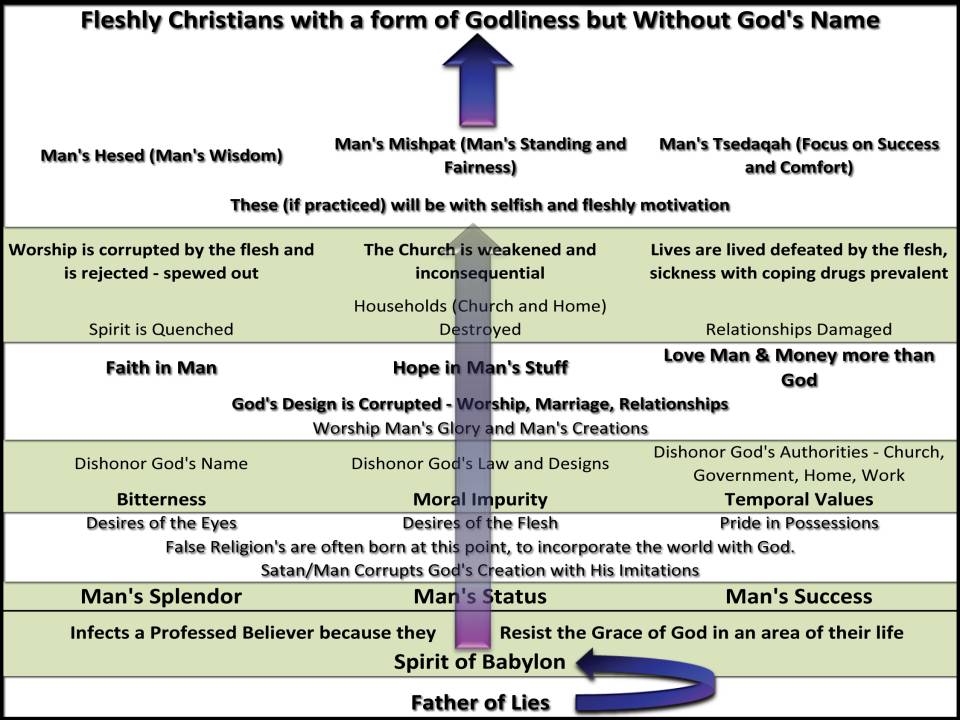
When we resist the Grace of God, we hinder God’s hesed, mishpat and tsedaqah from working in our lives. When we resist the Grace of God, we are being like the Jews in the wilderness, who were overcome in the wilderness, because they failed to believe God’s Word, failed to trust completely in God, and failed to obey God. They failed the Discipleship Test. The following chart illustrates how the Father of Lies works through our stubbornness and sinful resistance of God. Satan even has counterfeit hesed, mishpat & tsedaqah, based upon man’s wisdom and man’s self-effort. Satan does not want us to Honor the Name of God!

Our only decision should be to join the battle of the Name of the Lord! He needs our full and undivided support! He needs us to join Him in fighting the Father of Lies. He needs warrior who are Mighty in Spirit, exercising hesed, mishpat and tsedaqah!
[1] Adam Clarke, A Commentary and Critical Notes, (New York: Abingdon-Cokesbury Press, 1826), WORDsearch CROSS e-book, Under: “1 Samuel 30”.

[2] Adam Clarke, A Commentary and Critical Notes, (New York: Abingdon-Cokesbury Press, 1826), WORDsearch CROSS e-book, Under: “1 Samuel 31”.

[3] Adam Clarke, A Commentary and Critical Notes, (New York: Abingdon-Cokesbury Press, 1826), WORDsearch CROSS e-book, Under: “The Second Book of Samuel”.

[4] Adam Clarke, A Commentary and Critical Notes, (New York: Abingdon-Cokesbury Press, 1826), WORDsearch CROSS e-book, Under: “2 Samuel 2”.

[6] Warren Baker and Eugene Carpenter, The Complete Word Study Dictionary – Old Testament, (Chattanooga, TN: AMG Publishers, 2003), WORDsearch CROSS e-book, 687.

[8] James Strong, Strong’s Talking Greek & Hebrew Dictionary, (Austin, TX: WORDsearch Corp., 2007), WORDsearch CROSS e-book, Under: “6818”.


The First Century Church Experienced the Power of Grace and Touched the World with the Power of the Gospel of Jesus Christ. They did so because they were not ashamed of the Cross of Jesus Christ. They were not ashamed of following a God who had been cursed on the unspeakable Cross of Crucifixion. They were not ashamed because they were LIVING PROOF of the Power of the Cross over the corruption of the flesh. Jesus Christ was not only Savior of their Souls, He was the Savior of their LIVING! 

Church must emphasize a 24/7 devoted living in Christ and His commands, not just a segregated devotional (quiet) time.

Church must emphasize a 24/7 praying life not just a prayer time.

Church must direct Disciples how to bring their spiritual existence into touch with the physical reality of living.

Church must lead Disciples to put into daily practice what Christ commanded and taught.

Church is a Community of Love in Christ centered around a Grace Missional purpose to bring the lost and hurting into the reality and power of Christ.

Church builds Disciples not motivated by guilt but empowered by forgiveness and redemption.

Church builds Disciples who Share Christ with friends and neighbors because they Love and Trust Jesus Christ.

Church builds Disciples who Give because they Love and Trust.

Church is Powerful to the Community when it is a Powerful Community of Love that empowers people to Break Bad Habits (Spirit conquers Flesh).

Church is Powerful as Disciples grow past guilt to productive change built upon Confession and Abandonment to Jesus Christ.

Church preaches Repentance to Abandon the fleshly world and live in the Spirit of Grace

Church leads Disciples to Abandon themselves to God’s Grace and God’s responsibilities for them.

Church leads Disciples to Greater and Growing Trust in God, because mistrust leads to sin.

Church leads Disciples to the Dominion of God’s Kingdom over their own Kingdoms.

Church that Grows and Develops Disciples will constantly Apply the Truth of Redemption to the Disciple’s Life.

Church will constantly strive to bring ALL lives into Christ’s Life.

Church will Grow from a Growing Relationship with Christ’s Life.

  • Church can change if there is a goal that can be accomplished with specific steps of action.
  • That goal is to build Disciples who experience and share the Reality and Power of Christ’s Life in their daily living.

I would like 2012 to be a significant year in the life of our church. I want us to get serious about Discipleship. I want discipleship to be discussed in every class room, every committee meeting, every get together. I want the question that is asked most of each other, “How are you developing as a Disciple of Jesus Christ?” I want each of us to have a clear picture of how we are to develop as disciples of Christ. It will not happen right away, but over the next 18 months, as we look at every aspect of our church in light of Discipleship, we can make the proper adjustments in how we do ministry, and develop a clear-cut road to discipleship, Biblical Discipleship.

This will not come without some difficulties. Discipleship is difficult, for the way is blocked with Goliath’s. Saul’s and Doegs. But if we continue to kneel before the Cross, and desire to follow the Holy Spirit, Christ will do an amazing work in this church and in your lives.

Many (if not most) Christians Live in a Cave

We need to ask ourselves “Are we walking in the Light?” (If you are not daily in the Word of God how can you think you are walking in the Light?) I believe many Christians are living in a cave, but they may or may not realize it. Their profession of faith in Christ may have been real, but they have stopped walking by FAITH. They walk by sight. And sadly, when you walk by sight, you are blind. You are living in a Cave. The danger is that living in a cave will produce eyes that no longer see the light. They can no longer walk by faith. They can no longer see Him who is invisible. When you become used to the darkness of the cave, you don’t realize how much ‘light’ you are missing. Isaiah wrote about the Lord:

Isaiah 42:5-7 Thus says God, the LORD, who created the heavens and stretched them out, who spread out the earth and what comes from it, who gives breath to the people on it and spirit to those who walk in it: “I am the LORD; I have called you in righteousness; I will take you by the hand and keep you; I will give you as a covenant for the people, a light for the nations, to open the eyes that are blind, to bring out the prisoners from the dungeon, from the prison those who sit in darkness.

When Jesus began His public ministry, he proclaimed:

Luke 4:18 “The Spirit of the Lord is upon me, because he has anointed me to proclaim good news to the poor. He has sent me to proclaim liberty to the captives and recovering of sight to the blind, to set at liberty those who are oppressed,

The Jewish people thought they were walking in the light. But in actuality they were held in prison by the perversions of the Law perpetrated by the Pharisees. Jesus opened many eyes to the true Light of the Gospel, but the religious Leaders remained blind, because “we just don’t do it that way”. Jesus did not fit into the mold formed in the cave of their minds and they rejected Him. In fact, they crucified Him, for they refused to follow His light.

Discipleship is difficult, for you follow Christ, not a religion, not a list of man-made rules or traditions. Discipleship requires an ongoing growth and development of a relationship with an invisible Savior. Discipleship requires Faith, for only Faith imparts the ability to see Him who is Invisible.

Jesus proclaimed that He was coming to give sight to the blind. But in order to receive sight, we must be willing to submit to His leadership and commands. Any resistance on our part places us right back in the darkness that Jesus came to free us from.

I.   David Discipleship Involves:

A. Involves Growing Faith, Or It Is Not Discipleship.

1 Samuel 23:29 And David went up from there and lived in the strongholds of Engedi.

David leaves the Rock of Escape and goes down to the Dead Sea, to find refuge in the Strongholds of EnGedi. EnGedi is a great hideout. Plenty of hide-outs, fresh water, a veritable oasis. EnGedi is the largest oasis along the western shore of the Dead Sea.  The springs here have allowed nearly continuous inhabitation of the site for 4000 years. The abundant springs and year-round temperate climate provided the perfect conditions for agriculture in ancient times. Solomon compared his lover to “a cluster of henna blossoms from the vineyards of EnGedi,” an indication of the beauty and fertility of the site (Song 1:14).

Even though there are many springs around the Dead Sea, most of them have a high salt content. EnGedi is one of only two fresh water springs located on the western shore of the Dead Sea and, because of the greater availability of land for agriculture at EnGedi, it is the best spring by which to settle.

EnGedi means literally “the spring of the kid (goat).” Evidence exists that young ibex have always lived near the springs of EnGedi. One time when David was fleeing from King Saul, the pursuers searched the “Crags of the Ibex” in the vicinity of EnGedi.

David could have settled here and hoped in the natural strongholds that were there in EnGedi. He may not have become content, but he and his men could have resumed more normal lives. They could have still worshipped God, do an occasional good deed, and been safe. That is what a stronghold is, a place of safety due to its position or protection.

But this would not produce the Discipleship that God required of David, nor would it serve to transform David’s crew into Mighty Men. God wanted them to grow in their faith.

So God allowed King Saul to find David. God lead Saul into David’s Stronghold.

 1 Samuel 24:1-3 When Saul returned from following the Philistines, he was told, “Behold, David is in the wilderness of Engedi.” Then Saul took three thousand chosen men out of all Israel and went to seek David and his men in front of the Wildgoats’ Rocks. And he came to the sheepfolds by the way, where there was a cave, and Saul went in to relieve himself. Now David and his men were sitting in the innermost parts of the cave.

 His Men are urging David to Kill Saul

1 Samuel 24:4 And the men of David said to him, “Here is the day of which the LORD said to you, ‘Behold, I will give your enemy into your hand, and you shall do to him as it shall seem good to you.’ ”

Perhaps David had told his men of a promise God had given him, a promise of deliverance similar to Abraham. His men believed in David, and when Saul came to them, excitedly they exclaimed that “Deliverance is Here”! Perhaps David identified with Abram, when God delivered his enemies into his hand:

 Genesis 14:17-20 After his return from the defeat of Chedorlaomer and the kings who were with him, the king of Sodom went out to meet him at the Valley of Shaveh (that is, the King’s Valley). And Melchizedek king of Salem brought out bread and wine. (He was priest of God Most High.) And he blessed him and said, “Blessed be Abram by God Most High, Possessor of heaven and earth; and blessed be God Most High, who has delivered your enemies into your hand!” And Abram gave him a tenth of everything.

Encouraged by his men, the Scriptures record what happened next: “Then David arose and stealthily cut off a corner of Saul’s robe.” His men must have been shocked. Why didn;t he kill him. Their troubles would be over. They could go home. David could be King. But God wanted each of them to learn a valuable lesson. 

1.  Disciples that desire safety and comfort usually end up in the dark as far as God is concerned.
2.  In the cave of safety, our self-centeredness prevents us from seeing the light of Jesus Christ
3.  In the cave of safety we often resort to solving our problems with our own short-sighted vision.

God wanted David and his men to look to Him in the darkness of the cave, not to their own resources. Here was a struggle of conscience pre-ordained of God that would lead these men into the very presence of God!

As John Piper told his church:

But if we do what David did, and follow the call of God—hazards and all—then we will come to this place week in and week out with a sense of deepening reality and power.

That’s essential number one: if God’s blessing is going to be on this place, as a place of real worship, then those of us who gather here must gather as a kind of haven between hazards. Not as a haven instead of hazards but a haven between hazards. True worship will come from the impulse to hazard things for the name of God.[1]

B. Involves Growing Worship, Or It Is Not Discipleship.

Most people associate worship with something you do when things are going OK. We associate church with worship. We go to church when things are normal. I have discovered that when things get “abnormal” that folks don’t really feel like worshipping at church. When we are overwhelmed with house guests. When we experience the loss of a loved one. When we have a tragedy strike us. When we are stricken with a deadly disease.

One thing very obvious about David is His worship of God, especially when things were “abnormal” And David’s worship wasn’t confined to the Tabernacle of the Temple. David worshipped God anywhere and everywhere. But David especially worshipped God when things were “abnormal”, because Worship was what David lived for.

When David found himself in the cave, with Saul but a breath away, followed by his 3000 trained killers, David was justifiably afraid. It was dark, he was trapped, here was Saul, his men outside. David’s men wanted to kill Saul, but David feared God much more than he feared King Saul. Since he was the anointed King of Israel, only God could remove him. It was not within David’s power. Even if Saul was dead, what would the 3000 armed men do when they discovered he was dead?

No, this was problem too great for David. His men needed to learn what David already knew, that God had great power to deal with dangerous or perilous situations in our life. We can see David’s heart response and message to his men in Psalm 57:

For the director of music. To the tune of “Do Not Destroy.” Of David. A miktam (instruction). When he had fled from Saul into the cave. 

Psalm 57:1-11 Be merciful to me, O God, be merciful to me, for in you my soul takes refuge; in the shadow of your wings I will take refuge, till the storms of destruction pass by. I cry out to God Most High, to God who fulfills his purpose for me. He will send from heaven and save me; he will put to shame him who tramples on me. Selah God will send out his steadfast love and his faithfulness! My soul is in the midst of lions; I lie down amid fiery beasts— the children of man, whose teeth are spears and arrows, whose tongues are sharp swords. Be exalted, O God, above the heavens! Let your glory be over all the earth! They set a net for my steps; my soul was bowed down. They dug a pit in my way, but they have fallen into it themselves. Selah My heart is steadfast, O God, my heart is steadfast! I will sing and make melody! Awake, my glory! Awake, O harp and lyre! I will awake the dawn! I will give thanks to you, O Lord, among the peoples; I will sing praises to you among the nations. For your steadfast love is great to the heavens, your faithfulness to the clouds. Be exalted, O God, above the heavens! Let your glory be over all the earth!


David cried out to God to fulfill His purpose in his life. If God’s purpose was to be accomplished by David’s death, then so be it. But David had a promise from God that he would be King, so David cried out for that purpose to be accomplished.

  • David asked God to send out His “hesed” (unfailing love) and his faithfulness
  • David asked that God be exalted regardless of what happened.
  • David affirmed that his heart was fixed upon God.
  • David promised to give thanks to all the people, regardless of the outcome.
  • David worshiped one more time and exalted God.

Because David’s heart was fixed upon God, David always worshipped God in the midst of his problems, and in fact exalted God in the face of his problems. No matter what David faced, he always said “God, this is for you to handle. You be exalted, and however you work this out, I will praise you before all the people”.

We will see this over and over in David’s life. Because his heart was given to God, David sought to see God’s justice in every situation he faced, even in the unjust ones.

Application:

Are you overwhelmed with a certain situation? Do you struggle with what God is doing in your life?

  • Confess to God your sinfulness for not giving Him your heart, and for not fixing your heart upon Him.
  • Confess your lack of worship and then bow humbly before Him, and ask Him to fulfill His purpose for your life. Ask Him to be exalted in the situation you are facing. Then bow before Him and say, whatever you want for my life, I accept it and I want it. I want you to be exalted in this situation.

II.  David Discipleship Requires:

A. Requires Humble Submission to God’s Ways, or there will be no Discipleship

There was a mom with a young pre-teen who was neglecting his chores to play his new video game, Call of Duty: Modern Warfare 3. His room was a disaster, and Mom had enough. She marched into his room and holding her preferred form of politically incorrect discipline, exclaimed “Get up and clean this room or you will know the wrath of Vladimir Makarov!” He knew what that meant, so he jumped up and started cleaning his room. You could tell his heart was not in it, however, and soon he said, “I may be cleaning my room on the outside, but inside I’m playing Modern Warfare 3 and I’m blasting away! He was submitting to a greater force, but only because he had to. But that is not David’s heart in the Cave.

Three things in Psalm 57:1 show a disciple’s (David) submission before God.

  • He cries for mercy. He sees his need from God for mercy and grace. 
  • He cries out for a refuge. He is vulnerable before his enemies, he sees his need for God’s provision. 
  • He calls his refuge the “shadow of God’s wings.” David, the mighty warrior, the anointed of God, says, “In the shadow of thy wings I will take refuge.” In other words, “I am a little chick. And I need the covering of my God.” Submission to God requires humility.

Psalm 57:2 “I cry out to God Most High, to God who fulfills his purpose for me”.

Discipleship requires you to submit your will to God’s purpose for you. That took humility for David, especially in front of 600 manly vagabums. But it also requires something else, something that most American Christians stumble at:

B. Requires the Desire for God’s Glory above Our Own Concerns, or there will be no Discipleship

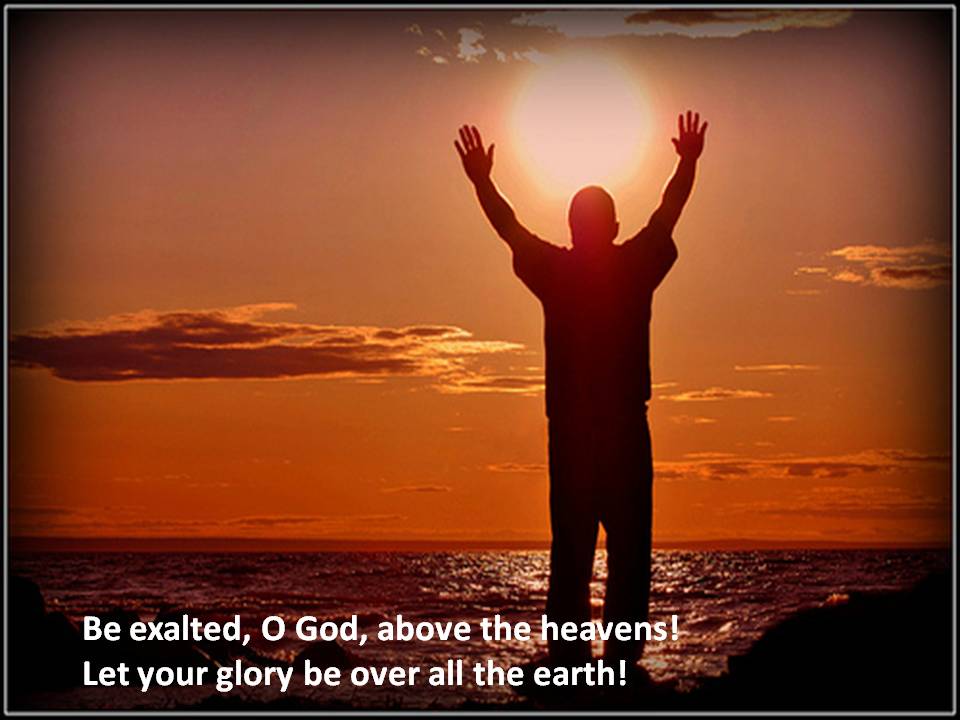
  • Psalm 57:5 Be exalted, O God, above the heavens! Let your glory be over all the earth!
  • Psalm 57:11 Be exalted, O God, above the heavens! Let your glory be over all the earth!
  • Psalm 57:7 My heart is steadfast, O God, my heart is steadfast! I will sing and make melody!

No matter what happens, I want you to be exalted. If it means my death, or my imprisonment, that will be your purpose, and You will be Exalted.

You must be willing to accept poverty, homelessness, sickness, disease, rejection, betrayal, injustice, abuse, anything, as long as it exalts God. A Disciple never says I don’t have to put up with this. A Disciple exalts God to where His glory is between you and any problem you may be having.

Jesus did just that:

1 Peter 2:20-24 For what credit is it if, when you sin and are beaten for it, you endure? But if when you do good and suffer for it you endure, this is a gracious thing in the sight of God. For to this you have been called, because Christ also suffered for you, leaving you an example, so that you might follow in his steps. He committed no sin, neither was deceit found in his mouth. When he was reviled, he did not revile in return; when he suffered, he did not threaten, but continued entrusting himself to him who judges justly. He himself bore our sins in his body on the tree, that we might die to sin and live to righteousness. By his wounds you have been healed.

We have become a Nation that focuses so  much on our Individual Rights, that we place our supposed rights before our responsibilities. That philosophy has infected our church to the point that we put our rights before our responsibilities as a Disciple of Christ.

  • We want our discipleship to be comfortable, but Jesus says I don’t even promise you a bed to sleep on.
  • We want our discipleship to fit our schedule, but Jesus says let the dead bury their dead.
  • We want our discipleship to be convenient, but Jesus says if you put your hand to the plow and then look back at those conveniences, you are not fit for the Kingdom of God.
  • We don’t want our discipleship to make us so different that we’ll be embarrassed, or laughed at,  , or be embarrassing, but Jesus said “whoever is ashamed of me and of my words, of him will the Son of Man be ashamed when he comes in his glory”.
  • We want our discipleship to not be too costly, but Jesus says if you are going to follow Him, you must give up everything by dying to self and taking up His cross for you!

We always say that our primary purpose as Christians is to give Glory to God, but what we mean is that we want a nice comfortable life that portrays the good side of God. How dare Him make us suffer! How can our suffering bring glory to Him? I can do so much more for God when I am affluent and generous! Right?

I was reading about the injustices going on in Eritrea. Evangelical Christians are imprisoned, some for life, for simply bowing their heads in prayer over a meal. They are imprisoned in stifling hot shipping containers or underground bunkers. They are never given baths or showers. There are so many forced into a small place that to lay down and sleep they must sleep on their side. The stench is intolerable. They are given one glass of water a day. They get bread if they are lucky. The prison officials do not care if they live or die. Some are executed. Most are tortured. When a new prisoner come, the first thing anyone says to him, “Did you smuggle any razor blades” because they want to kill themselves. Some are given the opportunity to leave if they recant their faith. Most do not. They cannot, for they are Disciples of Jesus Christ. They knew what it would cost them when they gave their lives to Him!

One young woman who was caught with a Bible was arrested and tied with her hands and feet tied to opposite limbs behind the back. Her captors told her, “Jesus will save you now.”[2]

Jesus did not save her. She eventually died. Did she march up to Jesus in Heaven and say “How could you forget about me? How could you let me endure such suffering that I died of dehydration?” No, she wakes up in the arms of Jesus, and when she looks into His eyes, she says, Jesus, I would do it all over again, for your wonderful glory!

Watch Videos Describing the Torture of Christians going on in Eritrea TODAY!

That is what Discipleship is all about. We develop as Disciples as everything in our life, our good, our bad, our successes, our failures, our joys, our sadness’s are laid at the Cross and our only cry is “Be exalted, O God, above the heavens! Let your glory be over all the earth!” My life is inconsequential to your Glory, but I dedicate it to you, for your use in whatever will bring you Glory!

Psalm 112:1-7 Praise the LORD! Blessed is the man who fears the LORD, who greatly delights in his commandments! His offspring will be mighty in the land; the generation of the upright will be blessed. Wealth and riches are in his house, and his righteousness endures forever. Light dawns in the darkness for the upright; he is gracious, merciful, and righteous. It is well with the man who deals generously and lends; who conducts his affairs with justice. For the righteous will never be moved; he will be remembered forever. He is not afraid of bad news; his heart is firm, trusting in the LORD.

A Disciple is never afraid of bad news. He is not afraid of a diagnosis of cancer. He is not afraid of hearing of a loved one’s tragic death. His heart is firm, always trusting God, no matter what the news.

David wrote another Psalm while he was in the Dark Cave:

Psalm 142 -A maskil (instruction) of David. When he was in the cave. A prayer.

Psalm 142:1-7 With my voice I cry out to the LORD; with my voice I plead for mercy to the LORD. I pour out my complaint before him; I tell my trouble before him. When my spirit faints within me, you know my way! In the path where I walk they have hidden a trap for me. Look to the right and see: there is none who takes notice of me; no refuge remains to me; no one cares for my soul. I cry to you, O LORD; I say, “You are my refuge, my portion in the land of the living.” Attend to my cry, for I am brought very low! Deliver me from my persecutors, for they are too strong for me! Bring me out of prison, that I may give thanks to your name! The righteous will surround me, for you will deal bountifully with me.


When Surrounded by Darkness, in whom do you trust?

  • Do you trust in yourself, doing what you think is best?
  • Do you trust your friends, to get their help?

If David had done either of those, we wouldn’t be studying his life.

David cried out to God, knowing, that

  • “When my spirit faints within me, you know my way!”
  • “You are my refuge, my portion!”
  • “Bring me out of the darkness of this cave, and I will give thanks to your name!”
  • “You deal bountifully with me!”

David turned to God when he was backed into a corner, deep in the darkness of the cave!

What lessons of Hesed, Mishpat and Tsedaqah are in this experience of David’s?

Hesed, Unfailing Love-was in his heart as he refused to kill King Saul. His love for God and trust in Him was stronger than any feeling of hate that might have welled up and led him to take vengeance into his own hands.

  • As a result those men with Him saw the Mercy of God in David’s actions.

Mishpat, justice, was brought into David’s House as both he and his men realized that God must be trusted even in perilous situations where you are tempted to do things your own way. God’s Justice must reign in your response to every situation, good or bad.

  • His men saw that, and the House of David grew strong in the ways of God that day.

Tsedeqah, righteousness, was David’s Hope as He agreed to wait upon God. Even though that meant years of struggle and hardship, it was worth it because David’s Hope was to be in God and His strength, and not in himself. Temporary relief would have brought eternal damnation.

  • His men saw David’s Hope, and would learn to trust God!

Then ask God to grow your Faith to see Him in the Darkness.Do you want to Grow to be a Mighty Man or Woman of God in 2012? Do you want to draw closer to Christ than ever before? Do you His love to be sweeter than ever before?

  • Worship God more faithfully and He will give you more reasons to worship Him.
  • Humble yourself to being a little chickie, needing the protection of His wings.
  • Desire God to be exalted in whatever you face this next year.

Isaiah 9:2 The people who walked in darkness have seen a great light; those who dwelt in a land of deep darkness, on them has light shined.

2 Samuel 22:29-30 For you are my lamp, O LORD, and my God lightens my darkness. For by you I can run against a troop, and by my God I can leap over a wall.

Psalm 18:28-29 For it is you who light my lamp; the LORD my God lightens my darkness. For by you I can run against a troop, and by my God I can leap over a wall.

Isaiah 50:10 Who among you fears the LORD and obeys the voice of his servant? Let him who walks in darkness and has no light trust in the name of the LORD and rely on his God.

When surrounded by Darkness in Whom Do You TRUST?

Isaiah 50:10 … Let him who walks in darkness and has no light trust in the name of the LORD and rely on his God.

How are YOU developing as a Disciple of Jesus Christ?

Overflow through Me!

In days of barren darkness,
I need a light to encourage, refresh,
bring life – God’s word, and grace, and peace.

In a dark and barren world,
God’s Spirit lives within me to be a Light,
abundantly stretching forth, bringing life for all.

Lord, fill me with your light – allow it to shine through me!


I am not against dogs. I love dogs. My only use of ‘dog’ when it comes to “Doeg” is for ease of remembering and to gain an understanding of how David felt as he realized he was now a wanted man, being pursued by “Doeg’s”. Everyone who desires to be a Disciple of Jesus Christ, must realize there are “Doeg’s” that will work to cause us to stumble from the “way of a disciple”. David encountered Doeg in 1 Samuel 21. Let’s see what lessons on Discipleship can we learn.

The very first lesson God taught fleeing David took place at Nob. He had an encounter with a ‘Dog’ (Doeg). (This is not to condemn “Dog the Bounty Hunter“). He is a just a scary looking “Dog” and he pursues relentlessly.

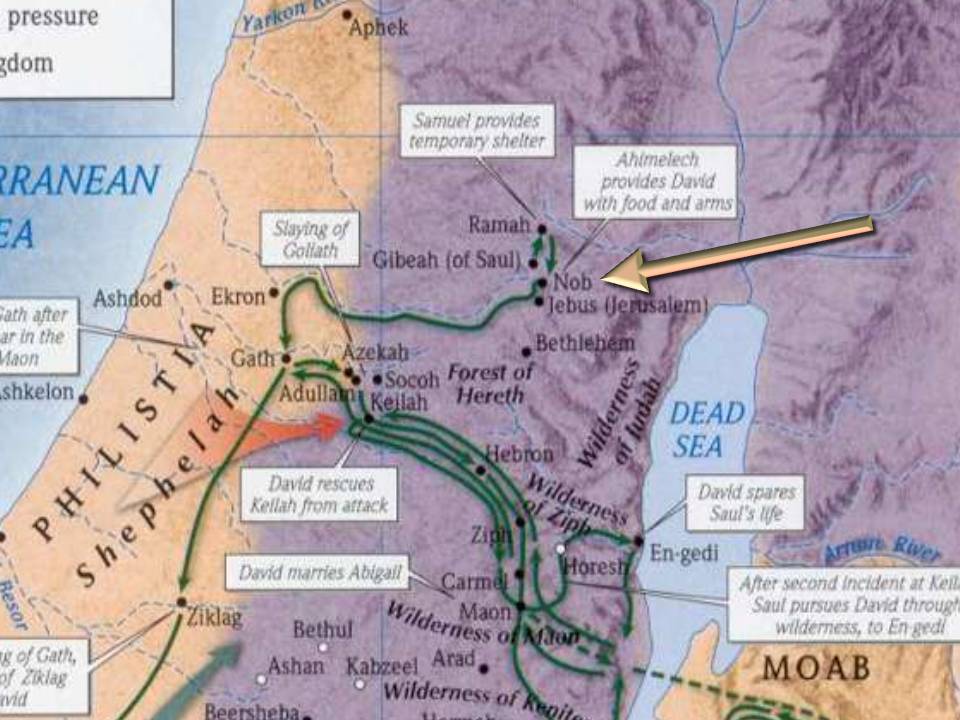
After David left Jonathan at Gibeah, he fled to Nob, the place of the Tabernacle, the city of Priests. Thus began his ‘life as a fugitive’ from Saul, a period of ten years during which he was ‘public enemy number one’ in all of Israel! (1 Sam 21:1-29:11).

God used this time of forced exile to develop David into the Disciple worthy of the Kingdom, in fact, a Disciple worthy of leading the Kingdom. God wanted David to face various tests of his faith, trust and hope. God wanted David to lay the foundation of a Kingdom that one day His very Son would rule over. So that foundation must not be in anything of man, or man’s working. The Foundation of the Kingdom of Christ must be in His Justice and His Righteousness. Therefore David had lessons that God wanted him to learn, lessons that would develop David into the Disciple worthy of establishing the Kingdom of His Son!

The Psalms that David wrote during these 10 years offer insight into David’s Discipleship. While it’s difficult to determine the background of every psalm, it’s likely that David’s fugitive years are reflected in Psalms 7, 11-13, 16-17, 22, 25, 31, 34-35, 52-54, 56-59, 63-64, 142-143[1].

God Wanted David to Rely Solely on Him

Psalm 18 is the Psalm he wrote when the LORD delivered him from the hand of all his enemies and from the hand of Saul. It reveals the Diploma David earned after 10 years of extreme Graduate School!

He began his Psalm of praise with a strange statement coming from a “mighty warrior” who had eluded Saul’s vast army for 10 years. This is not the kind of thing you would hear today from a WWE champion like ” Triple H” aka “The King of Kings”.

 “I love you, O LORD, my strength. The LORD is my rock and my fortress and my deliverer, my God, my rock, in whom I take refuge, my shield, and the horn of my salvation, my stronghold. I call upon the LORD, who is worthy to be praised, and I am saved from my enemies”. Psalm 18:1-3 (ESV)

Becoming a Disciple is about learning not to rely on your own strength, but to rely on the one who is greater than everything!

David’s Experience with Doeg

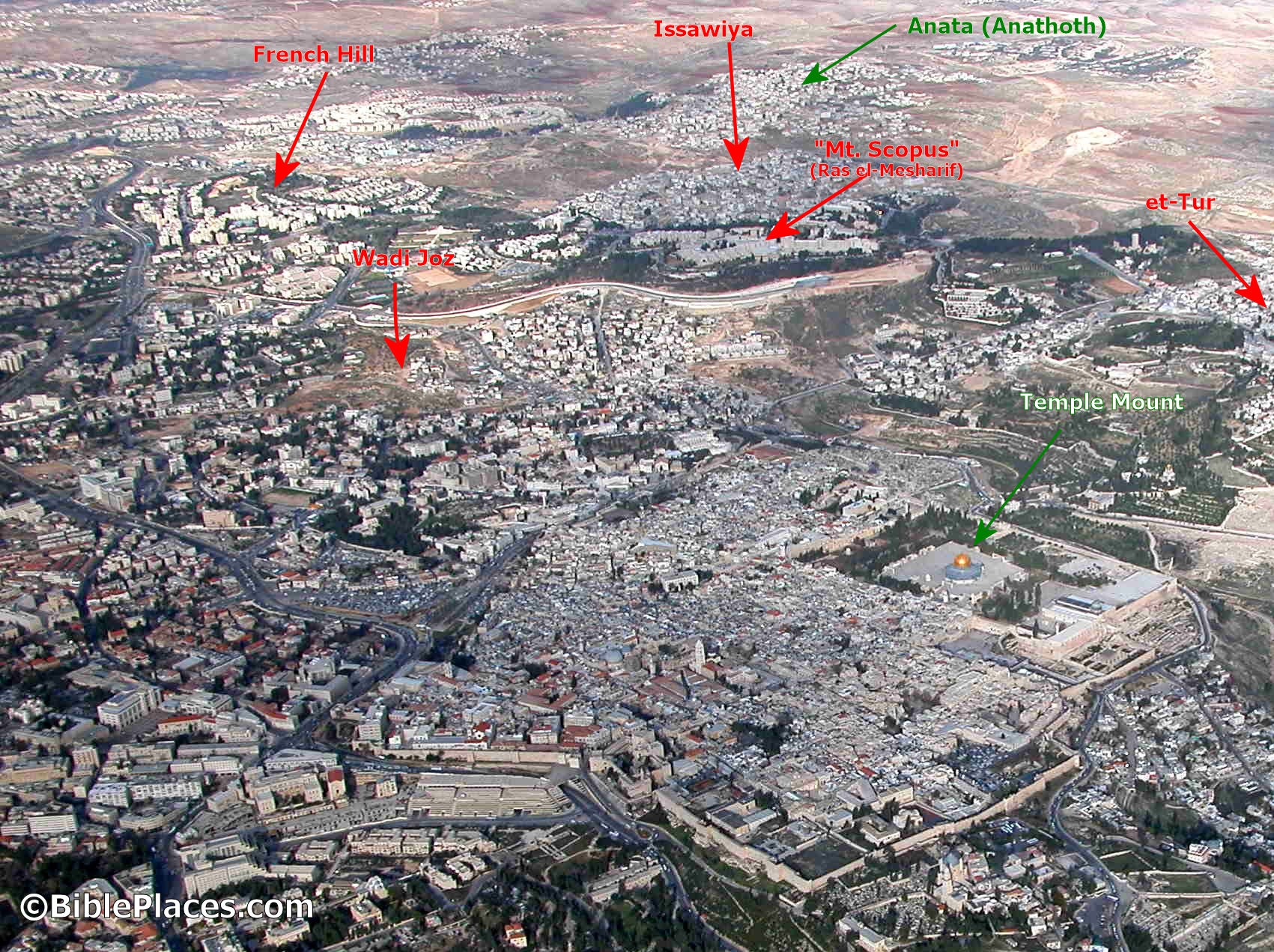
 Then David came to Nob <means fruit[2]; Nob was in the neighborhood of Jerusalem, near the Mount of Olives >[3]. to Ahimelech <means ‘my brother is King’ [4]>, the priest. And Ahimelech came to meet David trembling and said to him, “Why are you alone, and no one with you?”

Nob was known as the town of Priests. The Tabernacle was here and because of David’s relationship with Samuel, he thought he would be welcome here. It was also the responsibility of the Priests to keep provisions on hand for those in need. It was an hour and half walk from Gibeah. It probably took David longer for he had to travel at night, without light, to escape those seeking him. It was the morning of a Sabbath when he suddenly presented himself, alone, unarmed, weary, and faint with hunger before the high-priest.

Ahimelech was frightened to see David looking so, without his usual delegation.

And David said to Ahimelech the priest, “The king has charged me with a matter and said to me, ‘Let no one know anything of the matter about which I send you, and with which I have charged you.’ I have made an appointment with the young men for such and such a place.

He may or may not have been aware of the conflict between David and Saul. But certainly he thought something was up. However, David had reasonable answer’s for all of his questions. The King’s business had been so pressing and secretive that David was forced to leave without adequate provisions and weapons.

David Needed Mercy in the Form of Provisions

Now then, what do you have on hand? Give me five loaves of bread, or whatever is here.” And the priest answered David, “I have no common bread on hand, but there is Holy bread— if the young men have kept themselves from women.” And David answered the priest, “Truly women have been kept from us as always when I go on an expedition. The vessels of the young men are holy even when it is an ordinary journey. How much more today will their vessels be holy?” So the priest gave him the holy bread, for there was no bread there but the bread of the Presence, which is removed from before the LORD, to be replaced by hot bread on the day it is taken away.

David was on the run, homeless, penniless, and had likely been three days without food. He came to the place where he had prayed to so many times. He needed mercy from God. He didn’t need a lecture or a sermon. He needed God’s mercy!

This little incident allows us to evidence the decay into which the priesthood and offerings of the people had fallen. The fact that there was nothing to offer David except the shewbread reveals the poverty of the priesthood, and the neglect of such by the people. If people would have been offering sacrifices, there would be plenty of food.

The Table of Shewbread

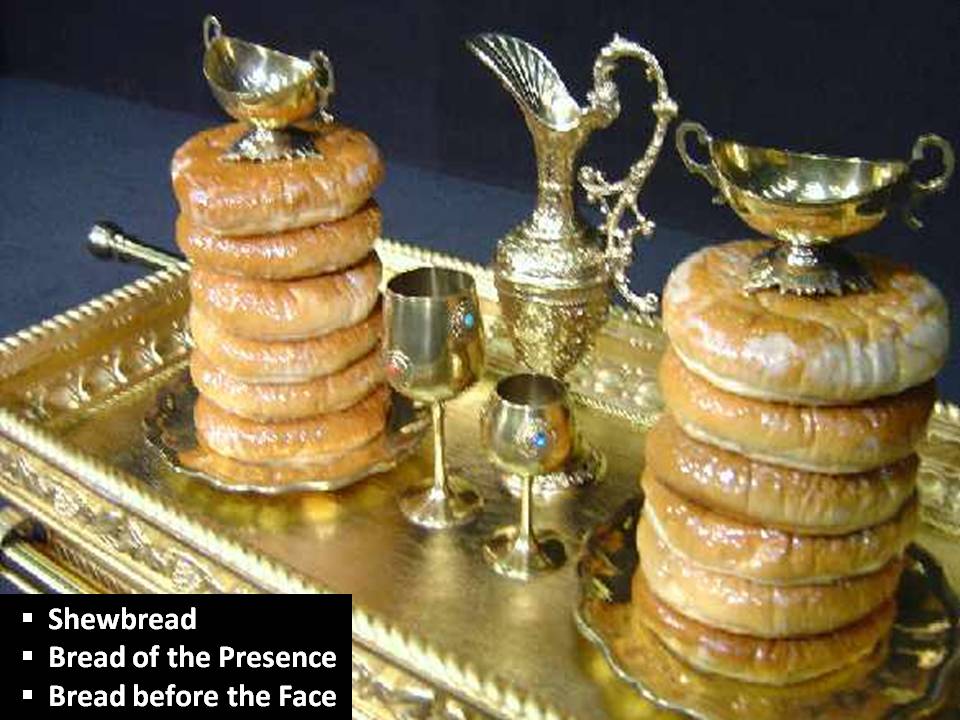
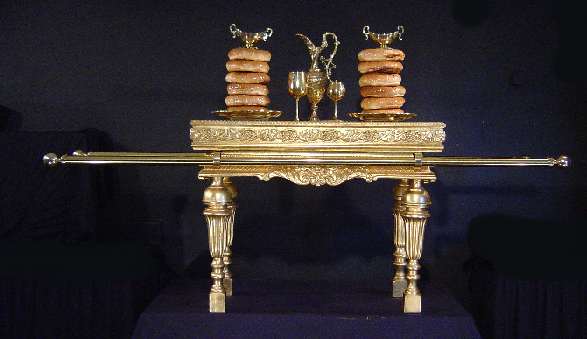
When you walk into the tabernacle you enter a door that leads to the holy place. The priest had at his right hand the table of shewbread or also referred to as the table of the presence. It was made of acacia wood overlaid with pure gold. Its size was 2 cubits (3 feet) in length by one cubit (1 1/2 feet) in breadth and a height of 1 1/2 cubits (2 1/4 feet). Around the table was a border of gold and then a little further in, on the table top, an additional border which would hold the contents in place. The table had four legs, and two gold-plated poles were inserted through golden rings attached to the legs for transporting.

  • “And you shall set the showbread on the table before Me always.”

The purpose of the golden table was to hold 12 cakes of bread made of fine flour. They were placed there in two stacks (or rows) of six, each loaf representing one of the tribes of Israel (Lev. 24:8).

  • Lev 24:5-9 And you shall put pure frankincense on each row, that it may be on the bread for a memorial, an offering made by fire to the LORD. Every Sabbath he shall set it in order before the LORD continually, being taken from the children of Israel by an everlasting covenant. And it shall be for Aaron and his sons, and they shall eat it in a holy place; for it is most holy to him from the offerings of the LORD made by fire, by a perpetual statute.”

Significance of the Bread of Presence

  • Fine Flour (from the earth)
  • Baked (agony and suffering)
  • Unleavened (nothing artificial)
  • Sprinkled with pure frankincense[5]

Bread Sprinkled with Pure Frankincense

Frankincense was given to Baby Jesus, and symbolizes His office as High Priest, offering prayers of intercession before the Father for us. Here, sprinkled upon the bread that is to be always before the face of God, it illustrates the truth of what Jesus declared in John 6.

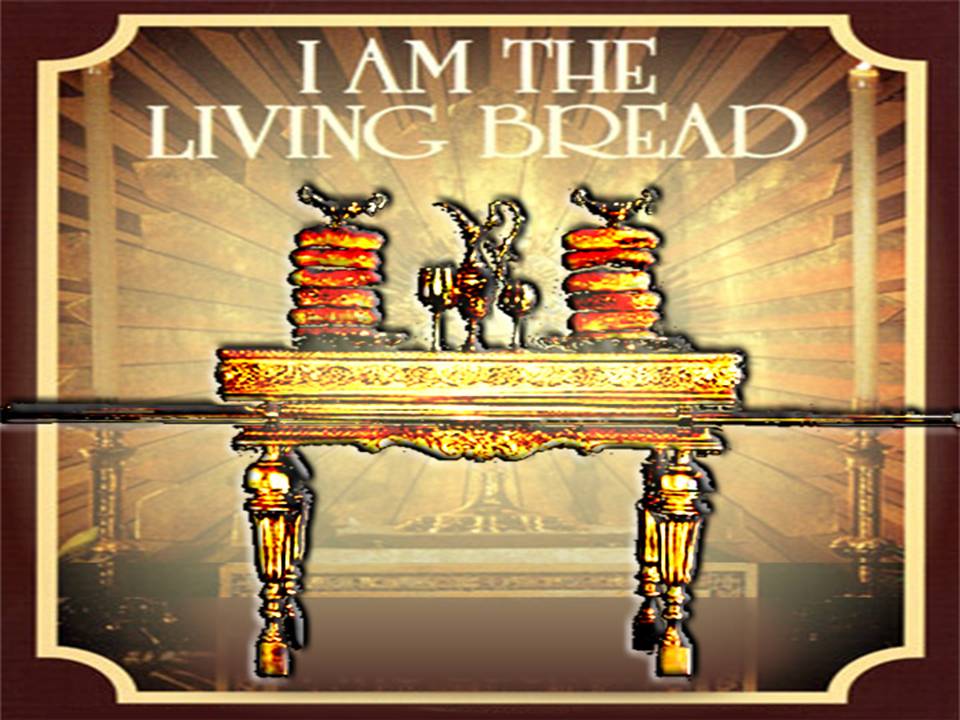
I AM the Living Bread

John 6:51-58 “I am the living bread which came down from heaven. If anyone eats of this bread, he will live forever; and the bread that I shall give is My flesh, which I shall give for the life of the world. As the living Father sent Me, and I live because of the Father, so he who feeds on Me will live because of Me. This is the bread which came down from heaven– not as your fathers ate the manna, and are dead. He who eats this bread will live forever.”

When David ate the Shewbread, he was prophetically eating a symbol of the Savior that he hoped in, and who offered his body a broken sacrifice for him. That broken body is ever before the face of God, offering prayers on our behalf! This is a picture of how our Hope is not in our own strength, but the strength that comes from the Bread of Life!

Recent studies by an international team of scientists, including researchers from Johns Hopkins University and the Hebrew University in Jerusalem, have indicated that burning frankincense resin helps to alleviate anxiety and depression. The University of Munich found the anti-inflammatory properties of frankincense very effective as a treatment for joint pain and arthritis[6]

 2000 Years Later, Jesus faced a similar situation:

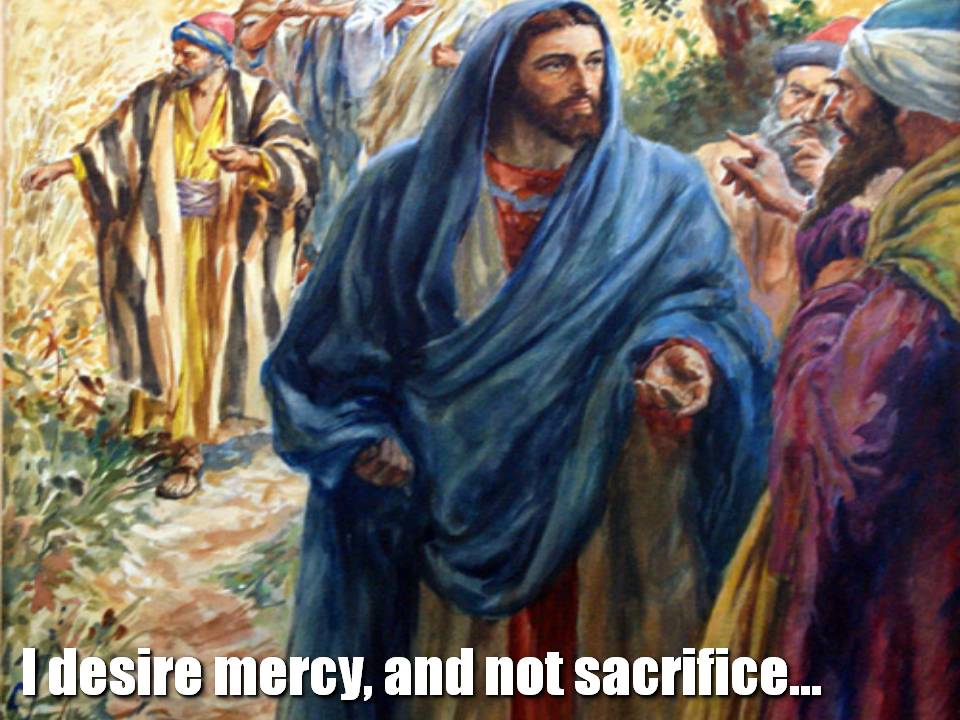
Jesus is walking with his disciples through a corn/wheat field. It was on a Sabbath, and they were very hungry. So they plucked the grain and ate it. (I’ve eaten freshly plucked wheat, so I know they must have been very hungry to eat it). Some Pharisees watched and immediately cried “law breakers’!

According to the Pharisees, the disciples reaped a crop. They threshed it by rubbing the berries in their hands and breaking the hulls off. Then they winnowed it by blowing the hulls away. By doing so, they were guilty of preparing a meal.

Jesus said to them, “Have you not read what David did when he was hungry, and those who were with him: (4) how he entered the house of God and ate the bread of the Presence, which it was not lawful for him to eat nor for those who were with him, but only for the priests? (5) Or have you not read in the Law how on the Sabbath the priests in the temple profane the Sabbath and are guiltless? (6) I tell you, something greater than the temple is here. (7) And if you had known what this means, ‘I desire mercy, and not sacrifice,’ you would not have condemned the guiltless. (8) For the Son of Man is lord of the Sabbath.” Matthew 12:1-8 (ESV)

Jesus deliberately drew attention to one of the Sabbath’s main purposes: It is a day of mercy and not a day of sacrifice.

Christ’s referred to 1 Samuel 21-when David ate the showbread. He wanted the Pharisees to understand that the Sabbath is to benefit a mercy needing man. David benefited from the Mercy of Ahimelech in giving him the showbread at a time when he was starving and weak. Mercy for the weak and hurting trumped the Law. Christ is always about Life, not Death.

The Pharisees didn’t understand Jesus. They did not see the Life He offered.

The Sabbath is a Day of Mercy for it is a Day of Hope!

David was about to learn the need for Hope!

The Doeg

Now a certain man of the servants of Saul was there that day, detained before the LORD. His name was Doeg the Edomite, the chief of Saul’s herdsmen.

It so happened in the Providence of God, that on this special Sabbath, one of Saul’s principal officials, the “chief over the herdsmen,” was in Nob, “detained before Jehovah.” The expression implies that Doeg was obliged to remain in the sanctuary in consequence of some religious ceremony—whether connected with his admission as a proselyte, for he was by birth an Edomite, or with a vow, or with some legal purification. (22:22)[7].

Doeg’s presence at the tabernacle is a mystery. He was an Edomite and whose presence would not normally be welcomed. He was “detained before the Lord” at the sanctuary (1 Sam. 21:7). Perhaps he had become a Jewish proselyte and was following the Hebrew faith in order to hold his job. As Saul’s chief shepherd, Doeg could easily have become defiled so that he had to bring a sacrifice to the Lord.

David knew that Doeg would report to Saul what he had seen at Nob and that this would mean trouble.Perhaps that is why he was not being honest with Ahimelech, so as to insulate him from the wrath of Saul.

Doeg Tells Saul

1 Samuel 22:6-19 reveals the Destructiveness of Doeg

(6) Now Saul heard that David was discovered, and the men who were with him. Saul was sitting at Gibeah under the tamarisk tree on the height with his spear in his hand, and all his servants were standing about him. (7) And Saul said to his servants who stood about him, “Hear now, people of Benjamin; will the son of Jesse give every one of you fields and vineyards, will he make you all commanders of thousands and commanders of hundreds, (8) that all of you have conspired against me? No one discloses to me when my son makes a covenant with the son of Jesse. None of you is sorry for me or discloses to me that my son has stirred up my servant against me, to lie in wait, as at this day.” (9) Then answered Doeg the Edomite, who stood by the servants of Saul, “I saw the son of Jesse coming to Nob, to Ahimelech the son of Ahitub, (10) and he inquired of the LORD for him and gave him provisions and gave him the sword of Goliath the Philistine.” (11) Then the king sent to summon Ahimelech the priest, the son of Ahitub, and all his father’s house, the priests who were at Nob, and all of them came to the king. (12) And Saul said, “Hear now, son of Ahitub.” And he answered, “Here I am, my lord.” (13) And Saul said to him, “Why have you conspired against me, you and the son of Jesse, in that you have given him bread and a sword and have inquired of God for him, so that he has risen against me, to lie in wait, as at this day?” (14) Then Ahimelech answered the king, “And who among all your servants is so faithful as David, who is the king’s son-in-law, and captain over your bodyguard, and honored in your house? (15) Is today the first time that I have inquired of God for him? No! Let not the king impute anything to his servant or to all the house of my father, for your servant has known nothing of all this, much or little.” (16) And the king said, “You shall surely die, Ahimelech, you and all your father’s house.” (17) And the king said to the guard who stood about him, “Turn and kill the priests of the LORD, because their hand also is with David, and they knew that he fled and did not disclose it to me.” But the servants of the king would not put out their hand to strike the priests of the LORD. (18) Then the king said to Doeg, “You turn and strike the priests.” And Doeg the Edomite turned and struck down the priests, and he killed on that day eighty-five persons who wore the linen ephod. (19) And Nob, the city of the priests, he put to the sword; both man and woman, child and infant, ox, donkey and sheep, he put to the sword. 1 Samuel 22:6-19 (ESV)

Doeg, wanting to gain from Saul, (Saul had just mentioned what he could give people), told about David being offered help by the Priests in Nob. He did not reveal that David had gained the help by misleading Ahimelech. He knew his information would better him at the expense of the Priests.

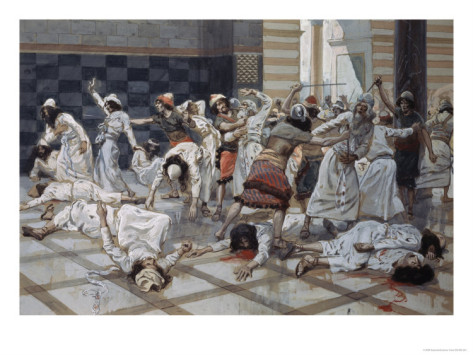
When all of Saul’s servants refused to go against the Priests, Saul turned to Doeg, and he not only killed all the priests, but he went to Nob and killed everyone there, boys, girls, mothers, even infants. He totally wiped the city of Nob from the face of the earth. Doeg was not only a Doeg, but he was a Destroyer.

Doeg is a Disciple killer

David had faced Goliath, and defeated him with a single stone. David’s heart was so united with God’s that there was nothing of this world that could defeat him. Now David was on the run from his authority, the anointed King of Israel. David had the love of Jonathan, and a few servants, but no one else to aid him, except God. So he came to the Tabernacle for food, provisions, and to inquire of the Lord for guidance. There he encountered Doeg, and David knew he was evil, but he had no idea what would happen. Perhaps he had an inkling, and that is why he did not tell Ahimelech the truth.

As a David Disciple you will encounter Goliath’s, you will encounter Saul’s, and you will encounter Doegs.

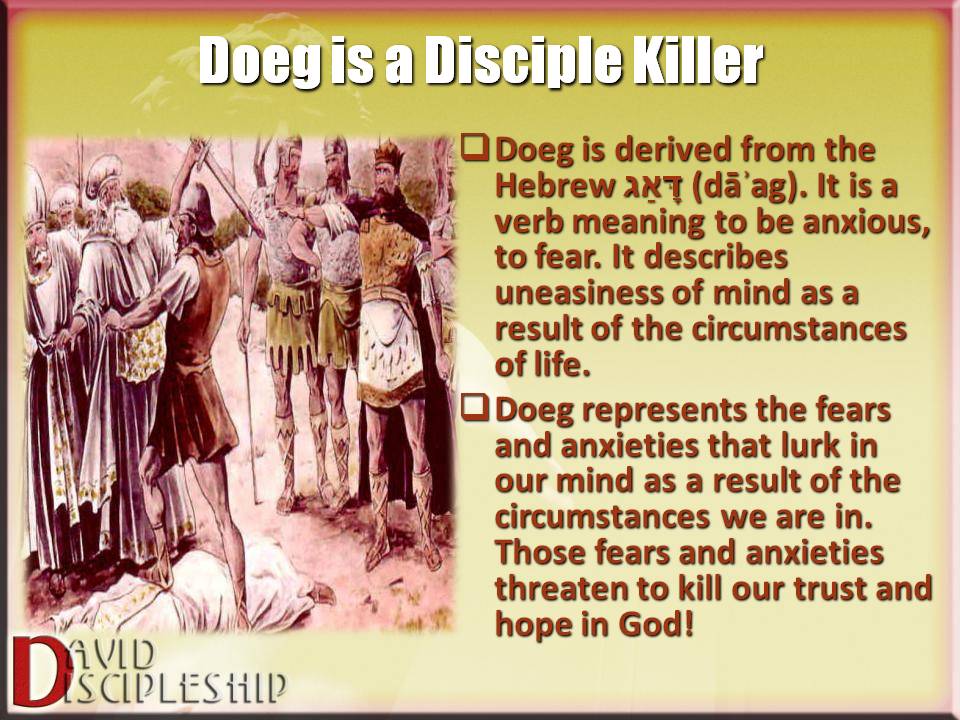
Doegs are very dangerous to Disciples, for they lurk in the shadows. They don’t come directly at you. Often they are an unseen enemy. But Doegs are very deadly. Doeg is derived from the Hebrew ‏דָּאַג‎ (dāʾag). It is a verb meaning to be anxious, to fear. This word describes uneasiness of mind as a result of the circumstances of life[8].

Doeg represents the fears and anxieties that lurk in our mind as a result of the circumstances we are in. Those fears and anxieties threaten to kill our trust and hope in God!

David described how his sin made him ‘dāʾag

I confess my iniquity; I am troubled (dāʾag) by my sin. Psalm 38:18 (NIV)

 Jeremiah used the word ‘dāʾag’ to illustrate how Disciples are to be:

He is like a tree planted by water, that sends out its roots by the stream, and does not fear when heat comes, for its leaves remain green, and is not anxious (dāʾag) in the year of drought, for it does not cease to bear fruit.” Jeremiah 17:8 (ESV)

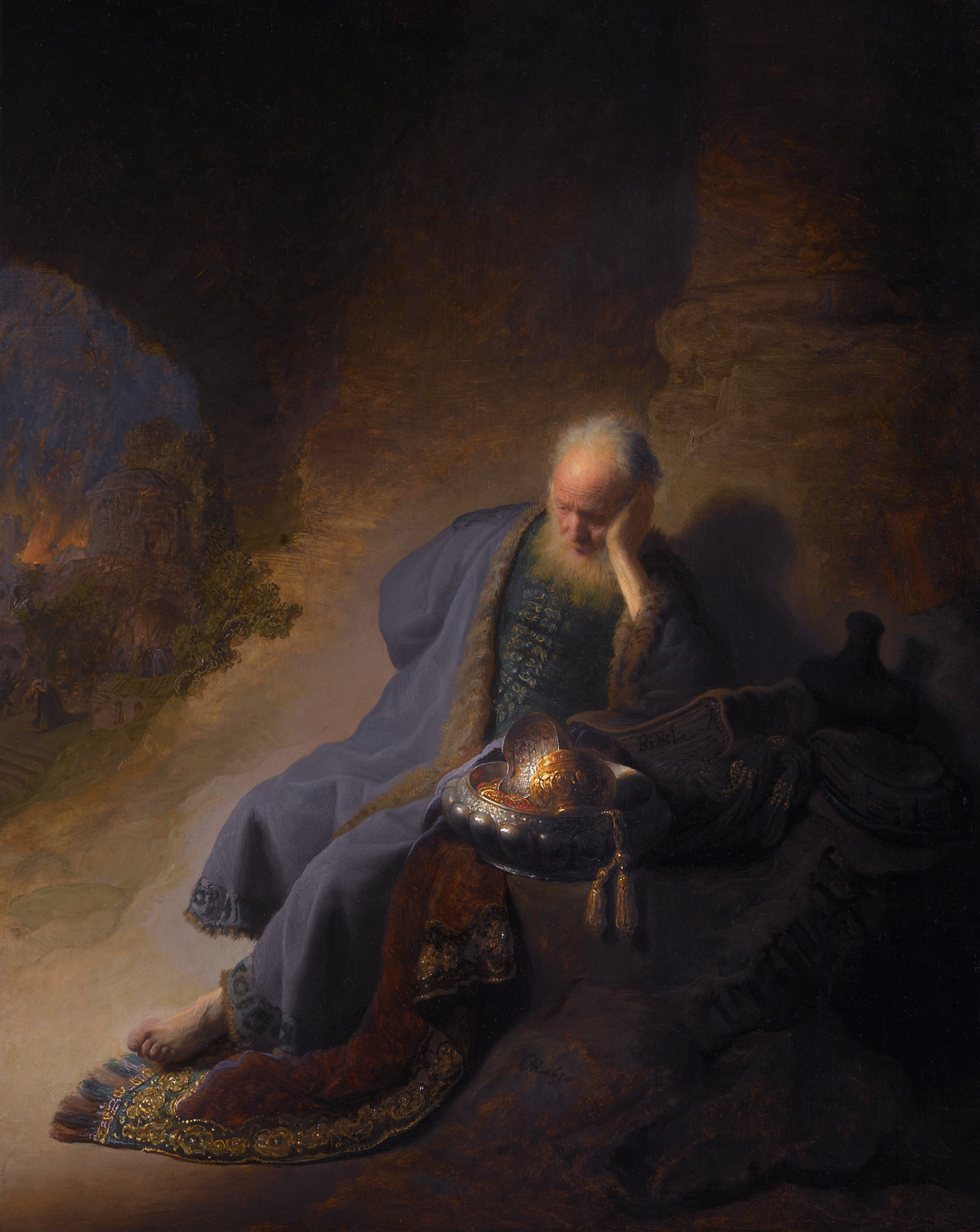
Jeremiah was called the weeping prophet. One poignant moment immortalized by Rembrandt depicts Jeremiah grieving over the destruction of Jerusalem and the First Temple by Nebuchadnezzar. Tradition has him in a grotto just outside the North Wall of Jerusalem. It is under the hill called Golgotha. He wrote the five poems of Lamentations near the  place where our Savior was crucified.

Jeremiah’s sermons and prophecies were ignored and scoffed at by the leaders of Jerusalem. Jeremiah (in a message from God) encouraged the soldiers to surrender to Nebuchadnezzar to save the city. They threw him into an empty cistern in the King’s palace prison and he sank in mud up to his armpits. They left him there to starve to death, hoping to silence him. Still he kept on preaching the Word of the Lord. Fortunately an Ethiopian man, a court official, persuaded the King to release Jeremiah. It took thirty men with ropes to pull Jeremiah out of that mud.

As much as Jeremiah was despised. As grief-stricken as he was when he wrote this:

How lonely sits the city that was full of people! How like a widow has she become, she who was great among the nations! She who was a princess among the provinces has become a slave. Lamentations 1:1 (ESV)

Jeremiah did something totally crazy:

While he was imprisoned, Jeremiah received a visit from his cousin Hanamel. Hanamel wanted to sell Jeremiah a piece of land in their hometown of Anathoth. It was a foolish request, for the land was already in control of the Chaldeans and Nebuchadnezzar. Furthermore, Jeremiah was in prison for treason, and unable to use the land. Jeremiah bought the land in front of many witnesses, saying:

‘Thus says the LORD of hosts, the God of Israel: Take these deeds, both this sealed deed of purchase and this open deed, and put them in an earthenware vessel, that they may last for a long time. For thus says the LORD of hosts, the God of Israel: Houses and fields and vineyards shall again be bought in this land.’ Jeremiah 32:14-15 (ESV)

In spite of his grief and despair over the circumstances he was in, Jeremiah never lost his Hope in God.

Jeremiah discovered a Hope that is greater than all our fears:

  •  The steadfast love of the LORD never ceases; his mercies never come to an end; they are new every morning; great is your faithfulness. “The LORD is my portion,” says my soul, “therefore I will hope in him.”  The LORD is good to those who wait for him, to the soul who seeks him. Lamentations 3:22-25 (ESV)
  • There is hope for your future,” says the LORD. “Your children will come again to their own land. Jeremiah 31:17 (NLT)

Jer 14:8 Calls out to the Hope of Israel – its Savior. Then He reveals the coming Hope:

Jeremiah’s Hope – The Lord our Righteousness

“For the time is coming,” says the LORD, “when I will raise up a righteous descendant from King David’s line. He will be a King who rules with wisdom. He will do what is just and right throughout the land. And this will be his name: ‘The LORD Our Righteousness.’ yehōwāh tṣid̠qēnû (from tsedaqah) Jeremiah 23:5-6 (NLT)

 Fear versus Hope (Doeg vs the Lord)

Discipleship is all about knowing the ways of God, embracing and understanding all that He delights in. He delights in hesed, mishpat and tsedaqah. (Jer 9:24)

The hesed of God strengthens our heart to defeat Goliath. The mishpat of God enables us to endure the injustice of Saul, as we focus on our responsibility to build our house by reaching out to the lame and lost.

The Tsedaqah of God allows us to conquer the Doegs of life by focusing on the Hope we have in Christ, and His righteousness.

The Psalms that David wrote after these encounters reveal that David learned this exact lesson:

David wrote Psalm 52 when he learned of Doeg’s murderous actions

The Steadfast Love (hesed) of God Endures: To the choirmaster. A Maskil of David, when Doeg, the Edomite, came and told Saul, “David has come to the house of Ahimelech.”

(5) But God will break you down forever; he will snatch and tear you from your tent; he will uproot you from the land of the living. Selah (6) The righteous shall see and fear, and shall laugh at him, saying, (7) “See the man who would not make God his refuge, but trusted in the abundance of his riches and sought refuge in his own destruction!” (8) But I am like a green olive tree in the house of God. I trust in the steadfast love of God forever and ever. (9) I will thank you forever, because you have done it. I will wait for your name, for it is good, in the presence of the godly. Psalm 52:5-9 (ESV)

God told David to go to Gath (when he inquired of Ahimelech), for God wanted David doubly learn this lesson. God wanted David to never forget!

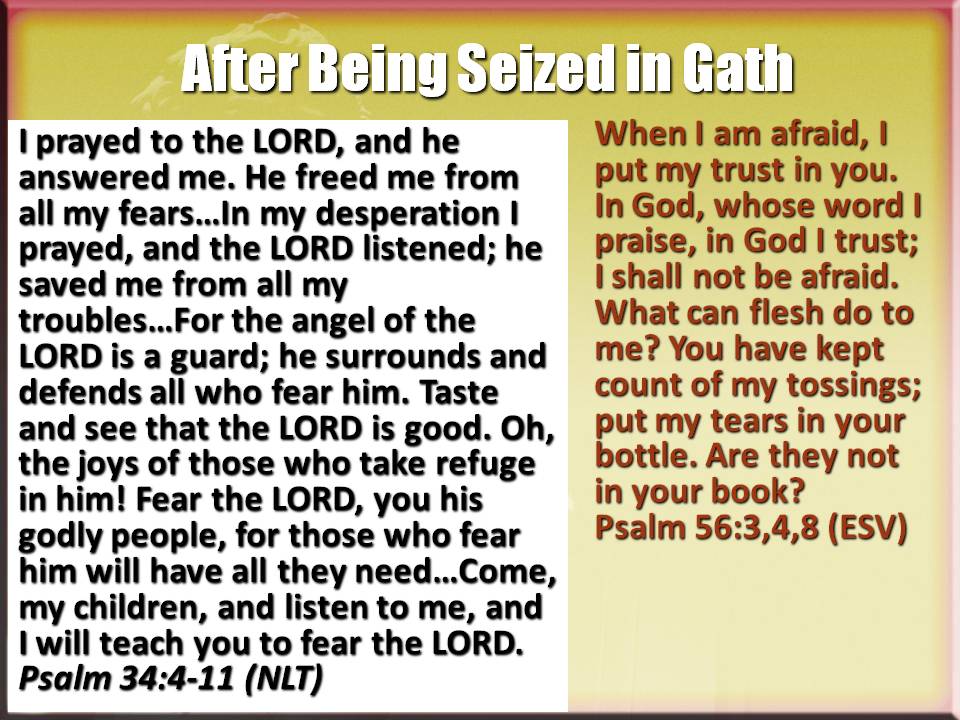
After Being Seized in Gath

Psalm 34: “Of David, when he pretended to be insane in front of Abimelech, who sent him away”.

I prayed to the LORD, and he answered me. He freed me from all my fears…In my desperation I prayed, and the LORD listened; he saved me from all my troubles…For the angel of the LORD is a guard; he surrounds and defends all who fear him. Taste and see that the LORD is good. Oh, the joys of those who take refuge in him! Fear the LORD, you his godly people, for those who fear him will have all they need…Come, my children, and listen to me, and I will teach you to fear the LORD. Psalm 34:4-11 (NLT)

Psalm 56: In God I Trust “To the choirmaster:. A Miktam of David, when the Philistines seized him in Gath”.

When I am afraid, I put my trust in you. In God, whose word I praise, in God I trust; I shall not be afraid. What can flesh do to me? Psalm 56:3-4 (ESV)

David learned that the fear of the Lord conquers every other fear (vv. 9-16). When you walk in fear of the Lord, you walk in His Righteousness. When you walk in His righteousness, you are no longer walking in fear or anxiety. Doeg can never push you from the discipleship path!

How are you handling the Doegs of Life? Are circumstances getting to you? Is fear lurking in the corners of your mind? Have you been hoping in something that has let you down? Perhaps it is time to follow David, and learn the fear of the Lord, learn that Jesus is your Righteousness! Life is never meant to be up to us. There are too many “Doeg’s” that lurk in the shadows. Fear is a discipleship killer. There is no fear of man when we walk in fear of the Lord, when we walk in the Righteousness of Christ!


[1] Warren W. Wiersbe, The Bible Exposition Commentary – History, (Colorado Springs, CO: Victor, 2003), WORDsearch CROSS e-book, 264.

[2] James Strong, Strong’s Talking Greek & Hebrew Dictionary, (Austin, TX: WORDsearch Corp., 2007), WORDsearch CROSS e-book, Under: “5011”.

[3] Robert Jamieson, A.R. Fausset, David Brown, A Commentary: Critical, Experimental, and Practical on the Old and New Testaments, (Toledo, OH: Jerome B. Names & Co., 1884), WORDsearch CROSS e-book, Under: “1 SAMUEL”.

[4]Warren Baker and Eugene Carpenter, The Complete Word Study Dictionary – Old Testament, (Chattanooga, TN: AMG Publishers, 2003), WORDsearch CROSS e-book, Under:  “אֲחִימֶלֶךְ ’aḥiymelek̠”.

[7] Alfred Edersheim, Bible History Old Testament, (London: Religious Tract Society, 1890), WORDsearch CROSS e-book, Under: “CHAPTER 12”.

[8] R. Laird Harris, Gleason L. Archer, Bruce K. Waltke, ed., “393: ‏דָּאַג‎,” in Theological Wordbook of the Old Testament, (Chicago: Moody Press, 1980), WORDsearch CROSS e-book, Under: “‏דָּאַג‎”.


When I owned an Asphalt Paving company we decided to get into concrete, and so we did in a big way. We even did footings, slabs and walls for new construction. I learned a great deal about foundations for commercial buildings. You don’t just dig a trench and pour concrete. You must consider where the main support beams are placed, what the weight load of the walls will be, what type of soil the foundation is on, and many other factors. The foundation is a really big deal that I had taken for granted. Good concrete alone is not enough for a solid foundation. You must use steel re-bar, and the amount and configuration of the re-bar depends upon the load at that point. Even concrete slabs have to consider the weight of the objects they will support. As part of our foundation work we did some banks which had bank vaults. Most vaults nowadays are actually pre-fab concrete units that are shipped in and moved in place. The vault door is added later. But the slab of the vault is poured 12″ to 24″ thick, with 2 to 3 layers of 3/4″ re-bar tied on 12″ centers. (We did one with 6″ centers). They do not want the vault going anywhere! It also indicates the weight (and importance) of the bank vault. Before concrete, I never thought about foundations. Now I consider them wherever I go. I even took this picture of some awesome re-bar for a building going up in Addis Ababa, Ethiopia. Judging by the re-bar pile, they still had a lot of tying to do!

The church of today is so often about programs. We need programs to keep drawing crowds and making people ‘feel’ like they are Christians. So often ministry programs for children, seniors, life groups, special events, and whatever must pass the “feel good” test. Will it “minister to a felt need” and make everyone “feel good”. Modern ministry must have an emotional draw or it usually dies.

The church that Jesus began and the Apostles modeled was centered around discipleship, making disciples. Emotional feelings quickly fade in the face of persecution. There must be something more about being a church than “feel good” programs. That more is true discipleship. We tried to get a “discipleship program” going within a year after coming to my present church, Pleasant Prairie. But we were only 3 years removed from a tragic ‘split’ that nearly destroyed a church that had been there for 36 years at the time. The people were not ready for a discipleship program that did not meet the need to rebuild their emotional being. There were emotional scars of bitterness and unforgiveness that needed attention before discipleship could begin. Inward hurts hinder the ability to look upward and outward!

God has recently burdened me that it is time to more clearly define the mission of our church. God has been sending some great men and families our way, but we need to have a clearly defined discipleship path. Our church is ready to stand and embrace discipleship as our core value, but I do not want it to be a “program”. Discipleship does not automatically have a “feel good” component that builds excitement. Most Christians seem to view discipleship as something for Paul’s and Timothy’s, people who serve in a major capacity. Even leaders in the church seem to shy away from intentional discipleship. Too often Christians are ‘comfortable’ where they are at. Convenience and comfort are often core values of most American Christians.

The Holy Spirit was leading me to preach on the Life of King David. He is a great example of a man of God. There is no more transparent life in the Bible than King David. But the Holy Spirit was also burdening me with the need for a clearly defined discipleship path in our church. For some reason He led me to the ‘last saying’ of King David in 2 Samuel 23:5. I won’t get it to it in this writing, but through this, the Holy Spirit is revealing some awesome revelations about discipleship and how the church can embrace it, accomplish it and even have a “feel good”  component at the same time. 

So the next few posts will be the “Laying of the Foundation” of what I am calling “David Discipleship”. We don’t often associate King David with discipleship, but I believe his life is the very definition of discipleship, beginning with the revelation of His last words.

Now to bend and tie the “re-bar” of David Discipleship:

If the church is not to be about “programs” but about making disciples, what is a disciple? 

Disciple: One who embraces and assists in spreading the teachings of another. In the New Testament, the word is Mathētés. Here it means more than a mere pupil or learner. It is an adherent who accepts the instruction given to him and makes it his rule of conduct[1]. The general designation of mathētés was given to those who believed on Christ. Jesus clearly defines disciple in John 8:31: (ESV) So Jesus said to the Jews who had believed in him, “If you abide in my word, you are truly my disciples”.

What is Discipleship?

If a disciple is an adherent of another person’s teachings, what is discipleship?

A consensus of definitions produces this: Discipleship is the process of learning about the teachings of another, internalizing them and then acting upon them. Most discipleship programs focus on the learning process, with the emphasis on knowledge.

Peters Perspective on the Discipleship Process

Peter turned out to be the most dynamic of the early disciples of Christ. He had learned a great deal after spending three years at the feet of the Master Teacher. Yet when it was time for the rubber to meet the road, Mighty Peter failed, and denied his Master in a dramatic fire. Where was that knowledge then? What good did his earlier confession do at the moment when it mattered most? Peter sheds a glaring light upon what a discipleship program should be about.

2 Peter 1:1 (ESV) Simeon Peter, a servant and apostle of Jesus Christ, To those who have obtained a faith of equal standing with ours by the righteousness of our God and Savior Jesus Christ…

2 Peter 1:3-5 (ESV) 3 His divine power has granted to us all things that pertain to life and godliness, through the knowledge (epignosis)[2] of him who called us to his own glory and excellence, 4 by which he has granted to us his precious and very great promises, so that through them you may become partakers of the divine nature, having escaped from the corruption that is in the world because of sinful desire. 5 For this very reason, make every effort to supplement your faith with virtue, and virtue with knowledge(gnosis) …

Peter’s Insights into Discipleship:

1. Equal Faith <–> Righteousness of Christ

  • Discipleship grows from Faith that is provided by the righteousness of our Savior Jesus Christ. That faith makes each believer equal in the sight of God. That equality is not based upon knowledge, but upon the righteousness provided us by our God and Savior Jesus Christ!

2. Growth <–> Relational Knowledge

  • Our growth in life and godliness is by His divine power and only through knowing Him in His glory and excellence.

3. Growth <–> Precious Promises

  • Our growth is only by His divine nature becoming our nature through the power of the Word and His precious promises.

4. Growth <–> Focus on His Virtue becoming our Virtue

  • Discipleship must focus on His Virtue becoming our Virtue. We first add virtue to our faith, and knowledge to virtue.

VIRTUE is the Greek “areté” which denotes in a moral sense what gives man his worth[3]

Why is Virtue Important to Discipleship?

There are four synonyms to Areté in the Greek according to Zodhiates…

  • dóxa – glory;
  • dúnamis – power;
  • chárisma – gift;
  • ōphéleia – usefulness[4]

Virtue is a quality that is difficult to define, but definite in its impact. From the synonyms we glimpse the power of this little word. Here is my humble attempt at a definition.

Virtue is the strength of the character of Christ internalized into my life as I follow Him. Virtue brings worth and value to my life. Without His virtue I am weak and ineffective.

Virtue grows from an obedient relationship!

Discipleship programs are not effective if their focus is primarily upon knowledge (ginosis). It must be knowledge that grows from a personal on-going relationship with Jesus Christ Himself! (epiginosko). I know far too many graduates of Christian Schools and Colleges that display little if any of the life of Jesus Christ. A surprising number no longer go to church. Knowledge is not enough to become a disciple of Jesus Christ. Look at Judas. He had three years of instruction from Jesus Christ, and yet there was no changed life!

Discipleship is Life-Changing only if it is Life-Giving!

Discipleship must lead believers into a life that is above the natural, a life that is empowered by the Righteous Life of Jesus Christ. His virtue of LIFE becomes our virtue by our dying.

We Have No Virtue worth Propping up

Discipleship is not a self-improvement course. It is not a way of “improving” your Christian walk! We are ugly before we are saved, we are ugly after we are saved. The only beauty we can ever have is the beauty of Jesus Christ.

COULD YOUR HEART PASS THE HOLE IN THE WALL TEST?

God told Ezekiel to dig a hole in the King’s wall. He was startled by the abominations being committed by the ‘supposed’ righteous leaders of Israel.

Ezekiel 8:8-13 (ESV) 8 Then he said to me, “Son of man, dig in the wall.” So I dug in the wall, and behold, there was an entrance. 9 And he said to me, “Go in, and see the vile abominations that they are committing here.” 10 So I went in and saw. And there, engraved on the wall all around, was every form of creeping things and loathsome beasts, and all the idols of the house of Israel. 11 And before them stood seventy men of the elders of the house of Israel, with Jaazaniah the son of Shaphan standing among them. Each had his censer in his hand, and the smoke of the cloud of incense went up. 12 Then he said to me, “Son of man, have you seen what the elders of the house of Israel are doing in the dark, each in his room of pictures? For they say, ‘The Lord does not see us, the Lord has forsaken the land.’ ” 13 He said also to me, “You will see still greater abominations that they commit.”

No matter how ‘spiritual’ we pretend to be, or how much ‘Bible knowledge’ we possess, no one can pass the “Hole in the Wall” test. Our hearts are full of abominations through sin. The harder we try to be a good disciple, the further we alienate ourselves from the heart of God! The heart of God is centered around the virtue of His Son, Jesus Christ! The only virtue worth having is not man-centered but Christ-centered!

Discipleship finds all that we need in Jesus Christ

1 Corinthians 1:30-31 (NIV) 30 It is because of him that you are in Christ Jesus, who has become for us wisdom from God–that is, our righteousness, holiness and redemption. 31 Therefore, as it is written: “Let him who boasts boast in the Lord.”

Discipleship which focuses on knowledge will always lead to pride and self-effort. Discipleship which focuses on virtue will always lead to humility and dependence.

Therefore I define Discipleship as:

Discipleship – “the intentional process of making the virtue of Christ my own, through submitting to His Lordship and Direction, and the daily Hope of Gaining Christ”

Discipleship is simply gaining by trading (diapragmateúomai)[5];

The King will demand an accounting of what you have GAINED by trading

Luke 19:15 (ESV) When he returned, having received the kingdom, he ordered these servants to whom he had given the money to be called to him, that he might know what they had gained by doing business.

I believe we will be judged at the ‘bema seat’ and our judgment will simply be an accounting of what we traded to gain for the sake of becoming like Jesus Christ! We will be judged for how we ‘gained’ Jesus Christ! Christians are to be about the business of trading their lives to gain Jesus Christ!

Paul said it best in Philippians 3:8: Philippians 3:8 (ESV) Indeed, I count everything as loss because of the surpassing worth of knowing Christ Jesus my Lord. For his sake I have suffered the loss of all things and count them as rubbish, in order that I may gain Christ

So the ‘re-bar’ of discipleship is the Virtue of Jesus Christ! Any substitution or absence of His virtue will result in a foundation that is weak and doomed to fail.

Our Hope of Glory is Christ IN me

Colossians 1:27 (ESV) To them God chose to make known how great among the Gentiles are the riches of the glory of this mystery, which is Christ in you, the hope of glory.


[1] Spiros Zodhiates, The Complete Word Study Dictionary – New Testament, (Chattanooga, TN: AMG Publishers, 1993), WORDsearch CROSS e-book, 936.

[2] Epígnōsis: In the NT, it often refers to knowledge which very powerfully influences the form of religious life, a knowledge laying claim to personal involvement. When used as an obj. (Eph. 1:17; 4:13; Col. 1:9, 10; 2:2; 1 Tim. 2:4; 2 Tim. 2:25; 3:7; Titus 1:1; Heb. 10:26; 2 Pet. 1:2, 3), it shows the relationship of the learner to the object of his knowledge (2 Pet. 1:8). Spiros Zodhiates, The Complete Word Study Dictionary – New Testament, (Chattanooga, TN: AMG Publishers, 1993), WORDsearch CROSS e-book, 624.

[3] Spiros Zodhiates, The Complete Word Study Dictionary – New Testament, (Chattanooga, TN: AMG Publishers, 1993), WORDsearch CROSS e-book, 252-251.

[4] Spiros Zodhiates, The Complete Word Study Dictionary – New Testament, (Chattanooga, TN: AMG Publishers, 1993), WORDsearch CROSS e-book, 252.

[5] Spiros Zodhiates, The Complete Word Study Dictionary – New Testament, (Chattanooga, TN: AMG Publishers, 1993), WORDsearch CROSS e-book, Under: “megauploaddiapragmateúomai”.