Archive for the ‘Jesus Christ’ Category


The Biblical Process of Discipleship

Peter was no stranger to failure and success in his discipleship journey.  As a result of the lessons he learned, he is able to describe for us the discipleship journey we will encounter.  Disciples become partakers of the divine nature of Christ through the Word (precious promises). Through the power of the Word we escape the corruption that is in the world because of sinful desire (the desire for things apart from God). To enjoy this “divine nature” (Paul calls it the ‘fullness of Christ’) we must diligently pursue the seven stages of discipleship that Peter lists. We must diligently seek to “ADD” these things to our life.  He concludes in verse 8, “For if these things are yours and abound, you will be neither barren nor unfruitful in the knowledge of our Lord Jesus Christ.” The end result of being a disciple is abounding in Jesus Christ and abounding in the fruit that knowing and abiding in Him brings!

Seven Stages of Discipleship – II Peter 1: 4-8

Step One: Repentance & Faith
John 1; Luke 3
New Life in Christ becomes reality through conversion wrought by Holy Spirit through faith – FAITH
Step Two: Enlightenment & Guidance
John 2-5
Once that change becomes reality, the disciple begins learning how to “put on Jesus Christ” – VIRTUE
Step Three: Growth in Christ
Luke 4-6
 
The disciple grows more and more into the fullness that God has for him in Jesus Christ.  – KNOWLEDGE
Step Four: Ministry Development
Luke 6-9
 
The inward transformation of Christ’s Word begins to become an outward reality of righteousness that results in ministry to others. – SELF-CONTROL
Step Five: Testing
John 6-8 (Understand how God uses ‘death of a vision)
Ministry will always involve “fiery trials” (I Peter 4:12) These build endurance and work to reveal the power and glory of Christ in your life. (Rom 5:2-3) – STEADFASTNESS
Step Six: Ministry in the Power of Christ
Luke 10-19, John 9-12
The disciple ministers with a greater awareness of the power of the Holy Spirit, whether as a leader or a worker. The ministry is of and through Christ, not the disciple’s natural abilities. – GODLINESS
Step Seven: Fruit through the Fullness of Christ
Luke 20-22, Acts 2,10, John 15
 
The Word continues to manifest the fullness of Christ, resulting in greater love for those around him, and a heart for the needs of the world. Other disciple’s are birthed and the Word continues to profit as God pleases. – LOVE

Seven Stages Explained 

A.  Stage One – Repentance and Faith in Christ

Brings new (changed) life through the regeneration of the Holy Spirit

1)   Grief over our sins against God brings repentance unto salvation. 2 Corinthians 7:10

2)   Repentance produces a change which results in turning toward God Acts 26:20

3)    Repentance has two facets.

  • „ From God. The work of ‘regeneration’ which results in our inner man becoming alive to God and our ‘old man’ or nature being put to death. 2 Corinthians 5:17-18, Titus 3:5, Eph 2:4-5
  • „ From Man. Our response to the conviction of the Holy Spirit which produces inner change and keeps us growing in Christ.

4)    Those unwilling to change or submit to the Holy Spirit cannot be discipled.

5)    Baptism is a revealer of one’s willingness to repent before the Lord. Acts 2:37-38

B.    Stage Two – Enlightenment & Guidance

Learning of the One who gave me new life. Matthew 11:28-30

1)    The Christian Life is meant to be an “exchanged life.”[1]

What Do We Exchange?

What we give up

What we get in return

Our sin

2 Cor. 5:21

Christ’s Righteousness

Wrath of God

Rom. 5:1

Peace with God

Condemnation (Hell)

Eph. 2:6,19

Father’s House (Heaven)

Death

Gal. 2:20

Life

The Old Man

2 Cor. 5:17

The New Man

Law

Rom. 7:4-6

Grace

Our weakness

1 Cor. 12:9-10

His Strength

Our Impurity

Heb. 10:21-22

His purity

External morality

Eph. 1:4

Holiness of God

Self strength

Is. 40:31

God’s Power

Tribulation

Eph. 2:14

Peace

Defeat

1 Cor. 15:57

Victory

Sorrow

John 15:11

Joy[2]

2)    We are to put on Jesus Christ. Romans 13:14, Galatians 3:27

3)    We are seated with Christ, which is to say we rest upon Christ. Ephesians 2:6

4)    Disciples learn to live every aspect of their lives in the faith of Jesus Christ. Galatians 2:20

5)    Disciples can derail growth in Christ by acting or trying in the flesh. Romans 8:4-8

C.    Step Three: Growth in Christ

Participating with Christ to build His Body

1)    The whole body is built up as we grow in Christ.

Ephesians 4:14-16 so that we may no longer be children, tossed to and fro by the waves and carried about by every wind of doctrine, by human cunning, by craftiness in deceitful schemes. Rather, speaking the truth in love, we are to grow up in every way into him who is the head, into Christ, from whom the whole body, joined and held together by every joint with which it is equipped, when each part is working properly, makes the body grow so that it builds itself up in love.

2)    As you grow in Christ, so will your desire to participate in the ministry to His body-the church.

3)    Jesus was always giving His disciples an opportunity to get involved in ministry to others. (The feeding of the 5,000 & 4,000, the sending forth into the towns to preach the Kingdom of God, his very call in Matthew 4:19)

4)    The Life of Christ in us is not to be a Lake (because it becomes the Dead Sea). It is to be a River, flowing from Christ through us to the thirsty.

John 7:37-38 On the last day of the feast, the great day, Jesus stood up and cried out, “If anyone thirsts, let him come to me and drink. Whoever believes in me, as the Scripture has said, ‘Out of his heart will flow rivers of living water.’ ”

5)    Growth in Christ involves Character building, being conformed to Jesus Christ.

Romans 8:29 For whom he did foreknow, he also did predestinate to be conformed to the image of his Son, that he might be the firstborn among many brethren.

Ephesians 2:10 For we are his workmanship, created in Christ Jesus unto good works, which God hath before ordained that we should walk in them.

D.   Step Four: Ministry Development

The Righteousness of Christ manifests itself outwardly in ministry to those around you.

Philippians 1:9-11 And it is my prayer that your love may abound more and more, with knowledge and all discernment, so that you may approve what is excellent, and so be pure and blameless for the day of Christ, filled with the fruit of righteousness that comes through Jesus Christ, to the glory and praise of God.

The need for the “Exchanged Life” will be apparent as you minister, for regardless of the capacity in which you serve, the work must be of God!

1 Corinthians 3:6-9 I planted, Apollos watered, but God gave the growth. So neither he who plants nor he who waters is anything, but only God who gives the growth. He who plants and he who waters are one, and each will receive his wages according to his labor. For we are God’s fellow workers. You are God’s field, God’s building.

1)    Who makes a good partner in the ministry of the Gospel?

  • One who follows Christ – Matthew 4:19
  • One who learns of Christ – Matthew 11:28
  • One who knows the power of the Cross in their life – 1 Cor 1:17-18
  • One who in weakness depends totally upon Christ – 1 Cor 1:26-29
  • One who knows intimately Jesus Christ and Him crucified – 1 Cor 2:1-2
  • One who glories in his weakness so that he can know the grace and power of Christ – 2 Cor 12:9
2 Cor 12:9 But he said to me, “My grace is sufficient for you, for my power is made perfect in weakness.” Therefore I will boast all the more gladly of my weaknesses, so that the power of Christ may rest upon me.

2)    Who makes a bad partner in the ministry of the Gospel?

  • One who puts his confidence in his flesh (talents, abilities) – Phil 3:3
  • One who sets his mind on fleshly things – Romans 8:7,8
  • One who cannot control his tongue – James 3:5-6
  • One who does not submit to authority – 1 Peter 2:13
  • One who holds a high opinion of himself (pride) – Romans 12:3
  • One who has bitterness – Hebrews 12:15
  • One who has temporal values – 1 John 2:15, 1 Cor 10:7
  • One who has moral impurity – Hebrews 12:16, 1 Cor 10:8
  • One who has broken relationships due to lack of love for others – 1 John 4:19-21

E.    Step Five: Testing

Learning to depend upon Christ

Jesus said “many are called, but few are chosen” (Matt 22:14). The chosen picture those followers who have the favor of God because they have responded to His discipline. Between the calling and chosen status (being favored as a son), there is always discipline. That discipline takes the form of testing and trials. You must expect it, you must endure it if you are to be “chosen.” Even Paul remarked on many who had turned back from the Lord, because their love for this world weakened their resolve to endure.

Hebrews 12:5-7 And have you forgotten the exhortation that addresses you as sons? “My son, do not regard lightly the discipline of the Lord, nor be weary when reproved by him. For the Lord disciplines the one he loves, and chastises every son whom he receives.” It is for discipline that you have to endure. God is treating you as sons.

1)    Expect your resolve to follow Christ to be tested and tried.

1 Peter 4:12-14 Beloved, do not be surprised at the fiery trial when it comes upon you to test you, as though something strange were happening to you. But rejoice insofar as you share Christ’s sufferings, that you may also rejoice and be glad when his glory is revealed. If you are insulted for the name of Christ, you are blessed, because the Spirit of glory and of God rests upon you.

2)    Understand trials and tests prove the genuineness of your faith and result in Christ being glorified.

1 Peter 1:6-7 In this you rejoice, though now for a little while, if necessary, you have been grieved by various trials, so that the tested genuineness of your faith—more precious than gold that perishes though it is tested by fire—may be found to result in praise and glory and honor at the revelation of Jesus Christ.

3)    Learn to welcome trials as close friends. (Count it all joy)

James 1:2 When all kinds of trials and temptations crowd into your lives my brothers, don’t resent them as intruders, but welcome them as friends! Realize that they come to test your faith and to produce in you the quality of endurance. But let the process go on until that endurance is fully developed, and you will find you have become men of mature character with the right sort of independence. (Phillips translation)

4)    Understand that when God is working supernaturally, He works “death of a vision” in our life.

Death of a Vision

This means he will give us a “vision” of what He wants us to do, but due to events, that vision seems to die. This is how God works:

  • „  Abraham – Promised to be a great nation, then spent 25 years waiting for a son, then asked to sacrifice his son.
  • „  Joseph – Dreamed of being great, then 13 years in Egypt as a slave, much of it in jail.
  • „  Moses – Wanted to free his people, then 40 years in hiding
  • „  David – Anointed the future king of Israel, then 10 years on the run from Saul
  • „  Paul – Called to be a messenger to the Gentiles, then spent years in obscurity in Arabia
  • „  The Apostles – believed Jesus was establishing a Kingdom, but that dies with Him on the Cross.

F.    Step Six: Ministry in the Power of Christ

Learning that all ministry is of Him, through Him and for Him

1)    Jesus did not minister in power until He endured testing

Luke 4:1-2 And Jesus, full of the Holy Spirit, returned from the Jordan and was led by the Spirit in the wilderness for forty days, being tempted by the devil… Luke 4:14 And Jesus returned in the power of the Spirit to Galilee

2)    Ministry must be done in the Power of Christ, and not in the power of the flesh.

1 Thessalonians 1:5 because our gospel came to you not only in word, but also in power and in the Holy Spirit and with full conviction. You know what kind of men we proved to be among you for your sake.

3)    Faith is never to be in man, but in the Power of God

1 Corinthians 2:3-5 And I was with you in weakness and in fear and much trembling, and my speech and my message were not in plausible words of wisdom, but in demonstration of the Spirit and of power, that your faith might not rest in the wisdom of men but in the power of God.

4)    Anyone who ministers is only a conduit for the power of God

2 Corinthians 4:7 But we have this treasure in earthen vessels, that the Excellency of the power may be of God, and not of us.

G.   Step Seven: Fruit through the Fullness of Christ

Learning that bearing Fruit is His responsibility, not mine

1)    Bearing Fruit is a natural process of abiding on the Vine

John 15:4-5 Abide in me, and I in you. As the branch cannot bear fruit by itself, unless it abides in the vine, neither can you, unless you abide in me. I am the vine; you are the branches. Whoever abides in me and I in him, he it is that bears much fruit, for apart from me you can do nothing.

2)    Discipleship is all about Fruit from the Fullness of Christ

Philippians 1:9-11 And it is my prayer that your love may abound more and more, with knowledge and all discernment, so that you may approve what is excellent, and so be pure and blameless for the day of Christ, filled with the fruit of righteousness that comes through Jesus Christ, to the glory and praise of God.

3)    The Purpose of the Gospel within us is FRUIT and GROWTH

Colossians 1:5-6 Of this you have heard before in the word of the truth, the gospel, which has come to you, as indeed in the whole world it is bearing fruit and growing—as it also does among you, since the day you heard it and understood the grace of God in truth,


[1] the exchanged life is Christ living His life through us, rather than us trying to make life work through our own efforts and resources. It is made possible by the believer’s union with Christ in His death, burial and resurrection (Romans 6-8)


Jesus rebukes His disciples for their unbelief

Mark 16:14-18 Afterward he appeared to the eleven themselves as they were reclining at table, and he rebuked them for their unbelief and hardness of heart, because they had not believed those who saw him after he had risen. And he said to them, “Go into all the world and proclaim the gospel to the whole creation. Whoever believes and is baptized will be saved, but whoever does not believe will be condemned. And these signs will accompany those who believe: in my name they will cast out demons; they will speak in new tongues; they will pick up serpents with their hands; and if they drink any deadly poison, it will not hurt them; they will lay their hands on the sick, and they will recover.”

The disciples were reclining. They were at ease in their unbelief. They were more concerned about their bellies than they were their hard hearts. Jesus rebuked them for their unbelief and hardness of heart. They had refused to believe the report that Jesus was risen and alive!

The disciples were allowing a fleshly thing to cloud a spiritual reality. Their focus on what was in the past hardened their heart to what was true in the now! This is true of Christians today. We feed our hearts on what God has not done or failed to do. Whenever we dwell on what has not happened, we foster the atmosphere for the spirit of offense and bitterness to arise and then thrive. When we dwell on what has not happened, we legitimize unbelief. We even excuse unbelief as normal. So we promote a sense of justification for not believing God.

Jesus rebuked that attitude in His disciples. He rebukes that attitude now! That attitude and thinking has to die! Christians are at ease in their unbelief. They are reclining at the table of fleshly attitudes and thinking. While we feed our bellies, the world is crying out for spiritual truth that will change their lives. While we are content in our unbelief our neighbors are crying out for something worth believing in.

Too often the Church focuses on keeping people from “sin” instead of taking people into their destiny with the power of the risen Christ. Churches that provide excuses for falling short of and not believing the power of Christ are merely promoters of “religion,” for God’s Word says religion is “form without power!” (2 Tim 3:5)

The area of our greatest unbelief is in our prayers. So much of the content of our praying is for things we already possess in Christ, but fail to believe. So we labor to ask God for things we already have. We expose our unbelief through our boring prayers. We fail to ask God for things we do not possess because we fail to believe what God has given us. No wonder prayer is laborious and cursory to most Christians. No wonder there is a prevailing attitude that their prayers never reach the ceiling! Our prayers are often exercises in unbelief!

Churches are to be houses of prayer. The God purpose of prayer is to produce JOY in the experience of the believer.

John 16:24 Until now you have asked nothing in my name. Ask, and you will receive, that your joy may be full.

Prayer is not to twist God’s arm, or to make us seem more spiritual. Prayer is to encourage our belief in the reality of Jesus. Jesus wants prayer to take us into fullness of JOY! JOY is the currency of Heaven! God reserves JOY as the reward for the suffering. Christ endured the cross for the JOY that was set before Him. The reality of Christ will deposit the currency of heaven in our lives. JOY is the currency of Heaven! JOY is the result of prayer! Jesus says to all faithful servants who live with His power in their lives, “Well done…enter into the joy of your master.” (Matthew 25:23)

God wants us to feast on belief in the power of the Name of Jesus. Prayer is designed to be a breakthrough into His heavenly JOY! Prayer is the expenditure of belief in return for the heavenly currency. If we pray only for that which we already possess, we will never experience the breakthrough of JOY. We will never discover the riches of God’s heavenly currency!

Never allow our prayers to contradict what God has already promised. Our unbelief closes heaven’s resources to us. Closed heavens are between our ears. Failure to know JOY is between our ears! We limit our God because our unbelief does not want to take hold of His power and JOY, even when He is standing in front of us with outstretched arms!

This is why Paul prayed so fervently for us:

Ephesians 1:18-19 having the eyes of your hearts enlightened, that you may know what is the hope to which he has called you, what are the riches of his glorious inheritance in the saints, and what is the immeasurable greatness of his power toward us who believe, according to the working of his great might…

Paul saw Jesus, saw His power, and saw that power in His life. Paul experienced JOY even in prison, even in the stockades, even holding flotsam in the middle of the ocean. Paul’s eyes were opened and his heart was on fire for the realities of Jesus Christ! He could see the greatness of the power within Him, the same power that raised Jesus from the grave.  Paul never reclined in unbelief after that vision.

Our Vision should FIRE our Heart!

Christians have no excuse for not seeing the same vision. The vision is there for all to see. If we fail to believe, the hardness of our heart is exposed.

When Jesus was baptized, Matthew writes, “immediately he went up from the water, and behold, the heavens were opened to him, and he saw the Spirit of God descending like a dove and coming to rest on him” (Matthew 3:16). The picture is of the heavens being divided, rolled back, suddenly exposing the power of the heavenlies, and allowing the Holy Spirit to descend upon Jesus. Stephen saw the heavens rolled back and gazed upon the Glory of God and His Son. The truth is that the heavens have been opened to all Christians! The Holy Spirit has been given to all Christians. The Glory of God is for all Christians. We have the Holy Spirit living within us, a gift from our Savior!

Our Father is jealous for us to know the power of the Holy Spirit within us. He earnestly desires us to belief and experience His JOY!

James 4:5 Or do you suppose it is to no purpose that the Scripture says, “He yearns jealously over the spirit that he has made to dwell in us”?

We live under an open heaven. The heavens are rolled back revealing the Power of the Holy Spirit. The Spirit lives in every believer, but his POWER is not upon every believer. Luke 4:1 says that Jesus left the Jordan River full of the Holy Spirit. But he did not have the POWER of the Holy Spirit until He believed the Word of God in His confrontation with Satan in the wilderness.

Are You Aware of the Power within You?

The Holy Spirit is in us eternally, but His POWER is not opened to us unless we believe. When we allow the wilderness of this world to influence our believing, we fail to see the power of the Spirit. We fail to influence the wilderness around us. We fail to alter the environment around us. Men who believed in the POWER of Christ influenced the environment into which they were placed. Stephen had a profound effect upon those angry men. Paul had an astounding effect upon prisoners, towns people, and even hardened Roman Soldiers.

Christians must learn how to “host” the presence of God such that He is always before us, influencing the environment of every place we step into. What we are conscious of, we are positioned to manifest. What we are aware of, we are able to release. If we are not conscious and aware of the POWER of God within us, we will never be able to influence those around us. The Gospel is not a ministry of words. The Gospel is the ministry of Power because of the presence of the Holy Spirit in our lives.  The Gospel is the ministry of releasing the presence of the Holy Spirit in the whole earth. We will never release that which we are unaware of.

A woman who had struggled for years with an issue of blood made a “demand” upon Christ. In desperation she reached out among the throng to touch the “hem of His garment.” She made a demand for her life. In spite of all the people pressing around Him, Christ was so aware of the Spirit’s presence that He instantly knew when a demand was made to which the Spirit responded. If we are not intensely aware of the Holy Spirit within our lives, we will have nothing to offer those around us who are desperately seeking power for their lives. They are overwhelmed, they are needy, and we have no life-giving power to offer them.

A demand was made upon Peter. Peter confessed he had no silver or gold, but Peter was intensely aware of what he did possess. Peter had life in Christ, and He was willing to share that POWER with the beggar at the gate. Peter said “what I do have I will give you.”

Write a HUGE Check with Heavenly Currency!

Peter knew a heavenly currency that the world knows nothing about. Peter wrote a HUGE check because he knew what he possessed (Acts 3:6). Most Christians can only write tiny checks because our unbelief has obscured what we possess.

We live with such ignorance of what we possess. We possess the very “Kingdom of God.” The one who freed us from our sins, at the same time made us a Kingdom, Priests to His God and Father (Rev 1:6). Jesus said “the words that I speak to you are spirit and life.” (John 6:63)

John 6:63 It is the Spirit who gives life; the flesh is no help at all. The words that I have spoken to you are spirit and life.

Jesus, being the very logos (word), spoke the Spirit and Life where ever He journeyed. When Christ spoke, His words became the Spirit and brought LIFE to those who believed. When we believe in the Words of Christ, and speak them into the world, we impart the Spirit to our environment, and we impart LIFE to those who believe.

We are Kingdom builders through the POWER that is in us. This Kingdom is not in food or drink, but is righteousness, peace and JOY in the Holy Spirit (Romans 14:17).

When we are aware of the power that lies within us, and we exercise that power in faith, we are building the Kingdom by bringing people to the LIFE in Christ. We are dispensing the heavenly currency of JOY to those around us.

When you are handing out money, people stop and demand some. When you are handing out JOY, joy that this world is so hungry for, people will stop and demand it. The communities around the disciples took note of what they were handing out. They took note of where they went. They even brought the sick and lame into the streets to catch the shadow of Peter and be healed (Acts 5:15). Note: Your Shadow will always release what overshadows you! Peter was overshadowed by the Holy Spirit!

An unbelieving, defeated group of Christians will never see life brought to the dead in sin. They will never see miracles of God. Unbelief and defeat produces inward focused Christians, prone to depression and discouragement. When we turn inward we become a dead sea. An inward focused Christian is a dead Christian. An inward Christian is self-absorbed and self-centered. We need to be pre-occupied with who Christ is! With what Christ can do! We need to constantly release Him into every circumstance we encounter. We release His POWER by faith!

Don’t allow disappointments to obscure Revelation

So much of “Christianity” is based upon disappointment rather than revelation. We fail to see the Glory of God or the Power of His Son. Stephen saw the revelation in the midst of a downpour of stones. Paul saw the revelation in the midst of a hateful heart. John saw the revelation in the midst of loneliness and exile. The Revelation of Christ changes our environment. It changes our heart! Rather than being disappointed in what God fails to do for us, we need to focus on all that God has done for us!

Jesus said that if you see Him, you have seen the Father. So Jesus is the revelation of the nature and power of God. Jesus said that “all power” had been given to him in heaven and on earth (Matthew 28:18). His power is the basis of us going into the world. If we do not know His power by revelation, then we will be powerless if we go into the world. We will be overcome by the world!

Christ is in us as a River
Let Him Flow!

Powerlessness is inexcusable and unacceptable. The Spirit that raised Jesus from the dead is in you and he wants out. He is not in us as a lake, or a ‘dead sea’, but rather as a river. Rivers flow from. The nature and power of God becomes ours as a believer. We have to believe in our own conversion! We have to believe in the POWER that was given to Jesus and was given to us!

As Paul prayed, the Lord is releasing a spirit of wisdom and revelation so that we can actually rise to who He says we are! We cannot afford to rest in unbelief, nor can we afford to think thought that God never thinks about us. We must learn to meditate on the things the Holy Spirit can say “AMEN!” to.

Paul wrote that in order to serve God acceptably, our minds (that thing between our ears) must be renewed so that our lives are transformed. Our minds must come under the influence of the Holy Spirit. We must learn divine perspective in order to live the divine life.

This renewing of our mind can only come from a divine encounter with the POWER of God. We must see the revelation of Christ as the POWER in our life. Any creed or teaching that does not take us to the person of Jesus in a divine encounter will only make us more “religious.” It will only equip us to argue, not bring life into our environment.

When our beliefs line up with the POWER of Christ in us, we can take the Gospel into our communities without limits, without baggage that weighs it down and renders it powerless. We must have the experience of the Gospel that changes our lives, changes our thinking and makes us intensely aware of the divine POWER within us. Only then can we dispense the currency of heaven to those joyless souls around us.

(Inspired by Bill Johnson of Bethel Church)


The Crucifixion in Excruciating Detail

1 Corinthians 1:18-25 For the word of the cross is folly to those who are perishing, but to us who are being saved it is the power of God. For it is written, “I will destroy the wisdom of the wise, and the discernment of the discerning I will thwart.” Where is the one who is wise? Where is the scribe? Where is the debater of this age? Has not God made foolish the wisdom of the world? For since, in the wisdom of God, the world did not know God through wisdom, it pleased God through the folly of what we preach to save those who believe. For Jews demand signs and Greeks seek wisdom, but we preach Christ crucified, a stumbling block to Jews and folly to Gentiles, but to those who are called, both Jews and Greeks, Christ the power of God and the wisdom of God. For the foolishness of God is wiser than men, and the weakness of God is stronger than men.

To ask a Gentile to believe in a Savior who had been crucified was absolute foolishness at the time of Paul. Crucifixion was considered so obscene that no one spoke of it. If a relative had been crucified for his crimes, you would be too ashamed to mention it. A Crucified Savior was unheard of! It was foolishness to the “wisdom” of the Gentiles. It was a stumbling block to the Jews, who looked for a Kingly Messiah, not a Crucified commoner.

Death was designed for maximum pain with minimal blood loss, thereby extending the pain and suffering by days. Crucifixion was, in every sense of the word, excruciating (Latin, excruciatus, or “out of the cross”). In order to understand the obscenity and shame of the crucifixion, and to know the depths of the Love of our Savior,  we need to understand the horrors to which our Savior willingly submitted Himself.

The Scourging

Preparations for Jesus’ scourging were carried out at Caesar’s orders. The prisoner was stripped of His clothing and His hands tied to a post above His head. The Roman legionnaire stepped forward with the flagrum, or flagellum, in his hand. This was a short whip consisting of several heavy, leather thongs with two small balls of lead attached near the ends of each. The heavy whip was brought down with full force again and again across Jesus’ shoulders, back, and legs. At first the weighted thongs cut through the skin only. Then, as the blows continued, they cut deeper into the subcutaneous tissues, producing first an oozing of blood from the capillaries and veins of the skin and finally spurting arterial bleeding from vessels in the underlying muscles.

The small balls of lead first produced large deep bruises that were broken open by subsequent blows. Finally, the skin of the back was hanging in long ribbons, and the entire area was an unrecognizable mass of torn, bleeding tissue. When it was determined by the centurion in charge that the prisoner was near death, the beating was finally stopped.

The Humiliation

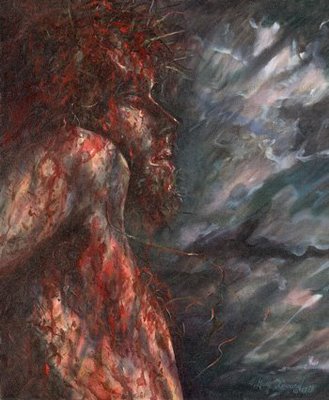
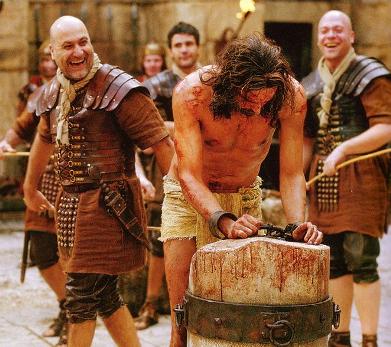
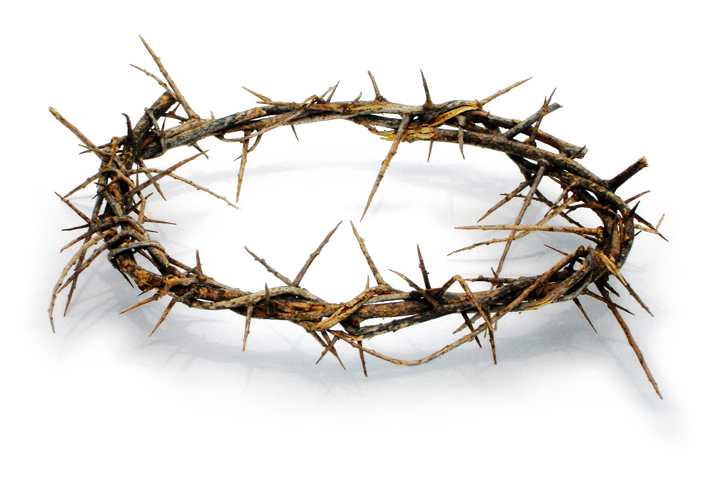
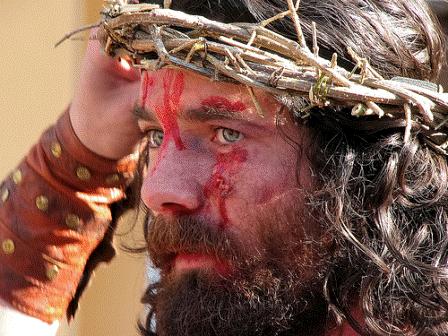
The half-fainting Jesus was then untied and allowed to slump to the stone pavement, wet with his own blood. The Roman soldiers saw a great joke in this provincial Jew claiming to be a king. They threw a robe across His shoulders and placed a stick in His hand for a scepter. They still needed a crown to make their travesty complete. Small flexible branches covered with long thorns, commonly used for kindling fires in the charcoal braziers in the courtyard, were plaited into the shape of a crude crown. The crown was pressed into his scalp and again there was copious bleeding as the thorns pierced the very vascular tissue. After mocking Him and striking Him across the face, the soldiers took the stick from His hand and struck Him across the head, driving the thorns deeper into His scalp. Finally, they tired of their sadistic sport and tore the robe from His back. The robe had already become adherent to the clots of blood and serum in the wounds, and its removal, just as in the careless removal of a surgical bandage, caused excruciating pain. The wounds again began to bleed.

Jesus had not drank since the night before, so the combination of the beatings, the crown of thorns, and the scourging would have set into motion an irreversible process of severe dehydration and cardio respiratory failure. All of this was done so that the prophecies would be fulfilled:

  • I can count all my bones: they look and stare upon me. Psalm 22:17
  • I gave my back to those who strike, and my cheeks to those who pull out the beard; I hid not my face from disgrace and spitting. Isaiah 50:6
  • As many were astonished at you— his appearance was so marred, beyond human semblance, and his form beyond that of the children of mankind. Isaiah 52:14
  • Surely he has borne our griefs and carried our sorrows; yet we esteemed him stricken, smitten by God, and afflicted. But he was wounded for our transgressions; he was crushed for our iniquities; upon him was the chastisement that brought us peace, and with his stripes we are healed. Isaiah 53:4-5

Behold the Man!

The Crown of Thorns and the Robe

The significance of the scarlet robe and crown of thorns is to emphasize Jesus’ taking the sins of the world upon His body. The Bible describes sin by the color of scarlet and that thorns first appeared after the fall, as a sign of the curse. Thus, the articles that He wore are symbols to show that Jesus took on the sins (and the curse) of the world upon Himself.

  • Genesis 3:17-18: “Cursed is the ground because of you; through painful toil you will eat of it all the days of your life. It will produce thorns and thistles for you, and you will eat the plants of the field.
  • “Isaiah 1:18 “Come now, let us reason together,” says the LORD.”Though your sins are like scarlet, they shall be as white as snow; though they are red as crimson, they shall be like wool.”  

Crucifixion

Crucifixion was invented by the Persians approximately 300-400 B.C. It was “perfected” by the Romans in the first century B.C. It is arguably the most painful death ever invented by man and is where we get our term “excruciating.” It was reserved primarily for the most vicious of criminals, as well as conquered foes.

Victims of crucifixion were typically stripped naked and their clothing divided by the Roman guards. In Jesus’ case this was done in fulfillment of Psalm 22:18, “They divide My garments among them, and for My clothing they cast lots.”

It was customary for the condemned man to carry his own cross from the flogging post to the site of crucifixion outside the city walls. He was usually naked, unless this was prohibited by local customs. Since the weight of the entire cross was probably well over 300 lb., only the crossbar was carried. The heavy patibulum of the cross, (weighing 75 to 125 lb.) was placed across the nape of the victim’s neck and balanced along both shoulders. Usually, the outstretched arms were tied to the crossbar. The procession of the condemned Christ, two thieves, and the execution detail of Roman soldiers headed by a centurion began its slow journey along the route which we know today as the Via Dolorosa.

In spite of Jesus’ efforts to walk erect, the weight of the heavy wooden beam, together with the shock produced by copious loss of blood, was too much. He stumbled and fell. The rough wood of the beam gouged into the lacerated skin and muscles of the shoulders. He tried to rise, but human muscles had been pushed beyond their endurance. The centurion, anxious to proceed with the crucifixion, selected a stalwart North African onlooker, Simon of Cyrene, to carry the cross. Jesus followed, still bleeding and sweating the cold, clammy sweat of shock. The 650-yard journey from the Fortress Antonia to Golgotha was finally completed.

Outside the city walls were permanently located the heavy upright wooden stipes, on which the patibulum would be secured. At the site of execution, by law, the victim was given a bitter drink of wine mixed with myrrh (gall) as a mild analgesic. Even though Jesus was severely dehydrated through blood and fluid loss, He refused this drink. He chose to face death in full control of His senses. Edersheim writes:

“It was a merciful Jewish practice to give to those led to execution a draught of strong wine mixed with myrrh so as to deaden consciousness” (Mass Sem 2.9; Bemid. R. 10). The draught was offered to Jesus when He reached Golgotha. But having tasted it….He would not drink it. ….He would meet Death, even in his sternest and fiercest mood, and conquer by submitting to the full…. (p.880).

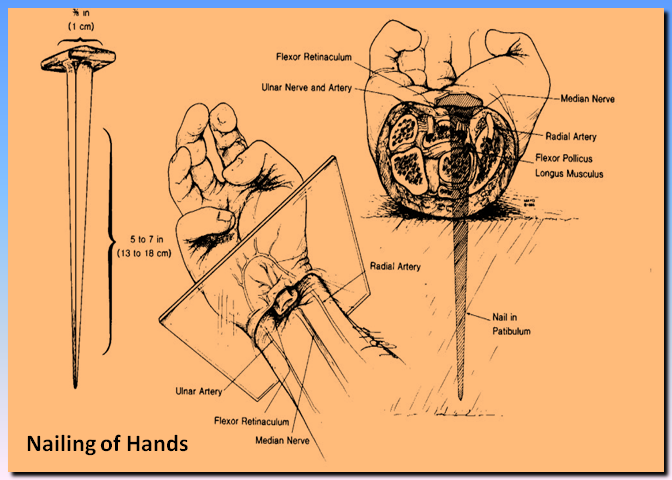
Jesus refused this drink. The criminal was then thrown to the ground on his back, with his arms outstretched along the patibulum. The hands could be nailed or tied to the crossbar, but nailing apparently was preferred by the Romans. The archaeological remains of a crucified body, found in an ossuary near Jerusalem and dating from the time of Christ, indicate that the nails were tapered iron spikes approximately 5 to 7 in (13 to 18 cm) long with a square shaft 3/8 in (1 cm) across. Furthermore, ossuary findings and the Shroud of Turin have documented that the nails commonly were driven through the wrists rather than the palms.

After both arms were fixed to the crossbar, the patibulum and the victim, together, were lifted onto the stipes. On the low cross, four soldiers could accomplish this relatively easily. However, on the tall cross, the soldiers used either wooden forks or ladders.

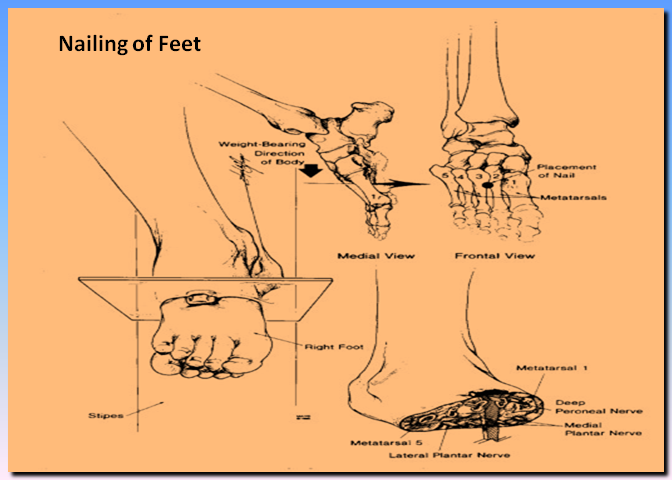
Next, the feet were fixed to the cross, either by nails or ropes. Ossuary findings and the Shroud of Turin suggest that nailing was the preferred Roman practice. Although the feet could be fixed to the sides of the stipes or to a wooden footrest, they usually were nailed directly to the front of the stipes. To accomplish this, flexion of the knees may have been quite prominent, and the bent legs may have been rotated laterally. The left foot was pressed backward against the right foot. With both feet extended, toes down, a nail was driven through the arch of each, leaving the knees moderately flexed. The victim was now crucified.

When the nailing was completed, the titulus was attached to the cross, by nails or cords, just above the victim’s head. The soldiers and the civilian crowd often taunted and jeered the condemned man, and the soldiers customarily divided up his clothes among themselves.

To add to the horror, insects would light upon or burrow into the open wounds or the eyes, ears, and nose of the dying and helpless victim, and birds of prey would tear at these sites. Moreover, it was customary to leave the corpse on the cross to be devoured by predatory animals. However, by Roman law, the family of the condemned could take the body for burial, after obtaining permission from the Roman judge.

Since no one was intended to survive crucifixions the body was not released to the family until the soldiers were sure that the victim was dead. By custom, one of the Roman guards would pierce the body with a sword or lance. Traditionally, this was a spear wound to the heart through the right side of the chest — a fatal wound probably taught to most Roman soldiers. The Shroud of Turin documents this form of injury. Moreover, the standard infantry spear, which was 5 to 6 ft long, could easily have reached the chest of a man crucified on the customary low cross.”

On the Cross

As Jesus slowly sagged down with more weight on the nails in the wrists, excruciating, fiery pain shot along the fingers and up the arms to explode in the brain. The nails in the wrists were putting pressure on the median nerve, large nerve trunks which traverse the mid-wrist and hand. As He pushed himself upward to avoid this stretching torment, He placed His full weight on the nail through His feet. Again there was searing agony as the nail tore through the nerves between the metatarsal bones of His feet.

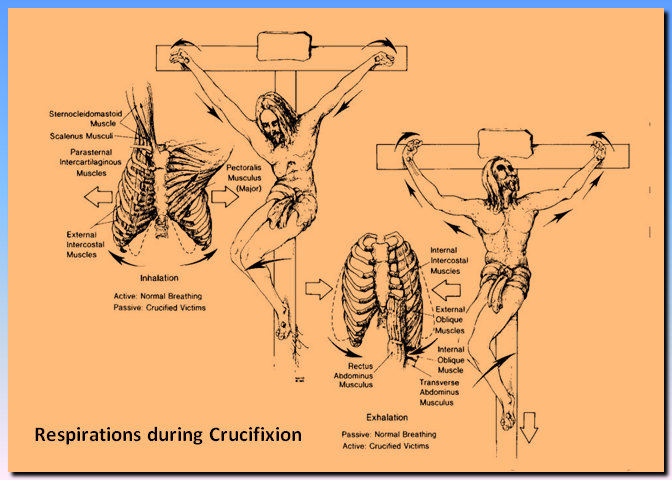
At this point, another phenomenon occurred. As the arms fatigued, great waves of cramps swept over the muscles, knotting them in deep relentless, throbbing pain. With these cramps came the inability to push Himself upward. Hanging by the arm, the pectoral muscles, the large muscles of the chest, were paralyzed and the intercostal muscles, the small muscles between the ribs, were unable to act. Air could be drawn into the lungs, but could not be exhaled. Jesus fought to raise Himself in order to get even one short breath. Finally, the carbon dioxide level increased in the lungs and in the blood stream, and the cramps partially subsided.

Forces of Darkness

While He was on the cross, darkness covered the land (noon to three p.m.). Jesus, in Luke 22:53, associates those who arrested Him with the power of darkness. Where were the evil forces while Jesus was on the cross? The verses below from Psalm 22 seem out of place when first read. There seems to be no mention of “bulls” and “lions” around the cross. The verses, however, have a deeper meaning. Bashan was an area to the east of the Jordan River which was famous for its fertility. There cattle were raised which grew to enormous sizes. The people there worshipped demon spirits (associated with Baal) within the cattle.1 Pet 5:8 describes Satan as “a roaring lion…seeking those who he may devour” These verses are thus suggestive of the spiritual activity of Satan and his demons, celebrating as Jesus was suffering on the cross.

Psalm 22:12-13: “Many bulls surround me; strong bulls of Bashan encircle me. Roaring lions tearing their prey open their mouths wide against me.”

Medical Aspects of Crucifixion

After forced to carry his cross to the site, the victim was then placed on his back, arms stretched out and nailed to the cross bar. The nails, which were generally about 7-9 inches long, were placed between the bones of the forearm (the radius and ulna) and the small bones of the hands (the carpal bones).

The placement of the nail at this point had several effects. First it ensured that the victim would indeed hang there until dead. Secondly, a nail placed at this point would sever the largest nerve in the hand called the median nerve.

The severing of this nerve is a medical catastrophe. In addition to severe burning pain the destruction of this nerve causes permanent paralysis of the hand. Furthermore, by nailing the victim at this point in the wrist, there would be minimal bleeding and there would be no bones broken! Thus scriptures were fulfilled:

  • He keepeth all his bones: not one of them is broken. Psalm 34:20

The positioning of the feet is probably the most critical part of the mechanics of crucifixion. First the knees were flexed about 45 degrees and the feet were flexed (bent downward) an additional 45 degrees until they were parallel the vertical pole. An iron nail about 7-9 inches long was driven through the feet between the 2nd and 3rd metatarsal bones. In this position the nail would sever the dorsal pedal artery of the foot, but the resultant bleeding would be insufficient to cause death.

The scourging prior to crucifixion served to weaken the condemned man and, if blood loss was considerable, to produce orthostatic hypotension[1] and even hypovolemic[2] shock. When the victim was thrown to the ground on his back, in preparation for transfixion of the hands, his scourging wounds most likely would become torn open again and contaminated with dirt. Furthermore, with each respiration, the painful scourging wounds would be scraped against the rough wood of the stipes. As a result, blood loss from the back probably would continue throughout the crucifixion ordeal.

With arms outstretched but not taut, the wrists were nailed to the patibulum. It has been shown that the ligaments and bones of the wrist can support the weight of a body hanging from them, but the palms cannot. Accordingly, the iron spikes probably were driven between the radius and the carpals or between the two rows of carpal bones, either proximal to or through the strong band like flexor retinaculum and the various intercarpal ligaments. Although a nail in either location in the wrist might pass between the bony elements and thereby produce no fractures, the likelihood of painful periosteal injury would seem great. Furthermore, the driven nail would crush or sever the rather large median nerve. The stimulated nerve would produce excruciating bolts of fiery pain in both arms. Although the severed median nerve would result in paralysis of a portion of the hand, ischemic contracture and impalement of various ligaments by the iron spike might produce a claw like grasp.

Most commonly, the feet were fixed to the front of the stipes by means of an iron spike driven through the first or second inter metatarsal space, just distal to the tarsometatarsal joint. It is likely that the deep peroneal nerve and branches of the medial and lateral plantar nerves would have been injured by the nails. Although scourging may have resulted in considerable blood loss, crucifixion per se was a relatively bloodless procedure, since no major arteries, other than perhaps the deep plantar arch, pass through the favored anatomic sites of transfixion.

Tetanic Spasm

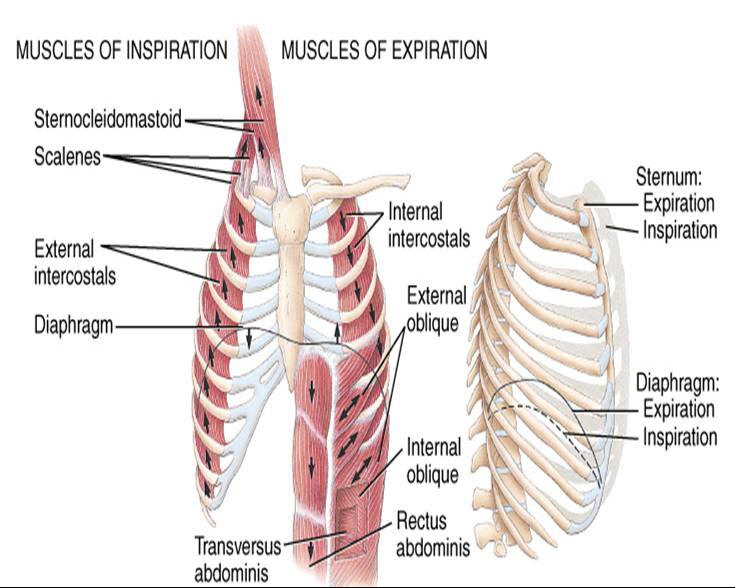
The major effect of crucifixion, beyond the excruciating pain, was a marked interference with normal respiration, particularly exhalation. The weight of the body, pulling down on the outstretched arms and shoulders, would tend to fix the intercostal[3] muscles in an inhalation state and thereby hinder passive exhalation.  Accordingly, exhalation was primarily diaphragmatic, and breathing was shallow. It is likely that this form of respiration would not suffice and that hypercapnia[4] would soon result. The onset of muscle cramps or tetanic spasms[5], due to fatigue and hypercapnia, would hinder respiration even further.

The resulting position on the cross sets up a horrific sequence of events which results in a slow, painful death. Having been pinned to the cross, the victim now has an impossible position to maintain.

With the knees flexed at about 45 degrees, the victim must bear his weight with the muscles of the thigh. However, this is an almost impossible task-try to stand with your knees flexed at 45 degrees for 5 minutes. As the strength of the legs gives out, the weight of the body must now be borne by the arms and shoulders. The result is that within a few minutes of being placed on the cross, the shoulders will become dislocated. Minutes later the elbows and wrists become dislocated. The result of these dislocations is that the arms are as much as 6-9 inches longer than normal.

With the arms dislocated, considerable body weight is transferred to the chest, causing the rib cage to be elevated in a state of perpetual inhalation. Consequently, in order to exhale the victim must push down on his feet to allow the rib muscles to relax. The problem is that the victim cannot push very long because the legs are extremely fatigued. As time goes on, the victim is less and less able to bear weight on the legs, causing further dislocation of the arms and further rising of the chest wall, making breathing more and more difficult.

  • …all my bones are out of joint; my heart is like wax; it is melted within my breast; Psalm 22:14

The result of this process is a series of catastrophic physiological effects. Because the victim cannot maintain adequate ventilation of the lungs, the blood oxygen level begins to diminish and the blood carbon dioxide (CO2) level begins to rise. This process sets up a vicious cycle of increasing oxygen demand-which cannot be met-followed by an ever increasing heart rate. The rising CO2 level stimulates the heart to beat faster in order to increase the delivery of oxygen and the removal of CO2. Due to the shallow breathing, the victim’s lungs begin to collapse in small areas, causing hypoxia and hypercapnia. A respiratory acidosis[6], with lack of compensation by the kidneys due to the loss of blood from the numerous beatings, resulted in an increased strain on the heart, which beats faster to compensate. After several hours the heart begins to fail, the lungs collapse and fill up with fluid, which further decreases oxygen delivery to the tissues. The blood loss and hyperventilation combines to cause severe dehydration. Over a period of several hours the combination of collapsing lungs, a failing heart, dehydration, and the inability to get adequate oxygen supplies to the tissues cause the eventual death of the victim. The victim, in effect, cannot breath properly and slowly suffocates to death. In cases of severe cardiac stress, such as crucifixion, a victim’s heart can even burst. This process is called “Cardiac Rupture.”

The actual cause of death by crucifixion was multifactorial and varied somewhat with each case, but the two most prominent causes probably were hypovolemic shock and exhaustion asphyxia. Other possible contributing factors included dehydration, stress-induced arrhythmias, and congestive heart failure with the rapid accumulation of pericardial and perhaps pleural effusions. Crucifracture (breaking the legs below the knees), if performed, led to death from asphyxia within minutes.

His Last Words

Spasmodically, Jesus was able to push Himself upward to exhale and bring in life-giving oxygen. It was undoubtedly during these periods that He uttered the seven short sentences that are recorded.

He suffered hours of limitless pain, cycles of twisting, joint-rending cramps, intermittent partial asphyxiation, and searing pain as tissue was torn from His lacerated back from His movement up and down against the rough timbers of the cross. Then another agony began: a deep crushing pain in the chest as the pericardium, the sac surrounding the heart, slowly filled with serum and began to compress the heart.

The prophecy in Psalm 22:14 was being fulfilled: “I am poured out like water, and all my bones are out of joint, my heart is like wax; it is melted in the midst of my bowels.”

The end was rapidly approaching. The loss of tissue fluids had reached a critical level; the compressed heart was struggling to pump heavy, thick, sluggish blood to the tissues, and the tortured lungs were making a frantic effort to inhale small gulps of air. The markedly dehydrated tissues sent their flood of stimuli to the brain. Jesus gasped His fifth cry: “I thirst.” Again we read in the prophetic psalm: “My strength is dried up like a potsherd; my tongue cleaveth to my jaws; and thou has brought me into the dust of death” (Psalm 22:15 KJV).

Jesus was offered a second drink, which He accepted. It is ‘pocsa’, a sour wine popular at that time. Jesus accepted this drink because of two important images. The drink was given on the “stalk of a hyssop plant”. Remember that these events occurred at the Feast of the Passover. During this feast, hyssop was used to apply the blood of the Passover lamb to the wooden doorposts of the Jews. It is interesting the end of this hyssop stalk pointed to the blood of the Perfect Lamb which was applied to the wooden cross for the salvation of all mankind.

In addition, the wine vinegar is a product of fermentation, which is made from grape juice and yeast. The word literally means “that which is soured” and is related to the Hebrew term for “that which is leavened”. (Holmans) Yeast or leaven, is a Biblical symbol of sin. When Jesus took this drink, (i.e. a drink which was “leavened”) it is thus symbolic of His taking the sins of the world into His body.

After this last drink, His body was now in extremis, and He could feel the chill of death creeping through His tissues. This realization brought forth His sixth word, possibly little more than a tortured whisper: “It is finished.” His mission of atonement had been completed. Finally, He could allow His body to die. With one last surge of strength, He once again pressed His torn feet against the nail, straightened His legs, took a deeper breath, and uttered His seventh and last cry: “Father, into Your hands I commit My spirit.”

While the crucifixion is horrible to our physical senses, we will never understand the spiritual agony of Hell that Jesus experienced for us upon the cross. There is no graphic display that can impress upon our senses the wrath of God upon Jesus Christ. He drank of God’s Wrath against our sin! Wrath that was meant for us, to be experienced in an eternity of Hell, Jesus experienced in a moment. God experienced Hell for you and me! That is love that cannot be defined, only experienced! Do you know His Love? Has He changed your life?

This is a Compilation from the following Sources:

Dr. C Truman David, “The Crucifixion”,, New Wine Magazine, April 1982. Originally published in Arizona Medicine, March 1965, Arizona Medical Association.

The Agony of Love by Dr. Mark Eastman

http://www.frugalsites.net/jesus/crucifixion.htm

Medical Aspects of the Crucifixion of Jesus Christ, Compiled by David Terasaka, M.D. ©1996.


[1] Orthostatic hypotension is a form of hypotension in which a person’s blood pressure suddenly falls when standing up or stretching. The symptom is caused by blood pooling in the lower extremities upon a change in body position. It is quite common and can occur briefly in anyone, although it is particularly prevalent among the elderly, and those with low blood pressure.

[2] Hypovolemic shock refers to a medical or surgical condition in which rapid fluid loss results in multiple organ failure due to inadequate circulating volume and subsequent inadequate perfusion.

[3] Intercostal muscles are several groups of muscles that run between the ribs, and help form and move the chest wall. The intercostal muscles are mainly involved in the mechanical aspect of breathing. These muscles help expand and shrink the size of the chest cavity when you breathe.

[4] Hypercapnia (or hypercarbia) is generally defined as an abnormally high level of carbon dioxide (e.g., more than 45 mm Hg) in the arterial blood.

[5] a state of sustained muscular contraction without periods of relaxation caused by repetitive stimulation of the motor nerve trunk at frequencies so high that individual muscle twitches are fused and cannot be distinguished from one another

[6] Respiratory acidosis develops when there is too much carbon dioxide (an acid) in the body. This type of acidosis is usually caused when the body is unable to remove enough carbon dioxide through breathing.


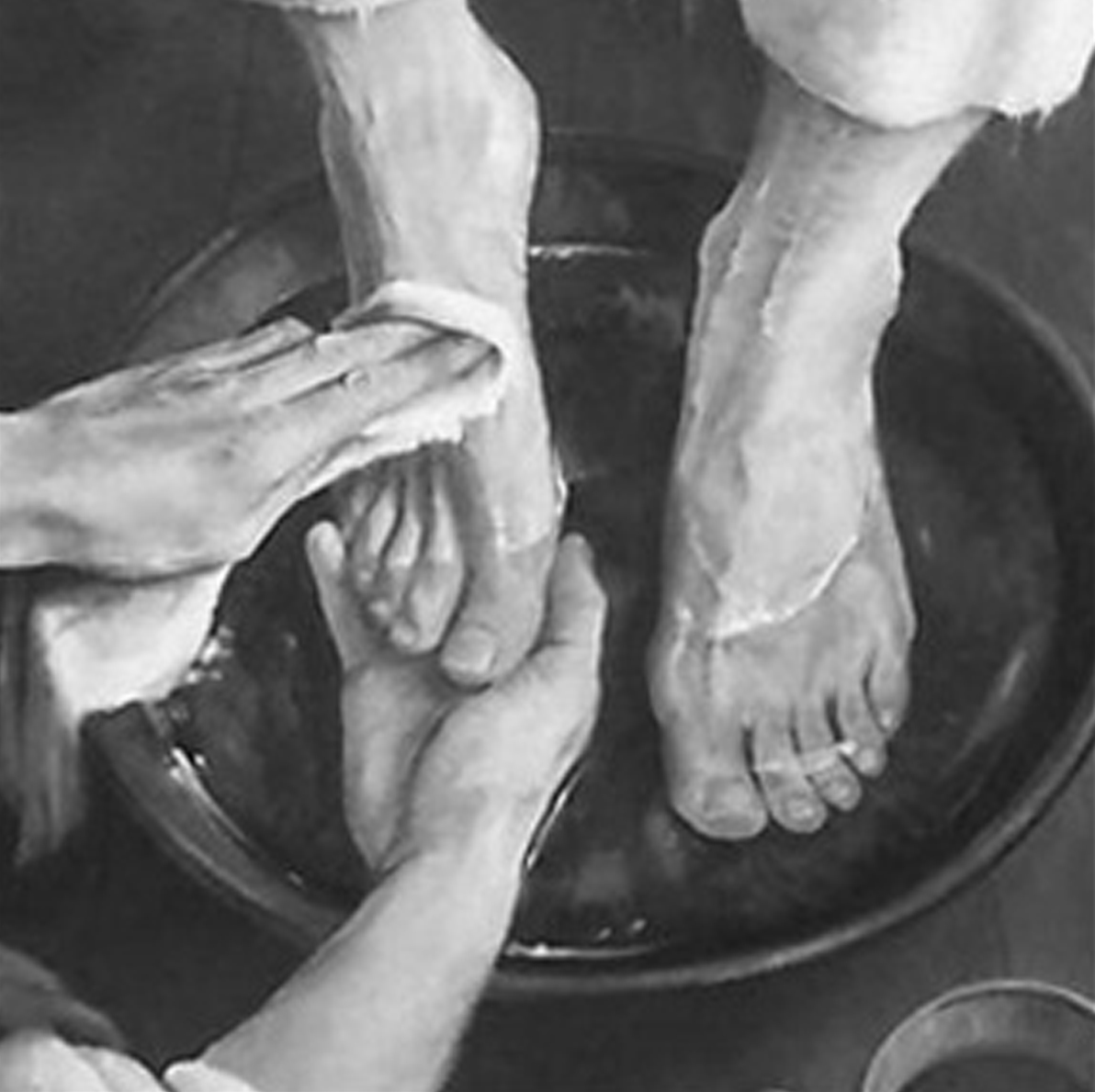
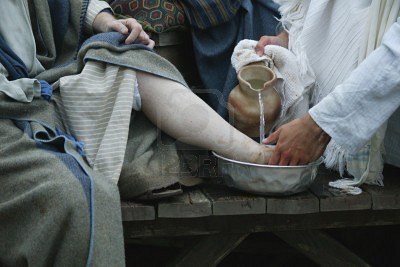
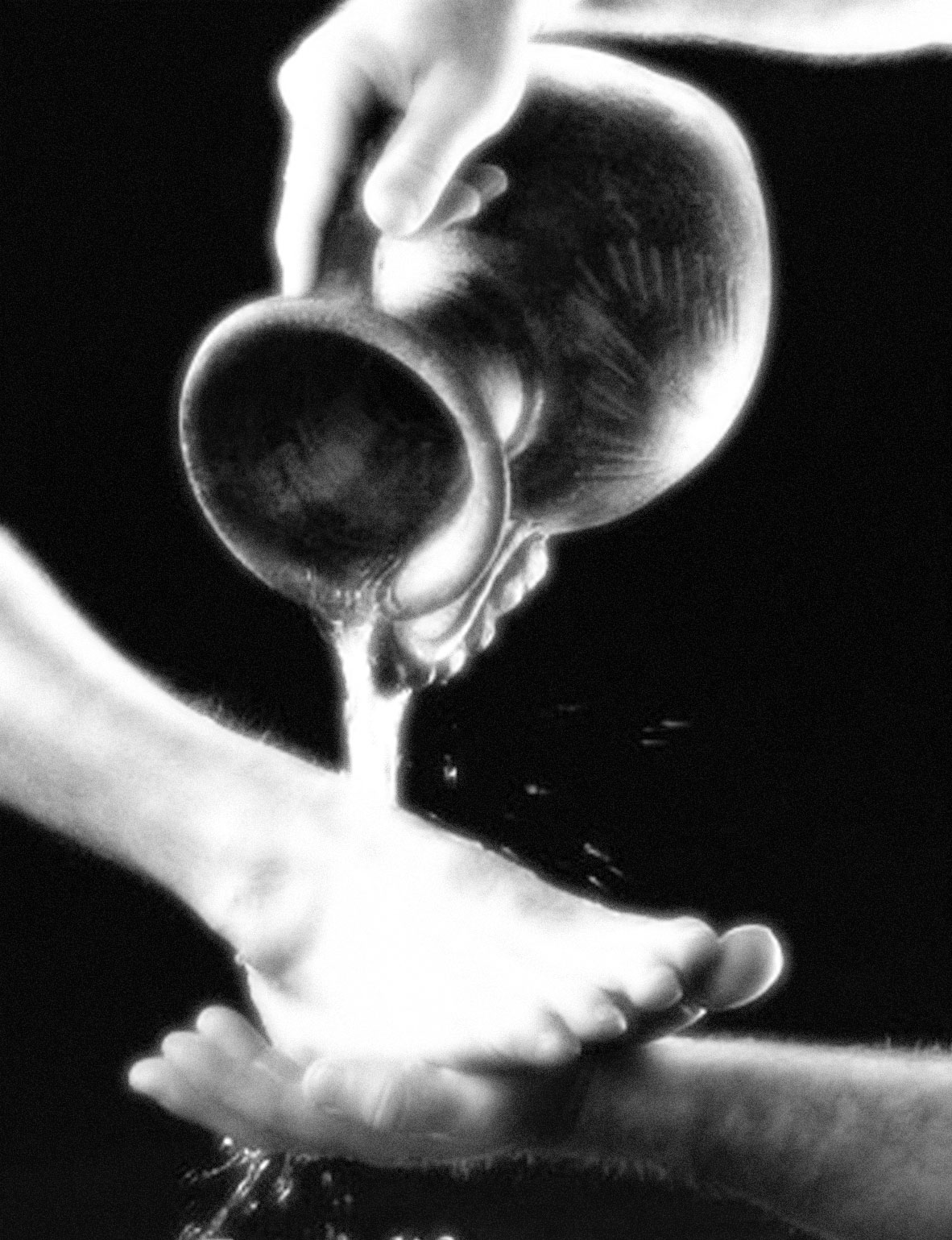
Last week we were in John 12, and observed a woman washing the feet of Jesus with an expensive ointment. It was shocking to the Disciples, but gave great delight to the Lord. This week we will focus on Jesus washing the feet of his Disciples. It was equally shocking to the Disciples and equally delighting to the Lord.

Lydia Will, a mother of 4 young boys writes in Small Town Simplicity,

No matter my nagging, they just cannot seem to resist kicking off their shoes and squelching in the sun-warmed mud. Four sets of mud encrusted feet patter up the path and up the porch steps, one by one dunking feet into the warm white foam. I’ve got the rolled up sleeves and scrub tiny toes, searching for the pink skin beneath all the grime. Then towel dry and open the door, in they come looking for their dinner.

I wish I could say I had a good attitude about all of this, but it was not the first time I cleaned them up today. Nor the second, for that matter. In fact, if I am completely honest, I was downright annoyed.

I tossed out murky water, turn toward the sink to scrub the pot. And right there it strikes me.

Today I didn’t make a million dollars.
I didn’t attend an important investment meeting.
I didn’t wear expensive clothes.
Today I didn’t save a life, or change a law, or bring about world peace.
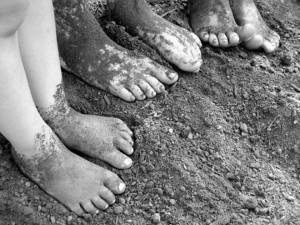
It may look like I really didn’t do much of worth to anyone.

But today, and really, every day, I washed feet.

As I make my way through this life of mine, I am taught so much. I am learning, daily, to look for the small and the humble – the quiet and the meek. The foot-washing moments that point me toward the blessings of laying down self and striving to serve. In lowering me, He elevates.

Read John 13:1-20 There are three things that Jesus said which bear closer examination. They reveal the motivation and message of the Gospel.

  • “If I do not wash you, you have no share with me.”
  • “I have given you an example”
  • “If you know these things, blessed are you if you do them”
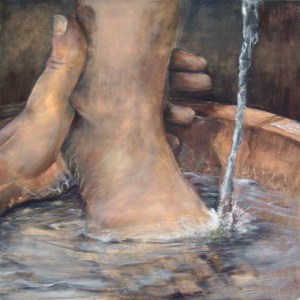
Most of us know this story. Jesus washes the feet of His disciples. Peter protests at first, but relents. It is a touching story reenacted in many churches even today. But too often we miss the message Jesus wanted to get into the thick skulls of His disciples. 
“Do you understand what I have done to you? You call me Teacher and Lord, and you are right, for so I am. If I then, your Lord and Teacher, have washed your feet, you also ought to wash one another’s feet. For I have given you an example, that you also should do just as I have done to you. Truly, truly, I say to you, a servant is not greater than his master, nor is a messenger greater than the one who sent him. If you know these things, blessed are you if you do them.”

There is a Blessing here, but we have to make it a part of our life. Its roots are in the Gospel. Its foundation is in the power of the Gospel we saw last week, the waste that Mary exhibited.

This is the Passion Week, and the memories of that week frame each of the Gospels. Obviously, of all that happened during 3-1/2 years of training, the events of those weeks stuck out most in their hearts and minds. Yet only in John’s gospel is this story mentioned – the one in John 13:1-20.

Coming just a day or so after the Disciples had been chided for their treatment of Mary, Jesus was having a His Last Supper with His Disciples. In one simple act Jesus reveals the power of the Gospel through His Motivations and the Message He wants His Disciples to learn.

The Motivation of Jesus
John 13:1 reveals that before this supper, Jesus had determined two things:

1. His hour had come to depart and return to His Father

All through his ministry he knew he was to be the “Lamb of God who would take away the sin of the world,” (John 1:29). The time has also come when he, as the grain of wheat, must fall into the ground and die. He sees, as a result of his death, a great harvest of Jews and Gentiles to follow in the power of the second Adam, freed from the defeat of death and sin. This is the power of the Gospel, Death with a View to Increase!

2. Having loved his own, He would love them to the uttermost.

Regardless of their denials or flight, Jesus would love them to the very end, or ‘uttermost’ as the Greek could be translated. He knew what was coming and knew the Disciples would need His Love. Within a few hours of this event, he would be hanging upon a cross. His Disciples would be scattered in utter dismay. He must love them to the uttermost!

Later this evening he says to his disciples, “Greater love has no man than this, that a man lay down his life for his friends,” (John 15:13 RSV). No one can go further in his expression of love for someone than to die for him. This is what it means for Jesus to love his disciples “unto the uttermost.”

The Gospel of John is very clear that the relationship, which Jesus had with his disciples, is the relationship he has with all who follow Him as Savior and Lord. This means each of you who are born again have a Savior who loves you to the uttermost.

Nothing we do, or fail to do will stop Him from loving us to the uttermost. He will discipline us, He will grieve, but His love will always be there.

That is the first thing about this love. It is not offended by our failures. He does not withdraw His love because we make mistakes. We may often disappoint Him, we may often fail Him, we may often grieve His heart, but He goes on loving us. He loves us unto the uttermost, right to the end. He is not offended by our failures. That is a very different kind of love from our love. This is God’s love in Christ. – T Austin Sparks[1]

He may bring remarkable experiences into our lives, but we may be sure that underneath all is his loving concern for us. How important it is for us to remember that. Jude writes, “Keep yourself in the love of God,” (Jude 1:21). When you by faith enter into the New Covenant with God through the Blood of Jesus, God takes full responsibility for your life. He is faithful. His Love guides everything that happens in our lives.

We can see this because even though Jesus was facing the greatest trial of his life, his focus was not on Himself. His focus was on loving His disciples.

  • Verse two reveals that Jesus was also aware of something else:

3. The Devil had entered the room and was in the heart of Judas.

Yes, there was an unwelcome guest at that meal, a guest that escaped the attention of everyone else but Jesus. You will not see him in Da Vinci’s: “Last Supper,” but he is there.

John 13:2 “the devil had already put it into the heart of Judas Iscariot, Simon’s son, to betray him”
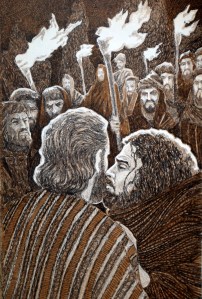
Jesus knew that the devil was bringing about a crisis and that he had determined to use Judas to betray him. This indicates how easily we can be victimized by the devil. He can put thoughts into our minds and hearts and, if we follow them, we will end up betraying our highest hopes. It is so important that we guard our hearts through the Word of God. If you are not daily in the power of the Word, do you think you are immune from Satan’s influence and doubts? Faith comes by the Word of God. Doubts come when our faith is weak.

Judas was a devoted disciple. He went out witnessing. He even healed people. But Satan used a desire of his to cause him to turn away. His desire for wealth and standing got in the way of his following a Savior who was to be crucified. The only way wrong desires can be changed is through the power of the Word! Never resist it. Always honor it.

Jesus knew that the Devil was in the room and so Jesus had to show his disciples something drastic.

There is the third motive: The devil, the enemy, is at work, closing in on Jesus, and he knew it!

  • Something else that Jesus knew is mentioned in verse 4:

4. All things were given into His hands. He had come from God and would return to God.

Now that may seem like a slogan, like Allstate Insurance – You are in Good Hands. However, I believe the Word of John 13:3 is quite literal. Jesus had the most powerful hands in the Creation of God. All things had been placed in His Hands. Jesus was no helpless pawn, drawn along reluctantly. He was the director; He was in control of Passion Week. He was behind the smallest detail.

Can you visualize what this means?

Those soldiers who were beating Him, mocking Him, nailing Him to the Cross- were given into His hands. The Pharisees who were crying out to crucify him were in His hands.

Your sickness, your disease, your pain, is in His hands.
Your children, your grandchildren are in His hands.
Your life, your possessions, your career, your reputation are all in His hands.

Everything has been given into His hands. He knew exactly who He was and where He was headed. Jesus is Lord of ALL! Throughout the Passion Week, Jesus never panics. He is always in control. He moved with a quiet majesty through the events of his arrest and his appearance before Herod, Pilate and the chief priests. He is in full control because He knows who He is. He is God.

How important for Christians to understand this! The New Testament constantly thrusts this one truth upon us! When you are facing pressure at home, in your job, in relationships, in temptations, in whatever, the Scripture urges you, “Remember who you are. You need no longer be the victim of the wiles of the enemy; you no longer must obey him. You belong to Jesus Christ, Lord of the Universe. You are part of His Kingdom of love, not of anger and fear. You are loved and cherished by your Father. Your situation is in His hands.”

What worries do you have? What problems are keeping you up at night? See His hands! He has hold of it. Nothing is too great for His hands to handle!

Jesus is about to use those powerful hands to demonstrate the Message and Power of the Gospel.

B. The Message of Jesus

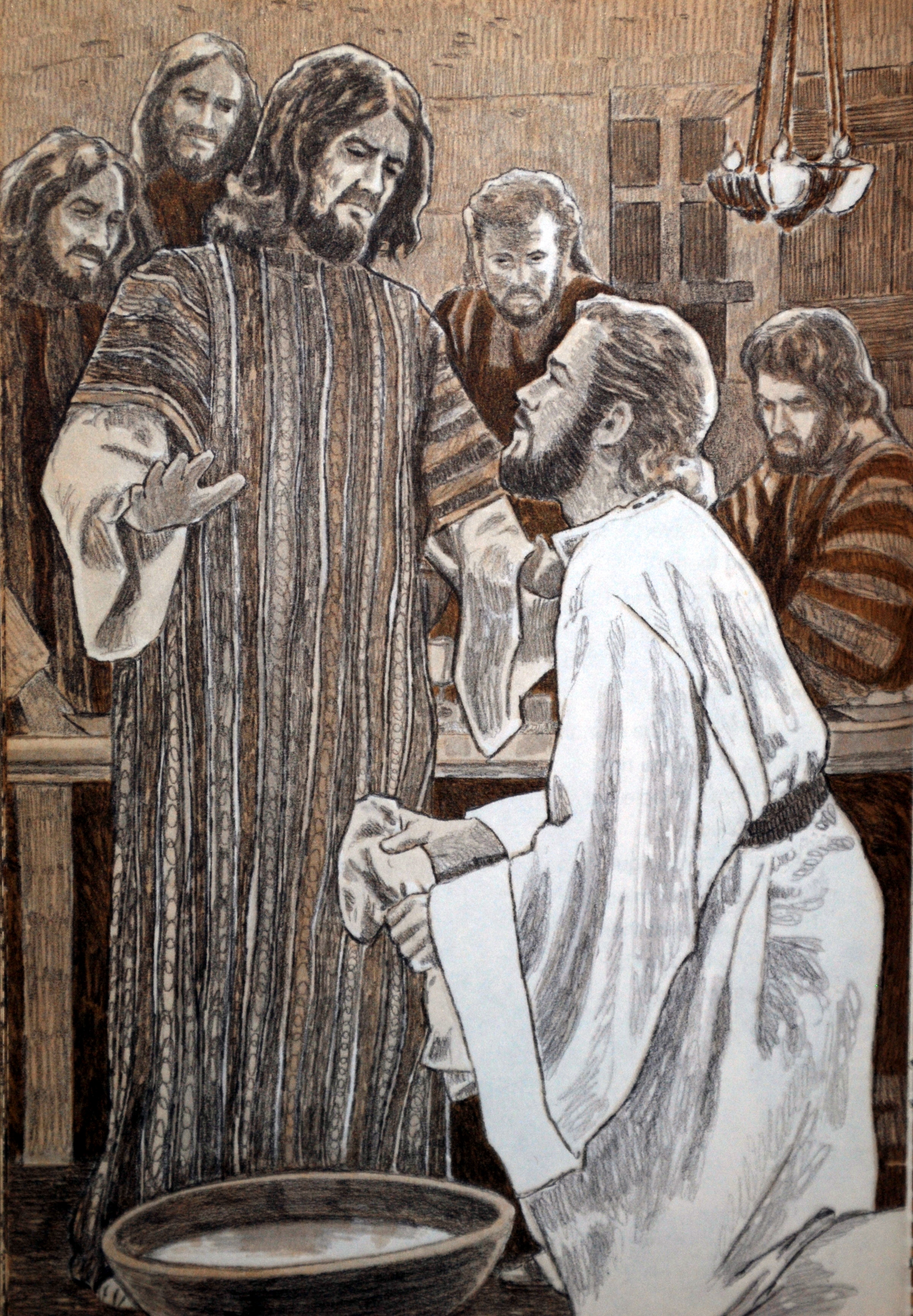
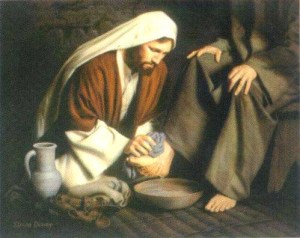
Verse 4 & 5: (He) rose from supper. He laid aside his outer garments, and taking a towel, tied it around his waist. Then he poured water into a basin and began to wash the disciples’ feet and to wipe them with the towel that was wrapped around him.
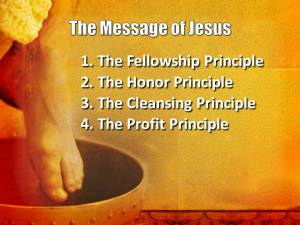
When Jesus took his outer garments off, he was taking on the dress of a slave. This would have been quite shocking to these Jews. Slaves were non-people, treated like livestock, property.

The rich used slaves to have their feet washed. The poor would set water by the door and you would wash your own feet. Roads were dusty, dirty, and muddy in ancient Palestine. There was no asphalt or concrete. No curbs and gutter. Travel was along footpaths that were dusty when hot, muddy when wet. The custom was to bath in the morning, but by the dinner hour, feet would need to be washed because they would be filthy with the grime of the streets.

For some reason this had not been done. Perhaps the disciples were stressed by the busy week, but perhaps Luke sheds light on why their feet were not washed. I am sure the disciples, being poor, would take turns washing each other’s feet. However, Luke reveals something that had been discussed that evening.

Luke 22:24-30 A dispute also arose among them, as to which of them was to be regarded as the greatest.
The disciples had been arguing over who would hold the leading positions in the government Jesus was about to set up (cp. Luke 22:24; Mark 10:35-45, esp. Mark 10:41). The discussion was heated. They were caught up in the ambition for position and power and authority.[2]

Jesus needed His disciples to realize that the glory of the Gospel is through death and service, not through position and authority.

Jesus had to get this truth across forcibly enough that they would never forget it as long as they labored for the Gospel.

I want to correct the picture of the Last Supper that most of us have from Da Vinci. Unlike his painting, the disciples reclined on their left side, leaving their right hand free to eat. This accounts for the fact that John lay “on Jesus’ breast,” as his head was right next to Jesus’ head. It is clear also that Judas lay on the other side of Jesus. Somehow, he had managed to place himself next to Jesus, which later allowed Jesus to hand him a piece of bread to indicate that he was the traitor.

So as they were all reclined around the table, about to eat, the disciples began to argue over who was greatest. Like children who won’t do their assigned work (washing the dishes, for instance) because they are angry at each other, they refuse to acknowledge whose turn it is, until one is made to do it by a wise parent. This was happening in the Upper Room as the argument over who was the greatest went on. Each of the disciples said to himself, “I’m not about to wash that turkey’s feet! I am above all that. We’re about to see the Messiah manifest himself as the Deliverer” and “I’m so close to Jesus I shouldn’t have to do this kind of work.” However, Jesus waited until they were all reclining around the table, no one having offered to do the foot washing. Without a word he rose, took off his garments (reducing himself to the position of a slave), and, kneeling in front of each disciple in turn, including Judas, washed his feet and dried them with a towel. They were shocked, stunned, and embarrassed. They did not know what to make of this.
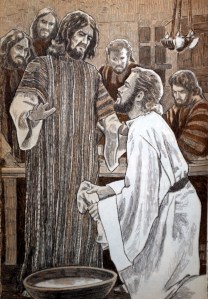
Jesus came to Peter, and he protested, “Lord, do you wash my feet?” Jesus answered, “What I am doing you do not understand now, but afterward you will understand.” Peter said, “You shall never wash my feet!” Jesus said, “If I do not wash you, you have no share with me.”

John 13:9-11 Simon Peter said to him, “Lord, not my feet only but also my hands and my head!” Jesus said to him, “The one who has bathed does not need to wash, except for his feet, but is completely clean. And you are clean, but not every one of you.” For he knew who was to betray him; that was why he said, “Not all of you are clean.”

Now here Jesus is illustrating Spiritual Truths through a Physical example. They certainly understood the need to wash your feet after a day of walking. They understood what he meant by being clean from your daily bath. But Jesus wanted them to see that they were clean in Him, as Peter had confessed that Jesus is the Messiah. The clean that Jesus provides is at once for past, present and future sins. Romans says we are justified before God – Romans 3:24 “we are justified by his grace as a gift.” We are declared righteous. We are saints. But Jesus through this one example of washing their feet illustrated Four Spiritual Truths:

1.  The Fellowship Principle

Jesus wanted them to see that the dirt of this life accumulates and must be washed, it must be cleansed, or it will keep us from sharing in Jesus. Here our Savior was showing the power of His hands. All things had been placed in His hands, even the power to wash us from our daily sins.

We are clean before God, but sin in our life will hinder our fellowship with Jesus. It will cause us to lose passion and desire for Him and what He wants to accomplish.

No matter how you fail Him after your salvation, no matter how despicable or horrid or selfish your sin is, all things have been given to His hands. Let Him wash your feet through the power of His Word. He is faithful to cleanse us from all unrighteousness.

This is the advice of 1 John 1:5-10

1 John 1:5-10 This is the message we have heard from him and proclaim to you, that God is light, and in him is no darkness at all. If we say we have fellowship with him while we walk in darkness, we lie and do not practice the truth. But if we walk in the light, as he is in the light, we have fellowship with one another, and the blood of Jesus his Son cleanses us from all sin. If we say we have no sin, we deceive ourselves, and the truth is not in us. If we confess our sins, he is faithful and just to forgive us our sins and to cleanse us from all unrighteousness. If we say we have not sinned, we make him a liar, and his word is not in us.

One point of information for your understanding of the Blood of Christ.

Jesus washed their feet with water, not blood. Sometimes we will say we need to be cleansed through the blood, but that really is a onetime thing.
The blood of Jesus Christ, God’s Son, cleanses us from all sin — past, present, and future — in one application. There is only one sacrifice. Hebrews 10:14 says: “For by one offering He has perfected for all time those who are sanctified.”

When you and I came as sinners to Christ Jesus, it was His shed blood that once and for all cleansed us, justified us, redeemed us and gave us a righteous standing before God.

Romans 3:24-25 and are justified by his grace as a gift, through the redemption that is in Christ Jesus, whom God put forward as a propitiation by his blood, to be received by faith. This was to show God’s righteousness, because in his divine forbearance he had passed over former sins.

However, we get our feet dirty with sin along our journey. We need washing. Jesus washed the disciple’s feet to illustrate this. But what washes us? It is no more than the Word of God, for the Bible says if we agree with Him about our sins, He is faithful and just to cleanse us. If we disagree, we call God a liar, and the power of His word is not in us.

Therefore, the power of the Gospel applies to sins past present and future, and it has power to keep us clean so that we can enjoy fellowship with our Lord Jesus Christ.

Ephesians 5:26 that he might sanctify her, having cleansed her by the washing of water with the word…

But more than 1 John 1:9, Jesus wants us to understand that the Gospel is not man’s wisdom, not man’s standing, not man’s righteousness.

Do you understand what I have done to you? You call me Teacher and Lord, and you are right, for so I am. If I then, your Lord and Teacher, have washed your feet, you also ought to wash one another’s feet. For I have given you an example, that you also should do just as I have done to you.

The Gospel is the wisdom of God in the Cross. The Gospel is the Justice of the Word of God over our lives. The Gospel is the Righteousness of Christ alone. If we do not embrace the Hesed, Mishpat and tsedaqah of the Gospel, we will not enjoy the blessing that it promises us.

2. The Honor Principle.

John 13:12-17 When he had washed their feet and put on his outer garments and resumed his place, he said to them, “Do you understand what I have done to you? You call me Teacher and Lord, and you are right, for so I am. If I then, your Lord and Teacher, have washed your feet, you also ought to wash one another’s feet. For I have given you an example, that you also should do just as I have done to you. Truly, truly, I say to you, a servant is not greater than his master, nor is a messenger greater than the one who sent him. If you know these things, blessed are you if you do them.

Gaining by Trading

The foundational truth of Discipleship is “Gaining by Trading.” Therefore, Jesus says if you want to share with me, you will embrace this principle.

Luke 22:24-30 A dispute also arose among them, as to which of them was to be regarded as the greatest. And he said to them, “The kings of the Gentiles exercise lordship over them, and those in authority over them are called benefactors. But not so with you. Rather, let the greatest among you become as the youngest, and the leader as one who serves. For who is the greater, one who reclines at table or one who serves? Is it not the one who reclines at table? But I am among you as the one who serves. “You are those who have stayed with me in my trials, and I assign to you, as my Father assigned to me, a kingdom, that you may eat and drink at my table in my kingdom and sit on thrones judging the twelve tribes of Israel.

Jesus says “It shall not be so among you,” indicating his rejection of hierarchical authority in the church. Here in John, he says, “I have given you an example that you also should do as I have done to you.”

The Gospel is not about position or authority. It is about humble service to others. It is about meeting the needs of others, regardless of their position or authority.

Romans 12:10 Love one another with brotherly affection. Outdo one another in showing honor.

Regardless of your position in the church, or workplace, or home, we must remember that we are not greater than our master. A wife is not greater than her husband, a husband is not greater than God, an employee is not greater than his boss, a boss is not greater than God. A deacon is not greater than the pastor, a pastor is not greater than God.  Jesus realized that He too was under God’s authority. He wanted His Disciples to realize they should not seek to exalt themselves as they work for the sake of the Gospel.

We are all under authority, and as such none of us is exempt from serving. When we realize and continually do this Christ says we will be blessed.

To embrace the Honor Principle, you must embrace God’s Unfailing Love that extends to each one, even those we do not like. His Hesed working in our life instead of our pride will motivate us to love and honor those around us, especially those authorities God has placed in our life. It will motivate those in authority to love and honor those under his employ or care.

So an employee serves his boss, and a boss serves his employee. A wife serves her husband, and a husband serves his wife. A deacon serves his pastor, and his pastor serves the deacon. Regardless of your position there is an obligation of service, because we are all under God’s authority.

There are no “But’s” to the Honor Principle.

You don’t say I will not honor him because he’s a lousy boss. I will not honor him because he is a lousy husband. Jesus honored Judas when he knew Satan had entered his heart. In effect, Jesus was honoring Satan. The Honor Principle defies man’s wisdom and points out the wisdom of the cross!

  • 1 Timothy 6:1 Let all who are under a yoke as slaves regard their own masters as worthy of all honor, so that the name of God and the teaching may not be reviled.
  • Philippians 2:1-8 So if there is any encouragement in Christ, any comfort from love, any participation in the Spirit, any affection and sympathy, complete my joy by being of the same mind, having the same love, being in full accord and of one mind. Do nothing from rivalry or conceit, but in humility count others more significant than yourselves. Let each of you look not only to his own interests, but also to the interests of others. Have this mind among yourselves, which is yours in Christ Jesus, who, though he was in the form of God, did not count equality with God a thing to be grasped, but made himself nothing, taking the form of a servant, being born in the likeness of men. And being found in human form, he humbled himself by becoming obedient to the point of death, even death on a cross.
  • Ephesians 6:5-8 Slaves, obey your earthly masters with fear and trembling, with a sincere heart, as you would Christ, not by the way of eye-service, as people-pleasers, but as servants of Christ, doing the will of God from the heart, rendering service with a good will as to the Lord and not to man, knowing that whatever good anyone does, this he will receive back from the Lord, whether he is a slave or free.

3. The Cleansing Principle
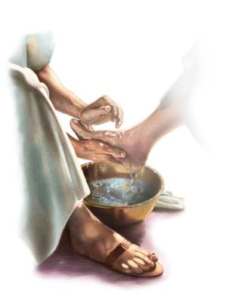
Jesus indicated we need a daily spiritual cleansing from the dirt of this world. When He exhorted His disciples to do as He did, he charged them with the responsibility of cleansing each other. We have a ministry to one another to help keep our spiritual feet clean.

Followers of Jesus are to be servants, not putting up walls, but building bridges. Walls are erected on a foundation of sin and fleshly pride. Bridges are built because of God’s Justice. When we bring God’s Justice into our lives, and respond to His Word by serving other brothers, feet are cleansed, disciples are encouraged, and the Body is blessed with healthy growth.

When flesh and pride prevent the Justice of God’s Word, the body is not cleansed, it gets dirty and Satan has a foothold. That is what happened when the Disciples focused on themselves rather than on the Lord. Judas focused on himself, money, and power and Satan was given a foothold.

Just as Jesus cleansed His disciples, so do we cleanse each other through our service to each other. This brings cleansing and encouragement and keeps the body healthy.

James 5:16 Therefore, confess your sins to one another and pray for one another, that you may be healed. The prayer of a righteous person has great power as it is working.

Hebrews 12:12-15 Therefore lift your drooping hands and strengthen your weak knees, and make straight paths for your feet, so that what is lame may not be put out of joint but rather be healed. Strive for peace with everyone, and for the holiness without which no one will see the Lord. See to it that no one fails to obtain the grace of God; that no “root of bitterness” springs up and causes trouble, and by it many become defiled;

4. The Profit Principle

Jesus shocked his disciples with what He did. This was unheard of. Peter protested most of all. But Jesus said, “if you do not let me do this you will have no share with me.” Jesus wanted His Disciples to see that Jesus was willing to go beyond what was expected to show His love for them. If they wanted to share with Jesus, they must follow His example, and do more than what is expected of them.

Following Jesus is not about position or accomplishments or degrees or knowledge. Following Jesus is about service beyond what people expect. It is along the Waste Principle we saw last week, it is the Second Mile Principle that Jesus preached on the Mount. If you want the power of Jesus in your life, if you want to share in the beauty of His Love and Glory, you will embrace this profit principle. Jesus taught it in Luke 17.

Luke 17:7-10 “Will any one of you who has a servant plowing or keeping sheep say to him when he has come in from the field, ‘Come at once and recline at table’? Will he not rather say to him, ‘Prepare supper for me, and dress properly, and serve me while I eat and drink, and afterward you will eat and drink’? Does he thank the servant because he did what was commanded? So you also, when you have done all that you were commanded, say, ‘We are unworthy servants; we have only done what was our duty.’ ”

Duty serves most Christians well. They feel good about their religion as long as they are doing such and such. For each one it is different. It can be attendance, tithe, reading the Bible. We feel close to God as long as we are fulfilling our ‘duty’ as we perceive it.

Jesus wants us to see that following Him is much more than ‘fulfilling a duty’. If we are to be profitable to Jesus, if we are to share with Him, we must go beyond our perceived ‘duties’ and serve when it is not expected.

This is the Victory that is in the Righteousness of Christ. If you are living your Christian life as a duty, you are walking in the flesh. You are serving in your own strength. You can ‘handle’ the Christian life.

However, Righteousness and sharing with Christ comes only as you go beyond what you can naturally do, or handle. When your service forces you to rely on Christ because you cannot do it, that is when you share with Christ. That is when His Righteousness is yours. You depend upon Him.

Ephesians 6:7 Rendering service with a good will as to the Lord and not to man,

2 Corinthians 4:5 For what we proclaim is not ourselves, but Jesus Christ as Lord, with ourselves as your servants for Jesus’ sake.

The Promise attached:

John 13:17 If you know these things, blessed are you if you DO them.

If you know these things, blessed are you if you do them. Mother Teresa discovered the joy and blessing of service. After all, service for the sake of others is the Gospel in its simplest form.

Mother Teresa

Mother Teresa lived her life by the simplicity of the Gospel and experienced great Joy through the power of Jesus: Mother Teresa sang a hymn to joy that went like this:

Joy is prayer
Joy is strength
Joy is love
Joy is a net of love by which you can catch souls.

She said: “The best way to show our gratitude to God and the people is to accept everything with joy.”

  • “Never let anything so fill you with sorrow as to make you forget the joy of the Risen Christ.”
  • “We all long for Heaven where God is, but we have it in our power to be in Heaven with him right now to be happy with him at this very moment.

But being happy with him now means:

  • loving as he loves
  • helping as he helps;
  • giving as he gives
  • serving as he serves
  • rescuing as he rescues
  • being with him 24 hours a day[3]

Whose feet will you wash today?


[2] The Preacher’s Outline & Sermon Bible – John, (Chattanooga: Leadership Ministries Worldwide, 1991), WORDsearch CROSS e-book, Under: “XIII. THE REVELATION OF JESUS, THE GREAT MINISTER AND HIS LEGACY, 13:1-16:33”.

[3] “Mother Teresa—Messenger of God’s Love” by E.Le Joly.


I don’t believe we fully understand how bad off Job was. I have been with many people who were suffering from the pain of cancer, of burns, and it is horrible. Thank God they were always on morphine or some other drug to keep them comfortable. Most of us know what pain is, even constant pain, but Job experienced something that I don’t think we can begin to relate to.

Job 2:7-8 So Satan went out from the presence of the LORD and struck Job with loathsome sores from the sole of his foot to the crown of his head. And he took a piece of broken pottery with which to scrape himself while he sat in the ashes.

Most people think he had some skin disease that resulted in pussy sores or boils (Hebrew word sehiyn). But I believe it was much more painful and deadlier than that. Hezekiah had šehiyn’s and he nearly died from just one. The Lord told the physician to put figs on the šehiyn and he was healed[1].

If Satan is given permission to mess with your body, I don’t think he throws any punches. He had a whole arsenal of diseases, and I think he picked one we call MRSA. Have you ever had MRSA. It’s a horrible bacterial infection. MRSA not only attacks your skin, it can get into your bloodstream, heart or lungs, even your urinary tract It can produce:

Chest pain, Chills, Cough, Fatigue, Fever, General ill feeling (malaise), Headache, Muscle aches, Rash and even Shortness of breath.

Study Job and you will find he displayed all of those symptoms. If you ever had a MRSA boil you know you can try and get it to pop, but the infection can go down so far, nothing relieves the pain and the burning. Imagine one big MRSA boil being able to torment your life and cause all those symptoms, and even causing your death. Now imagine 200 or 300 of them all over your body. I don’t think we can even begin to imagine the pain he was in. I mention this because as bad as some bacteria infections are, they don’t begin to compete with the pain and the damage caused by the DSCR virus.

The CDC doesn’t want you to know it, and it is kept out of the press for fear of inciting public outcry and fear, but the DSCR Virus is on the verge of being a pandemic.

You never heard of the DSCR virus? Let me tell you about it.

Once upon a time the devil decided to have a garage sale. He did it because he wanted to clear out some of his old tools to make room for new ones. After he set up his wares, a fellow dropped by to see what he had. Arrayed on a long table were all the tricks of his infernal trade. Each tool had a price tag. In one corner was a shiny implement labeled “Anger—$250,” next to it a curved tool labeled “Sloth—$380.” As the man searched, he found “Criticism—$500” and “Jealousy—$630.” Out of the corner of his eye, the man spotted a beaten-up tool with a price tag of $12,000. Curious, the man asked the devil why he would offer a worn-out piece of junk for such an exorbitant price. The devil said it was expensive because he used it so much. “What is it?,” the man asked. The answer came back, “It is discouragement. It always works when nothing else will.”[2]

Yes, the DSCR virus is cause of that ancient malady, discouragement. It is the Devil’s favorite way of destroying Disciples, of rendering them powerless, and yes, even causing their death.

We all know from hard experience how the devil uses the DSCR Virus to keep us from moving ahead. When anger won’t stop us, when lust can do us no harm, when envy finds no foothold, discouragement always works. It is the devil’s number one tool.

Free Dictionary defines discouragement as “the feeling of despair in the face of obstacles[3].  Wordreference.com says to discourage is to “Cause (someone) to lose confidence or enthusiasm”.

The opposite is encourage, which is to put courage, confidence and enthusiasm into someone. Discouragement is anything that takes the courage out of someone. DSCR is a dangerous virus. It literally sucks the spiritual vitality out of you.

The DSCR virus causes your heart to be weaken and calcify, and then it messes with your eyesight and finally moves to destroy your soul.

Let’s look at what it did to David…in 1 Samuel 27

J Vernon McGee wrote this about this chapter in his “Thru the Bible Commentary”

Here is David — discouraged, despondent — doing something he should not have done. He leaves the land of Israel and goes to live among the Philistines. There is nothing in this chapter that would reveal that David is a man of God.[4]

That is his only comment on this chapter in his commentary. There is nothing more to learn, so he moves on. I believe 1 Samuel 27 is rich in application for Disciples. Look at the first verse:

1 Samuel 27:1 Then David said in his heart, “Now I shall perish one day by the hand of Saul. There is nothing better for me than that I should escape to the land of the Philistines. Then Saul will despair of seeking me any longer within the borders of Israel, and I shall escape out of his hand.”

1. David Settled.

David Said in his Heart…I shall perish by the hand of Saul…There is Nothing Better for me…

This is not the David I know. I can see why Dr. McGee wanted to skip ahead.

I see David as a Confident Leader:

  • Psalm 7:9-10 Oh, let the evil of the wicked come to an end, and may you establish the righteous— you who test the minds and hearts, O righteous God! My shield is with God, who saves the upright in heart.

I see David as the picture of Braveheart:

  • Psalm 37:30-31 The mouth of the righteous utters wisdom, and his tongue speaks justice. The law of his God is in his heart; his steps do not slip.

“tell our enemies that they may take our lives, but they’ll never take… OUR FREEDOM!” MY FEET WILL NEVER SLIP AWAY FROM YOU O GOD!

I see him ALWAYS Trusting in God:

  • Psalm 61:1-4 Hear my cry, O God, listen to my prayer; from the end of the earth I call to you when my heart is faint. Lead me to the rock that is higher than I, for you have been my refuge, a strong tower against the enemy. Let me dwell in your tent forever! Let me take refuge under the shelter of your wings! Selah

But Discipleship is hard. It is a constant battle. You can never let your guard down, because there is an epidemic of DSCR going around. It is highly contageous. Just one case of DSCR can break out in a church and drag the whole church down.

Discouragement can be caused by a lot of things. Rick Warren says there are four major causes: Fatigue, Frustration, Failure and Fear.

David had been on the run for over 8 years now. He had experienced major victories in his life and walk before God. He had spared Saul’s life once in the cave at En Gedi (I Samuel 24). Then he had spared Nabal’s life when Abigail interceded (I Samuel 25). Then he had very recently spared Saul’s life again when he crept into the camp and found Saul sleeping (I Samuel 26).  You would think that he was unstoppable, that he was a Spiritual Giant. But he was a man like you and me. He was vulnerable to the DSCR virus.

Certainly he could have grown weary from the constant pressure, he could have grown frustrated by God’s seeming inactivity, he could been in one of those moments where it seemed he had failed, he could have finally given in to the fear that certainly was warranted by his circumstances.

But I think David was Discouraged because he let his circumstances lead him to SETTLE.

We hear all the time: “HANG ON, HANG TOUGH, HANG IN THERE” but God never, never settles. He never never hangs in there! God is an Overcomer and He wants us to be Overcomers! Overcomers never settle, never hang in there, they always move forward to Victory!

God practices and delights in Righteousness. The Key to being Righteous is the Focus of your Hope. Who you are counting on for your righteousness, who are you allowing to live through you. Simply because we feel we are not righteous, do we give up and accept our sin and failures? Do we give up praying to God because He never seems to answer? Do you give up on a son or daughter simply because they seem so set against God?

Do we say, “well that’s the way it always has been, so why fight it”? Do we give up hope and settle for our circumstances?

Remember the little widow lady?

Luke 18:1-8 And he told them a parable to the effect that they ought always to pray and not lose heart. He said, “In a certain city there was a judge who neither feared God nor respected man. And there was a widow in that city who kept coming to him and saying, ‘Give me justice against my adversary.’ For a while he refused, but afterward he said to himself, ‘Though I neither fear God nor respect man, yet because this widow keeps bothering me, I will give her justice, so that she will not beat me down by her continual coming.’ ” And the Lord said, “Hear what the unrighteous judge says. And will not God give justice to his elect, who cry to him day and night? Will he delay long over them? I tell you, he will give justice to them speedily. Nevertheless, when the Son of Man comes, will he find faith on earth?” There is a direct connection between FAITH and your heart!

Faith Never Settles. Faith Never accepts an Adversary. Faith is Always Praying. When Faith fades, we lose heart, we become discouraged. We have settled.

When you Settle instead of Struggling, your immune system gets weak and the DSCR Virus can take hold. It seeks out your HEART!

Listen to David as the DSCR virus takes hold of his heart:

  • Psalm 38:10 My heart throbs; my strength fails me, and the light of my eyes—it also has gone from me.
  • Psalm 40:12 For troubles surround me— too many to count! My sins pile up so high I can’t see my way out. They outnumber the hairs on my head. I have lost all courage.

When you can only focus on your sins instead of focusing on His forgiveness, you know the DSCR virus has infected your heart and caused you to feel defeated.

David became discouraged!

Psalm 69:1-21 Save me, O God, for the floodwaters are up to my neck. Deeper and deeper I sink into the mire; I can’t find a foothold. I am in deep water, and the floods overwhelm me. I am exhausted from crying for help; my throat is parched. My eyes are swollen with weeping, waiting for my God to help me. Those who hate me without cause outnumber the hairs on my head. … Rescue me from the mud; don’t let me sink any deeper! Save me from those who hate me, and pull me from these deep waters. Don’t let the floods overwhelm me, or the deep waters swallow me, or the pit of death devour me. Answer my prayers, O LORD, for your unfailing love is wonderful. Take care of me, for your mercy is so plentiful. Don’t hide from your servant; answer me quickly, for I am in deep trouble! Come and redeem me; free me from my enemies. You know of my shame, scorn, and disgrace. You see all that my enemies are doing. Their insults have broken my heart, and I am in despair. If only one person would show some pity; if only one would turn and comfort me. But instead, they give me poison for food; they offer me sour wine for my thirst.

God seemed distant to David. His faith could not take God’s silence, and so it became weak, until He gave up on God doing anything. He gave up believing God’s Word. He settled. He said “this is my life, Saul will kill me, and there is nothing I can do. My life is over, God has left me, I might as well do the best I can”.

WOEME

His Heart had become infected by the ‘WOEME’ disease that results from the DSCR Virus invading your heart. “WOEME” disease is deadly. It slowly attacks a person’s heart, soul and eventually their strength.

Symptoms can appear gradually, or all at once.

Faith is attacked and grows weak. God seems distant, uncaring. His Word is dry and uncomforting. Circumstances seem to careen out of control. God shrinks and circumstances grow. You react by relying on counsel from friends, or doing what seems rational, or what brings you the most comfort and safety.

2. David Skews

David said, “I shall escape out of his hand.” Wasn’t that what God had been doing for 8 years now? Why all of a sudden did he think God couldn’t protect him? Why? Because David’s vision was skewed to look only at his circumstances without the benefit of God’s Promises. WOEME Disease blinds our spiritual eyes.

  • I shall escape out of his hand…

Circumstances are distorted, and become the main influence upon your life. Not only is your life affected, but your family and friends can become infected. Your House is affected because you are reacting to God’s Design.

  • Bad Focus will cause you to lose sight of God’s Discipleship Ways
  • Bad Focus will cause you to react to God’s Lessons, and He will stop teaching you His Paths!

Psalm 25:4-5 Make me to know your ways, O LORD; teach me your paths. Lead me in your truth and teach me, for you are the God of my salvation; for you I wait all the day long.

David settled for his own path, because he stopped learning from God.

Discouragement is a Disciple Killer!

Now, if you asked David if he was discouraged, he would shake his head and say “no, not at all”. I still love God and follow him. I just think this is best for all of us. I don’t know why I didn’t do it sooner. (Flashback: You did try it and it didn’t work too good)

Most Christians will tell you they are not discouraged either, they are just doing what’s best.

I hear them all the time. They have excuses for not going to church, excuses for not reading their Bible, excuses for working on Sunday, excuses for gossiping, excuses for dishonoring authorities. But what is at the heart of our decision to go our own way and do what is best for us? Could it be that mistrust of God has allowed the DSCR virus to take hold of our heart?

Think about it.

  • ENCOURAGE vs DISCOURAGE
  • IN GOD vs DISTANT FROM GOD
  • IN THE COURAGE OF GOD vs DISTANT FROM THE COURAGE OF GOD
  • CONFIDENT IN GOD vs CONFIDENCE IN SELF
  • OBEDIENCE TO GOD vs OBEDIENCE TO SELF
  • IN THE WORD vs IN THE WORLD
  • IN vs DIS

Do you see it? The DSCR virus attacks when we are DISTANT from God! The DSCR virus can develop into much more than discouragement, or “WOEME” disease.

Look at all the other side effects:

  • Disheartened by obstacles, failure, or criticism
  • Distressed and fearful, lacking courage and confidence
  • Disillusioned, losing hope for the future
  • Disinterested, apathetic, lacking initiative
  • Doubtful about the value of certain actions
  • Down on himself/herself, with a poor sense of worth
Bottom Line

 It develops into estrangement from God’s Word and justification for a selfish course of action.

Let’s Examine David a little Closer. What was the result of his heart sickness that led him to think he had to settle and move to Philistia for protection.

A. David’s Perspective was SKEWED

Skew is :1350–1400;  (v.) Middle English skewen  to slip away, swerve.[5]

It all begins when David starts to think about his situation. For nearly nine years he’s been running from Saul, Doeg, Ziphites, Abner, 3000 trained killers, fools, you name it, David had encountered them.
  • He chooses to focus on what might happen instead of what has happened.
  • He chooses to focus on his own resources instead of God’s promises.

David writes God out of the picture. He thinks it is all up to him, and he has to do what a man has to do. After all God helps them that helps themselves! No, that is a lie of Satan. That statement alone is used to justify actions that are not dependant upon God, but dependant upon man. It is a fleshly statement, a worldly philosophy that will lead you away from God and into the arms of Satan.

B. He Made a Dumb Decision.

1 Samuel 27:5-6 Then David said to Achish, “If I have found favor in your eyes”

He sought the approval of an ungodly enemy.

Have you ever made a dumb decision? At the time you made it it seemed the best thing to do, but later on you realize what a dumb thing to have done. Thankfully God forgives us of our dumb decisions. God allows us to learn from our dumb decisions, and become mighty disciples. In fact, those dumb decisions wake us up to the fact that our life is out of whack with God. It’s important that we not hold those dumb decisions against a repentant heart, which David later had.

C. His Decision Led to Compromise.

1 Samuel 27:6-7 So that day Achish gave him Ziklag. Therefore Ziklag has belonged to the kings of Judah to this day. And the number of the days that David lived in the country of the Philistines was a year and four months.

The children of Israel were not to mix with the surrounding nations. Over and over the warning was given and every time somebody tried it, disaster resulted. David knew all that and he did it anyway. I’m sure if you had asked David as he led his band toward Gath, “Are you deserting God?” he would have said no. He probably would have been insulted by the very question. “Me, desert God? Are you kidding? I believe everything I always believed.” “But David, these are not God’s people.” “It makes no difference. I’m going to go live there for a while until the pressure is off. It’s not a big deal. I can have my quiet time in Gath just as easily as I can in Israel.”

We always have an excuse when we compromise. Some of us are doing it right now. We are involved in some things that would shock anyone if they knew the truth. We said something, we’ve done something that we normally wouldn’t do, but we feel we have a good excuse. You know you are compromising when you have to explain away some command of God in order to justify what you are doing.

You can be singing louder than anyone this morning, writing a big check for the offering, and be a compromiser. When the lights have faded, friends have gone, you are laying in bed thinking about your life, you have to ward off the discouragement with music or pills or alcohol.

Achish gave the city of Ziklag to David and his men and their families.  Ziklag is a variation of Zahaliku, which means downward slopes[6]

Taking your eyes off God and His Word, and then depending upon yourself or other people to do what’s best for you, often leads us slowly downward until we end up doing things we  never dreamed we would do. What starts as a fleeting thought or reaction becomes a plan, a plan becomes a commitment, and eventually a commitment becomes a lifestyle. We cope with our weaknesses by settling down and living with them as friends.

3. David Stews

1 Samuel 27:8-11 Now David and his men went up and made raids against the Geshurites, the Girzites, and the Amalekites, for these were the inhabitants of the land from of old, as far as Shur, to the land of Egypt. And David would strike the land and would leave neither man nor woman alive, but would take away the sheep, the oxen, the donkeys, the camels, and the garments, and come back to Achish. When Achish asked, “Where have you made a raid today?” David would say, “Against the Negeb of Judah,” or, “Against the Negeb of the Jerahmeelites,” or, “Against the Negeb of the Kenites.” And David would leave neither man nor woman alive to bring news to Gath, thinking, “lest they should tell about us and say, ‘So David has done.’ ” Such was his custom all the while he lived in the country of the Philistines.

David got in to a stew of lies, deception and murder. He and his men found safety, but at what cost. David was like Lot who chose the well watered plain, and whose soul became tormented because of the sin surrounding him. Compromise often leads us to a stew. Have you ever heard the idiom: “stew in one’s own juice”? It means to suffer the consequences of one’s own actions. “Stew” comes from a Middle English word from the 1350’s “stewen or stuwen” –  to take a sweat bath!

Oh, I’m sure David justified his actions. After all, God had commanded Joshua to kill all the Geshurites, the Girzites, and the Amalekites. I’m sure he thought he was actually doing God’s Will!

Not only is David living a lie, but now all the men and their families are involved as well. David had to keep trying to please Achish by lying about his raids, and hope that no one ever escaped or witnessed what they were doing. If David had any conscience at all, it must have been tormenting him like crazy.

When we compromise, we’ll always end up in a stew. Not only us, but we often take others with us. Our lies and selfishness can hurt a lot of people. The saddest think about taking our eyes off God, and spreading the DSCR virus, it quenches the Holy Spirit. It can even remove the Blessing of God.

4. David Stinks

1 Samuel 27:12 And Achish trusted David, thinking, “He has made himself an utter stench to his people Israel; therefore he shall always be my servant.”

David didn’t think he stunk. In fact, he thought, I’ve done a good thing. I am ridding the land of foes of old, more mighty men are coming to me, the Philistines think I’m with them, I don’t have to sleep with one eye open, the men are spending time with their wives and having babies. Life is good. King Saul is a distant worry. Verse 4 says Saul stopped looking for David, and vs 12 says Achish was very pleased with David.

The Devil stopped pursuing David and the world was OK with him.

If he was a good Southern Baptist he would be standing up and saying “look how God has blessed me!” Things were going well. He gets up in the morning about nine, reads the Ziklag Gazette, goes down to the gym to work out with the boys, in the afternoon he raids a nearby village, and in the evening maybe there’s a feast. Not a bad life. Disobedience often results in a temporary lessening of pressure. But God always has the last word, and David was about to come face to face with God!

5. Disciples Seek

After the Israelites heard the report of the spies, they became afraid, their faith in God’s Word went to nothing, and they decided not to trust God and depend upon Him to conquer the giants. At that point the message of God came to the people through Moses. Moses pronounced the judgment of God upon the people, that they would all perish in the wilderness and never enter the promised land. They reacted by trying to go ahead and enter the promised land.

Deuteronomy 1:41-42 “Then you answered me, ‘We have sinned against the LORD. We ourselves will go up and fight, just as the LORD our God commanded us.’ And every one of you fastened on his weapons of war and thought it easy to go up into the hill country. And the LORD said to me, ‘Say to them, Do not go up or fight, for I am not in your midst, lest you be defeated before your enemies.’

The people went anyway, and were defeated, and lived the rest of their lives in the wilderness. They settled, they skewed, they stewed, and eventually they stunk as rotting corpses in the desert. O, they still went to church, they still enjoyed their grandkids, but they were walking as defeated corpses, defeated because they failed to trust God when it counted.

Moses Fell Down Before the Lord

When God was giving the two tablets of stone to Moses, a great noise came to his ears from the base of the mountain. God told Moses to hurry up and get down there, because the people had corrupted themselves.

Deuteronomy 9:12 And Jehovah said unto me, Arise, get thee down quickly from hence; for thy people that thou hast brought forth out of Egypt have corrupted themselves; they are quickly turned aside out of the way which I commanded them; they have made them a molten image.

This word shāat[7]was used before as God described why He destroyed the earth in the flood:

Genesis 6:11-12 And the earth is corrupt before God, and the earth is filled with violence. And God seeth the earth, and lo, it hath been corrupted, for all flesh hath corrupted its way on the earth.

God’s world became corrupt because the people took their focus away from God and placed it upon themselves. The Jews became corrupt when they removed their focus from God and placed it on themselves, corrupted by the thinking of the fleshly Egyptians.

Once again, at that point, God told Moses that He would destroy those people, and Moses could start over with an uncorrupted group of people.

Moses pleaded with God, and then fell on his face before the Lord for 40 days and night, neither eating or drinking, and God relented of His plan.

DISCR anything-discourage, disenfranchised, discord, disheartened, disillusioned, distant is all dangerous, because it comes from a heart that had been corrupted by wrong influences, wrong thinking, wrong focus and wrong people.

If we want to keep wandering around as stinking corpses, we will not change. But if we want to experience victory, grow in faith, grow in Jesus Christ, grow to the point where we are seeing people saved, we are seeing Disciples grow and develop, then we need to fall on our face before the Lord. We need to confess our sin, we can’t settle, we must keep coming before our Father against any adversary and let Him know that we still have Faith we still believe His word.

James 4:4-10 You adulterous people! Do you not know that friendship with the world is enmity with God? Therefore whoever wishes to be a friend of the world makes himself an enemy of God. Or do you suppose it is to no purpose that the Scripture says, “He yearns jealously over the spirit that he has made to dwell in us”? But he gives more grace. Therefore it says, “God opposes the proud, but gives grace to the humble.” Submit yourselves therefore to God. Resist the devil, and he will flee from you. Draw near to God, and he will draw near to you. Cleanse your hands, you sinners, and purify your hearts, you double-minded. Be wretched and mourn and weep. Let your laughter be turned to mourning and your joy to gloom. Humble yourselves before the Lord, and he will exalt you.


[1] Warren Baker and Eugene Carpenter, The Complete Word Study Dictionary – Old Testament, (Chattanooga, TN: AMG Publishers, 2003), WORDsearch CROSS e-book, Under: “sehyin”.

[4] J. Vernon McGee, Thru The Bible with J. Vernon McGee, (Nashville, TN: Thomas Nelson, 1983), WORDsearch CROSS e-book, Under: “CHAPTERS 26 AND 27”.

[7] James Strong, Strong’s Talking Greek & Hebrew Dictionary, (Austin, TX: WORDsearch Corp., 2007), WORDsearch CROSS e-book, Under: “7843”.