Posts Tagged ‘Abraham’


What you BELIEVE truly matters:

A little girl was talking to her teacher about whales. The teacher said it was physically impossible for a whale to swallow a human because even though they were a very large mammal their throat was very small. The little girl stated Jonah was swallowed by a whale. The teacher reiterated a whale could not swallow a human; it was impossible. The little girl said, “When I get to heaven I will ask Jonah.” The teacher asked, “What if Jonah went to hell?” The little girl replied, “Then you ask him.”

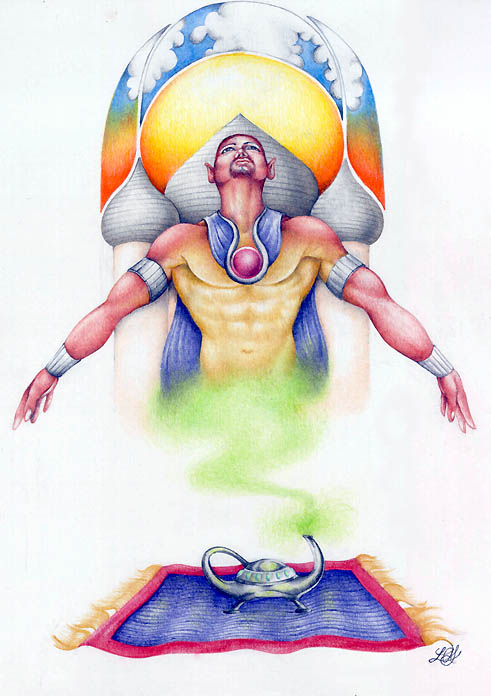
An atheist buys an ancient lamp at an auction, takes it home, and begins to polish it. Suddenly, a genie appears, and says, “I’ll grant you three wishes, Master.” The atheist says, “I wish I could believe in you.” The genie snaps his fingers, and suddenly the atheist believes in him. The atheist says, “Wow. I wish all atheists would believe this.” The genie snaps his fingers again, and suddenly atheists all over the world begin to believe in genies. “What about your third wish?” asks the genie? “Well,” says the atheist, “I wish for a billion dollars.” The genie snaps his fingers for a third time, but nothing happens. “What’s wrong?” asks the atheist. The genie shrugs and says, “Just because you believe in me, doesn’t necessarily mean that I really exist.”
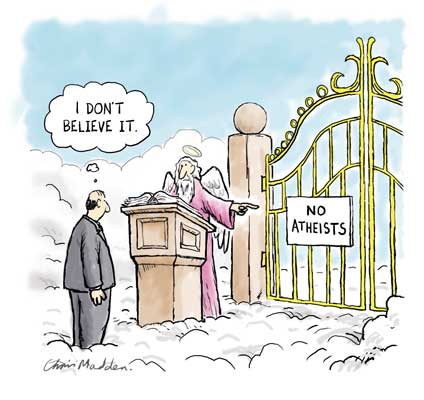
Today we will look at one of the greatest verses in the Bible. These Verses hold the Secret of Having a Christian walk that just staggers around or keeps Climbing Upward!

Romans 4:19-22 (KJV) And being not weak in faith, he considered not his own body now dead, when he was about an hundred years old, neither yet the deadness of Sara’s womb: He staggered not at the promise of God through unbelief; but was strong in faith, giving glory to God; And being fully persuaded that, what he had promised, he was able also to perform. And therefore it was imputed to him for righteousness.

Beneath the Text:

  • weak (asthenéō) = “without strength, powerless, sick”. Also “to doubt, hesitate, vacillate, as meaning weak or double-minded”. CWSD
  • considered not = “paid no attention to the physical obstacles”
  • staggered not (diakrinō ou) = To be in strife with oneself, i.e., to doubt, hesitate, waver CWSD

“to judge between two,” thus, “to vacillate between two opinions or decisions.” Abraham did not vacillate between belief and unbelief with respect to his difficulty and the ability of God to meet it. He did not waver. Wuest’s Word Studies

  • promise (epangelia) = “Primarily a legal term denoting a summons or promise to do or give something. Used only of the promises of God” (except one verse) CWSD.
  • unbelief (apistia) = uncertainty, distrust, unbelief. The lack of acknowledgment of Christ; want of confidence in Christ’s power. In general, a lack of trust in the God of promise! CWSD
  • strong (endynamoō) = grow stronger and stronger; “inwardly strengthened,” suggesting strength in soul and purpose. Vines “to make strong, endue with strength,” Wuest’s

Hebrews 11:34 (ESV) quenched the power of fire, escaped the edge of the sword, were made strong out of weakness, became mighty in war, put foreign armies to flight.

  • faith (pistis) = firm persuasion, conviction, belief in the truth, veracity, CWSD

That is, his faith was strengthened in God to meet his impossible difficulty with a miracle. The thought is not here that Abraham’s faith was strengthened so that his physical powers again became equal to bringing children into the world. Isaac was the result of a biological miracle performed by God in answer to Abraham’s faith. The glory would therefore be to God. Wuest

  • being fully persuaded (plērophoreō) = “To fulfill, thoroughly accomplish, equivalent to persuade fully, give full assurance. CWSD
  • able (dynatos) = from dunamis – “strong, powerful”. CWSD

The Point of our Text
Abraham firmly believed in what God promised, because he firmly believed in God’s power. Abraham’s belief in God allowed him to overlook the visible problems to see the power of Him who was invisible. His ability to see and trust the invisible kept him from staggering over the obstacles of doubt that surrounded him. By believing, Abraham climbed to the very heights and gave glory to the Power of God! God declared Abraham righteous because He believed Him!

Faith Is Not The Means By Which We Get God To Work In Our Lives; Faith Is The Means By Which We See His Will For Our Lives!

Unbelief and the Christian Walk

A.  Unbelief is not:

  • Unbelief is not the absence of faith.
  • Unbelief is not a negative state of mind.
  • Unbelief is not an intellectual attitude, or state, caused by a want of sufficient evidence.
  • Unbelief is not a state of blank ignorance of God and of his truth.
  • Unbelief is not the state of ignorance of the existence and attributes of God.
  • Unbelief is not disbelief or belief in the opposite of what the Bible says is true.
  • Unbelief is not an intellectual state at all.

The Bible represents unbelief as sin; therefore it is not a state of mind, it is a condition of our heart.

B.  Unbelief is:

1.  Unbelief is SIN.

Hebrews 3:12 (ESV) Take care, brothers, lest there be in any of you an evil, unbelieving heart, leading you to fall away from the living God.

2.  Unbelief is a CHOICE.

Mark 16:14 (ESV) Afterward he appeared to the eleven themselves as they were reclining at table, and he rebuked them for their unbelief and hardness of heart, because they had not believed those who saw him after he had risen.

3.  Unbelief is a lack of CONFIDENCE.

Withholding of confidence in one who is worthy of our confidence. Unbelief of the heart darkens one to committing your heart and soul to the will of God. Belief is giving God our confidence, in voluntarily yielding ourselves up to him, confiding in him, trusting in him, casting ourselves upon him, voluntarily receiving his truth, and committing ourselves to him.
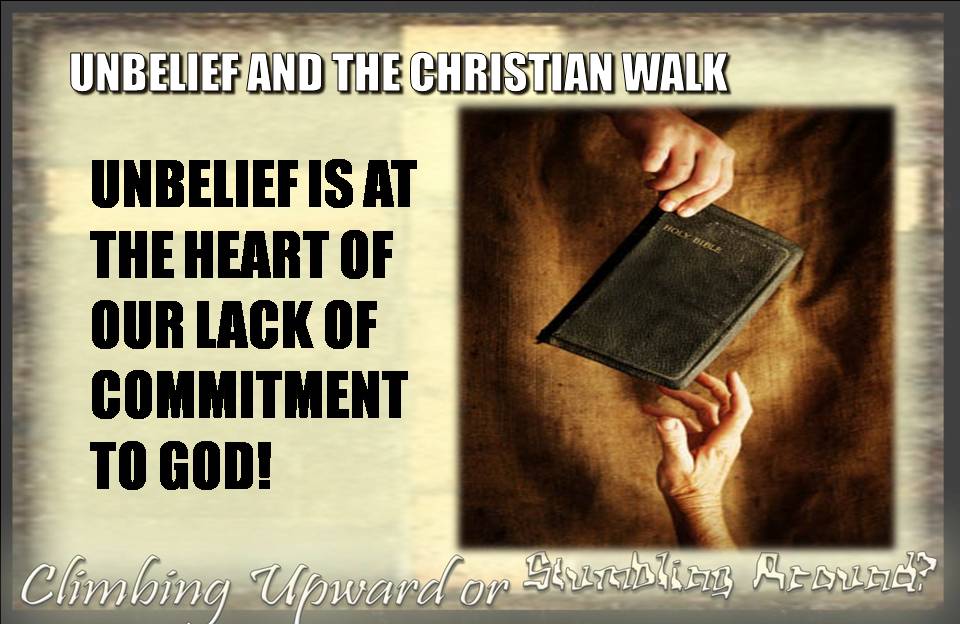
UNBELIEF IS AT THE HEART OF OUR LACK OF COMMITMENT TO GOD!

It is hard to love a God with all your heart, soul and strength if you don’t believe Him!

Let’s take a little time to understand unbelief by looking at the New Testament words for doubt and unbelief.

C.   Understanding Doubt & Unbelief

1.  Doubt: Diakrino & Distazo.

To be in strife with oneself, i.e., to doubt, hesitate, waver.  Being uncertain of what to believe or do.

  • Rom. 4:20 He staggered (diakrino) not at the promise of God through unbelief; but was strong in faith giving glory to God.
  • James 1:6 But let him ask in faith, nothing wavering (diakrino). For he that wavereth (diakrino) is like a wave of the sea driven with the wind and tossed.

This doubt comes through giving up one’s conviction of faith based on what one sees or feels.

Mat. 14:31 And immediately Jesus stretched forth his hand, and caught him, and said unto him, O thou of little faith, wherefore didst thou doubt (distazo)?

Peter was fine walking on water as long as he focused on Jesus. But as soon as he looked at his surroundings, focusing on the physical, on the wind, and the waves, he was a goner.

2.  Doubt Leads to Unbelief

Doubt, or focusing on circumstances or your own resources, allows unbelief to grow. When unbelief starts to grow, it destroys confidence, makes one uncertain, and builds distrust. Unbelief then leads to further unbelief and finally a hardening of one’s heart!

a.  Apistia
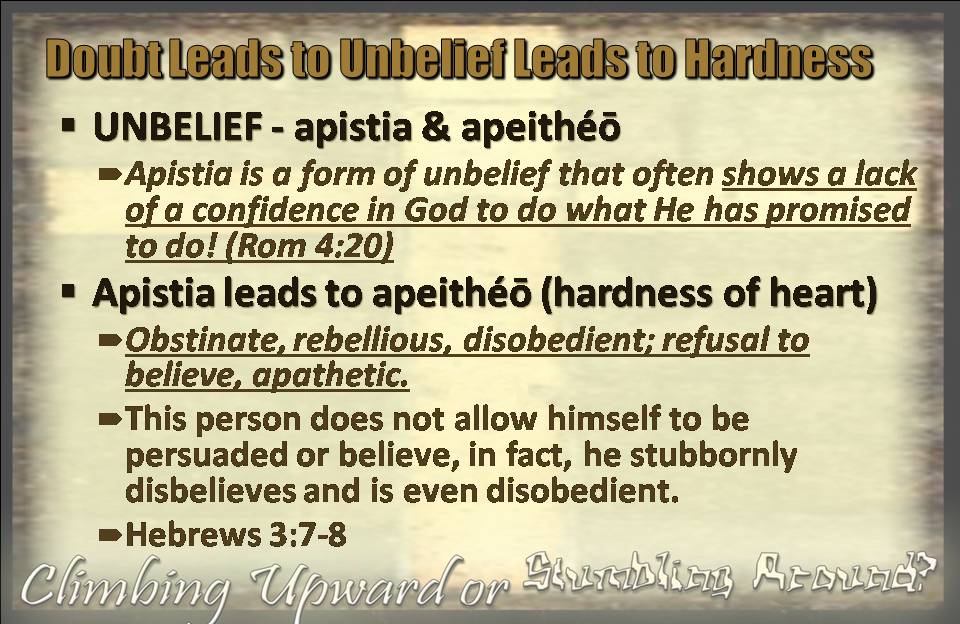
Lacking confidence in the performer, to put no confidence in, to disbelieve; uncertainty, distrust, unbelief. In general, a lack of trust in the God of promise. Apistia is a form of unbelief that often shows a lack of a confidence in God to do what He has promised to doApistia is a choice!

  • Mat. 13:58 And he did not many mighty works there because of their unbelief (apistia).
  • Heb. 3:19 So we see that they could not enter in because of unbelief (apistia).
  • Rom. 4:20 He staggered not at the promise of God through unbelief (apistia); but was strong in faith giving glory to God.

Apistia can develop into:

b.  apeithéō

Obstinate, rebellious, disobedient; refusal to believe, apathetic. A person who does not allow them self to be persuaded or believe, in fact, he stubbornly disbelieves and is even disobedient.

  • Eph. 5:6 Let no man deceive you with vain words: for because of these things cometh the wrath of God upon the children of disobedience (apeithéō).
  • Hebrews 3:7-8 (KJV) Wherefore (as the Holy Ghost saith, Today if ye will hear his voice, Harden not your hearts, as in the provocation, in the day of temptation in the wilderness:
  • Heb. 4:6 We see they entered not in because of unbelief (apeithéō). (Notice their unbelief in Heb 3 became hardened disobedient unbelief in Heb 4)
  • Heb. 4:11 Let us labour therefore to enter into that rest, lest any man fall after the same example of unbelief (apeithéō).

1. Unbelief is the Basis of all Sin
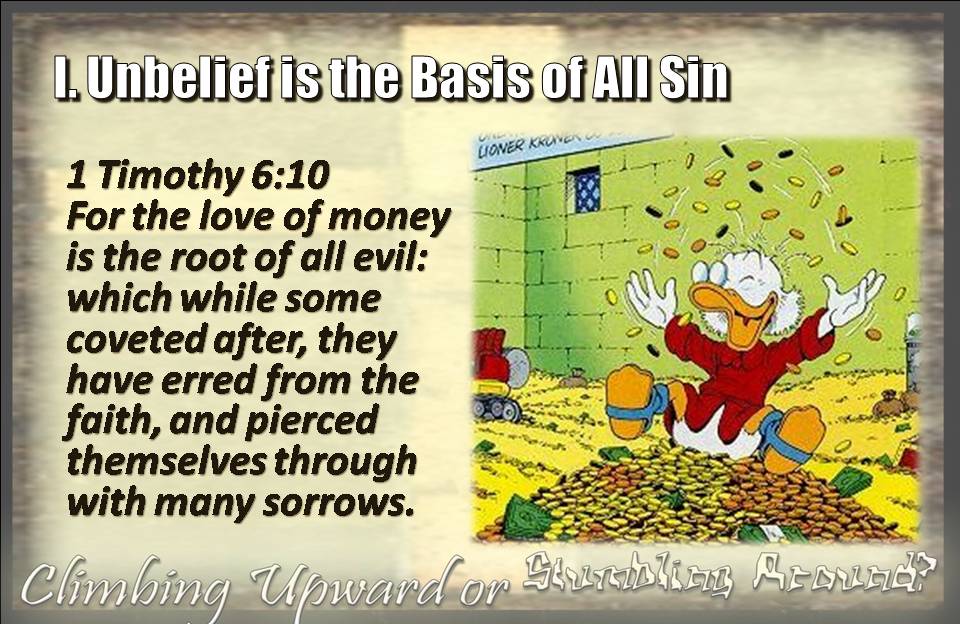
All Sins Come from Unbelief in God’s Word and Promises. Anxiety, misplaced shame, indifference, regret, covetousness, envy, lust, bitterness, impatience, despondency, pride—these are all sprouts from the root of unbelief in the promises of God.

Consider the message of 1 Timothy 6:10:

For the love of money is the root of all evil: which while some coveted after, they have erred from the faith, and pierced themselves through with many sorrows.

What did Paul mean? Is the love of money behind every sin? Is money on your mind when you sin? I believe that the evils of the world come from a certain kind of heart that loves money.  Now what does it mean to love money? It’s not being like Scrooge McDuck and going into your vault and playing with your money! What is money? Money is simply a symbol that stands for human resources. Money stands for what you can get from man, from man’s resources.

God resources can’t be bought with money! “Ho everyone who thirsts, come to the waters. He who has NO MONEY come buy and eat!” (Isaiah 55:1).

Money is the currency of human resources. So the heart that loves money is a proud, independent heart that places its hopes, pursues its pleasures, and puts its trust in what human resources can offer. So the love of money is the same as faith in money—belief (trust, confidence, assurance) that money will meet your needs and make you happy. Therefore the love of money, or belief in money, is the flip side of UNBELIEF in the promises of God.

Jesus said in Matthew 6:24—you cannot serve God and money. You can’t trust or believe in God and money.

Belief in one is unbelief in the other. A heart that loves money—banks on money for happiness, believes in money—is at the same time not banking on the promises of God for happiness. So when Paul says that the love of money is the root of all evils, he implies that unbelief in the promises of God is the taproot of every sinful attitude in our heart.

2. Unbelief is Calling God a Liar.

1 John 5:10 (ESV) Whoever does not believe God has made him a liar…
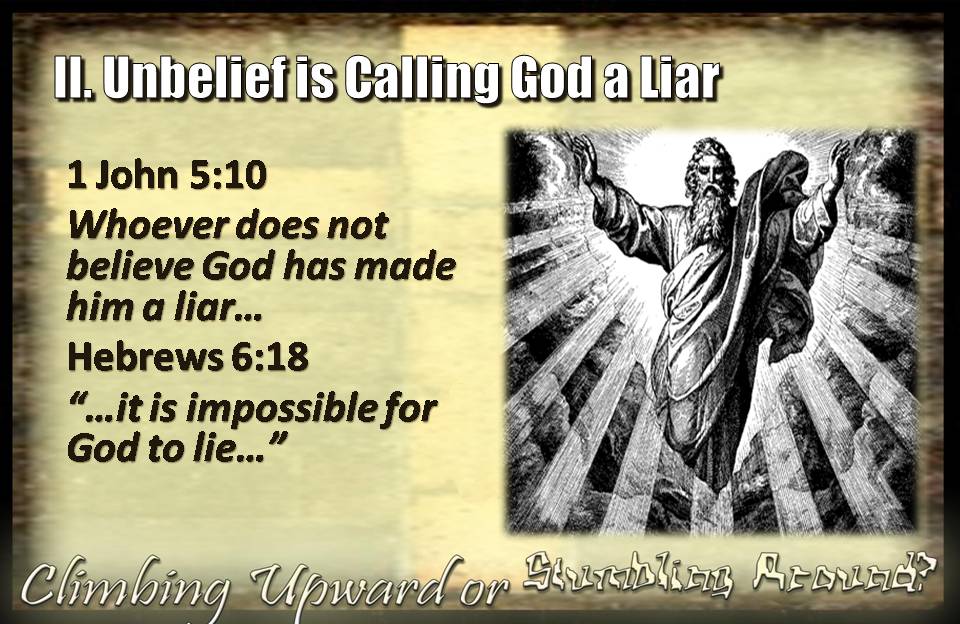
Unbelief, doubt, withholding of confidence, is a practical denial that God is worthy of confidence. You are denying His trustworthiness. What an infinitely awful sin it must be to make God a liar!! If anyone here was to stand up and say God is a liar, I’m sure some of us might grab them and forcibly remove them. We would call that person a blasphemer.

Hebrews 6:17-18 (ESV) So when God desired to show more convincingly to the heirs of the promise the unchangeable character of his purpose, he guaranteed it with an oath, so that by two unchangeable things, in which it is impossible for God to lie, we who have fled for refuge might have strong encouragement to hold fast to the hope set before us.

It is impossible for God to lie. Yet when you doubt God’s word, when you do not believe what God says, you are calling Him a liar. We are to agree to the truth of his promises, and the certainty of their accomplishment.
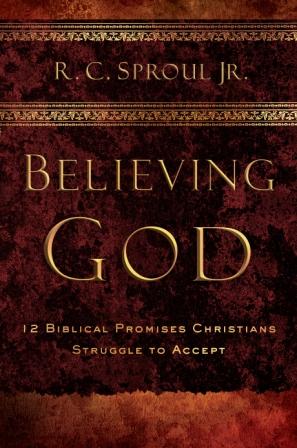
RC Sproul, Jr. wrote a book titled – Believing God: 12 Scriptural Promises Christians Struggle to Accept

These verses, while promises of God, are not really believed by many Christians.

  • 2 Timothy 3:16 (ESV) All Scripture is breathed out by God and profitable for teaching, for reproof, for correction, and for training in righteousness,
  • 1 John 3:1 (ESV) See what kind of love the Father has given to us, that we should be called children of God; and so we are. The reason why the world does not know us is that it did not know him.
  • 1 John 1:9 (ESV) If we confess our sins, he is faithful and just to forgive us our sins and to cleanse us from all unrighteousness.
  • James 1:5 (ESV) If any of you lacks wisdom, let him ask God, who gives generously to all without reproach, and it will be given him.
  • Psalms 127:3-5 (ESV) Behold, children are a heritage from the Lord, the fruit of the womb a reward. Like arrows in the hand of a warrior are the children of one’s youth. Blessed is the man who fills his quiver with them! He shall not be put to shame when he speaks with his enemies in the gate.
  • Psalms 37:4 (ESV) Delight yourself in the Lord, and he will give you the desires of your heart.
  • Malachi 3:10 (ESV) Bring the full tithe into the storehouse, that there may be food in my house. And thereby put me to the test, says the Lord of hosts, if I will not open the windows of heaven for you and pour down for you a blessing until there is no more need.
  • Mark 11:22-24 (ESV) And Jesus answered them, “Have faith in God. Truly, I say to you, whoever says to this mountain, ‘Be taken up and thrown into the sea,’ and does not doubt in his heart, but believes that what he says will come to pass, it will be done for him. Therefore I tell you, whatever you ask in prayer, believe that you have received it, and it will be yours.
  • Romans 8:28 (ESV) And we know that for those who love God all things work together for good, for those who are called according to his purpose.
  • John 16:33 (ESV) I have said these things to you, that in me you may have peace. In the world you will have tribulation. But take heart; I have overcome the world.”
  • Philippians 1:6 (ESV) And I am sure of this, that he who began a good work in you will bring it to completion at the day of Jesus Christ.
  • 1 John 3:2 (ESV) Beloved, we are God’s children now, and what we will be has not yet appeared; but we know that when he appears we shall be like him, because we shall see him as he is.

III. The results of unbelief.
A.   Unbelief produces a heartless religion.

There is only ritual, no satisfying of the soul. If it is not up to God, then it is up to you, and that produces frustration and sorrow. There is no enthusiasm of the heart. Are you filled with the peace and joy of the Holy Spirit? Do you wake up with a spontaneous love for God? Then your heart is filled with unbelief.

B.   Unbelief produces a legalistic religion

Unbelief will cause you to do a great many things without regard to God. Unbelief clouds your eyes and heart to seeing God’s will and His glory. Unbelief leads to an obedience that is selfish, and based on getting what you want.

C.   Unbelief produces an religion void of salvation

Belief in God is absolutely essential to knowing God, and knowing His salvation. If someone doesn’t believe in God, what interest is heaven to him? It’s only a selfish interest, lacking any desire to glorify God, or of having fellowship with Him.

D.  Unbelief produces a disobedient heart.

Disobedience of heart to God is always a result of unbelief. Unbelief will lead you to disavow God’s sovereignty, God’s government, and will lead you to do what is in your heart, what you believe is best.

This is the root of sin in man–withholding confidence in God.

E.   Unbelief produces RESTLESSNESS in your Soul.

Now, when you do have no confidence in the promises of God–do not believe that “all things shall work together for good to them that love God”– your are carrying your burdens upon your own back, and you will grow weary.

Matthew 11:28-30 (KJV) Come unto me, all ye that labour and are heavy laden, and I will give you rest. Take my yoke upon you, and learn of me; for I am meek and lowly in heart: and ye shall find rest unto your souls. For my yoke is easy, and my burden is light.

Your unbelief keeps you from resting in Jesus, it keeps you from His yoke, and it keeps you from His faithful promises.

F.   Unbelief results in an absence of peace in your life.

Where there is real faith, although there may be much to disturb and distress the mind, there is deep peace and joy in God, in the midst of it all; but where persons have not peace, real joy, and great satisfaction in God, in his truth, and in his promises, you may know that there is unbelief there.

Just as Paul told the sailors in Acts 27, that despite the furious storm, if they remained in the ship, no lives would be lost. Even in the most furious of storms, Paul had complete peace in the power of God

G.  Unbelief results in bondage to sin

“There is no condemnation to those who are in Christ Jesus, who walk not after the flesh but after the Spirit.” Now, when you are in bondage to any sin, you are under the influence of the world, and are condemned by the law.

I John 5:4 declares “For everyone who has been born of God overcomes the world. And this is the victory that has overcome the world— our faith.”

If you are living in bondage to sin because of unbelief, you are living in a state of condemnation; your own conscience condemns you because of your unbelief.

H.  Unbelief produces Servants and not Sons

By servant, I mean one who serves his master from fear, not love. People who don’t believe see God as someone who must be worshipped, who must be served, or they run the chance of getting on His bad side. There is no love, no anticipation, and no patient waiting upon a loving Father. There is no child-like belief in a loving heavenly Father! They don’t rely on the Father every day; they never ask Him for anything unless they get desperate. They pray, but only out of duty.

Belief will lead you to come before the throne with anticipation, with expectation, for you are a son needing the Father, depending upon the father!

I. Unbelief produces a Worldly Person.

You are given over to a worldly way of thinking and acting. After all it is up to you, because you don’t believe God. You mind earthly things; you don’t layup treasures for heaven. The Word of God is not your constant companion. The Holy Spirit is not your paraclete. No one neglects the Bible if you believe it!

IV. The Power of Believing Faith
Believing Faith Glorifies God!

A.  We glorify God by believing his promises.

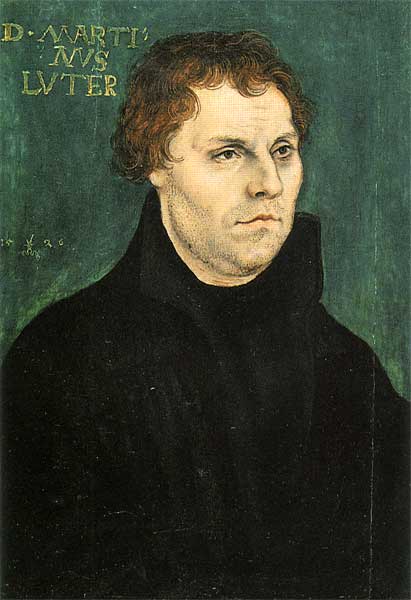
Faith . . . honors him whom it trusts with the most reverent and highest regard since it considers him truthful and trustworthy. There is no other honor equal to the estimate of truthfulness and righteousness with which we honor him whom we trust . . .On the other hand, there is no way in which we can show greater contempt for a man than to regard him as false and wicked and to be suspicious of him, as we do when we do not trust him. (Martin Luther, Selections, p. 59)
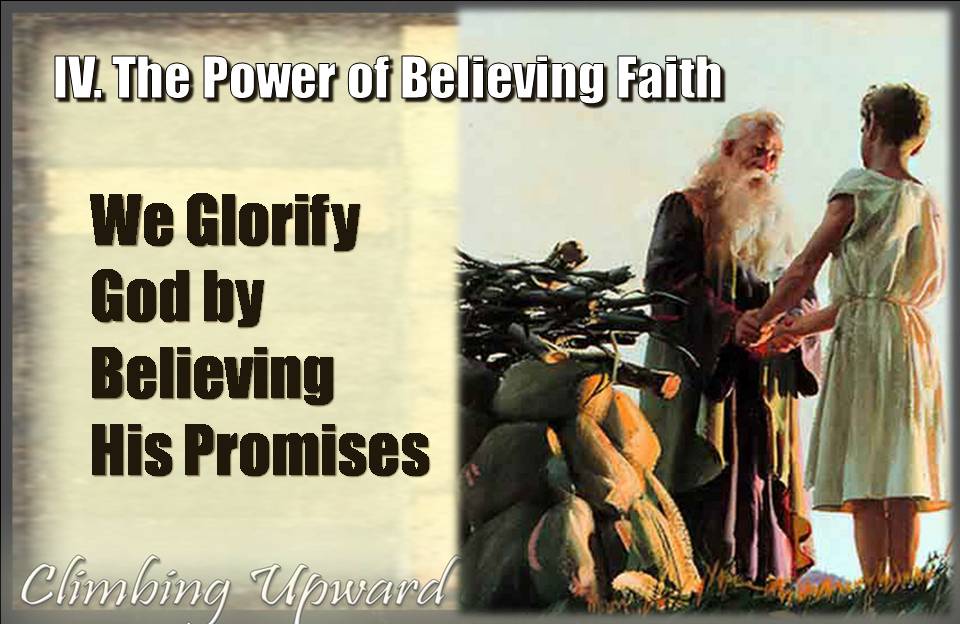
Trusting God’s Word is the most fundamental way that you can glorify God. You can say “Glory to God” all you want, but if you do not believe His Word, stop wasting your breath! When you believe a promise of God, you honor God’s ability to do what he promised and his willingness to do what he promised and his wisdom to know how to do it.

  • If our goal is to glorify God in all that we do, then we must make it our aim in all that we do to believe the promises of God.

Because it was when Abraham believed the promise of God that God was glorified. John 3:33 (ESV) Whoever receives his testimony sets his seal to this, that God is true.

  • Believing God is like setting your personal seal on God!
  • Sarah received power to conceive:

Hebrews 11:11 (ESV) By faith Sarah herself received power to conceive, even when she was past the age, since she considered him faithful who had promised.
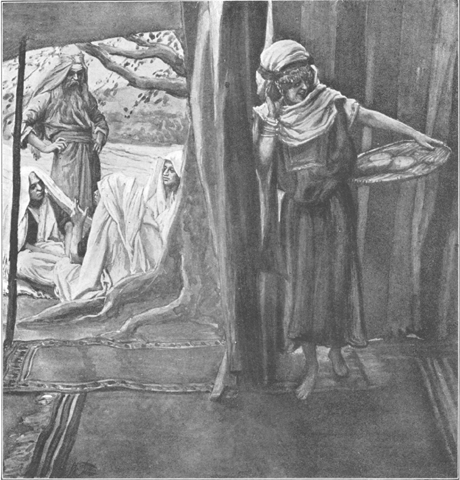
This is of the nature of faith: “The judging him faithful that promised and agreeing to the truth of his promises. You See and Believe in the Power of God!

1.  It Is Future Oriented
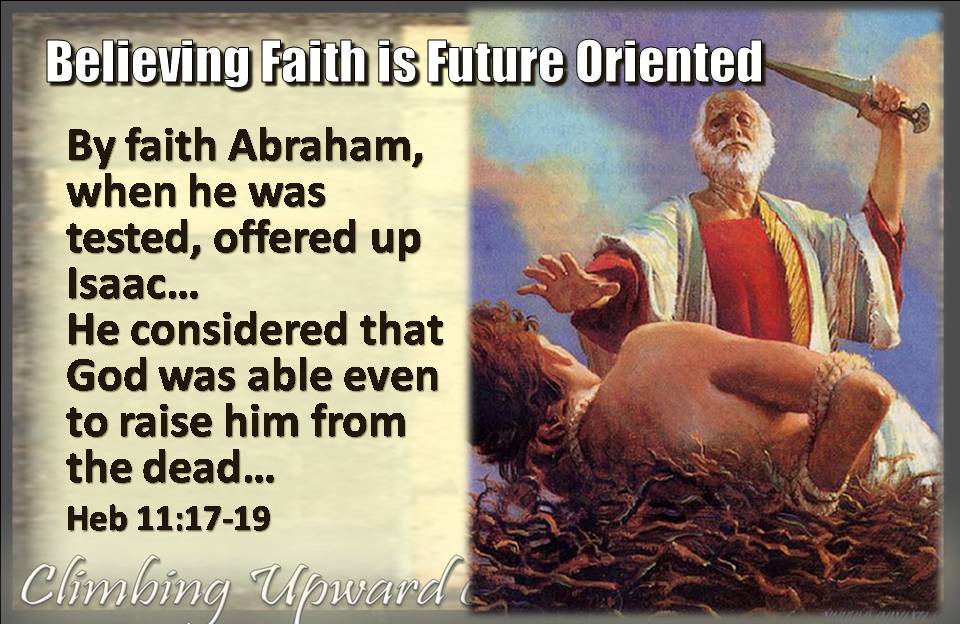
Belief that honors God means banking our hope for happiness on the promises of God. By faith Abraham, when he was tested, offered up Isaac… He considered that God was able even to raise him from the dead…Heb 11:17-19

People who say, “I believe that Christ died for my sins, and that he rose again from the dead,” but then don’t bank their hope on his promises day by day—those people don’t have faith that honors the God who justifies sinners.

  • Paul says, “That is why his faith was reckoned to him as righteousness.” So how did Abraham get justified in God’s sight? Why did God look at this imperfect man and count him as righteous in his sight?
  • Answer: because he believed the promises of God. It was future oriented faith that justified.

Now read on in the application to us. Verses 23–24,

The words, “it was reckoned to him,” were written not for his sake alone, but for ours also. It will be reckoned to us who believe in him that raised from the dead Jesus our Lord. Notice! It does not say, “It will be reckoned to us who believe the past historical fact that God raised Jesus from the dead.” As utterly crucial as that is! It says we will be reckoned righteous if we believe in God! Like Abraham believed in God!

You don’t get justified by believing that Jesus died for sinners and rose again. You get justified by resting your hope on the promises that God secured and guaranteed for you through the death and resurrection of his Son.

2.  It Produces Fruit
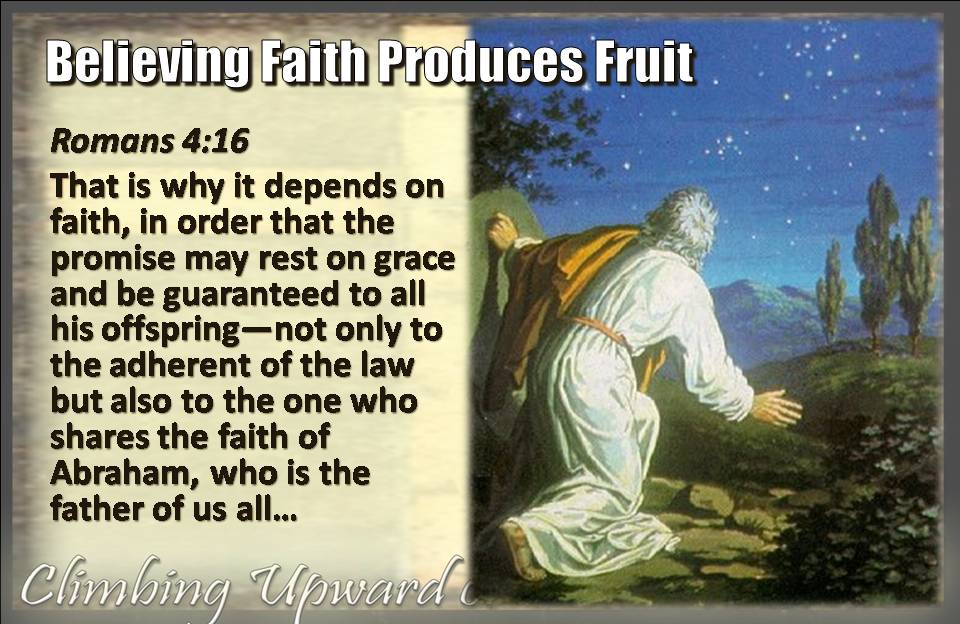
Abraham became the Father of a multitude. Of many nations! He is the Father of every born again Christian!

Romans 4:16 -That is why it depends on faith, in order that the promise may rest on grace and be guaranteed to all his offspring—not only to the adherent of the law but also to the one who shares the faith of Abraham, who is the father of us all…

Believing Faith in the promises of God produces what Paul calls the “work of faith.” Two times, once in 1 Thessalonians 1:3 and once in 2 Thessalonians 1:11 Paul refers to the “work of faith.” What he means is that there is a dynamic to this kind of faith that always changes the heart (Acts 15:9 (ESV) and he made no distinction between us and them, having cleansed their hearts by faith.) and produces the works of love.

The clearest statement of this is Galatians 5:6: “In Christ Jesus neither circumcision nor uncircumcision is of any avail, but faith working through love.” God was able to give Abraham a Son because He Believed.

What fruit has your belief produced?

Faith is a power. It never leaves the life unchanged. What you place your hope on always governs your life. If you bank your hope on money, if your bank your hope on prestige, if you bank your hope on leisure and comfort, if you bank your hope on power or success, it governs the choices you make and the attitudes you develop.

If you bank your hope on the promises of God every day, it will change the way you think, pray, and act. Belief in the promises of God is the taproot of all righteousness and love. Belief in the promises of God is not a dead and fruitless thing. What you bank on for happiness controls your life.

B.  We Must Battle Unbelief Every Day
Paul said to Timothy in 1 Timothy 6:12, “Fight the good fight of faith; take hold on eternal life to which you were called.” Fight against sin by fighting against unbelief in the promises of God. Fight for righteousness and love in your life by fighting to maintain faith in the promises of God. Unbelief requires a conscious decision.

Take warning from those who fell away in unbelief:

  • Some no longer have faith at all (II Thessalonians 3:2).
  • Some have shipwrecked their faith (I Timothy 1:19).
  • Some have left the faith for the doctrines of devils (I Timothy 4:1).
  • Some have denied the faith by not providing for their family (I Timothy 5:8).
  • Some have cast off their first faith (I Timothy 5:12).
  • Some have turned aside after Satan (I Timothy 5:15).
  • Some have erred from the faith for the love of money (I Timothy 6:10, 21).
  • Some are reprobate [disqualified] concerning the faith (II Timothy 3:8).

The saddest example of unbelief comes from the generation of Israelites who failed to reach the Promised Land.

“But with whom was he grieved forty years? Was it not with them that had sinned, whose carcasses fell in the wilderness? And to whom sware he that they should not enter into his rest, but to them that believed not? So we see that they could not enter in because of unbelief”(Hebrews 3:17-19).
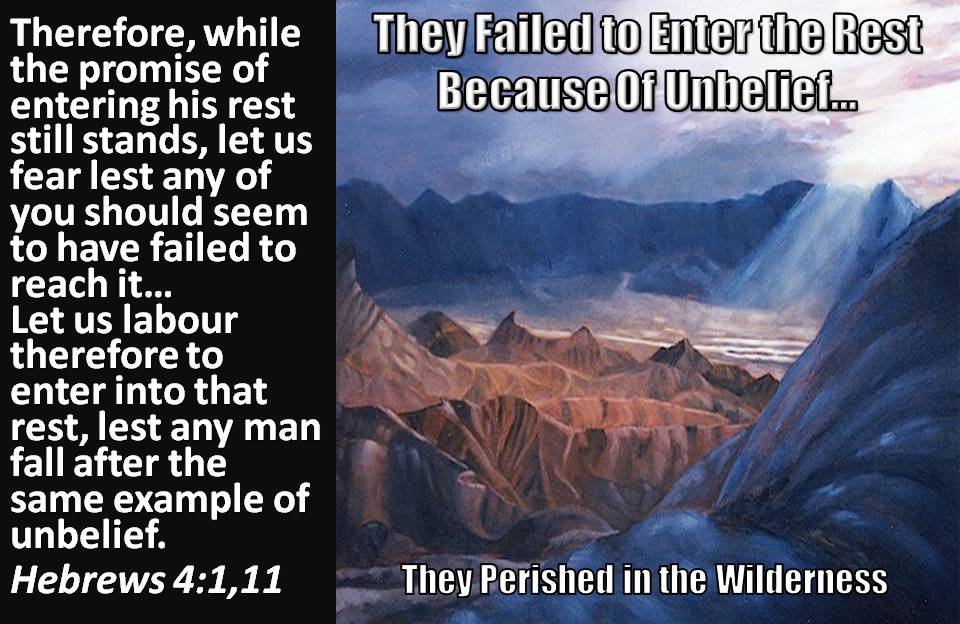
Those Israelites were initially saved: they were delivered from the bondage of Egypt, they were spiritually baptized in the Red Sea (I Corinthians 10:2), and they were led by a pillar of cloud and fire through the wilderness. But they refused to believe when God promised that He would give them the promised land. They looked at their own resources and refused to see God’s.

So we read in Jude 1:5: But then, “the Lord, having saved the people out of the land of Egypt, afterward destroyed them that believed not” (Jude 1:5);

As a result, that generation did not reach their final destination of salvation in the Promised Land.

  • “Ye therefore, beloved, seeing ye know these things before, beware lest ye also, being led away with the error of the wicked, fall from your own steadfastness” (II Peter 3:17).
  • “Therefore fear, lest, a promise being left us of entering into his rest, any of you should seem to come short of it …Labor therefore to enter into that rest, lest any man fall after the same example of unbelief” (Hebrews 4:1,11).

How is your Christian walk? Are you stumbling, or are you climbing? Examine your hearts. Is there doubt and unbelief in your life?

  • Does your life have Stability?
  • Are you growing in Christian maturity?
  • Do you seem to stagger in your Christian walk?
  • Is your Christian walk stagnating?
  • Is God producing visible fruit through your life?
  • Do you struggle with doubts and fears?

Are you ready to climb the Mountain, trusting God’s Word? Abraham did with his boy Isaac. Abraham staggered not at the promise of God through unbelief; but was strong in faith, giving glory to God;

Come to Jesus, Believe in Him, and He will give you rest!

“The epistle to the Romans is the true masterpiece of the New Testament and the very purest gospel, which is well worth and deserving that a Christian man should not only learn it by heart, word for word, but also that he should daily deal with it as the daily bread of men’s souls. It can never be too much or too well read or studied, and the more it is handled the more precious it becomes, and the better it tastes” (Martin Luther).

Paul wrote this letter about 56 A. D. when he was in the city of Corinth, before his trip to Jerusalem. Written to a church he hoped to visit soon. Paul had not yet visited the church in Rome. He wanted to go there and he prayed that God would make this visit possible (Rom. 1:10-12; 15:23-24). This makes the letter to the Romans unique. Most of Paul’s other letters were written to churches where he had personally ministered. But here was a church (the church at Rome) where Paul had not been and where Paul had not taught.

So the Book of Romans was preparation for when Paul would arrive in Rome.

Here in the book of Romans Paul gives a doctrinal preview of the content of his teaching ministry. What Paul unfolds in these 16 chapters is nothing less than a doctrinal masterpiece.

  • What is being a Christian all about?
  • What are the central truths of Christianity?
  • What is the gospel really?
  • What formed the foundation of Apostle Paul’s preaching wherever he went?

Influence of Romans

To find the answer to all these questions we turn to the greatest doctrinal book in the New Testament — the epistle of Paul to the Romans.

A group of scholars once made a list of the fifteen greatest books, books that were great based upon their beneficial influence upon humanity. Included in this list were John Wesley’sJournal, Luther’s 95 Theses, Augustine’s City of God and John Bunyan‘s Pilgrim’s Progress.

  • As his Journal reveals, Wesley was an unsaved preacher until he read the book of Romans and understood God’s way of salvation.
  • Luther, a Catholic monk, was greatly influenced by Romans 1:17, “The just shall live by faith,” which opened his eyes to the truth of justification by faith.
  • Augustine’s City of God was founded on his study of the Book of Romans.
  • Bunyan’s Pilgrim’s Progress was written after reading the Book of Romans in prison.  It became the best selling book of all time, next to the Bible.

Among the greatest books of the world, four which come near the top of the list were all directly influenced by the Book of Romans.

Has the Book of Romans changed your life? When was the last time you read through Romans?

Although Paul knows many of the people to whom he is writing, he did not found the church, and he has never been to Rome. So he has some work to do in the first 17 verses to introduce himself and his agenda. The “gospel” ties together Romans 1:1-17, and, indeed, the entire letter. In the introduction, Paul features both the content and the power of the gospel that unites Jewish and Gentile believers in Rome.

The object of the apostle in writing to this church was to explain to them the great doctrines of the gospel. His epistle was a “word in season.” Himself deeply impressed with a sense of the value of the doctrines of salvation, he opens up in a clear and connected form the whole system of the gospel in its relation both to Jew and Gentile.

Preparation for the Journey

Whenever I take a trip, I like to prepare myself so I can make the most of my time in the place I’m going. There are three things which you should study about your destination if you are to get the most of your time there:

  1. The Personality (of the people)
  2. The Places (what should we see)
  3. The Pillars (make it a desirable destination)

I. THE PERSONALITY OF ROMANS

The following terms must be understood if we are to understand the personality of Romans. Paul’s approach to these terms are nothing short of foundational to understanding the true Gospel of Jesus Christ. I am certain that most of us do not understand these terms the way Paul wants us to.

A. The LAW –  78x in 51 verses

  • For it is not the hearers of the law who are righteous before God, but the doers of the law who will be justified. Romans 2:13 (ESV)

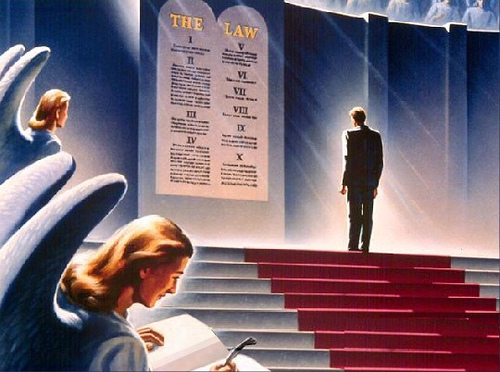
The Law is not to be understood in terms of  “Thou shall and thou shall not’s“. We commonly think that laws are obeyed and satisfied by works, whether your heart is in it or not. But God’s Law makes its demands not on your works but on the depths of your heart and does not let the heart rest content in works.

God calls all of us liars in Ps 116:11, because none of us keep the law from the depths of our heart. We all have an aversion to good and a craving for that which is forbidden. If our heart does not freely desire righteousness, our heart has not set itself on God’s Law. Regardless of outward good works, the appearance of an honorable life, our heart is sinful and deserving of the wrath of Righteous Holy God.

Romans  Two is pointed at the Jews, who are proud of their outward holiness. But Paul says that they are all sinners, and that only does of the law are justified in the sight of God. He reveals that no matter their outward obedience, there is none that truly obey. On the contrary, he says to them, “You teach that one should not commit adultery, and you commit adultery. You judge another in a certain matter and condemn yourselves in that same matter, because you do the very same thing that you judged in another.”

  • You who boast in the law dishonor God by breaking the law. Romans 2:23 (ESV)

It is as if he were saying, “Outwardly you live quite properly in the works of the law and judge those who do not live the same way; you know how to teach everybody. You see the speck in another’s eye but do not notice the beam in your own.”

You keep the Law (selfish motivations) outwardly out of fear of punishment or love of reward. You do everything as though you are chained-without free desire and love of the Law. If the Law did not exist you would be relieved, you would rejoice. In fact, Paul says (in Romans 5) that the Law causes sin to increase. This is because a person becomes more and more and enemy of the Law the more it demands of him what he can’t possibly do.

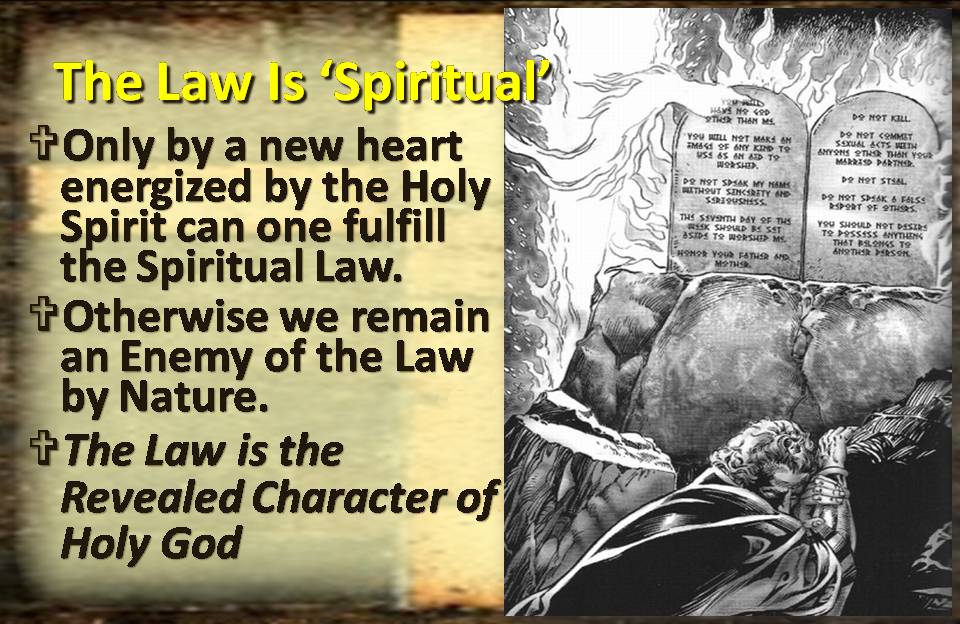
In Romans Seven, Paul says the Law is “spiritual”. What he means is that it were physical, it could be satisfied by your works. Since it is spiritual, no one can satisfy the law unless everything you do springs from the depths of your heart. But no one can have such a heart except the Spirit of God, who gives us a New Heart which has a heartfelt longing for the law and does everything not through fear or coercion, but from a new free and willing heart!

Only by a new heart energized by the Holy Spirit can one fulfill the Spiritual Law. Otherwise we remain an enemy of the Law by nature.

You must get used to the idea that it is one thing to do the works of the law and quite another to fulfill it. The works of the law are everything that a person does or can do of his own free will and by his own powers to obey the law. But because in doing such works the heart abhors the law and yet is forced to obey it, the works are a total loss and are completely useless.

That is what St. Paul means in chapter 3 when he says, “No human being is justified before God through the works of the law.”

Fulfilling the Law of God

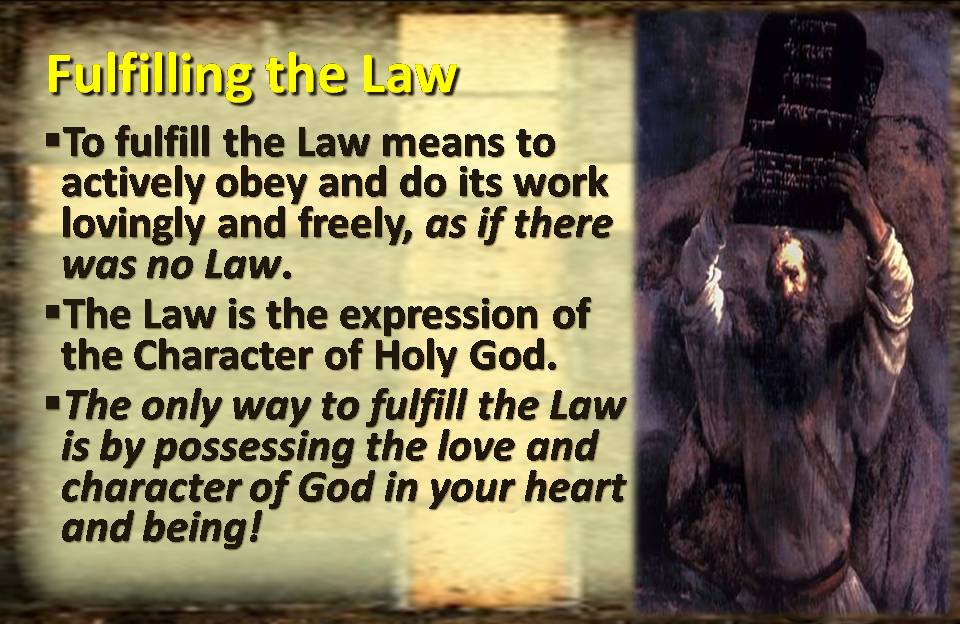
To fulfill the Law means to actively obey and do its work lovingly and freely, as if there was no Law. The Law is the expression of the character of God. The only way to fulfill the Law is through possessing the love and character of God in your heart and being!

Paul says that only the Holy Spirit can fill us with this Divine Love: “God’s love has been poured into our hearts through the Holy Spirit who has been given to us”. Romans 5:5 (ESV)  But the Spirit is given only in, with, and through faith in Jesus Christ, as Paul says in his introduction to Romans. For in it the righteousness of God is revealed from faith for faith, as it is written, “The righteous shall live by faith.” Romans 1:17 (ESV)

Faith alone makes the Love and Righteousness of God reality in our hearts. Faith alone fulfills the righteousness of the Law. Good works that proceed from faith alone are the only works that satisfy the demands of the Law.

The Law as Paul sees it: The Law is Spiritual – the revealed Character of Holy God.

B. SINS and SIN  – 48x – 41 verses

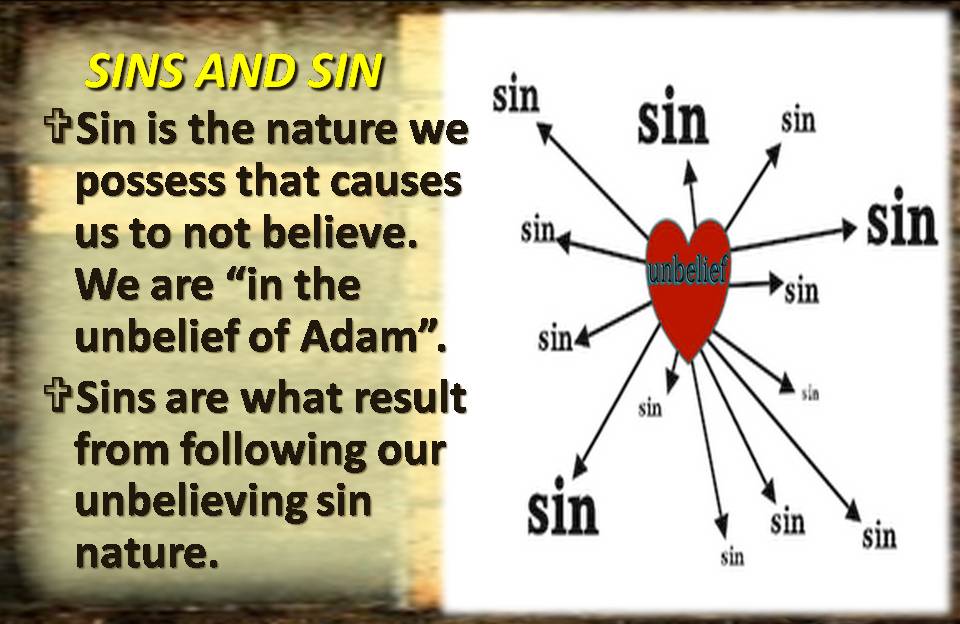
In Romans Paul deals with our sins, and then he deals with our sin. Sins refers to the external works of the body and soul. Sins of omission and commission. Sin refers to those forces within us that move us to do the sins. Sin is from the depth of our wicked heart with all its powers and inclinations.

The root and source of our sins is the sin nature that comes with being “in (the unbelief) of Adam”. The Holy Spirit and the Scriptures see into the heart, to the root source of sins, and that is our sin nature, which is founded in unbelief in the depth of the heart.

Just as faith alone makes us just and brings the Spirit and the desire to do good external works, so it is only unbelief which sins and exalts the flesh and brings desire to do evil external works.

That’s what happened to Adam and Eve in Paradise (cf. Genesis 3). That is why unbelief is called sin by Christ, as he says in John, chapter 16, “The Spirit will judge the world because of sin, because it does not believe in me.”

  • Sin is the nature we possess that causes us to not believe.
  • Sins are what result as a result of our unbelieving sin nature.

In Romans, Paul will show us how God can deal with our sins, and also our sin!

C. Grace and Gifts – 21x – 18 verses

  • and are justified by his grace as a gift, through the redemption that is in Christ Jesus, Romans 3:24 (ESV)

Grace is the active force in our lives which makes us completely just before God. God’s grace is not divided into bits and pieces, as are the gifts, but grace takes us up completely into God’s favor for the sake of Christ, our intercessor and mediator, so that the gifts may begin their work in us.

By this, we understand chapter 7, where Paul portrays himself as still a sinner, while in chapter 8 he says that, because of the incomplete gifts and because of the Spirit, there is nothing damnable in those who are in Christ. Because our flesh has not been killed, we are still sinners, but because we believe in Christ and have the beginnings of the Spirit, God so shows us his favor and mercy, that he neither notices nor judges such sins.

God’s grace allows Him to deal with us according to our position in Christ until our flesh is completely redeemed.

  • Grace is the Loving Power of God displayed in our daily lives
  • Gifts are the pieces of God’s grace that we often reject or neglect, and can lead us to miss or refuse God’s Grace.

D. FAITH – 40x – 35 verses

  • Through him we have also obtained access by faith into this grace in which we stand, and we rejoice in hope of the glory of God. Romans 5:2 (ESV)

Faith is not that human illusion and dream that some people think it is. When they hear and talk a lot about faith and yet see that no moral improvement and no good works result from it, they fall into error and say, “Faith is not enough. You must do works if you want to be virtuous and get to heaven.” The result is that, when they hear the Gospel, they stumble and make for themselves with their own powers a concept in their hearts which says, “I believe.” This concept they hold to be true faith. But since it is a human fabrication and thought and not an experience of the heart, it accomplishes nothing, and there follows no improvement.

Faith is a work of God in us, which changes us and brings us to birth anew from God (cf. John 1). It kills the old Adam, makes us completely different people in heart, mind, senses, and all our powers, and brings the Holy Spirit with it. Faith places us IN CHRIST. Faith keeps us abiding in Christ. We live the exchanged life by THE FAITH of the Son of God, who loved me and gave himself for me.

“What a living, creative, active powerful thing is faith! It is impossible that faith ever stop doing good. Faith doesn’t ask whether good works are to be done, but, before it is asked, it has done them. It is always active. Whoever doesn’t do such works is without faith; he gropes and searches about him for faith and good works but doesn’t know what faith or good works are. Even so, he chatters on with a great many words about faith and good works.” Martin Luther

  • Faith is the living, unshakeable confidence in God’s grace.

This kind of trust in and knowledge of God’s grace makes a person joyful, confident, and happy with regard to God and all that He does. Through faith, a person will do good to everyone without coercion, willingly and happily; he will serve everyone, suffer everything for the love and praise of God, who has shown him such grace. It is as impossible to separate works from faith.

Through faith a person becomes sinless and eager for God’s commands. Thus he gives God the honor due him and pays him what he owes him.

Faith comes only through the word of God, the Gospel, that preaches Christ: how he is both Son of God and man, how he died and rose for our sake. Paul says all this in chapters 3, 4 and 10.

That is why faith alone makes someone just and fulfills the law; faith in God’s promises sees the Power of the Holy Spirit in our daily lives. Faith opens our will and want to to do those ‘good works’ which God designed us for. Then good works proceed from faith itself. That is what Paul means in chapter 3 when, after he has thrown out the works of the law, he sounds as though the wants to abolish the law by faith. No, he says, we uphold the law through faith, i.e. we fulfill it through faith.

For we hold that one is justified by faith apart from works of the law. Or is God the God of Jews only? Is he not the God of Gentiles also? Yes, of Gentiles also, since God is one—who will justify the circumcised by faith and the uncircumcised through faith. Do we then overthrow the law by this faith? By no means! On the contrary, we uphold the law. Romans 3:28-31 (ESV)

  • Faith makes the Vitality and Power of God real in our daily living.

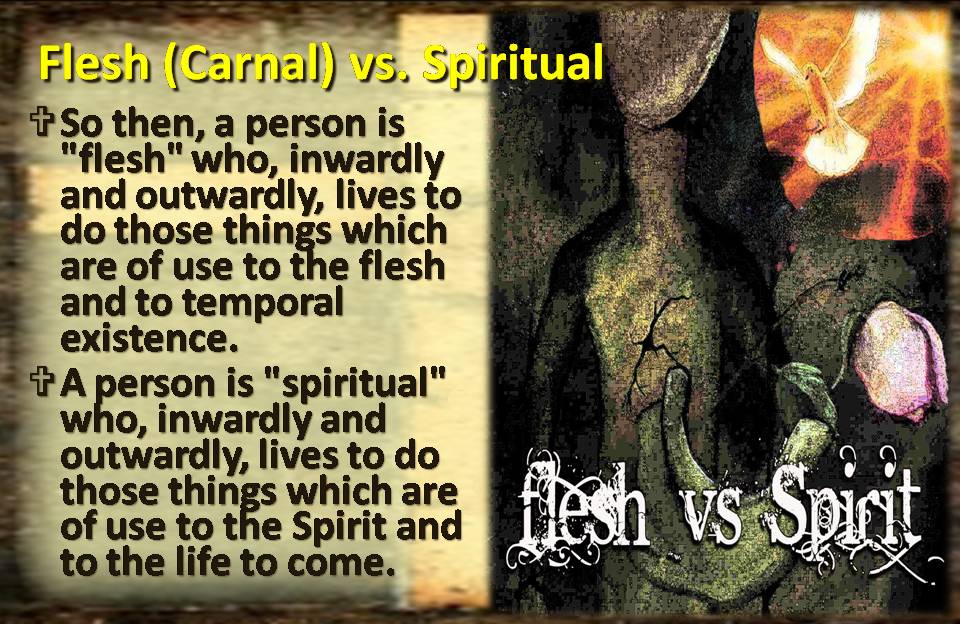
E. FLESH (CARNAL) 23x – 19 verses and SPIRITUAL (SPIRIT)

  • For I know that nothing good dwells in me, that is, in my flesh. For I have the desire to do what is right, but not the ability to carry it out. Romans 7:18 (ESV)

You must not understand flesh here as denoting only immorality or spirit as denoting only the inner heart. In Romans, Paul not only calls every human being ‘flesh’ but also everthing done by human beings in their own strength or in their own devices “fleshly”. Those living in the flesh can be sinners as well as saints. Anything done apart from the Spirit of God is walking in the flesh and not the Spirit. In Romans 8, Paul says that, through the flesh, the law is weakened. He says this, not of the immoral, but of all sins, most of all of unbelief, which is the most spiritual of sins. Unbelief destroys the SPIRITUAL life of any believer.

  • But now we are delivered from the law, that being dead wherein we were held; that we should serve in newness of spirit, and not in the oldness of the letter. Romans 7:6 (KJV)

I have come to the conclusion that a true Jew is not the man who is merely a Jew outwardly, and a real circumcision is not just a matter of the body. The true Jew is one who belongs to God in heart, a man whose circumcision is not just an outward physical affair but is a God-made sign upon the heart and soul, and results in a life lived not for the approval of man, but for the approval of God. Romans 2:28 (Phillips NT)

A person is spiritual who has been born of the Holy Spirit, and lives in and by the Spirit. Outward righteousness is a result of the inward spirit of God producing the life and character of God.

  • So then, a person is “flesh” who, inwardly and outwardly, lives only to do those things which are of use to the flesh and to temporal existence.
  • A person is “spirit” who, inwardly and outwardly, lives only to do those things which are of use to the spirit and to the life to come.

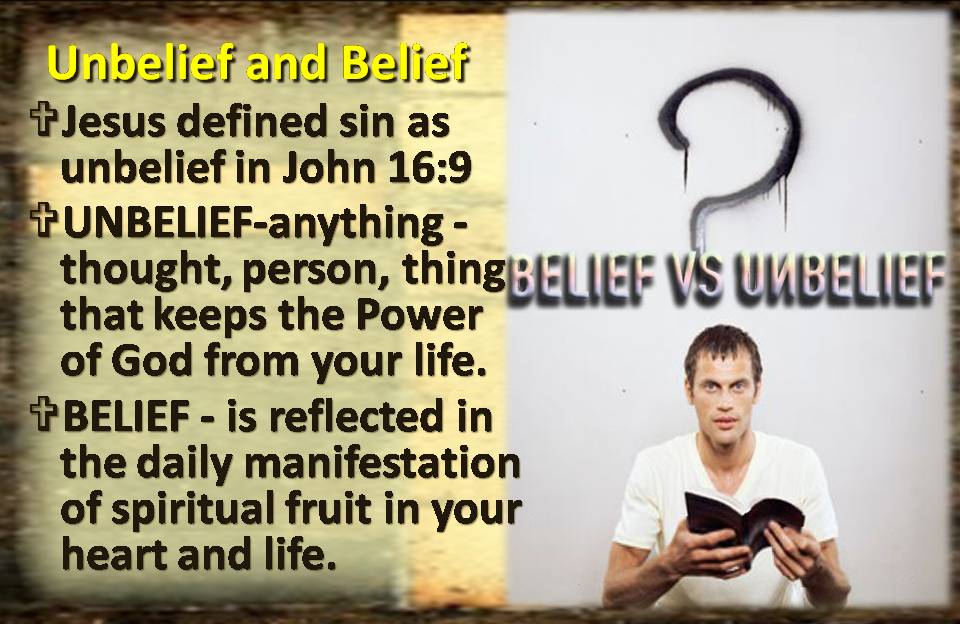
F. Unbelief and Belief

The very foundation of sin coming upon man was unbelief. Adam and Eve believed the deception rather than the Word of God. If they had only believed what God had said, they would have lived in eternal bliss.

Jesus defined sin as unbelief. God defined sin as going your own way. It is unbelief that leads us to go our own way. Unbelief in Romans reaches far beyond simple belief in Jesus as your Savior. Essential for being born again, yes,  but belief is essential for your very LIFE as a son of God. Your belief in the Word of God is foundational to your LIFE here and now and for all eternity.

Now if we have died with Christ, we believe that we will also live with him. We know that Christ, being raised from the dead, will never die again; death no longer has dominion over him. For the death he died he died to sin, once for all, but the life he lives he lives to God. So you also must consider yourselves dead to sin and alive to God in Christ Jesus. Romans 6:8-11 (ESV)

Paul uses Old Testament illustrations to convey the Truth of Romans. He points out Abraham, who did not stumble at the promises of God by unbelief. His belief is what made him righteous before God. His believing the promises of God is what gave him LIFE here on earth and in all eternity.

He staggered not at the promise of God through unbelief; but was strong in faith, giving glory to God; And being fully persuaded that, what he had promised, he was able also to perform. And therefore it was imputed to him for righteousness. Romans 4:20-22 (KJV)

In Romans, Paul lays out the truth of the gospel of Christ, and that truth doesn’t end at the cross, it goes through the cross to affect not only our sins, but our sin nature. We are made righteous by our belief in the promises of God. That belief does not stop at the cross. It does not stop at being born again. Belief in the Promises of God’s Word is to be a daily thing whereby we are made righteous every day. We are given LIFE every day. Not life in the flesh, but life in the Holy Spirit of God!

  • UNBELIEF-anything -thought, person, thing that keeps the Power of God from your life.
  • BELIEF – is reflected in the daily manifestation of fruit in your heart and life.

Summary of the Personality of Romans

Romans is the richest possible teaching about what a Christian should know: the meaning of law, Gospel, sin, punishment, grace, faith, justice, Christ, God, good works, love, hope and the power of the cross. We learn how we are to act toward everyone, toward the saints and the sinners, toward the strong and the weak, friend and foe, and toward ourselves. Paul bases everything firmly on Scripture and proves his points with examples from his own experience and from the Prophets, so that nothing more could be desired. Therefore it seems that Paul, in writing this letter, wanted to compose a summary of the whole of Christian and evangelical teaching which would also be an introduction to the whole Old Testament. Whoever takes this letter to heart possesses the light and power of the Old Testament. Therefore each and every Christian should make this letter the habitual and constant object of his study.

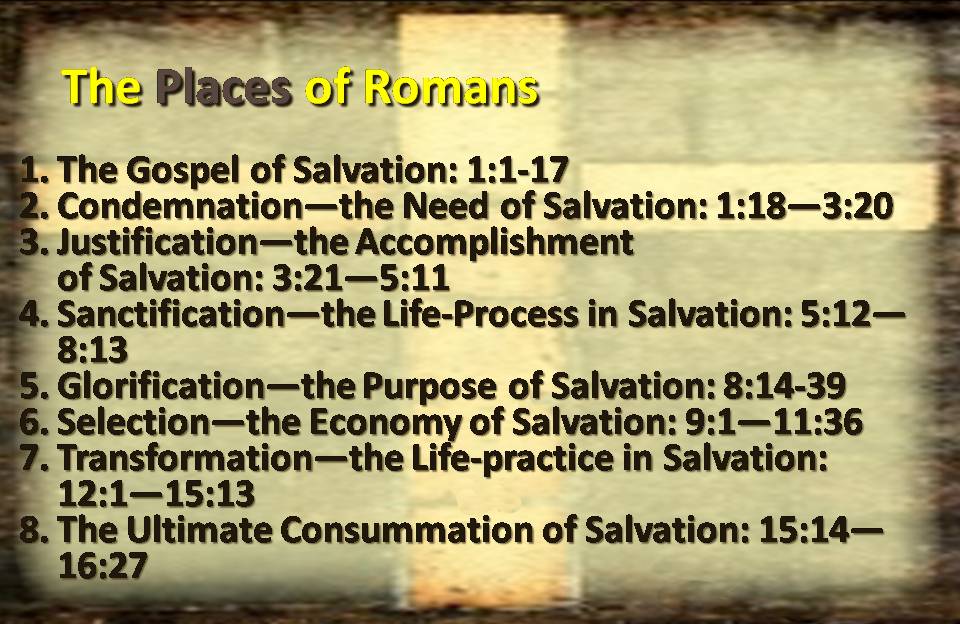
II. THE PLACES OF ROMANS

1. The Gospel of Salvation

The introduction (1:1-17) delineates the theme of the book of Romans, which is the gospel of God. This is the content of the introduction. Our next tour will explore this Gospel which was so important to Paul.

  • Paul, a servant of Christ Jesus, called to be an apostle, set apart for the gospel of God, which he promised beforehand through his prophets in the holy Scriptures, concerning his Son, who was descended from David according to the flesh and was declared to be the Son of God in power according to the Spirit of holiness by his resurrection from the dead, Jesus Christ our Lord, through whom we have received grace and apostleship to bring about the obedience of faith for the sake of his name among all the nations, including you who are called to belong to Jesus Christ, Romans 1:1-6 (ESV)
  • Now to him who is able to strengthen you according to my gospel and the preaching of Jesus Christ, according to the revelation of the mystery that was kept secret for long ages but has now been disclosed and through the prophetic writings has been made known to all nations, according to the command of the eternal God, to bring about the obedience of faith— to the only wise God be glory forevermore through Jesus Christ! Amen. Romans 16:25-27 (ESV)
2. Condemnation—the Need of Salvation

Following the introduction, we have the section on condemnation (1:18—3:20) that unveils to us the need of God’s salvation. We all are hopeless and helpless cases and are under God’s condemnation. We need God’s salvation.

3. Justification—The Accomplishment of Salvation

The third section, justification (3:21—5:11), reveals the accomplishment of God’s salvation. Related to this matter of justification we have three other items—propitiation, redemption, and reconciliation. We will cover these terms when we come to chapter 3. At this point I will only say a brief word. God’s justification depends upon the redemption of Christ. Without the redemption of Christ, God has no way to justify sinners. Therefore, justification depends upon redemption, and redemption has one major aspect—propitiation. Propitiation is the major structure of redemption. Propitiation is the major part of the redemption of Christ because, as sinners, we owed God a great deal. We were held by God to pay this debt, and this caused a tremendous problem. That problem has been resolved by Christ as our propitiatory sacrifice. Since this propitiation has solved our problems with God, we have been redeemed. Based upon the redemption of Christ, God can easily and lawfully justify us. Thus, justification depends upon redemption, and the major part of redemption is propitiation. What, then, is reconciliation? Reconciliation is the issue of justification. God’s justification issues in reconciliation. All of this has been accomplished. Hallelujah! Although you may not be clear about all of these words at present, you can say to the Lord, “Lord, I don’t understand all these terms, but I praise You that everything has been accomplished.”

Justification brings us to God. In fact, it not only brings us to God, but also into God. Therefore, we may have the full enjoyment of God. The King James Version says, “We joy in God” (Rom. 5:11). We not only joy in God; we enjoy God. God is our enjoyment. This is justification.

4. Sanctification—the Life-process in Salvation

Following this, we have sanctification (5:12—8:13). How great it is to be in God and to enjoy God!  After being justified, we need to be sanctified.

What does it mean to be sanctified? We use the illustration of tea. If we put tea into a glass of plain water, the water will be “teaified.” At best, we are plain water, although we are actually not plain, but dirty. Even if we are plain water, we lack the tea flavor, the tea essence, and the tea color. We need the tea to come into our very being. Christ Himself is the heavenly tea. Christ is in us. Hallelujah!

God is progressively revealed throughout the book of Romans:

  • In chapter 1 He is God in CREATION,
  • In chapter 3 God in REDEMPTION,
  • In chapter 4 God in JUSTIFICATION,
  • In chapter 5 God in RECONCILIATION,
  • In chapter 6 God in IDENTIFICATION.
  • In chapter 8 God in US.

Christ is in us (Rom. 8:10)! He is no longer merely in creation, redemption, justification, reconciliation, and identification, but He is now within us, in our spirit. Christ is in us doing a transforming and sanctifying work, just as the tea, when put into the water, works the element of tea into it. Eventually, the water will be wholly “teaified.” It will have the appearance, the flavor, and the taste of real tea. If I serve you some of this beverage, I will be serving you tea, not plain water.

  • Have you been JUSTIFIED?

You should all reply, “Hallelujah! We have been justified because Christ has accomplished redemption. God has reconciled us and we are now enjoying Him.”

  • Have you been SANCTIFIED?

If some of you married men claim to be sanctified, what would your wives say? “He may be justified, but it is doubtful he is sanctified.” Or you might say”maybe a little bit… or maybe he is improved, but I do not think he is sanctified yet.” I am not talking about being improved, but being sanctified—that is to have the very character of Christ worked into our very being, just as the essence, flavor, and color of the tea are worked into the water. This is sanctification. And every born again Christian should learn that he indeed is sanctified.

5. Glorification—the Purpose of Salvation

The next section in the book of Romans is GLORIFICATION (Rom. 8:14-39), unveiling the purpose of God’s salvation. Following sanctification, there is the need of glorification. Our body needs to be glorified. Although a brother may be quite saintly, his body needs to be glorified because of its physical defects and limitations. When the Lord Jesus comes, we will be glorified. Presently, I must wear thick, peculiar eyeglasses, but when the Lord comes I will be glorified. We shall not only be justified and sanctified; we shall be glorified, that is, our body shall be redeemed. Glorification is the full redemption of our body.

This glorification reveals the purpose of God’s salvation. The purpose of God’s salvation is to produce many brothers to Christ. Originally, Christ was the only begotten Son of God. Now the only begotten Son has become the firstborn Son. We ourselves will be processed into the many brothers of Christ and the many sons of God. He is the firstborn Son, and we, the many sons, are His many brothers. This is the purpose of God’s salvation.

6. Selection—the Economy of Salvation

After glorification, we come to selection which reveals the economy of salvation (Rom. 9:1—11:36). God has a purpose and an economy. His economy is for the fulfillment of His purpose. God is very wise and He arranges everything for the fulfillment of His purpose. He knows what He is doing. He knows who are His chosen people and He knows when His chosen people should be called. In relation to God, selection is for the accomplishment of His purpose; in relation to us, selection is our destiny.

7. Transformation—the Life-practice in Salvation

After this, we have the section on transformation, unfolding the life-practice in salvation (Rom. 12:1—15:13). In this section we see the life-practice of all that has been produced by the life-process. Whatever is produced in the section on sanctification is practiced in the section on transformation. Eventually, sanctification becomes transformation. In one sense, we are in sanctification; in another sense, we are also in transformation. We are in the process of life and in the practice of life that we may have the Body life with a proper private life. Every aspect of the proper Christian life and church life is included in this section on transformation. While we are being sanctified, we are also being transformed from one form into another form and from one shape into another shape. Praise the Lord! We are all under the life-process of sanctification for the life-practice of transformation.

8. Conclusion—the Ultimate Consummation of Salvation

The last section of the book of Romans is the conclusion, indicating the ultimate consummation of salvation (Rom. 15:14—16:27). The ultimate consummation of God’s salvation is the churches—not just the Body, but the local churches as the expressions of the Body. Hallelujah! The book of Romans begins with the Gospel of God and concludes with the local churches. In Romans, we do not have the local church in doctrine but the local churches in practice.

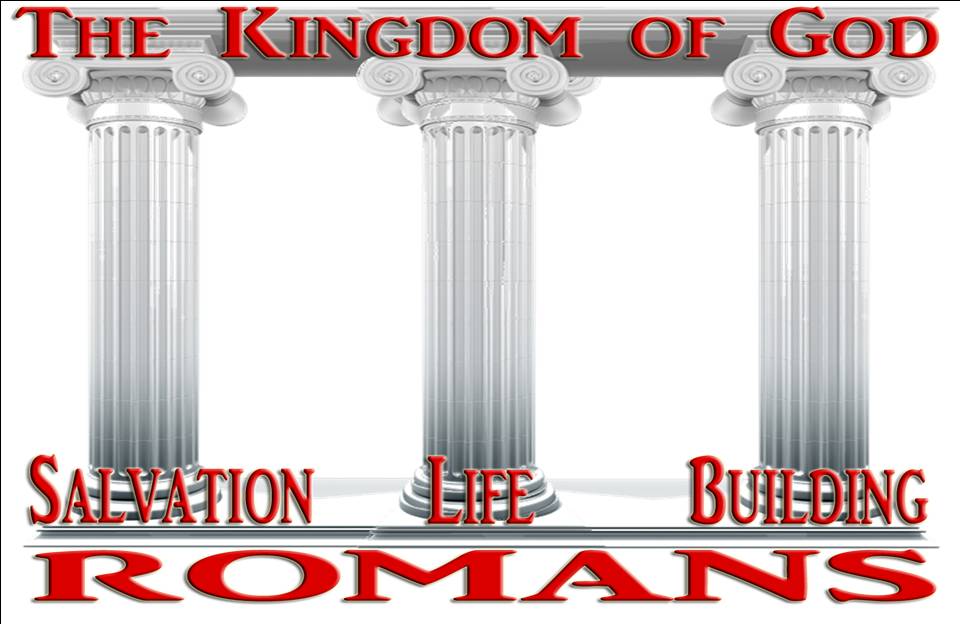
III. THE PILLARS OF ROMANS

The major structures of the book of Romans are three— salvation, life, and building.

A. Salvation

The first major structure of Romans is salvation, revealed in 1:1—5:11 and 9:1—11:36. Salvation includes propitiation, redemption, justification, reconciliation, selection, and predestination. In eternity past God predestinated us. Then He called us, redeemed us, justified us, and reconciled us to Himself. Thus, we have full salvation.

We need to differentiate between redemption and salvation. Redemption is what Christ accomplished in the eyes of God. Salvation is what God has wrought upon us based upon the redemption of Christ. Redemption is objective, and salvation is subjective. When redemption becomes our experience, it becomes salvation.

B. Life

Salvation is for the life unfolded in 5:12—8:39. In this section the word life is used at least seven times and, according to chapter 8, this life is four-fold. This Eternal Life or Life with God, begins not when we die but when we are born again!

C. Building

In the last part of Romans, 12:1—16:27, we have the building, the Body with all of its expressions in the local churches. Salvation is for life, and life is for building. Thus, the three major structures of Romans are salvation, life, and building.

Finally:

Why is our Tour through Romans called Journey Through the Cross?

Paul is all about this New Life that is the result of the Power of the Gospel of Christ.

For if you live according to the flesh you will die, but if by the Spirit you put to death the deeds of the body, you will live. For all who are led by the Spirit of God are sons of God. For you did not receive the spirit of slavery to fall back into fear, but you have received the Spirit of adoption as sons, by whom we cry, “Abba! Father!” Romans 8:13-15 (ESV)

Such is the Power of this New Life we have through the Gospel of Christ that Paul makes this BOLD declaration:

For I am not ashamed of the gospel, for it is the power of God for salvation to everyone who believes, to the Jew first and also to the Greek. For in it the righteousness of God is revealed from faith for faith, as it is written, “The righteous shall live by faith.” Romans 1:16-17 (ESV)

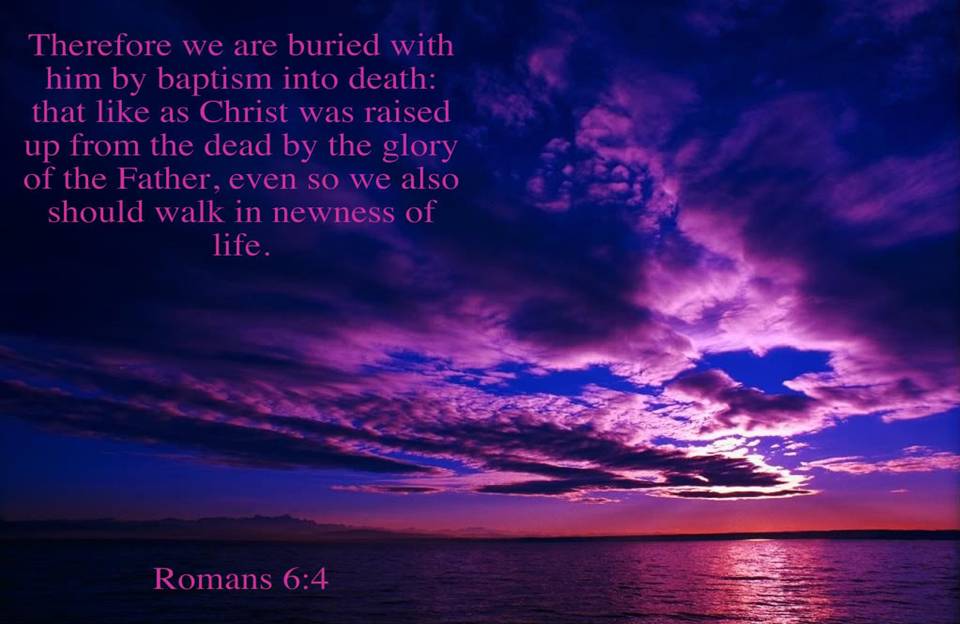
He boldly declares the power of the Cross of the Gospel in Romans 6. The Truth of Romans 6 is only experienced as we Journey Through the Cross:

We were buried therefore with him by baptism into death, in order that, just as Christ was raised from the dead by the glory of the Father, we too might walk in newness of life. For if we have been united with him in a death like his, we shall certainly be united with him in a resurrection like his. We know that our old self was crucified with him in order that the body of sin might be brought to nothing, so that we would no longer be enslaved to sin. Romans 6:4-6 (ESV)

Our Journey through the Cross is a Journey into the New Life that is in Jesus Christ


When I was a young man of 11, my next door neighbors, the Magyars, had a cute baby boy named Joey. I remember playing with him when he was about 2. One day I learned that he was dying of Leukemia. In fact he died rather suddenly, before he turned 3. What was really strange was that the Magyars and their daughter I was friends with, never spoke of Joey again. When I went to their house I would walk by Joey’s bedroom door, and it was shut, never open. I found out later they never went into his room after the funeral. They kept it exactly as it was the day he died.

This was probably the first time I had encountered death, and it raised a lot of questions? Was God behind this? Did God plan for Joey to die? Why did the Magyars, who were Jewish, get mad at their God? Did they think God had made a mistake? As a young teen I had no answers for them. I had no idea of God or His involvement in our every day lives.

As I grew older and became exposed to God’s Word, my concept of God started to change.

As a free thinking, free will young man I found myself thinking that God has an overall will or plan in mind. However, He leaves the details to us; after all we have a free choice. So much of what happens in this world depends upon us-our faith, our prayers, our evangelistic efforts. In fact, God must rely upon us in His overall battle with Satan. Now Satan will lose in the end, but He is constantly trying to mess things up, to get people to hate or doubt or turn away from God. I know longer think this based upon how God reveals himself in His Word, but I fear this sort of thinking is held by more “Christians” than you realize. I thought this way one time, and I am still tempted to think this way. I would wager that many of you have thought this way about the Will of God.

In Bible College I became exposed to traditional teaching on God. I learned of His:

Immutability: God cannot change in any way and is not able to change.

Impassibility: God is without emotion. God does not experience pain or pleasure. God is not subject to temptation or sin at all.

Omnipotence: God has all power, which includes complete sovereignty over all things.

Omnipresence: God is everywhere and in fact God transcends space and time.

Omniscience: God has all knowledge, including of all past, present, and future events.

These attributes were backed up by verses like these:

  • Mal 3:6 For I am the LORD, I change not; therefore ye sons of Jacob are not consumed.
  • Num 23:19 God is not a man, that he should lie; neither the son of man, that he should repent: hath he said, and shall he not do it? or hath he spoken, and shall he not make it good?
  • 1Sa 15:29 And also the Strength of Israel will not lie nor repent: for he is not a man, that he should repent.
  • Isa 46:10 Declaring the end from the beginning, and from ancient times the things that are not yet done, saying, My counsel shall stand, and I will do all my pleasure:

God’s Will and “Open Theism”

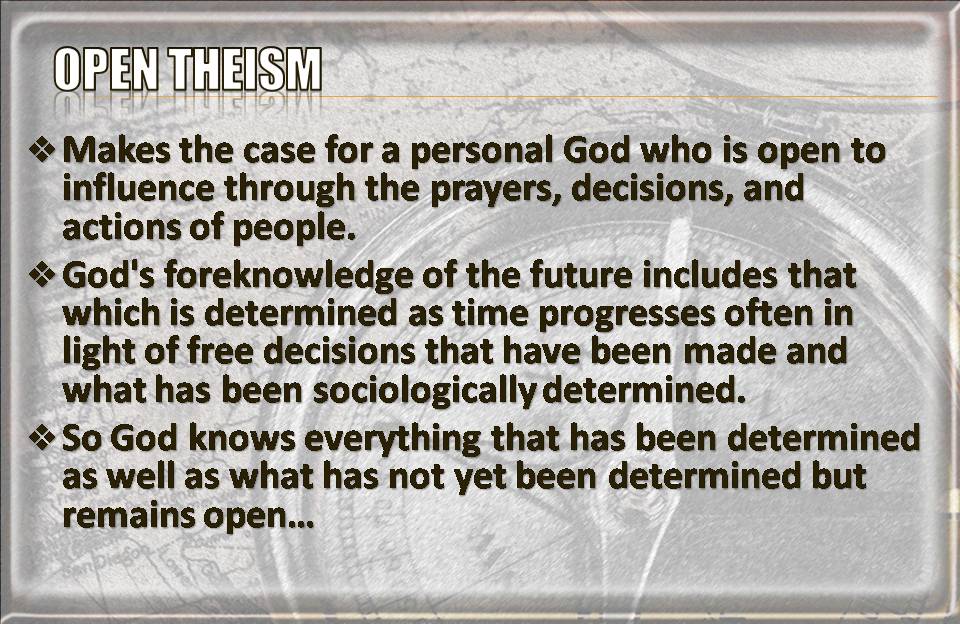
Back to the way I think many Christians view God. It is actually taking form as a modern day theology called “Open Theism”.  It began in the Pentecostal, Assembly of God schools and has spread to Evangelical churches and Seminaries. It makes sense in light of the “me-focused” spirituality many Christians practice.

Practically, open theism makes the case for a personal God who is open to influence through the prayers, decisions, and actions of people. Although many specific outcomes of the future are unknowable, God’s foreknowledge of the future includes that which is determined as time progresses often in light of free decisions that have been made and what has been sociologically determined. So God knows everything that has been determined as well as what has not yet been determined but remains open. As such, he is able to anticipate the future, yet remains fluid to respond and react to prayer and decisions made either contrary or advantageous to His plan or presuppositions.

They give several Scripture passages to make their case:

• Genesis 6:6-7 (KJV) God repents of his decision to make man and destroys mankind with a flood.

• Exodus 13:17 (KJV) And it came to pass, when Pharaoh had let the people go, that God led them not through the way of the land of the Philistines, although that was near; for God said, Lest peradventure the people repent when they see war, and they return to Egypt:

• Exodus 32:7-14 (RSV) And the LORD said to Moses, “Go down; for your people, whom you brought up out of the land of Egypt, have corrupted themselves; they have turned aside quickly out of the way which I commanded them; they have made for themselves a molten calf, and have worshiped it and sacrificed to it, and said, `These are your gods, O Israel, who brought you up out of the land of Egypt!'” And the LORD said to Moses, “I have seen this people, and behold, it is a stiff-necked people; now therefore let me alone, that my wrath may burn hot against them and I may consume them; but of you I will make a great nation.” But Moses appealed, and “And the LORD repented of the evil which he thought to do to his people.”

• Isaiah 38:1-5 At that time Hezekiah became very sick; he was almost dead. The prophet Isaiah son of Amoz went to see him and told him, “This is what the Lord says: Make arrangements, because you are not going to live, but die.” Hezekiah turned toward the wall and prayed to the Lord, “Lord, please remember that I have always obeyed you. I have given myself completely to you and have done what you said was right.” Then Hezekiah cried loudly. Then the Lord spoke his word to Isaiah: “Go to Hezekiah and tell him: ‘This is what the Lord, the God of your ancestor David, says: I have heard your prayer and seen your tears. So I will add fifteen years to your life.

So, Is God an unfeeling entity that is rigidly in control of His creation – as in “El Elyon” God Most High? Or is God some fatherly figure who limits His power and knowledge so as to allow trials and hardships for His children so that they will cry out to Him for help – as in “Abba Father”?

This morning I am not going to offer my well formulated opinions about God and the importance of His Will, and whether that will is constantly evolving subsequent to man’s decisions. I am simply going to look at what GOD says about His will in His Word. I think we’ll get a much clearer picture about the importance of God’s Will

Why Should I Seek to Know the Will of God?

We must know the Will of God so we will not be fools!

Therefore do not be foolish, but understand what the will of the Lord is. Ephesians 5:17

We also will be taught His Will if we allow Him. This will lead us to Jesus Christ.

Jn 6:45 It is written in the Prophets, ‘And they will all be taught by God.’ Everyone who has heard and learned from the Father comes to me—

So – How do I Begin?

Last week we committed to seeing God, to seeing His power, His presence in our life. I banned the can’t word from our church. From God’s Word we see more things we should do to know God’s Will:

Willingness to do God’s Will opens you to Know God’s Will.

  • Jn 7:17 If anyone’s will is to do God’s will, he will know whether the teaching is from God or whether I am speaking on my own authority.

God listens to sinners who desire to do His Will

  • Jn 9:31 We know that God does not listen to sinners, but if anyone is a worshiper of God and does his will, God listens to him.

Will of God affects our Salvation

  • Jn 1:13 who were born, not of blood nor of the will of the flesh nor of the will of man, but of God.

Holy Spirit: acts according to the Will of God

  • Rom 8:27 And he who searches hearts knows what is the mind of the Spirit, because the Spirit intercedes for the saints according to the will of God.

God’s Word is not by the will of Man but by God’s Spirit.

  • 2 Pet 1:21 For no prophecy was ever produced by the will of man, but men spoke from God as they were carried along by the Holy Spirit.

Is the Will of God an Every Day Thing?

Will of God is in your WORK & SERVICE

  • Eph 6:6 not by the way of eye-service, as people-pleasers, but as servants of Christ, doing the will of God from the heart,

God’s will determines our ENCOUNTERS

  • Rom 1:10 always in my prayers, asking that somehow by God’s will I may now at last succeed in coming to you.

God’s Will is SUPREME to man’s

  • Rom 9:16 So then it depends not on human will or exertion, but on God, who has mercy.

Will of God determines MINISTRY

  • 1 Co 1:1 Paul, called by the will of God to be an apostle of Christ Jesus, and our brother Sosthenes,

Will of God determines your GIVING

  • 2 Co 8:5 and this, not as we expected, but they gave themselves first to the Lord and then by the will of God to us.

Will of God requires DAILY OBEDIENCE

  • Matt 21:31 Which of the two did the will of his father?” They said, “The first.” Jesus said to them, “Truly, I say to you, the tax collectors and the prostitutes go into the kingdom of God before you.

Will of God will produce MATURITY AND ASSURANCE

  • Col 4:12 Epaphras, who is one of you, a servant of Christ Jesus, greets you, always struggling on your behalf in his prayers, that you may stand mature and fully assured in all the will of God.

Will of God is an ACTIVE FORCE

  • 1 Pet 5:10 And after you have suffered a little while, the God of all grace, who has called you to his eternal glory in Christ, will himself restore, confirm, strengthen, and establish you.

Will of God includes SUFFERING

  • 1 Pet 3:17 For it is better to suffer for doing good, if that should be God’s will, than for doing evil.
  • 1Pe 4:19 Therefore let those who suffer according to God’s will entrust their souls to a faithful Creator while doing good.

Will of God determines your ETERNITY

  • 1 Jn 2:17 And the world is passing away along with its desires, but whoever does the will of God abides forever.

How Important is the Will of God?

JESUS CHRIST

  • “I can do nothing on my own. As I hear, I judge, and my judgment is just, because I seek not my own will but the will of him who sent me. John 5:30

MAN

  • Rom 9:20 But who are you, O man, to answer back to God? Will what is molded say to its molder, “Why have you made me like this?”

RELATIONSHIP TO CHRIST

  • Mark 3:35 For whoever does the will of God, he is my brother and sister and mother.”

SALVATION

  • “Not everyone who says to me, ‘Lord, Lord,’ will enter the kingdom of heaven, but the one who does the will of my Father who is in heaven. Matthew 7:21

JUDGMENT

  • Rom 14:10 Why do you pass judgment on your brother? Or you, why do you despise your brother? For we will all stand before the judgment seat of God;
  • Rom 14:12 So then each of us will give an account of himself to God.
  • 1 Co 4:5 Therefore do not pronounce judgment before the time, before the Lord comes, who will bring to light the things now hidden in darkness and will disclose the purposes of the heart. Then each one will receive his commendation from God.

How Can I Know the Will of God?

The Will of God is DELIVERANCE from this Evil World

  • And this is the will of him who sent me, that I should lose nothing of all that he has given me, but raise it up on the last day. For this is the will of my Father, that everyone who looks on the Son and believes in him should have eternal life, and I will raise him up on the last day.” John 6:39-40
  • Gal 1:4 who gave himself for our sins to deliver us from the present evil age, according to the will of our God and Father,

The Will of God always involves JESUS

  • Heb 10:7 Then I said, ‘Behold, I have come to do your will, O God, as it is written of me in the scroll of the book.’ ”

The Will of God always involves the HOLY SPIRIT

  • Heb 2:4 while God also bore witness by signs and wonders and various miracles and by gifts of the Holy Spirit distributed according to his will.

The Will of God requires ENDURANCE

  • Heb 10:36 For you have need of endurance, so that when you have done the will of God you may receive what is promised.

The Will of God requires GIVING THANKS in ALL

  • 1Thes 5:18 give thanks in all circumstances; for this is the will of God in Christ Jesus for you.

The Will of God requires TRANSFORMED MINDS

  • Rom 12:2 Do not be conformed to this world, but be transformed by the renewal of your mind, that by testing you may discern what is the will of God, what is good and acceptable and perfect.

The Will of God requires SUBMISSION & DESIRE

  • Jas 4:7 Submit yourselves therefore to God. Resist the devil, and he will flee from you.

The Will of God requires CLOSENESS, CLEANNESS AND SINGLENESS OF PURPOSE

  • Jas 4:8 Draw near to God, and he will draw near to you. Cleanse your hands, you sinners, and purify your hearts, you double-minded.

The Will of God is GOOD WORKS

  • 1 Pet 2:15 For this is the will of God, that by doing good you should put to silence the ignorance of foolish people.

The Will of God is DENIAL OF THE FLESH

  • 1 Peter 4:1-2  Since therefore Christ suffered in the flesh, arm yourselves with the same way of thinking, for whoever has suffered in the flesh has ceased from sin, so as to live for the rest of the time in the flesh no longer for human passions but for the will of God.

The Will of God requires RESPECT FOR AUTHORITIES

  • Rom 13:2 Therefore whoever resists the authorities resists what God has appointed, and those who resist will incur judgment.

The Will of God is our SANCTIFICATION AND PURITY.

  • 1Thes 4:3 For this is the will of God, your sanctification: that you abstain from sexual immorality;

The Will of God Requires FOCUSED DESIRE

  • Jas 1:5-8 If any of you lacks wisdom, let him ask God, who gives generously to all without reproach, and it will be given him. But let him ask in faith, with no doubting, for the one who doubts is like a wave of the sea that is driven and tossed by the wind. For that person must not suppose that he will receive anything from the Lord; he is a double-minded man, unstable in all his ways.
  • Wisdom shouts in the streets. She cries out in the public square. She calls to the crowds along the main street… How long, you simpletons, will you insist on being simpleminded? How long will you fools hate knowledge? Come and listen to my counsel. I’ll share my heart with you and make you wise. “I called you so often, but you wouldn’t come. I reached out to you, but you paid no attention. You ignored my advice and rejected the correction I offered. So I will laugh when you are in trouble! I will mock you when disaster overtakes you— when calamity overtakes you like a storm, when disaster engulfs you like a cyclone, and anguish and distress overwhelm you. “When they cry for help, I will not answer. Though they anxiously search for me, they will not find me. For they hated knowledge and chose not to fear the Lord. They rejected my advice and paid no attention when I corrected them. Therefore, they must eat the bitter fruit of living their own way, choking on their own schemes. For simpletons turn away from me—to death. Fools are destroyed by their own complacency. But all who listen to me will live in peace, untroubled by fear of harm.” Proverbs 1:20-33

Knowing The Will Of God Requires His Wisdom, A Desire For His Teaching, Learning From His Correction, Fear And Reverence Of Him.

The Will of God requires DEPENDENCE ON GOD

  • Php 2:13 for it is God who works in you, both to will and to work for his good pleasure.

GOD’S WILL IS ULTIMATE

GOD’S WILL INVOLVES ALL LIVING THINGS

  • And whenever the living creatures give glory and honor and thanks to him who is seated on the throne, who lives forever and ever, the twenty-four elders fall down before him who is seated on the throne and worship him who lives forever and ever. They cast their crowns before the throne, saying, “Worthy are you, our Lord and God, to receive glory and honor and power, for you created all things, and by your will they existed and were created.” Revelation 4:9-11

This is how important obedience to the will of God is:

And Ezra the priest stood up and said to them, “You have broken faith and married foreign women, and so increased the guilt of Israel. Now then make confession to the Lord, the God of your fathers and do his will. Separate yourselves from the peoples of the land and from the foreign wives.” Ezra 10:10-11

The Jewish people had to put away their foreign wives and children in order to obey God’s Will. With tears they obeyed. I can’t begin to feel the pain they suffered as they left their wives and children behind. They had married outside the will of God. In order for this beginning to be in God’s Will, they had to firmly adhere to God’s Word. Above all, knowing God’s Will will involve obedience to His Word.

Knowing God’s Will begins with Proper Worship

Now, if you believe that God is so weak that He depends upon you to accomplish His Will, then you go on following that god. For you have just reached down in the mud and molded a little god that will be cute on your mantle, but will have no power to change and affect your life. You are basically putting yourself on center stage, and every now and then when life gets tough, you reach up and grab your god and ask him to do something amazing. After all, He is your god, and he needs you.

Wake up! That thinking is SO contrary to God’s Word!

God doesn’t need you to accomplish His Will. His will has been accomplished through the ages. His Will will continue to be accomplished. He was not surprised by Satan’s revolt. He was not surprised by Eve’s disobedience. He was not surprised by Ishmael being born to Abraham. He was not surprised by Joseph being sold into slavery. He was not surprised by Pharaoh. NOTHING, NOTHING ever surprised God. He works His Will in spite of us, and because of us! That is how awesome God is!

For some reason, He wants you and me! He wants us to tremble before Him in fear and reverence. He wants you to see that you owe everything to Him; you owe your very breath to Him. He wants you to get your life in line with His standards and His desires.

Yes, they knew God, but they wouldn’t worship him as God or even give him thanks. And they began to think up foolish ideas of what God was like. As a result, their minds became dark and confused. Claiming to be wise, they instead became utter fools. And instead of worshiping the glorious, ever-living God, they worshiped idols made to look like mere people and birds and animals and reptiles. Romans 1:21-23

He doesn’t want you to be a simpleton, wandering this life as best as you can, calling out to Him every once in a while when you get lost. He will laugh at you, He will not hear you. If you don’t want to follow Him in your daily life, why should He think you want to follow Him in the dark emergencies of your life? He knows your heart. He knows you are only turning to Him because all of a sudden you feel powerless or overwhelmed.

God’s will is for you to turn to Him for every breath you take, for every step you take. He wants you to live daily in His presence!

That is why I want us to look at the most profound verses in the Bible, the ones which will open our eyes to Knowing God’s Will in 2010.

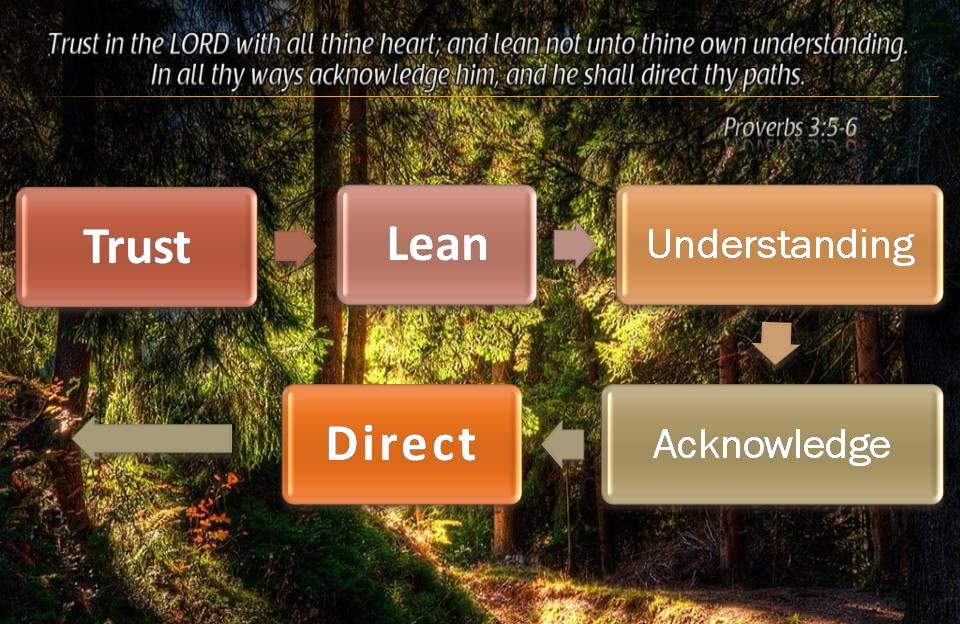
Proverbs 3:5-6

  • Trust in the Lord with all thine heart; and lean not unto thine own understanding. In all thy ways acknowledge him, and he shall direct thy paths. Proverbs 3:5-6 KJV
  • Trust in the Lord with all your heart, and do not lean on your own understanding. In all your ways acknowledge him, and he will make straight your paths. Proverbs 3:5-6 ESV

These two verses are among the most beloved in the entire Bible. You may have memorized them in Sunday school when you were a child.

British Bible teacher G. Campbell Morgan said that when he was leaving home for the first time, his father pressed a note into his hand. When Campbell Morgan unfolded it, he discovered it contained just one verse of Scripture: “In all thy ways acknowledge him, and he shall direct thy paths.” Looking back years later, he noted that his father had written that verse with no accompanying comment. No comment, he said, except the comment of his father’s godly life.

Solomon wrote quite simply as the Holy Spirit lead him. There is nothing complex about what he said. These verses can be understood by the simplest of minds. They are comfort to new believers, and they are profound to the most seasoned of believers. These verses cling to our soul because they speak to one of the greatest needs we have – to know the way.

I know this is a basic need, because my wife has revealed it to me. Whenever we are going somewhere new, she will always ask me which way I am going, where it is that we are going. I tell her I don’t know, but just sit back and trust me. That doesn’t work too well with her. She’ll start guessing as we continue driving.

Proverbs 3:5 & 6 are written to all those who like my wife like to know where they are going. These verses must be integral in your life if you are to live in God’s Will as our Journey 2010 seeks.

Five Key Steps to Knowing God’s Will

You may know this verse backwards and forwards, but are you living this verse? Is this your breath? Is this your food for life? God wants it to be!

Have you ever found yourself in a very dark place, not knowing what to do, where to turn, which way was North, South. Perhaps you were stuck with no one to help you out. Suddenly you cry out to God, perhaps with anguished tears, and said, God I don’t know where to turn, what to do, so I’m going to sit right here until you show me the next step.

Well, in these verses God gives us five steps for knowing what direction to take in our life. Let’s look at these five steps are revealed in five key words in Proverbs 3:5, 6.

1. TRUST

“Trust in the LORD with all your heart.” The word “trust” in Hebrew means “to lean with the full body,” “to lay upon,” “to rest the full weight upon.” It expresses the feeling of safety and security that is felt when one can rely on someone or something else. CWSDOT.

In Hebrew, baṭaḥa expresses that sense of well-being and security which results from having something or someone in whom to place confidence. TWOT.

The Septuagint never uses the Greek πιοτευω “believe in” but with ελπιξω “to hope,” in the positive sense “to rely on God” or πειφομαι “to be persuaded,”

So this trust is not based upon your belief in God, but upon your total confidence in who He is and His care for you. In fact, your knowledge can be imperfect without it affecting your trust. Just as a little child trusts completely in his Mom, it is a part of them, not based upon belief or knowledge.

In fact, the image of the Hebrew Word bāṭaḥ is actually much stronger. It has the idea of stretching yourself out upon a bed or resting on a hard surface. The word means to put your full weight on something. To trust in the Lord is to rest your whole weight upon him–to depend on him completely.

2. LEAN

“Lean not on your own understanding.” To “lean” means to rest upon something for partial support. Leaning is what you do when you walk with a cane or hold on to a walker because you are unsteady. This word is used for leaning against a tree or a stone cliff. You lean on something when you are not strong enough to stand alone.

This may mean literally leaning on someone’s arm or trusting in his or her counsel. Ultimately, God should be trusted and leaned on, for He will never fail. CWSDOT

3. UNDERSTANDING

“Lean not on your own understanding.” “Understanding” refers to the mental processes by which you analyze a problem, break it down into its smaller parts, and then make a decision about what you are going to do. Early in the morning when you make a list of all the things you have to do that day, you use your understanding to sort out your priorities. Or it’s what you use on Sunday night when you map out the upcoming week. That’s understanding. You use it any time you plan your life or solve a problem. Understanding is the decision-making ability that God has given you.

When you take the word “lean” and bring in the idea of “understanding,” then add the negative, the meaning is something like this: “Use all your mental powers, but do not lean on them for total support.” Don’t trust in your own ability to figure out your life. Lean instead on the Lord! Rest your weight on Him!

4. ACKNOWLEDGE

“In all your ways acknowledge him.” This word deserves extra consideration because the word “acknowledge” can be hard to understand. In the Hebrew this word is an imperative–a command. You could translate this by saying, “In all your ways know him.” The Hebrew word means to know deeply and intimately. It’s the kind of knowing that comes with personal experience. It means to know something through and through. For instance, somebody might say, “Do you know the President of the United States?” I would say, “Sure, Barack Obama is the President.” If President Obama walked in the room, I would know who he is. If I heard his voice coming over the TV, I would recognize it. Or if I saw his picture on the front page of the newspaper, I would know it was President Obama. But, I don’t really know him. I can’t pick up the phone and call the White House and say, “Mr. President, this is Jim Tompkins. let’s do lunch this week.” He won’t take my call because I don’t know him personally. I just know him at the level of head knowledge. I don’t know him intimately or on a friendship level.

There is another kind of knowing. My wife and I know each other in a completely different way. We’ve known each other intimately for over thirty-five years. When you live together for that many years, you get to know each other at such a deep level that you actually begin to know what the other person is thinking even as he or she is thinking it. You know what your wife is going to say before she says it. You know what your husband is going to do before he does it. You have a deep, personal, intimate knowledge of each other.

Seen in that light, we might translate verse 5 this way: “In all your ways know God intimately … deeply … personally. When you know God that way in every area of your life, he will direct your paths.”

5. DIRECT

“He will make your paths straight.” That brings me to the fifth word, which in the King James Version is translated, “He shall direct your paths.” That isn’t bad. But I think the ESV translation is a little better: “he will make straight your paths.” Imagine that you are driving along a road that appears to be impassable. The road winds through the mountains and down into the swamps. It seems to have a thousand switchbacks. As you travel on, you discover that portions of the road are washed out, others are filled with potholes, and still others are blocked by huge boulders. In some places the road apparently becomes a dead end. This is the road of your life. As you look at it, it appears to be covered with boulders and rocks. Some parts of it seem to be filled with potholes; other sections appear to be going nowhere. That’s the way life is.

Here is God’s message to you from Proverbs 3:5-6. If you will know God in every area of your life, he will take personal responsibility to make your way smooth and straight. He will remove the obstacles if they need to be removed. He will fill in the potholes if they need to be filled. He will redirect the detour so that what seemed to be a dead-end turns out to be the shortest way to reach your destination. All you have to do is trust in the Lord. Lay yourself completely on him for full support. Don’t lean for support on your own human understanding. In all your ways know God intimately. He will take the path of your life that seems to go up and down and around and sometimes seems to curve backwards, and He will make your way straight. That’s the promise of Almighty God to you.

Philip Yancey’s Definition

But it won’t always be easy or come quickly. For most of us, most of the time, the exact opposite will be true. Discovering God’s will takes times as the events of life unfold before us, often in ways that seem to make no sense at all. Rarely will we know the whole plan in advance.

As you join me in thinking over the last decade, at first we remember the hard times.

We remember the ones who died suddenly, financial hardships, losing a job, the breakup of a family. Some even think of the breakup of a church family.

Think a little more to the good times. I think of the Lord working it out so I could come here. I think of my children moving out but then going on to find a wife or a husband, and then of starting their own families.

My favorite definition of faith comes from Philip Yancey who said, “Faith means believing in advance what will only make sense in reverse.”

Why did God let things happen a certain way. Why did that loved one die suddenly? Why did Pastor so and so do such and such? Why did your good friend do so and so? Why did your son or daughter do such and such? We want to know why things happen the way they do and why couldn’t things have happened some other way. Why did Job have to go through so much for so long? God never even let Job know why He let happen what happened. Job had all those questions. Job pleaded for a chance to speak with God.

Yet when God finally appeared, Job was silent.

Faith enables us to see God, but it will not provide all the answers. Perhaps in heaven we will fully understand, or in heaven our desire to know will be transformed by our vision of the Lord like Job. By faith we see things that are invisible to others and by faith we believe in advance those things that right now make no sense but one day will make perfect sense because we will view them in reverse.

Believing is Seeing

The world says, “Seeing is believing.”  God says, “Believing is seeing.” We believe, therefore we see.

God wants us to live daily in His presence. That requires a daily dependence upon Him. When we believe to the point of 100% trust, God will show us His Will exactly when we need to know!

I have seen this principle in action in my life. One time that comes to me is when I had suddenly quit my job and at the same time chose not to show up at the closing where I was supposed to buy business that I had worked at for almost two years and had built his sales up substantially. I would have been in debt a million dollars (1990 dollars) but I believed the sales could have supported the debt. There were a lot of strings however. It was a dream come true, but that night I had the most distinct impression that God did not want me to do it. So I didn’t. The owner was extremely upset. He sued me, and won an injunction to prevent me from working in the only industry I had worked in for almost 20 years. The impact on our family finances was devastating. I was basically in limbo for 6 months. I tried to find some work, but nothing seemed to happen, so I simply waited. It was anxious waiting of course, but I wanted God’s direction for the next phase of my life. I spent some great time with my wife and family. Went down to my parents in Destin, Fl and spent some great time with them. The last three years had been very traumatic on our family, and God wanted me to take this time to “restore” and “refresh”. With God it is all about the wellness of our soul, for that is life to Him!

During this time God was working, and time doesn’t permit me to tell the whole story, but I was peaceful in waiting upon God. When I needed to know, He would show me. He did just that. At exactly the day we were out of money, out of direction, out of resources, God gave me the job that would determine the direction for my life and my family the next 16 years. When I needed to know, He showed me! That is why my life verse is found in 2 James 1:17- “Always give God one more day to show His power!” (Of course this is a Jimized verse.

The reason you don’t know is because you don’t need to know because if you needed to know, you would know, but since you don’t know, you must not need to know, because if you had needed to know by now, you would know by now, but since you don’t know, you must not need to know because when you need to know, you’ll know. If God is God that must be true.”

That’s how God works, isn’t it? When you need to know, you’ll know. Not one day sooner, not one day later. And if today you don’t know what to do next, it’s because you truly don’t need to know. Because if you needed to know, you would know. If God is God, that must be true.

That’s why the search for God’s will is so exhilarating. When God is leading the way, every obstacle will eventually be removed. The path may have many twists and turns, but in the end he will make your path straight. You have his word on it.

“Bless It All, Lord”

So many people struggle at this very point. The Bible says, in all your ways know God intimately, know him deeply, and know him personally. Know him to that depth. Know him with that kind of intimacy. So often we skip this. When we get up in the morning, we say, “O God, help me. I’m busy today. I’ve got so much to do. Lord, I don’t even have time to pray–so here’s my list. Bless it all, Lord. I’ve got to go.” We throw our list up toward heaven while we run out the door. What we are saying is, “God, here’s my schedule. Please rubber-stamp it with your blessing.” And we wonder why our days are filled with frustration.

Many of us go through life leaning almost completely on our own understanding. We like to be in control. I number myself among that group. I like to know what’s going on. I like to be in charge of my own destiny. This passage is a warning to all of us who lay out life the way we want it and then say, “Here, God, stamp it with your blessing because I am going to go out and do it for you.” God says, “I don’t work that way. Know me first. Put me first in everything, including all your plans, all your thinking, and all your scheming. Put me first. And I then will make your way straight.”

KNOW GOD

The real secret of knowing the will of God? Here it is: In everything you do, know God.

But we all want a formula. “I don’t like that. Give me a formula. Give me three steps.” Proverbs 3:5-6 tells us that the secret is a relationship with God.

Imagine you are Joe, and you have been dating Amber for nine months. You pick her up Friday night and she asks, “Where are we going?You say, “I don’t know. I want to take you someplace you really like. I wish you would give me a three-step formula so I could figure out where you like to go!”

How do you think Shirley would feel? Of course, she would be angry, upset. She would not so calmly say, “How is it that we’ve been dating every week for nine months and you don’t know what I like and don’t like? Where have you been all this time?”

We want to reduce our relationship with God to a formula. God says, “Know Me. Spend time with Me. Put Me first in every area of your life because when you do that I will take care of all those details.”

Believing is Seeing. Do you Know God enough to Trust Him with every aspect of your life? Or do you just let Him into certain parts? If you refuse to let God know you, it’s a good sign that you are not taking time to know Him. You are not listening to Him. You are not spending time with Him.

Which Way Do I Go?

We’re hung up on the decisions of life. Should I go here? Should I go there? Should I move to Kansas? Should I take the job with so and so? Should I marry Jill or Megan or stay single?

Here is the teaching of this passage stated in one sentence: God is much less concerned with what you do than with what kind of person you are. So when you say, “Lord, should I move to Kansas or take this job or marry this person?” you are asking the wrong question.

The question is not where are you going to go, but what kind of person you are going to be wherever you go. The question is not, who should I marry, but what kind of person am I going to be no matter whom I marry?

While you are wrestling with the question of relocation, God wants to know, “Are you going to be my man or my woman wherever you go or whomever you are married to?” If you decide to put God first in everything, it doesn’t matter where you live or who you marry.

We focus all our energy on decisions. But God says, “Know me and I will take care of the details.” We want specific direction. God says, “In all your ways know me, and everything else will fall into place.”

1000 Years

Most of our decisions won’t matter at all in 1,000 years. What a liberating way to look at life. The next time you face a tough decision, ask yourself, will it really matter in 1,000 years? Ninety-nine percent of what you worried about this week won’t matter three weeks from now, much less 1,000 years from now. In the year 3010 it won’t matter whether you lived in Minnesota, Arizona or South Carolina. But what will matter is that you have decided in all your ways to know God. That is what will really matter. All these trivial, fiddly details that just soak up so much energy will in that day be seen for what they really are–trivial, fiddly details.

As we began our message, we return to our question – What is God’s Will?

To know God in everything. To see him present everywhere and in everything, and to live in total surrender to him. The most important thing is not the decisions you face; the most important thing is your relationship with God. And the closer you get to God, the easier it will be for God to guide you in the way he wants you to go.

So for our friends the Magyars, who struggled with the death of their little boy Joey. Or to anyone who today struggles with where you have been or where you are going, understand that God wants you to know Him in everything that happens in your life. Your love for Him, your trust in Him is the most important thing in your life. You may not like what He has done or is doing, but I assure you, if you commit to Knowing God, He will make sense and reveal His purpose in the past, and He will show you His direction for your life in the future.

“Lord, Here Are My Hands”

Knowing God means using all your energies for him.

  • Lord, here are my hands.
  • Lord, here are my lips.
  • Lord, here are my eyes.
  • Lord, here are my ears.
  • Lord, here are my feet.

Knowing God means taking all that you have and placing it at the disposal of the King of kings and the Lord of lords. Proverbs 3:5-6 ends with a promise: “He will make your paths straight.” God is able to remove the obstacles in front of you. He is able to fill in the potholes and turn a dead-end into a four-lane highway. God rewards those who show regard for him by leading them straight to the right end and removing all the obstacles along the way. We rarely see this in advance. We mostly see the potholes. The boulders block our view. Many times it seems as if there is no path at all. But he will make a way. No one can say how he will do it. There are thousands of ways in which God leads his children. He leads us through delays, detours, miracles, the advice of friends, unexpected opportunities, suddenly closed doors, answered prayer, unanswered prayer, inner impressions, and a still, small voice in the night.

You don’t see it on this side. On this side you see the problems. But when you know God, he leads you step by step. When the journey is done, you will look back and say, “I don’t know how I got from there to here, but I do know this: Jesus led me all the way.”

Doing God’s will often involves great uncertainty and periods of deep doubt.

But if you are willing to do what he wants you to do, he then takes responsibility to reach into the chaos of life and lead you step by step to the place where he wants you to be.

Life is a mysterious journey, full of unexpected twists and turns. The path ahead is a mystery to us all. No one can say for sure what is around the next bend. It may be a smooth road through a lovely valley or we may discover that the bridge is washed out and we have to find a way to cross a deep river. Often the road will seem to disappear or it may suddenly seem to go in three different directions and we won’t know which way to go. But there is One who knows the way because the past, present, and future are all the same to him and the darkness is as the light of day. He knows the way we should go. He promised to direct your path and he will do it. You can count on it.

When you need to know, you’ll know. That is the promise of daily living in His presence. That is what Abraham knew and wanted His servant to know.

Abraham said in Gen 24:40, ‘The LORD, in whose presence I have lived, will send his angel with you and will make your mission successful. Yes, you must find a wife for my son from among my relatives, from my father’s family…

Abraham lived in the presence of God, and so He knew what God could do. When the servant needed to know, he would know!


Father and Elder Brother ArgueThe Elder Brother angrily argued with his Father because he was lavishing a wasteful feast upon his wayward younger brother. The Father had never done such a thing for him, the obedient Elder Brother. His appeals to stop the feast went unheeded, because the Father was intent upon celebrating the finding of his lost son. Jesus ends the story with the two at odds with each other, and the Elder Brother refusing to join the celebration.

The Elder Brother was not in sync with his Father. He failed to know his heart, and so communication broke down, and a wall was erected.

Elder Brothers must understand their Father’s heart, for failure to do so will result in a breakdown in communications. Walls will be be erected. families will be divided.

abraham Friend of GodAbraham was a friend of his Father, Jehovah. Because of their friendship, the channels of communication were open. That is why God chose to reveal His plans for Sodom and Gommorah in Genesis 18. This led Abraham to reason, to barter with God. In a spirited exchange, Abraham appeals to Jehovah on the basis of His RIGHTEOUSNESS. “Would you slay the righteous with the wicked”, he appeals. Still basing it upon God’s RIGHTEOUSNESS, he lowers his appeal from 50 all the way to 10 righteous. Then he shut up. Jehovah went on his way. Why did Abraham stop at 10? Surely he knew that Lot was the only righteous one left! But Abraham also knew the Father’s HEART! Abraham knew that God would do the RIGHTEOUS thing!

God destroys Sodom_and_GomorrahThe Bible records what happens when God left Abraham; how Lot, his wife and two daughters were led to safety, but the wife looked back and was turned into salt. What about Abraham? Was he worried that Lot would be destroyed? Scripture reveals Abraham’s peace about the matter:

Abraham got up early that morning and hurried out to the place where he had stood in the Lord’s presence. He looked out across the plain toward Sodom and Gomorrah and watched as columns of smoke rose from the cities like smoke from a furnace. Genesis 19:27-28 (NLT)

Lot and Daughters sparedAbraham rose early that morning, knowing that the cities would be destroyed. He knew how wicked they were. But Abraham knew that Lot would be delivered. Why? Because Abraham knew the Father’s Heart! Scripture records that:

God destroyed the cities in the valley, but he remembered what Abraham had asked. So God saved Lot’s life, but he destroyed the city where Lot had lived. (Genesis 19:29)
As 2 Peter 2:7 states; God rescued RIGHTEOUS Lot!

Abraham had understood the RIGHTEOUSNESS of the Father. He appealed to God’s RIGHTEOUSNESS in sparing his nephew Lot. He knew that God would still act as RIGHTEOUS God. God remembered what Abraham had said.

This is what Elder Brothers must learn when communicating with the Father. We must seek to know Him, what He delights in, and our appeals to Him must be on the basis of His character.

heartThe Father revealed His heart to the Elder Brother, and the Elder Brother refused to understand. He walled himself from His Father’s heart, and never enjoyed the Feast with his younger brother.

Abraham knew his Father’s heart, and was able to enjoy a Feast with his nephew Lot.

Would you rather complain and sulk in loneliness, or rejoice and enjoy a feast with loved ones? Purpose to know the Father’s heart, and remind Him that you know Him by the way you appeal to Him!

Father: I purpose from this day forward to know Your Heart, to know what you delight in! I will always pray to you with your heart’s desire in mind!


congressiona-medal-of-honorThe Congressional Medal of Honor was conceived in 1861 The Medal of Honor is awarded in the name of Congress to a person who, while a member of the Armed Services, distinguishes himself conspicuously by gallantry and intrepidity at the risk of his life above and beyond the call of duty while engaged in an action against any enemy of The United States. The deed performed must have been one of personal bravery or self-sacrifice so conspicuous as to clearly distinguish the individual above his comrades and must have involved risk of life.
  • The Congressional Medal of Honor is the highest award for valor in action against an enemy force which can be bestowed upon an individual serving in the Armed Services of the United States.
  • Presented by the President “for gallantry and intrepidity at the risk of his life above and beyond the call of duty”.
  • President Truman: “I would rather have the blue band of the Medal of Honor around my neck than be President!”
  • Recipients are always saluted, regardless of rank.
  • Since 1862 only 3,465 medals have been awarded to 3,446 men.

Honor is very important to our God. Learning to Value what He considers important is the key to seeing His Blessings upon your life, to seeing His Pathway, His Will for your Life.

We have examined the role of Honor in understanding and learning the Ways of God.

  • If you are pleased with me, teach me your ways so I may know you and continue to find favor with you. Remember that this nation is your people.” Exodus 33:13 (NIV)
  • Teach me Your way, O Lord, And lead me in a smooth path, because of my enemies. Psalms 27:11 (NKJV)
  • Show me Your ways, O Lord; Teach me Your paths. Psalms 25:4 (NKJV)
  • Teach me thy way, O LORD; I will walk in thy truth: unite my heart to fear thy name. (Ps 86:11)

You have to make a decision who you want to follow. You can follow God, or you can follow anything that is left. Following God involves Honoring who and what He says to Honor. That Honor brings rewards. Those rewards involve the presence and power of God in your life. What you do, who you follow determines whether you will enjoy God’s full reward or not.

Look to yourselves, that we do not lose those things we worked for, but that we may receive a full reward. 2 John 1:8

Finally I would like us to consider the Ultimate Honor. That thing or person we should value so much, it will open up God’s Pathway of Blessing in our lives.

What is the Ultimate Honor, as Far as God is Concerned?

ultimate-honorNow remember, honor means value, weight. When it comes to God and His creation, what is most important? I contend that the Ultimate Honor we can give God is to See the Value God Places Upon our Life. When We See the Value of our Life, and all that God gas done to give us Life, we will have an entirely new and radical focus on LIFE. The Ultimate Honor does not involve a religion, a set of rules to obey, it involves the Value we place on that which Gives us LIFE. I’m not talking about your momma and your daddy. For I don’t care how much you think you are alive, you are dead unless you see the realize the importance of this Ultimate Honor. To understand, realize the problem that Jesus had with the religious authorities of his day.
You search the Scriptures, for in them you think you have eternal life; and these are they which testify of Me. But you are not willing to come to Me that you may have life. I do not receive honor from men. But I know you, that you do not have the love of God in you. I have come in My Father’s name, and you do not receive Me; if another comes in his own name, him you will receive. How can you believe, who receive honor from one another, and do not seek the honor that comes from the only God? Do not think that I shall accuse you to the Father; there is one who accuses you–Moses, in whom you trust. John 5:39-45 (NKJV)

pharisees do not honor JesusThe Pharisees and other religious leaders thought they were giving the proper Honor to God. They were honoring one another. But Jesus said they were not seeking the Honor that comes from only GOD. Jesus went so far as to call them HYPOCRITES:
Hypocrites! Well did Isaiah prophesy about you, saying: ‘These people draw near to Me with their mouth, And honor Me with their lips, But their heart is far from Me. And in vain they worship Me, Teaching as doctrines the commandments of men.’ ” Matthew 15:6-9 (NKJV)

You can honor people, authorities, even God, but if you do not do that which brings the ultimate Honor, you are wasting your breath. For the Ultimate Honor we can partake of is the Honor God bestows upon us! Jesus said:

Jesus answered, “If I honor Myself, My honor is nothing. It is My Father who honors Me, of whom you say that He is your God. John 8:54 (NKJV)

What can I do that would make God want to honor me?

“Because he has set his love upon Me, therefore I will deliver him; I will set him on high, because he has known My name. He shall call upon Me, and I will answer him; I will be with him in trouble; I will deliver him and honor him. With long life I will satisfy him, And show him My salvation.” Psalms 91:14-16 (NKJV)

“That all should honor the Son just as they honor the Father. He who does not honor the Son does not honor the Father who sent Him.” John 5:23 (NKJV)

God Honors Us

The greatest Honor in the world is when we are crowned with God’s Honor. The only way to receive this Ultimate Honor is to Honor His Son, Jesus Christ. When we Honor His Son, We are crowned with Glory and Honor, because Jesus was crowned with glory and Honor.

crown-with-gloryGod is calling us to Honor His Son, and when we do, we receive the ultimate Honor. Jesus is the Word. He is God’s revelation of Love and Wisdom. He is the source of Proverbs. He is in every page of this Bible.
Get wisdom! Get understanding! Do not forget, nor turn away from the words of my mouth. Do not forsake her, and she will preserve you; Love her, and she will keep you. Wisdom is the principal thing; Therefore get wisdom. And in all your getting, get understanding. Exalt her, and she will promote you; She will bring you honor, when you embrace her. She will place on your head an ornament of grace; A crown of glory she will deliver to you.” Proverbs 4:5-9 (NKJV)

Each one of us has a choice. Each choice determines whether we will live lives crowned with Honor from the Lord, or crowned with shame. Whether our lives will have impact and influence for eternity, or whether we will just be a grave marker. Who will you choose to honor? What or Who are you going to consider the most important thing in your life. If you seek after God and His Son, He will crown you with Honor. That will give Him Honor!

CONSIDER ELI:

Why do you kick at My sacrifice and My offering which I have commanded in My dwelling place, and honor your sons more than Me, to make yourselves fat with the best of all the offerings of Israel My people?’ 1 Samuel 2:29 (NKJV)

consider-eliBut now the Lord says: ‘Far be it from Me; for those who honor Me I will honor, and those who despise Me shall be lightly esteemed. 31 Behold, the days are coming that I will cut off your arm and the arm of your father’s house, so that there will not be an old man in your house. 32 And you will see an enemy in My dwelling place, despite all the good which God does for Israel. Then I will raise up for Myself a faithful priest who shall do according to what is in My heart and in My mind. (1 Samuel 2:30-33)
God wanted a Priest who would obey Him over pleasing himself or people. That is why God chose to replace Eli with Samuel.

CONSIDER ABRAHAM:

consider-abrahamAbraham finally had Isaac at the age of 100. He had waited 25 years for this promised son. He loved him more than anything in the world. Sometime later, God tested Abraham’s faith. “Abraham!” God called. “Yes,” he replied. “Here I am.” “Take your son, your only son—yes, Isaac, whom you love so much—and go to the land of Moriah. Go and sacrifice him as a burnt offering on one of the mountains, which I will show you.” The next morning Abraham got up early. He saddled his donkey and took two of his servants with him, along with his son, Isaac. Then he chopped wood for a fire for a burnt offering and set out for the place God had told him about. Genesis 22:1-3 (NLT)
“Don’t lay a hand on the boy!” the angel said. “Do not hurt him in any way, for now I know that you truly fear God. You have not withheld from me even your son, your only son.” Genesis 22:12 (NLT). God honored Abraham becasue he chose to honor God above even his only son.

CONSIDER MOSES:

And it came to pass on the way, at the encampment, that the Lord met him and sought to kill him. Then Zipporah took a sharp stone and cut off the foreskin of her son and cast it at Moses’ feet, and said, “Surely you are a husband of blood to me!” So He (God) let him go. Then she said, “You are a husband of blood!”–because of the circumcision. Exodus 4:24-26 (NKJV)

consider-mosesNow a lot is left out from this account, and most people ignore these verses because they make no sense. Why would God try to kill Moses after He had just sent Him to Egypt to lead His people home? I think we can fill in the blanks. Imagine this scene:
Moses goes into the kitchen and tells his honey Zipporah that they have to pack the bags and move to Egypt. God has a special job for him. Zipporah, being the loving wife she is, says great, I’ll start packing. Moses says, God reviewed His covenant with Abraham with me, and told me I must circumcise our two boys….Wll, iprah says, lets start with Gershom, he’s the oldest. Ziprah watches as Moses performs the circumcision. She watches as Gershom screams out in agony, and then writes in agonizing pain on the ground. It hoorifies her. What kind of God would demand something so bloody and cruel? So Mom steps in and refuses to let four year old Eliezer be circumcised. She gathers him in her arms and says over her dead body will you circumcise Eliezer. A terrible fight erupts. It may have gone on for hours, but finally Moses gives up, after all he has an important job to do. He gives in and says, let’s go. On the way to Egypt, God comes into the camp to kill Moses because Moses honored his wife above honoring what God told him to do.

Zipporah realizes Moses is about to be killed and so she races to circumcise Eliezer and then casts the bloody foreskin at Moses.

Now why didn’t God try to kill Zipporah? Because Moses had been told to do something by God, and Moses was responsible to carry it out. Moses compromised and honored his wife above God. Moses nevermade that mistake again.

HONOR GOD ABOVE ALL

Who are you choosing to Honor in your life?

  • When you lay your head on your pillow, what occupies your thoughts?
  • When you awake in the morning, what occupies your thoughts?

Those are the things you honor more than God. We are to Honor God above all. In seeking to honor Him first, we bring honor upon our lives. That in turn honors God.

How Does Honoring God bring Honor upon our Lives?

covenant-with-abrahamWhen Abraham was 99 years old, God appeared to Abraham. Turn to Genesis 15, verse one. Abraham had honored God rather than riches when he refused the spoil from the King of Sodom. He had honored God with a tithe of all he possessed. He may have had doubts about continuing to honor God, because God had not given Him a son, as God had promised. When God repeated again that He was going to reward Abraham for honoring Him as his God, Abraham said how can I know this?
God gave him a grocery list, and said to cut the animals in half. He had to look at them for a few hours, and wonder what it meant. He even had to keep the buzzards away. Finally it grew dark, and Abraham fell into a deep sleep. This was not a peaceful sleep. He was filled with horror and deep dark blackness. I don’t know how long it lasted. It appears to have been into the next day. I believe God was speaking to his subconscious. When we encounter Holy God, it reveals the horribleness of our heart. God spoke to Abraham, and revealed His covenant with him. As God told Abraham of the future, all of a sudden a smoking oven and a burning torch passed between the pieces. And God pronounced His covenant with Abraham and his descendants.

What were the smoking oven and burning torch? They were symbols of God Himself.

God was passing between the bloody pieces. God could only swear by Himself that He would accomplish this covenant. In effect He was saying that if he did not accomplish His word, then may he be as these bloody animals, cut apart!

The one passing between the bodies is always the one responsible for keeping the covenant.

Now why should we Honor God? And how does that bring honor to us?

covenant-of-life-and-peaceBecause God has made a covenant with each one of us. God wants each one of us to fall into a deep sleep, dead from the influence and concerns of this world. He wants us to see how horrible our sins are to Him, how horrible the judgment of Hell that is upon us will be. Then He wants us to wake and look up and see His Son hanging upon the cross, His body broken and bloody, for He has become the Assurance of God’s Covenant of Honor with us. Jesus Christ has appeared suspended between hell and heaven, Satan and God, Unholy Man and Holy God. Jesus body was pierced by the sword, symbolizing the sacrifice cut in two. His blood was shed because God’s Covenants are ALWAYS BLOODY covenants, for God has said that LIFE is in the blood. If we are to have LIFE as God intends it, we must enter into this bloody covenant with God. It has been secured by Jesus Christ, God’s only begotten Son. God has honored us with His Son. The Ultimate Honor is having Peace & Life through His Son.
COVENANT OF PEACE and LIFE

Now the God of peace, that brought again from the dead our Lord Jesus, that great shepherd of the sheep, through the blood of the everlasting covenant, Make you perfect in every good work to do his will, working in you that which is well pleasing in his sight, through Jesus Christ; to whom be glory forever and ever. Amen. Hebrews 13:20-21 (KJV)

God made a Covenant with us so that we would Honor Him and walk with Reverence before His Name. In return, we have His Peace, His Life, and His Honor! We can live in Honor before a Righteous Holy God!

But now in Christ Jesus you who once were far off have been brought near by the blood of Christ. For He Himself is our peace, who has made both one, and has broken down the middle wall of separation, having abolished in His flesh the enmity, that is, the law of commandments contained in ordinances, so as to create in Himself one new man from the two, thus making peace, and that He might reconcile them both to God in one body through the cross, thereby putting to death the enmity. Ephesians 2:13-16 (NKJV)

My covenant was with him of life and peace; and I gave them to him for the fear wherewith he feared me, and was afraid before my name. Malachi 2:5 (KJV)

To refuse to Honor God with our lives is to spit upon God’s Love, to slap the Son of God and say with clinched fist “I DON’T NEED YOU”. I don’t need Peace with God! If you refuse to Honor Jesus Christ with your life, you refuse to Honor Holy God. You refuse to Honor the Covenant of Peace which God has offered each one of us.

Finally, all of you be of one mind, having compassion for one another; love as brothers, be tenderhearted, be courteous; not returning evil for evil or reviling for reviling, but on the contrary blessing, knowing that you were called to this, that you may inherit a blessing. For “He who would love life And see good days, Let him refrain his tongue from evil, And his lips from speaking deceit. Let him turn away from evil and do good; Let him seek peace and pursue it. For the eyes of the Lord are on the righteous, And His ears are open to their prayers; But the face of the Lord is against those who do evil.” 1 Peter 3:8-12 (NKJV)

When we take communion we are renewing our covenant with God through His Son Jesus Christ. We are also renewing our covenant to Love one another, to love those who are our brothers and sisters.

Are You Kicking at the Cross?

God asked ELI: Why do you kick at My sacrifice and My offering which I have commanded in My dwelling place, and honor your sons more than Me?

Some of you may be kicking at God, some of you may be kicking at Jesus, some of you may be kicking at fellow Christians, some of you may be kicking at parents, in-laws.YOU ARE kicking-at-the-crossBRINGING SHAME ON YOUR LIFE AND YOU ARE BRINGING SHAME ON THIS BODY AND ON JESUS CHRIST. YOU ARE NOT SEEKING WISDOM. YOU ARE NOT SEEKING TO HONOR THE LIFE THAT GOD GIVES YOU IN JESUS CHRIST.
YOU ARE MAD AT A FAMILY MEMBER. YOU ARE MAD AT AN IN-LAW. YOU ARE UNFORGIVING OF A CHRISTIAN BROTHER OR SISTER. YOU ARE TALKING BAD ABOUT THEM.

SOME OF US ARE KICKING AT FALLEN BROTHERS. HOW? BY IGNORING THE SITUATION, OR TALKING BAD ABOUT IT. EVEN TALKING BAD ABOUT EACH OTHER. YOU MAY THINK YOU ARE RIGHT, BUT I ASSURE YOU SUCH DOES NOT HONOR GOD, IT DOES NOT HONOR HIS WORD IT DOES NOT BRING HONOR TO YOUR LIFE.

Therefore you are inexcusable, O man, whoever you are who judge, for in whatever you judge another you condemn yourself; for you who judge practice the same things. But we know that the judgment of God is according to truth against those who practice such things. And do you think this, O man, you who judge those practicing such things, and doing the same, that you will escape the judgment of God? Or do you despise the riches of His goodness, forbearance, and longsuffering, not knowing that the goodness of God leads you to repentance? But in accordance with your hardness and your impenitent heart you are treasuring up for yourself wrath in the day of wrath and revelation of the righteous judgment of God, who “will render to each one according to his deeds”: eternal life to those who by patient continuance in doing good seek for glory, honor, and immortality; but to those who are self-seeking and do not obey the truth, but obey unrighteousness–indignation and wrath, tribulation and anguish, on every soul of man who does evil, of the Jew first and also of the Greek; but glory, honor, and peace to everyone who works what is good, to the Jew first and also to the Greek. For there is no partiality with God. Romans 2:1-11 (NKJV)

We are not to Kick anyone when they are down:

Now no chastening seems to be joyful for the present, but painful; nevertheless, afterward it yields the peaceable fruit of righteousness to those who have been trained by it. Therefore strengthen the hands which hang down, and the feeble knees, and make straight paths for your feet, so that what is lame may not be dislocated, but rather be healed. Pursue peace with all people, and holiness, without which no one will see the Lord: looking carefully lest anyone fall short of the grace of God; lest any root of bitterness springing up cause trouble, and by this many become defiled; Hebrews 12:11-15 (NKJV)

kneeling-at-the-crossI want our church to be a place where people can experience the Covenant of Life and Peace that God made with us through His Son. I want us to be a church that honors God by honoring the downtrodden, those that are broken. I want our church to experience the ultimate Honor, being Honored by God because we seek to Honor the Life of Jesus Christ living in us by Faith.

My covenant was with him of life and peace; and I gave them to him for the fear wherewith he feared me, and was afraid before my name. Malachi 2:5 (KJV)